
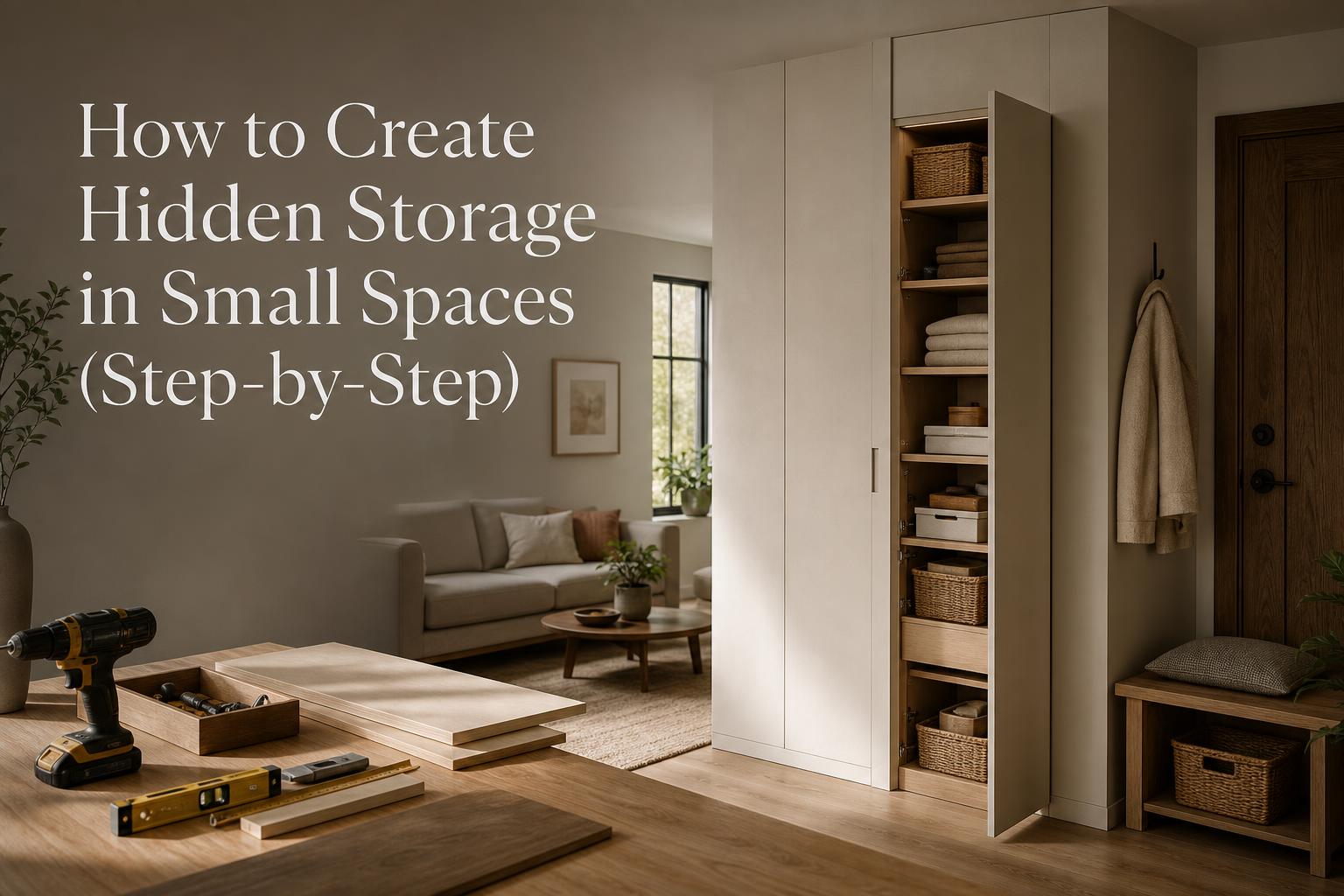
How to Create Hidden Storage in Small Spaces (Step-by-Step)
Hidden storage in a small space means recovering the unused volume you already have (under beds, behind benches, above door frames) and hiding the visually messy stuff so a room reads clean. This project takes a weekend for a renter-friendly setup or two to three days for a wall-mounted system, and difficulty runs from easy (over-door organizers) to intermediate (anchored wardrobes). The core rule: hidden storage cuts clutter, it does not add square footage, so measure first and hide only what you rarely touch.
That distinction matters because 68% of apartment renters lived in homes under 1,000 square feet, according to 2023 American Housing Survey data analyzed by Small Space Sorted in 2026. When floor space is fixed, the win comes from going vertical and using dead zones, not from buying more furniture than the room can hold.
What you need before you start
A short prerequisites checklist keeps you from buying the wrong thing:
- A tape measure and a notepad (or a notes app)
- A stud finder if you plan to wall-mount anything
- Painter's tape to mock up footprints on the floor
- A budget number you set before you shop
- A drill and fasteners matched to your wall type
- A clear sort of what's daily, weekly, seasonal, archival, and rarely used
Tip: Set your budget before you open any retailer's site. Frames often list cheap because doors, hinges, rails, drawers, and organizers sell separately. Reuse furniture you already own before buying a new system.
Step 1: Measure the dead zone completely
Measure every constraint, not just width and height. Record width, depth, ceiling height, baseboard thickness, outlet locations, heating vents, door swings, and how much wall clearance you have. A 2-inch baseboard or a badly placed vent can kill a plan that looked fine on paper.
This step exists because wall-mounted systems have exact clearance rules. IKEA specifies 2.5 inches of clearance from the wall or corner to attach the rail on a standard PAX configuration. Miss that and the frame won't sit right.
Pitfall: door swings eat floor space you forgot to account for. Tape the door's arc on the floor before you commit a footprint there.
Step 2: Prioritize vertical and hidden zones
List your overlooked zones and rank them by how much volume they hold. The usual winners are over-door areas, under-bed volume, furniture bases, shallow cabinet ends, and the space behind or beneath a bench. If the whole home lacks built-in storage, this guide to organizing a small house with no storage shows how to combine those overlooked zones into a complete system.
Under-bed is often the biggest single recovery in a bedroom. Users in r/SmallHome specifically ask for hidden and under-bed storage that keeps floor space open and stops a room from feeling cramped. Bed risers plus flat rolling bins turn that gap into a drawer.
For walls, wall storage ideas that double your space and genius ways to use corner space show where vertical volume hides in plain sight.
Step 3: Sort by frequency before you conceal anything
Sort your belongings into daily, weekly, seasonal, archival, and rarely used before you assign a hiding spot. Hidden storage works for seasonal, archival, or infrequent items. Daily-use things must stay easy to reach, or the compartment becomes clutter you can't get to.
This is the line between concealed storage and inaccessible storage. A lift-up bench is great for holiday decor and terrible for your everyday shoes.
A common worry in r/organizing is storing things you don't want to throw away without making the room look busier. Sorting by frequency answers that: archive the rarely-used stuff deep and out of sight, keep the daily stuff shallow and open.
Step 4: Choose renter-friendly options first
Start with removable and freestanding solutions if you rent, then consider built-ins only if you own. Freestanding wardrobes, over-door organizers, bed risers, rolling carts, and removable hooks give you hidden capacity with no wall damage.
This path matters because 34.1% of apartment renters moved into their current home during 2022 or 2023, per the 2023 American Housing Survey analysis by Small Space Sorted. If you may move soon, don't sink money into permanent millwork.
Over-door organizers punch above their price. People in r/ApartmentHacks cite over-door hanging shoe organizers as a cheap way to add bathroom and product storage. For a full renter playbook, see minimalist storage tricks for small apartments.
| Option | Renter-friendly | Rough starting cost |
|---|---|---|
| Over-door organizer | Yes | Low |
| Bed risers + bins | Yes | Low |
| Rolling cart | Yes | Low–medium |
| Freestanding wardrobe | Yes | Medium |
| IKEA ELVARLI system | Partly (wall/ceiling anchored) | Shelves from $20 |
| IKEA PAX wall-mounted frame | No (permanent mount) | Frame from $150 |
Step 5: Price the complete installation, not the frame
Add up every part before you buy, because frame prices exclude the finished cost. The IKEA PAX frame at 19 5/8 by 22 7/8 by 92 7/8 inches was listed at $170 in the U.S. in August 2026, with other sizes running $150 to $170, according to IKEA. But doors, hinges, and interior organizers all sell separately.
ELVARLI prices in August 2026 gave more entry points: shelves $20 to $60, an open storage combination at $340, a wardrobe combination at $355, a clothes rail at $20, a shoe shelf at $30, and a side unit at $95, per IKEA.
Warning: The frame is not the invoice. Budget for doors, rails, hinges, drawers, organizers, fasteners, delivery, and tax. IKEA Family members were offered 10% off PAX orders of $500 or more from August 3 to September 7, 2026, but that was a time-limited promotion, not a standing price.
If you're building a savings plan around a bigger purchase, Stashsavvy's budgeting tools help you split an essentials-first list from the nice-to-haves before you spend.
Step 6: Anchor wall-mounted units safely
Attach every wall-mounted unit with fasteners rated for the wall type and the load. Heavy units must catch studs or use masonry anchors; a tall wardrobe should never hang on standard drywall anchors alone. A loaded PAX can tip, so use its included anti-tip rail.
Before you drill, find outlets, switches, and pipes. Never bore into a wall where you suspect electrical or plumbing runs. A stud finder with AC detection helps.
Pitfall: skipping the wall-anchor strap. Anti-tip hardware is the single biggest safety item in this whole project, especially where children are present.
Step 7: Build banquettes and lift-up seats with care
Add hidden storage under seating only after you plan for hinges, ventilation, and load. Built-in banquettes combine seating with storage beneath and behind the bench and fit dining nooks, entryways, and narrow kitchens.
Lift-up bench seats and hinged compartments need attention to child safety, hinge behavior, ventilation, and how much weight the seat holds. Use soft-close or lid-stay hinges so a lid can't slam.
Van dwellers on r/vandwellers discuss concealed compartments and false bottoms for cash and valuables, often asking about childproof or magnetic latches. Treat hidden storage as clutter control, not as a safe. Valuables belong in something actually secure.
Step 8: Label by frequency and leave a buffer
Label bins and sections by category and frequency so you never dig for daily items. A daily / weekly / seasonal / archival / rarely-used labeling system keeps the deep, hidden spots reserved for the stuff you touch least.
Leave spare capacity. A simple editorial rule: keep roughly one bin or section in five empty. Filling everything on day one leaves no room for next season's incoming items and forces a re-sort within weeks.
For maintaining a tidy system long term, 15 genius small-space storage hacks pairs well with this workflow.
Troubleshooting
Why does my room look more cluttered after adding storage?
You likely hid daily items and left the messy overflow visible. Re-sort by frequency. Move seasonal and archival items into the deep hidden zones and keep only shallow, everyday things in reach. If bins sit on the floor, get them off it with risers or wall mounts to free visual space.
My wall anchors keep pulling out. What went wrong?
Standard drywall anchors can't hold a loaded wardrobe. Locate studs and drive screws into them, or switch to masonry anchors on brick and concrete. Always attach the included anti-tip rail. If you can't hit a stud where you need one, choose a freestanding unit instead.
I rent and can't drill. What are my options?
Prioritize freestanding wardrobes, over-door organizers, bed risers, rolling carts, and removable hooks. These recover under-bed and over-door volume with no permanent damage. Tension rods and adhesive hooks rated for your wall finish extend the options further without a single hole.
The compartment I built is impossible to reach daily. Fix?
You concealed something you use every day. Swap the contents: put archival or seasonal items in the hard-to-reach spot and relocate daily items to an open, shallow shelf. Hidden storage should hold what you touch least, not what you touch most.
Next steps
Start with one dead zone (under the bed is the usual biggest win), measure it fully, and sort what goes in it by frequency before buying anything. Set your budget, price the complete installation including doors and fasteners, and reuse furniture you already own first. When you're ready for a bigger closet system, plan it in a free layout tool like IKEA's ELVARLI planner before you buy.
Frequently asked questions
What are the best hidden storage ideas for small spaces?
The highest-volume options are under-bed bins on risers, over-door organizers, storage benches or banquettes, furniture with hollow bases, and wall-mounted wardrobes. Renters should start with freestanding and removable options; homeowners can add built-ins. Sort belongings by frequency first so hidden spots hold seasonal and archival items, and keep daily-use things shallow and easy to reach.
Does hidden storage actually create more space?
No. Hidden storage recovers volume you already have and reduces visual clutter, but it does not add square footage. The gain comes from using dead zones (under beds, above doors, behind benches) and going vertical. If a room feels cramped, the fix is usually clearing floor space and hiding infrequently used items, not adding furniture.
How much does an IKEA PAX or ELVARLI setup really cost?
More than the frame price. The PAX frame started around $150 to $170 in the U.S. in August 2026 per IKEA, but doors, hinges, and organizers sell separately. ELVARLI shelves ran $20 to $60, with combinations around $340 to $355. Budget for fasteners, delivery, and tax too, and set your number before you shop.
What hidden storage works for renters who can't drill?
Freestanding wardrobes, over-door organizers, bed risers with bins, rolling carts, tension rods, and removable adhesive hooks. These recover under-bed and over-door volume with no wall damage, which matters since a third of apartment renters moved recently. Save permanent built-ins for when you own the space.
Is hidden storage safe for valuables?
Treat hidden storage as clutter control, not security. Concealed compartments and false bottoms hide items from casual view, but they are not a substitute for a safe. Store cash, documents, and valuables in something genuinely secure. If you build lift-up seats or compartments near children, use soft-close hinges and childproof latches.
How do I keep hidden storage from becoming inaccessible clutter?
Label everything by frequency (daily, weekly, seasonal, archival, rarely used) and put the least-used items in the deepest hidden spots. Keep daily items shallow and open. Leave roughly one bin or section in five empty as a buffer so incoming seasonal items have a home and you don't re-sort every few weeks.
Related Reading
- Small Apartment Storage Ideas That Make Studio Living Practical
- Small Apartment Storage Ideas for Renters: Temporary, Low-Cost Upgrades
- Top 10 Small Bedroom Storage Ideas for More Floor Space
- Small Bedroom Storage Ideas That Boost Sleep and Reduce Stress
- Under the Bed Storage Ideas That Maximize Small Apartment Space
- 7 Minimalist Small Closet Organization Ideas to Maximize Every Inch
- Closet Organization Ideas on a Budget That Actually Work
- Closet Organization Alternatives When You Can’t Install Permanent Shelves
- 16 Best RV Storage Ideas for Small Campers and Travel Trailers
- 15 Best Junk Room Storage Ideas for Small Homes