
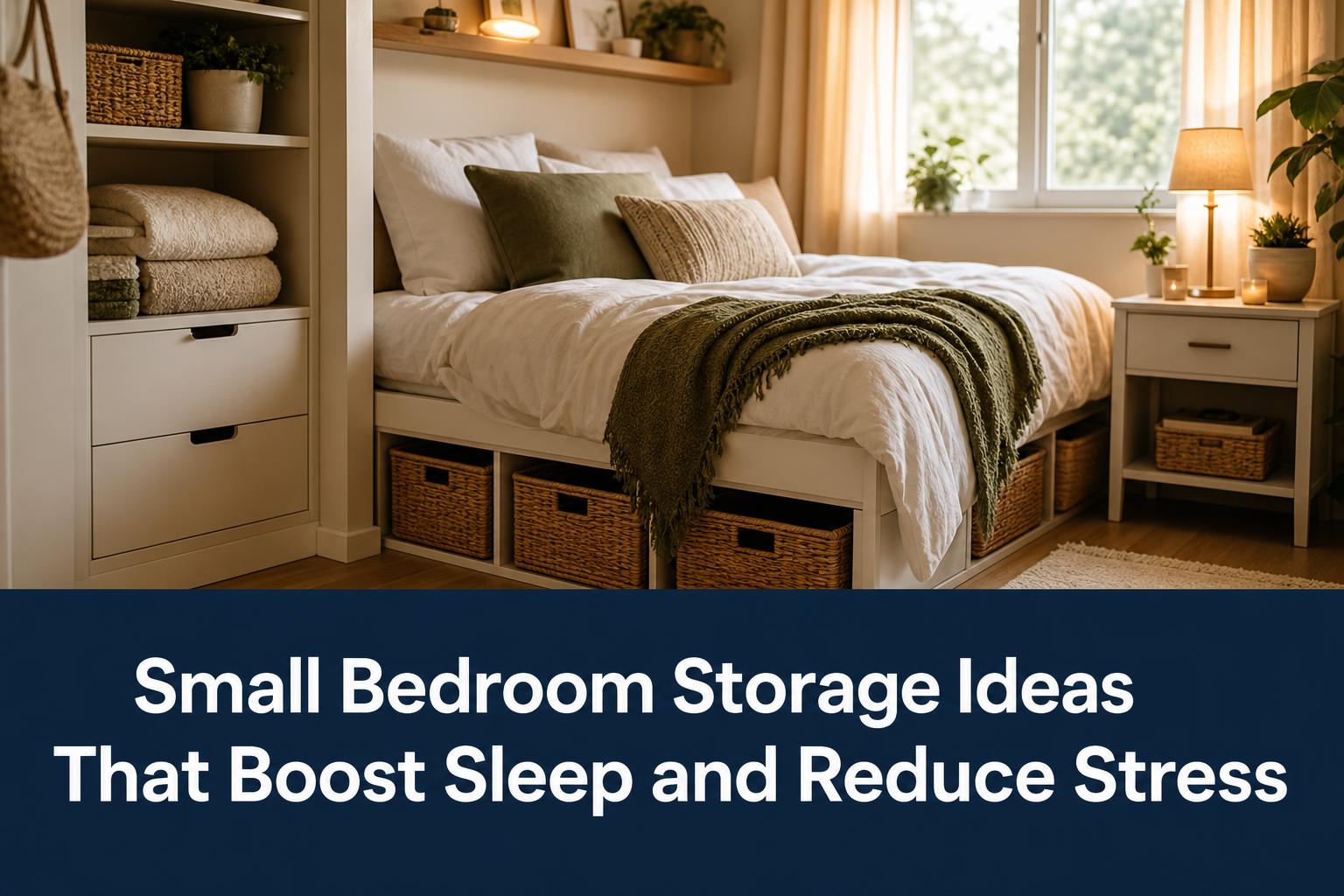
Small Bedroom Storage Ideas That Boost Sleep and Reduce Stress
Small bedroom storage works best when it clears the floor, hides visible clutter, and keeps your nightly routine easy, all of which make the room calmer to sleep in. Start by measuring bed clearance and choosing storage by how often you use each item: rolling drawers for weekly things, lidded bins for seasonal goods. A basic under-bed setup costs $10 to $40, so you can declutter without a full redesign. Clearer surroundings support a more restful room, but no current evidence shows storage products directly cure insomnia or anxiety.
Key takeaways
- Measure first: check bed clearance, container height, and the pull-out space before buying anything.
- Match storage to access frequency. Weekly items go in rolling drawers; seasonal items go in lidded bins pushed deep under the bed.
- Under-bed boxes start at $10 (Target Brightroom 41-quart) and IKEA's PÄRKLA case runs $1.99, so a working system costs little.
- Transparent, coordinated bins cut visual noise and make contents identifiable at a glance.
- Renter-friendly options like over-door organizers, removable hooks, and storage benches avoid permanent changes.
- Decluttering supports a calmer sleep environment, but the available research does not show it lowers cortisol, anxiety, or insomnia.
What are the best small bedroom storage ideas?
The best small bedroom storage ideas keep floors clear, hide visible clutter, and separate work or laundry from where you sleep. Under-bed bins, storage benches, shallow wall shelves, over-door organizers, and furniture with built-in compartments do this without shrinking usable floor space. Choose each piece by how often you reach for what's inside.
Start under the bed, the largest unused space in most small rooms. Wheeled boxes and pull-out drawers hold weekly items like extra sheets or shoes and slide out without crawling. Deep lidded bins hold seasonal goods you touch a few times a year.
Move to vertical space next. Shallow shelves above a doorway or along a wall hold books and small items without eating into the walking path. These space-saving book storage ideas offer more ways to organize a collection, while our wall storage ideas recover square footage the floor can't spare.
Then handle the everyday pile-up. A storage bench at the foot of the bed hides blankets and doubles as a seat. Over-door organizers hold accessories and toiletries. For shared rooms, giving each person a labeled bin cuts the "whose stuff is this" friction.
Users on r/SmallHome describe the bed, dresser, and nightstand as competing for the same floor. The fix is storage that lives inside furniture you already own or in dead space above and below, so nothing new lands on the ground.
Tip: If two people share the room, assign each person their own colored or labeled bin. It removes daily negotiation over shared space and makes it obvious when something needs putting away.
How do I choose under-bed storage?
Choose under-bed storage by measuring three things: the clearance between your bed frame and the floor, the height of the container, and the space you need to pull it out fully. Buy only after those numbers work together. A box that's a half-inch too tall won't fit, and one shoved against a wall you can't reach is wasted space.
Match the container type to how often you use it. Wheeled organizers and pull-out drawers suit items you grab weekly, since they roll out without moving the bed. Lidded fabric or clear boxes suit seasonal bedding and clothes you rotate a few times a year.
Transparent boxes let you see contents without opening them, which matters when several bins look alike. Coordinated bins in one color reduce the visual clutter that mismatched containers create, a point people on r/organizing raise when they want a small room to look tidier without owning less.
Retailers give a rough sense of demand. Target lists 23 under-bed products and reports more than 58,000 purchases in the last month for its $10 Brightroom 41-quart clear box. Its $15 fabric bin with lid passed 5,000 monthly purchases, and the $24.99 Sterilite 74-quart clear box passed 3,000. IKEA's U.S. under-bed category has 18 items; the $1.99 PÄRKLA case holds a 4.8/5 rating across 8,902 reviews, and the $9.99 SKUBB case holds 4.8/5 across 2,470. These are retailer-reported figures and change often.
For a fuller walkthrough, see our guide to under-bed storage ideas.
Does decluttering a bedroom actually improve sleep?
A clear, well-organized bedroom supports better sleep by cutting visual clutter, keeping the floor safe to walk at night, and separating work or laundry from the sleep area. For practical ways to create that setup, see these small bedroom organization ideas. But the current evidence does not show that decluttering or storage products directly reduce insomnia, anxiety, or stress. Treat storage as one part of a calmer room, not a cure.
Sleep researchers frame the bedroom as an environmental design problem. The Global Wellness Institute's 2026 trends report names "Sleep by Design" as an emerging trend built around temperature, air quality, light, noise, and the physical sleep environment. Storage touches the last of those by keeping the space uncluttered and easy to move through.
There's a correlation worth naming honestly. In a 2026 exploratory study of U.S. self-storage users, 10.5% reported housing loss as a life disruption and 7.2% reported relationship problems. That suggests storage use often accompanies stressful circumstances, not that storage causes or cures stress.
So keep expectations grounded. A tidy room you can move through in the dark is genuinely more restful, and the CDC reports that a large share of U.S. adults fall short of recommended sleep. Storage helps set the stage. It isn't a treatment.
Warning: Don't buy storage expecting it to fix anxiety or insomnia. The research supports storage as part of a calmer environment, not as a medical intervention. If sleep problems persist, that's a conversation for a clinician.

What storage works for renters who can't make permanent changes?
Renter-friendly bedroom storage relies on reversible, damage-free solutions: under-bed cases, freestanding shallow shelves, storage benches, over-door organizers, and removable adhesive hooks. None of these require drilling, painting, or landlord permission, and all of them come out cleanly when you move.
People on r/interiordecorating want a cozier room but can't paint or alter fixtures. The workaround is furniture and hooks that stand or hang without hardware. A storage bench adds a seat and hidden space in one footprint. Over-door organizers use the back of a door, which no lease restricts.
Freestanding shelves beat mounted ones when you can't drill. A shallow unit against a wall holds what a floating shelf would, and it leaves no holes. Removable hooks handle bags, robes, and jewelry, then peel off at move-out.
Under-bed storage is the strongest renter play because it uses space the lease can't touch. A three-drawer under-bed unit runs about $40 at Target, and a wheeled organizer with adjustable dividers runs about $25. Both replace floor-standing furniture in a room where the bed, dresser, and nightstand already compete for space.
Our guide on organizing a small house with no storage covers more reversible tactics for rentals.
How much should small bedroom storage cost?
A functional small bedroom storage system costs $10 to $60 total, not hundreds. Under-bed boxes start at $10, a fabric bench runs $30 to $50, and reusable compression bags cost a few dollars each. Treat these as one-time purchases and buy only what your measurements confirm will fit.
Sort spending by tier. Low-cost solutions handle most of the job. Mid-range furniture-integrated pieces cost more but replace a bulkier item, so they can pay for themselves in reclaimed floor space.
| Item | Price | Best for |
|---|---|---|
| IKEA PÄRKLA storage case | $1.99 | Seasonal clothes, low weekly use |
| Target Brightroom 41-qt clear box | $10 | Everyday under-bed items you want to see |
| The Container Store under-bed drawer | $19.19 (sale) | Weekly-access items, pull-out ease |
| Target wheeled under-bed organizer | $25 | Frequently grabbed items, no crawling |
| Target 3-drawer under-bed unit | $40 | Replacing a small dresser |
Prices are current retailer listings and change with sales and stock.
The finance logic is straightforward. Compare cost per container against how often you'll use it. A $40 drawer unit that removes a $200 dresser and frees floor space is better value than three cheap bins you can't reach. Separate essential storage upgrades from discretionary décor and buy the essentials first.
A worked example: organizing a 100-square-foot shared bedroom
Consider two roommates in a 100-square-foot rented room, with a queen bed, one small dresser, and a nightstand each. They can't paint or drill, and neither wants to give up belongings.
They start with measurements: 11 inches of clearance under the bed, so they need boxes 10 inches or shorter, plus 24 inches of pull-out room on the accessible side.
They buy two Target Brightroom 41-quart clear boxes at $10 each for weekly items like sheets and gym clothes, one $9.99 IKEA SKUBB case each for out-of-season clothes pushed to the far side, and a $25 wheeled organizer for shoes that rolls out from the foot of the bed. Total spend: $64.99.
They add a $40 storage bench for blankets and a shared seat, and each person gets a colored bin so daily items have an owner. That ends the weekly reconciliation scramble over whose clutter is whose.
Result: the dresser stays, the floor clears, and every item has a home matched to how often it's used. The whole system cost about $105 and needed no permanent changes.
Bottom line
Small bedroom storage earns its keep when it clears the floor, hides clutter, and matches how often you use each item, not when it promises to fix your sleep. Measure your bed clearance first, buy under-bed and reversible pieces in the $10 to $40 range, and give shared items a clear owner. A calmer, easier-to-navigate room supports rest. The storage is a tool, not a treatment.
Frequently asked questions
How do I hide clutter without getting rid of things I value?
Match each item to storage by how often you use it, then move rarely used things into deep, lidded under-bed bins where they're out of sight but kept. Weekly items go in accessible rolling drawers. A storage bench and over-door organizer absorb the daily pile-up. You keep everything you value; you just stop leaving it on visible surfaces where it makes the room feel cramped.
What's the cheapest way to add under-bed storage?
IKEA's PÄRKLA storage case at $1.99 and Target's Brightroom 41-quart clear box at $10 are the lowest-cost options. Both hold seasonal clothes or bedding. Buy a clear box if you want to see contents without opening it. Measure your bed clearance first, most cheap boxes run 6 to 12 inches tall, so confirm the fit before ordering.
How do I improve a small bedroom's flow if I can't move the closet or dresser?
Reclaim vertical and under-bed space so nothing new lands on the floor. Shallow wall shelves, over-door organizers, and under-bed drawers add capacity without widening furniture's footprint. Keep the walking path between bed and door clear. People on r/DesignMyRoom raise this exact problem; the answer is storing up and under rather than rearranging fixed pieces.
Does under-bed storage need wheels?
Wheels help for items you use weekly, since a wheeled organizer rolls out without moving the bed or crawling underneath. For seasonal items you touch a few times a year, a plain lidded box pushed to the far side works fine and costs less. Target lists a $25 wheeled under-bed organizer with adjustable dividers for frequently grabbed things like shoes.
Will decluttering my bedroom help me sleep better?
A clear, easy-to-navigate room supports more restful sleep, but current evidence doesn't show decluttering directly reduces insomnia or anxiety. The Global Wellness Institute's 2026 "Sleep by Design" trend treats the sleep environment as one factor among temperature, light, noise, and air quality. Storage helps set a calmer stage. If sleep problems continue, see a clinician rather than buying more bins.
How do roommates share bedroom storage without arguing?
Give each person their own labeled or colored bins so ownership is obvious and there's no daily negotiation over shared space. Assign specific zones: one side of the under-bed area each, separate drawers, individual over-door hooks. Shared items like spare blankets go in a common storage bench. Clear ownership ends the weekly scramble over whose clutter belongs where.
Related Reading
- Under the Bed Storage Ideas That Maximize Small Apartment Space
- Small Apartment Storage Ideas That Make Studio Living Practical
- Closet Organization Ideas on a Budget That Actually Work
- Bathroom Storage Ideas With No Cabinets for Renters and Small Homes
- Kitchen Storage Ideas for Small Spaces: Budget-Friendly Solutions
- Best Small Bathroom Storage Ideas That Save Money and Space
- Garage Storage Ideas to Declutter Without Expensive Shelving Systems
- Small Laundry Room Storage Ideas to Streamline Chores on Budget
- 16 Best RV Storage Ideas for Small Campers and Travel Trailers
- 15 Best Junk Room Storage Ideas for Small Homes