
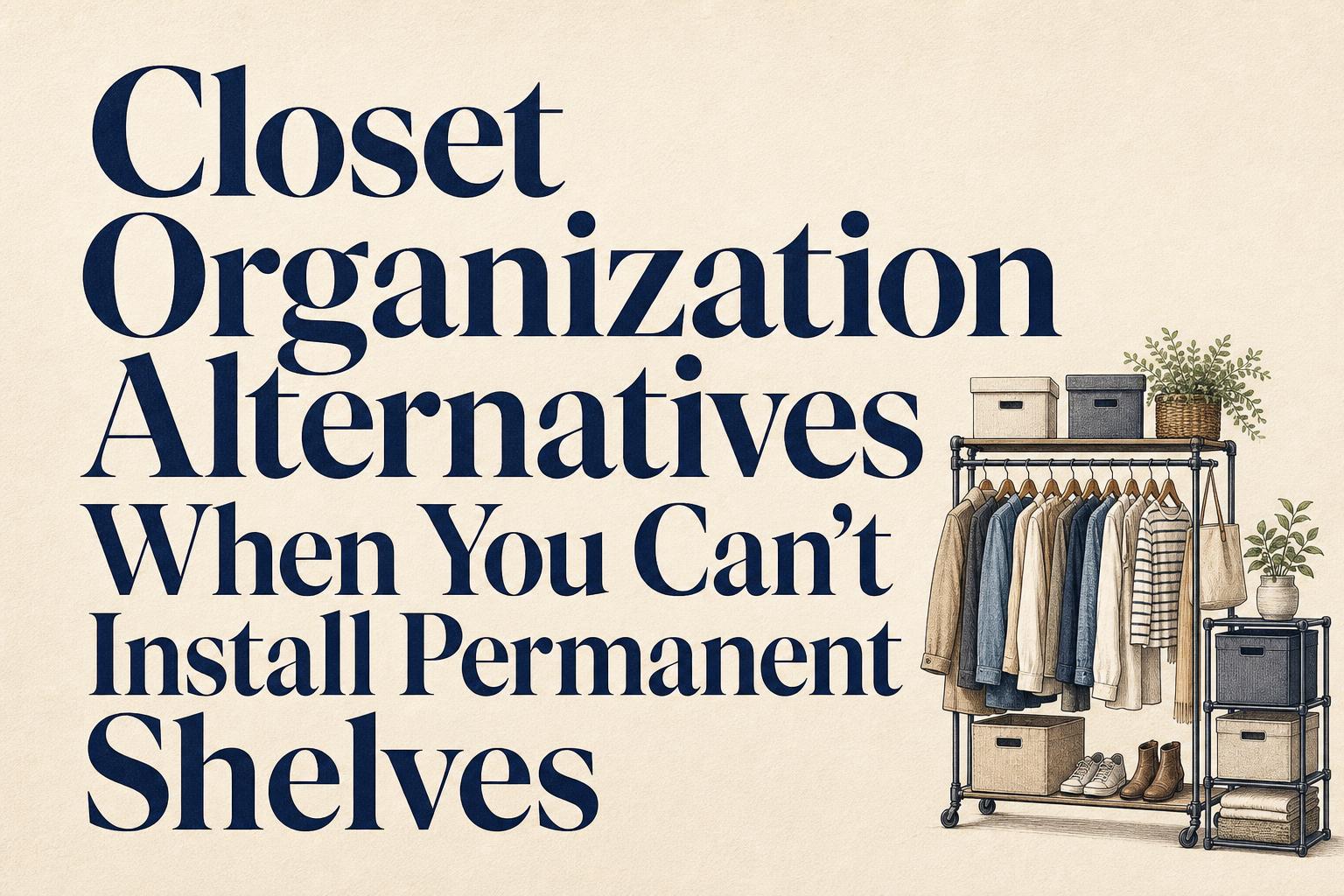
Closet Organization Alternatives When You Can’t Install Permanent Shelves
No-drill closet organization alternatives include freestanding garment racks, rolling drawer towers, stackable clear bins, over-door organizers, tension rods, and freestanding modular systems like IKEA OMAR or JONAXEL. These work in rentals, dorms, and shallow closets where drilling is prohibited, and they range from under $30 for bins to over $800 for a complete freestanding closet system. According to YouGov's 2025 survey, 74% of Americans already use storage bins or containers, making them the most common home-organization tool by a wide margin.
The catch: some systems marketed as "modular" still require wall anchoring. IKEA ELVARLI and PAX both include wall-attachment guidance, so they aren't true no-drill options for renters. This roundup separates genuinely portable solutions from those that need a drill, and prices every tier so you can decide before spending.
Top statistics
- 74% of Americans use storage bins or containers to organize their homes, versus 54% who use shelving and 49% who use hooks or hanging systems (YouGov, 2025).
- Only 30% of Americans use dedicated closet organizers, roughly tied with the 31% who use drawer dividers (YouGov, 2025).
- 40% of U.S. adults describe their homes as cluttered, including 9% who say very cluttered (YouGov Daily Question, 2025).
- 33% of Americans currently use self-storage, and another 18% plan to rent it (StorageCafe, 2026).
- Complete Elfa Classic reach-in configurations run about $804–$838 for a 6-foot closet and $1,389–$1,457 for an 8-foot closet (The Container Store, 2026).
- IKEA ELVARLI combinations range from $175 to $540 in the U.S. (IKEA U.S., 2026).
- 66% say organization helps them find things easily, and 66% say an organized home makes them feel better (YouGov, 2025).
How common are portable storage solutions?
Storage bins are the default tool for organizing an American home. According to YouGov's 2025 survey, 74% of Americans use storage bins or containers, 54% use shelving units, and 49% use hooks or hanging systems.
-
74% of Americans use bins or containers. According to YouGov's 2025 survey, containers outrank every other organizing method. That matters for renters: bins need no installation, stack anywhere, and move with you.
-
54% use shelving units, 49% use hooks. Per the same YouGov data, freestanding shelving and hooks are the next most common tools. Both can be no-drill: freestanding shelves rest on the floor, and adhesive or over-door hooks avoid the wall entirely.
-
Only 30% use dedicated closet organizers. YouGov's 2025 figures show closet organizers trail drawer dividers (31%). The gap suggests most people improvise closet storage with general containers rather than closet-specific systems.
-
Just 21% use labels. YouGov reports label use is the lowest of the common methods. That's a missed opportunity, because clear bins plus labels solve the "which box is the winter stuff in" problem that fills self-storage units.
Why does clutter drive people toward more storage?
Two in five U.S. adults live with clutter they'd rather not have. According to YouGov's 2025 Daily Question, 40% of adults describe their homes as very or somewhat cluttered, and that discomfort pushes many toward paid storage they may not need.
-
40% of U.S. adults call their homes cluttered. Per YouGov's 2025 Daily Question, 9% say very cluttered and 31% say somewhat cluttered. Community members on r/organizing frequently describe clothes piled into broad heaps, sweaters, pants, shirts, and a catch-all "miscellaneous" pile, which is the visible symptom of missing category zones.
-
66% organize to find things more easily. According to YouGov's 2025 survey, 66% say organization helps them locate items, 66% say it improves how they feel, and 61% organize to reduce clutter. Simple, visible zones deliver all three without construction.
Tip: Before buying anything, declutter and measure. Note your closet's width, depth, and height plus any floor items already living there, like a hamper or backpack. Users on r/organizing repeatedly ask for solutions tailored to their exact layout rather than a generic system, because a rod that fits an 8-foot closet is useless in a 4-foot one.
How much do self-storage units cost people who run out of space?
Self-storage is the expensive fallback when a closet overflows. According to StorageCafe's 2026 data, 33% of Americans currently rent self-storage and another 18% intend to. A no-drill closet system is often cheaper than a year of monthly unit rent.
-
Self-storage adoption rose from 11.1% to 13.4% of households. Self-Storage Association data summarized by PwC in 2026 shows the share of households renting at least one unit grew between 2022 and 2024. The self-storage sector reached more than 2.1 billion square feet of space by 2026.
-
33% of Americans currently use self-storage. Per StorageCafe's 2026 report, a third of the country rents storage and 18% more plan to. If your closet overflow is seasonal clothing, under-bed bins can absorb it for a one-time cost instead of a recurring bill.
The finance angle is direct. Recurring self-storage rent is money that could stay in your emergency fund or a starter brokerage account. Solving the space problem inside your home once, rather than paying monthly, is usually the cheaper path.

What do no-drill closet systems actually cost?
Prices span from pocket change to four figures, and knowing the tiers prevents overspending. Individual Elfa freestanding uprights list at $24.99 to $49.00 each at The Container Store, while a full Elfa Classic 6-foot closet runs roughly $804–$838.
-
Elfa freestanding uprights list at $24.99–$49.00 each. According to The Container Store's 2025/26 Elfa pricing guide, single uprights are inexpensive, but a complete configuration adds up fast. Buy pieces incrementally rather than the whole kit at once.
-
IKEA ELVARLI combinations range $175–$540. Per IKEA U.S. pricing accessed in 2026, ELVARLI is priced attractively, but IKEA describes it as a wall-mounted system that should be attached to the wall. It is not a true no-drill option for renters or anyone prohibited from anchoring furniture.
-
Complete Elfa reach-in closets cost $804–$1,457. The Container Store's 2026 listings put a 6-foot Elfa Classic closet at about $804–$838 and an 8-foot at $1,389–$1,457. At that price, a freestanding armoire or a stack of drawer towers often makes more financial sense for a rental.
Budget tiers for no-drill closet storage
| Tier | Typical products | Portability | Best for |
|---|---|---|---|
| Under $30 | Stackable clear bins, tension rods, over-door hooks | Very high | Renters, dorms, quick wins |
| $30–$100 | Rolling drawer towers, freestanding garment rack, under-bed bins | High | Adding hanging or drawer space |
| $100–$250 | Freestanding modular (IKEA JONAXEL, OMAR), small armoire | Medium | Reconfigurable closet middle ground |
| $250–$550 | Larger freestanding wardrobe, multi-unit Elfa freestanding | Medium | Whole-closet rebuilds without drilling |
| $800-plus | Complete Elfa Classic, custom built-ins | Low | Owners staying put long-term |
Which alternatives are genuinely no-installation?
The safest no-drill choices rest on the floor or hang over a door, with nothing anchored to a wall. Freestanding garment racks, rolling drawer towers, stackable bins, and freestanding modular systems like IKEA OMAR and JONAXEL fit this category. IKEA ELVARLI and PAX do not, because both include wall-mounting guidance.
Freestanding modular systems are the middle ground between cheap bins and permanent built-ins. They disassemble, move, and reconfigure, though tall units may need a stabilization kit or safety strap. When wall attachment is prohibited, freestanding ELVARLI alternatives such as armoires, OMAR shelving, and JONAXEL are the appropriate picks.
Tension rods add a second hanging bar without a single hole. Keep loads within the rod's stated weight rating, check your closet width and wall surface, and watch for slipping under heavier coats. Over-door organizers reclaim wasted vertical space for shoes, belts, and scarves, but verify door clearance, hinge strength, and the product's weight limit before loading it.
Warning: Tall freestanding furniture and loaded over-door racks can tip or pull loose. Use a wall-strap stabilization kit where allowed, keep heavy items low, and never exceed a tension rod's or over-door hook's rated weight. A furniture strap uses one small anchor, which many rental agreements permit even when full shelving installation does not.
What the data means
The numbers point to one conclusion: most people already own the cheapest tool that works. With 74% of Americans using bins yet only 21% using labels, the problem usually isn't a lack of containers, it's a lack of visible, labeled category zones. Clear bins plus one category per container fix the piled-heap issue that r/organizing users describe far more cheaply than a custom build.
The self-storage data reframes the spending question. As 33% of Americans pay for storage and 40% call their homes cluttered, a one-time no-drill closet fix under $250 often beats years of monthly unit rent. For someone protecting an emergency fund or starting to invest, that recurring cost is the more expensive mistake.
Skip the assumption that pricier means better. A complete Elfa closet at $800-plus and a $175 freestanding wardrobe both hold clothes; the difference is permanence and finish, not function. Renters and anyone who moves often get more value from portable systems they can take with them. Stashsavvy's practical guidance treats storage as a spending decision, matching the tool to the constraint rather than defaulting to the most expensive option.
Community sentiment on r/organizing adds one design rule: keep systems low-friction and easy to reset, especially for people managing ADHD. Open baskets, clear bins, and labeled zones you can refill in seconds beat elaborate systems that collapse the first busy week.
For more on working within tight footprints, see 12 minimalist storage tricks for small apartments and 15 genius small space storage hacks. Renters often pair these with 19 IKEA hacks to keep things organized.
Methodology and sourcing
Statistics come from named public sources. Home-organization behavior figures (bins, shelving, hooks, closet organizers, labels, clutter perception, and reasons for organizing) are from YouGov's 2025 surveys, including its Daily Question series. Self-storage adoption and square-footage figures are from StorageCafe's 2026 industry data and Self-Storage Association data summarized by PwC in 2026.
Pricing reflects listed U.S. figures accessed in 2026: IKEA ELVARLI combinations from IKEA U.S., and Elfa freestanding uprights and complete Elfa Classic configurations from The Container Store's 2025/26 pricing guide. Prices vary by retailer, location, stock, delivery, sale, and configuration; treat every figure as a snapshot, not a fixed quote. Where a current price is unavailable, check the retailer's site directly.
Frequently asked questions
What are the best closet organization alternatives if I can't drill?
Freestanding garment racks, rolling drawer towers, stackable clear bins, over-door organizers, tension rods, and freestanding modular systems like IKEA OMAR or JONAXEL all work without drilling. They rest on the floor or hang over a door. Avoid IKEA ELVARLI and PAX for a true no-drill setup, since both include wall-mounting guidance and are meant to be anchored to the wall.
Are cheap hardware-store closet organizers actually worth it?
Often, yes. According to YouGov's 2025 survey, 74% of Americans organize with basic bins, the most common method by far. Under-$30 tools like clear stackable bins, tension rods, and over-door hooks solve most closet problems if you add labels and keep one category per container. Spend on a $175-plus freestanding system only when you need real hanging or drawer capacity, not for prestige.
Is a freestanding closet system worth it versus built-in shelves?
For renters and frequent movers, usually yes. Freestanding modular systems disassemble and move with you, unlike built-ins. A complete built-in Elfa closet runs $804 to $1,457 at The Container Store, while a freestanding wardrobe can start around $175. Built-ins make more sense only if you own your home and plan to stay put for years.
How do I stop clothes from piling up in a small closet?
Use visible, labeled category zones you can reset in seconds. Clear bins let you see contents; one category per container (sweaters, pants, accessories) prevents mixed heaps. Only 21% of Americans use labels, per YouGov's 2025 data, yet labeling is what makes portable storage stay organized. Users on r/organizing recommend low-friction systems specifically because complicated setups collapse within a week.
Should I rent a self-storage unit or reorganize my closet?
Reorganize first. StorageCafe's 2026 data shows 33% of Americans pay for self-storage, but a one-time no-drill closet fix under $250 often costs less than a year of monthly rent. Move seasonal clothing to under-bed bins instead of a paid unit. Skipping recurring storage rent keeps that money in your emergency fund or a starter investment account.
Do over-door organizers and tension rods have weight limits?
Yes, and exceeding them causes failures. Tension rods slip under heavy coats if you pass their rated load, so check the rating and your closet width first. Over-door organizers depend on door clearance, hinge strength, and their own weight limit. Keep heavy items low and use a stabilization strap for tall freestanding furniture where your lease allows it.
Related Reading
- Closet Organization Ideas on a Budget That Actually Work
- 7 Minimalist Small Closet Organization Ideas to Maximize Every Inch
- Kitchen Storage Ideas for Small Spaces: Budget-Friendly Solutions
- Small Apartment Storage Ideas That Make Studio Living Practical
- Best Small Bathroom Storage Ideas That Save Money and Space
- Dollar Tree Organization Hacks for Kitchen, Bath, and Closets
- Dollar Tree Organization Hacks That Look High-End for Low Cost
- Small Bedroom Storage Ideas That Boost Sleep and Reduce Stress
- 16 Best RV Storage Ideas for Small Campers and Travel Trailers
- 15 Best Junk Room Storage Ideas for Small Homes