
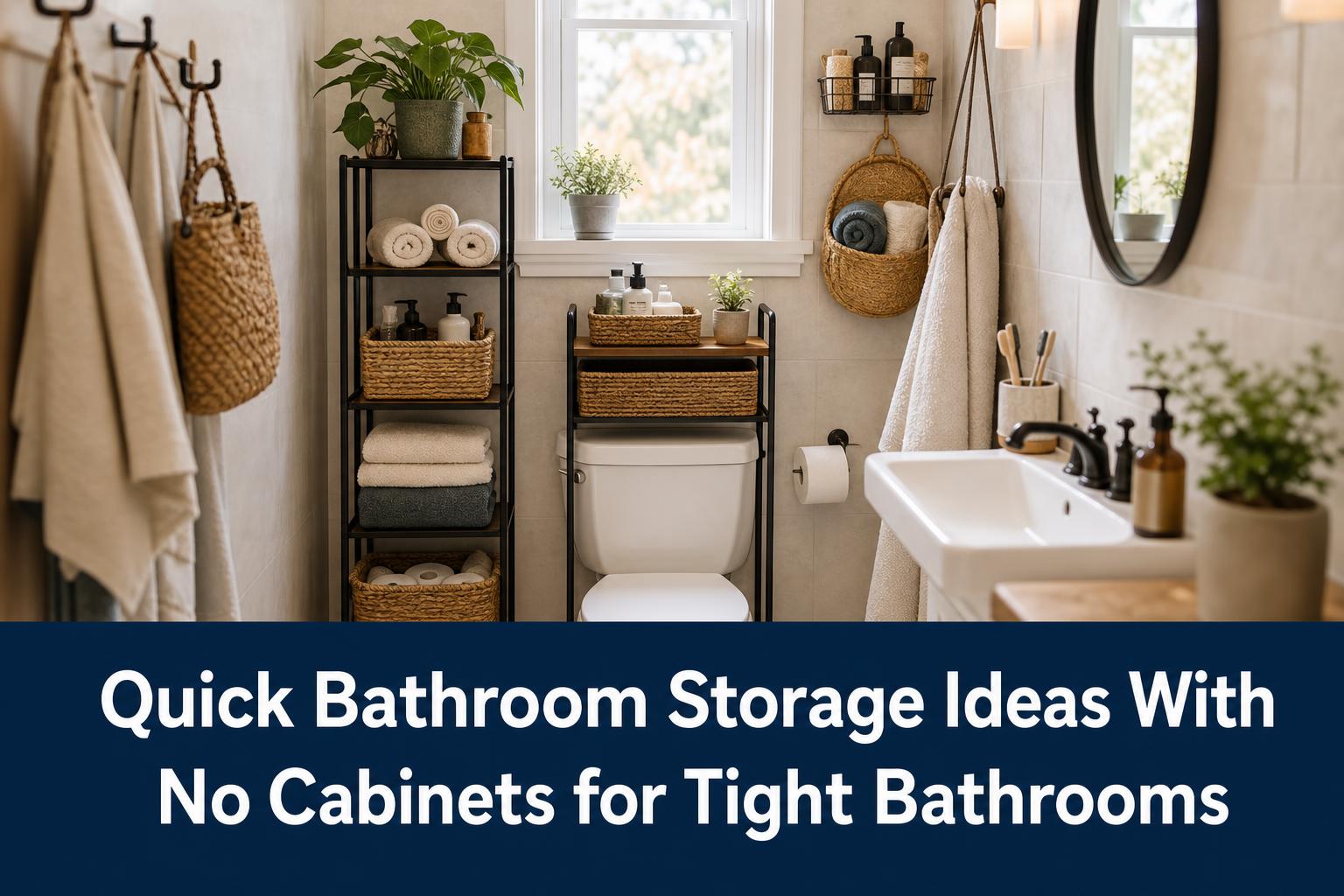
Quick Bathroom Storage Ideas With No Cabinets for Tight Bathrooms
You can store everything a bathroom needs without a single cabinet by using the walls, the space above the toilet, and the back of the door. The cheapest fixes cost nothing (declutter and rearrange), and no-drill adhesive shelves ran roughly $63 to $85 at Home Depot as of August 2026, while over-the-toilet units ranged from about $63 for a three-tier organizer to $172 for a wide adjustable-shelf model. Assign each spot one job, keep daily items between waist and shoulder height, and never block the toilet shutoff valve.
Key takeaways
- Vertical storage adds capacity without eating floor space: over-the-toilet shelving, floating shelves, peg rails, wall baskets, and adhesive organizers.
- No-drill adhesive shelves suit renters but demand a check on wall surface, weight limit, and moisture exposure before you buy.
- Assign every zone one purpose (skincare shelf, towel rail, toilet-paper basket) instead of one giant catch-all unit.
- Cost ladder: free decluttering, then hooks and baskets, then adhesive shelves, then over-the-toilet units, then custom work.
- 33% of homeowners bought storage or organizational products during 2025 home projects, per the 2026 U.S. Houzz & Home Study.
- Measure wall width, toilet height, door swing, and sink clearance before ordering anything.
How do you store bathroom items with no cabinets?
Use vertical and surface-mounted storage: shelves, hooks, rails, and baskets that project from the wall instead of sitting on the floor. In a cabinet-free bathroom, the walls, the area over the toilet, and the back of the door hold most of your supplies. This keeps the floor clear and puts daily items within easy reach.
Surface-mounted storage projects from the wall without cutting into it, so it works in rentals and older homes where wall excavation is not an option. Floating shelves, peg rails, and wall-mounted baskets all follow this principle. That matters because recessed cabinets remained the majority at 66% in the 2025 U.S. Houzz Bathroom Trends Study, yet surface-mounted medicine cabinets rose 8 percentage points to 31% over the same period, a sign that homeowners are choosing less invasive options.
Start by grouping what you own. Skincare, hair tools, medications, towels, and toilet paper each need a home. Users on r/bathrooms describe a common trap: a small mirror cabinet fills up fast, leaving toiletries stranded in boxes or on the sink edge. The fix is not a bigger cabinet. It is spreading items across several small, single-purpose spots.
Tip: Before you buy anything, empty every drawer and basket you already have. Roughly a third of the clutter in a tight bathroom is expired product or duplicates. Decluttering is the only storage upgrade that costs nothing and frees space immediately.
For more ways to squeeze storage from a small footprint, see our guide to genius small space storage hacks that actually work.
What are the cheapest ways to add bathroom storage?
The cheapest path is a cost ladder: start free, then spend only where a free fix runs out. Decluttering and rearranging cost nothing. Adhesive hooks and a couple of baskets run under $20. No-drill adhesive shelves ran $63 to $85 at Home Depot in August 2026, and over-the-toilet units started around $63.
Here is the ladder in order:
- Free — Declutter, then move daily items to eye level and stash backups low or in another room.
- Under $20 — Adhesive hooks for towels and robes, a small basket for toilet paper, an over-the-door hook rack.
- $60 to $85 — No-drill adhesive shelves. A two-piece decorative shelf listed at $62.99, floating shelves with a wire basket at $76.15, and a two-pack shower corner rack at $84.99 (Home Depot, checked August 2026).
- $63 to $172 — Over-the-toilet units. A Volenca three-tier organizer with towel holder listed at $63.07, a Dracelo black organizer at $86.41, and a wider adjustable-shelf unit at $171.93 (checked August 2026).
- Highest cost — Custom built-ins or recessed shelving, usually involving a professional. In the 2025 Houzz study, 84% of homeowners hired a pro for bathroom work.
Prices vary by store, ZIP code, tax, shipping, and stock, so treat these as snapshots, not fixed figures. The point of the ladder is spending discipline: try the free rung first, and only climb when you have to. That habit, spending the least amount that solves the problem, applies to a bathroom shelf the same way it applies to a monthly budget.

Where should you put storage in a tight bathroom?
Put frequently used items between waist and shoulder height, keep floor storage out of the walking path, and use the wall above the toilet for the rest. This range is the easiest to reach without bending or climbing, which matters more as households plan for aging in place. In the NKBA | KBIS 2026 Bath Trends Report, 32% of professionals called aging-in-place a mainstream trend already, with another 48% saying it is becoming mainstream.
Break the room into zones and give each one job:
- Sink wall — A narrow shelf or two adhesive shelves for daily skincare and a toothbrush.
- Over the toilet — A three-tier unit or floating shelves for backup supplies and folded towels.
- Shower corner — A corner rack for the bottles you actually use, not the ten you don't.
- Behind the door — An over-the-door rack for towels or a hanging caddy.
- Toilet-paper spot — A single basket within arm's reach of the toilet.
Homeowners on r/HomeDecorating often ask where to place hooks in a small guest bathroom when the mirror is not a cabinet. Put a towel hook or bar at shoulder height on the largest open wall, and a second hook near the shower for a robe. Keep hooks off the door swing path.
Measurement is where most purchases go wrong. Readers on r/DesignMyRoom describe tightly measured recesses, such as 17.5 inches wide by 33 inches deep, where standard furniture simply will not fit. Measure wall width, toilet height, door swing, sink clearance, shower access, and outlet locations before you order. A shelf too deep for a narrow room becomes a shin-bruiser you eventually remove.
Our guide to over-the-toilet storage ideas for tiny bathrooms covers this zone in detail.
Are no-drill adhesive shelves worth it for renters?
Yes, for renters and quick upgrades, adhesive shelves avoid holes and landlord disputes, but they fail in humid conditions if you skip the fine print. Check three things before buying: wall-surface compatibility, weight limit, and moisture exposure. Follow the installation instructions exactly, including the cure time before you load the shelf.
Adhesive works on smooth, clean, non-porous surfaces like painted drywall, tile, or glass. It struggles on textured paint, wallpaper, and unsealed surfaces. Home Depot's adhesive shelf category ranged from about $63 to $85 in August 2026, and each product lists its own weight rating. Respect it. Heavy glass jars belong on a drilled shelf or down low, not on a peel-and-stick strip above the toilet.
Warning: The most common adhesive failure is humidity. Steam weakens many adhesives over months, and a shelf that held fine in winter can drop in a hot summer shower. Keep adhesive shelves away from the direct steam zone, load them light, and don't mount anything breakable above where you stand.
If you own your home and want permanent capacity, drilled peg rails and wall-mounted baskets carry more weight and last longer. The trade-off is holes and anchors sized to your wall material. Renters get the flexibility of removable storage; owners get the security of anchored storage. Both beat a floor pile.
What over-the-toilet storage actually works?
Over-the-toilet units work when they are stable, sized to your toilet, and loaded with heavy items down low. This spot uses vertical space that would otherwise sit empty. The catch is stability and access: a wobbly freestanding rack straddling the toilet is a hazard, and you must keep the tank lid and shutoff valve reachable.
Three unit types fit most bathrooms:
- Freestanding three-tier — Straddles the toilet, no drilling. The Volenca three-tier with towel holder listed at $63.07 (August 2026). Good for renters, but confirm the legs clear your toilet width.
- Wall-mounted shelves — Anchored above the tank, nothing touching the floor. More stable, requires drilling.
- Adjustable-shelf cabinet-free unit — A wider model listed at $171.93 (August 2026) for households needing more shelves.
Some homeowners on r/interiordecorating call over-the-toilet cabinets tacky and weigh them against standing units or built-ins. Open floating shelves sidestep that look entirely and cost less. If you go freestanding, pick one whose feet sit flat on the floor, not on the baseboard, and keep the bottom shelf for the heaviest items so the unit stays bottom-weighted.
Never mount a shelf so low it blocks the tank lid. You need to lift that lid to fix a running toilet, and you need the shutoff valve clear for emergencies. For more ideas in this zone, see our audacious over-the-toilet storage ideas.

Comparison: no-cabinet storage options
| Option | Install type | Approx. price (Aug 2026) | Floor-space impact | Renter-friendly | Best for |
|---|---|---|---|---|---|
| Adhesive hooks | Peel-and-stick | Under $20 | None | Yes | Towels, robes |
| Adhesive shelves | Peel-and-stick | $63–$85 | None | Yes | Daily skincare |
| Shower corner rack | Adhesive or tension | $85 (2-pack) | None | Yes | Shower bottles |
| Freestanding over-toilet | No-drill straddle | $63–$172 | Minimal (over toilet) | Yes | Backup supplies |
| Wall-mounted shelves | Drilled | Varies, see site | None | No | Permanent capacity |
| Peg rail | Drilled | Varies, see site | None | No | Towels, tools |
Prices reflect Home Depot listings checked August 2026 and vary by location, tax, and shipping.
A worked example: outfitting a $150 bathroom
Take a rented 5-by-7-foot bathroom with a small mirror (no medicine cabinet), one towel bar, and no other storage. Here is a build under $150.
Start free: declutter and remove three expired products and two duplicate shampoos. Move daily skincare to the sink area, backups to a bedroom closet.
Then spend:
- Four adhesive hooks for towels and a robe: about $15.
- One adhesive shelf pair for the sink wall (daily skincare): $62.99.
- One two-pack shower corner rack: $84.99 (use one, keep the spare).
Total: about $163 before tax, or $78 if you skip the corner rack spare and buy hooks alone plus the shelf. Every item is removable, leaves no holes, and clears the floor. Compared to a $7,000 median guest-bathroom renovation reported in the 2026 U.S. Houzz & Home Study, this fixes the storage problem for roughly 1% of a remodel.
Bottom line
You do not need cabinets to store a bathroom. You need walls, the space above the toilet, and one job per zone. Start with the free rung (declutter), climb to hooks and baskets under $20, then adhesive shelves at $63 to $85 or over-the-toilet units from $63 if you need more. Measure first, keep daily items at reach, and never block the toilet valve. Spend the least that solves the problem, then stop.
Frequently asked questions
What is the best bathroom storage with no cabinets?
The best no-cabinet storage combines wall shelves, hooks, and an over-the-toilet unit, each assigned one purpose. Use adhesive or floating shelves for daily skincare, hooks or a peg rail for towels, a basket for toilet paper, and a shower corner rack for bottles. Spreading items across several single-purpose spots reduces clutter better than one large catch-all organizer. Match each product to your wall material and the space you measured.
Do adhesive bathroom shelves fall off in humidity?
They can. Steam weakens many adhesives over months, so a shelf mounted in cool weather may drop in a hot summer shower. Reduce the risk by mounting on smooth, clean, non-porous surfaces, keeping shelves out of the direct steam zone, respecting the listed weight limit, and allowing full cure time before loading. Never place breakable or heavy items on adhesive shelves above where you stand.
How much does no-cabinet bathroom storage cost?
It ranges from free to about $172, depending on the option. Decluttering costs nothing, adhesive hooks and a basket run under $20, and no-drill adhesive shelves listed at $63 to $85 at Home Depot in August 2026. Over-the-toilet units ranged from $63.07 for a three-tier organizer to $171.93 for a wide adjustable-shelf model. Prices vary by store, ZIP code, tax, and shipping.
Where should I put a towel hook in a small bathroom?
Mount towel hooks at shoulder height on the largest open wall, and a second hook near the shower for a robe. Keep hooks clear of the door swing so they do not catch when the door opens. In a rental, adhesive hooks avoid holes; in a home you own, drilled hooks or a peg rail carry more weight and last longer.
Are over-the-toilet units stable enough to trust?
Freestanding over-the-toilet units are stable when the feet sit flat on the floor and the heaviest items load the bottom shelf. Avoid legs resting on the baseboard, which causes wobble. Keep the tank lid and shutoff valve reachable at all times. Wall-mounted shelves are more stable than freestanding racks but require drilling and anchors sized to your wall.
Can renters add bathroom storage without drilling?
Yes. Renters can use adhesive shelves, adhesive hooks, tension-rod shower caddies, over-the-door racks, and freestanding over-the-toilet units, none of which require drilling. These options leave no holes and come down when you move. Check each product's weight limit and wall-surface compatibility before buying, and keep breakable items off adhesive mounts in the steam zone.
Related Reading
- Best Small Bathroom Storage Ideas That Save Money and Space
- Bathroom Storage Ideas With No Cabinets for Renters and Small Homes
- Kitchen Storage Ideas for Small Spaces: Budget-Friendly Solutions
- Closet Organization Alternatives When You Can’t Install Permanent Shelves
- Small Laundry Room Storage Ideas to Streamline Chores on Budget
- Small Apartment Storage Ideas That Make Studio Living Practical
- Budget-Friendly Garage Storage Ideas That Increase Home Value Potential
- Closet Organization Ideas on a Budget That Actually Work
- 16 Best RV Storage Ideas for Small Campers and Travel Trailers
- 15 Best Junk Room Storage Ideas for Small Homes