
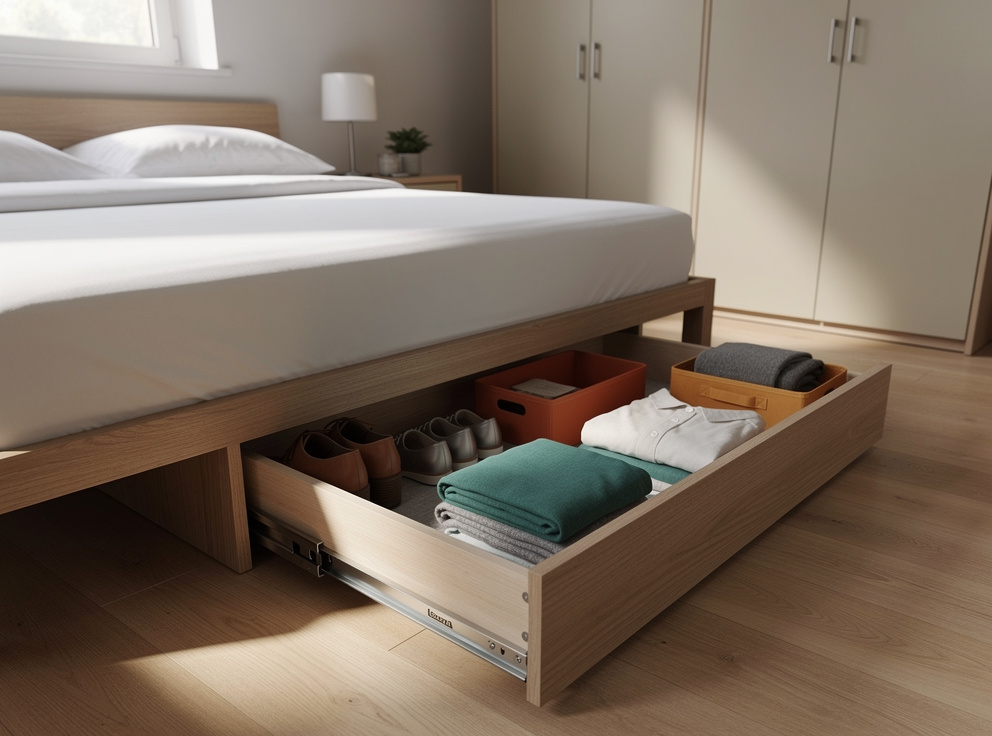
Under the Bed Storage Ideas That Maximize Small Apartment Space
The space under your bed can hold seasonal clothing, spare bedding, and keepsakes without adding a single piece of furniture to your floor. Before buying anything, measure the clearance from the floor to the lowest part of your bed frame, since many current under-bed containers stand about 7 to 7.5 inches tall and will not fit under a low frame. Match the container type to what you're storing: fabric cases for textiles, clear lidded bins for items you want to see and protect, wheeled organizers for heavy or platform beds, and lockable trunks for valuables. Prices start around $1.99 for a soft case and climb to roughly $80 to $98 for coordinated furniture-style boxes or lockable trunks.
Key takeaways
- Measure clearance height, width, and length before buying. Most under-bed boxes need about 7 to 7.5 inches of vertical space.
- Store infrequently used items only: seasonal clothes, spare bedding, keepsakes. Keep daily essentials somewhere you can reach without kneeling.
- Fabric cases suit textiles, clear bins protect and display, divided organizers separate categories, and trunks lock up valuables.
- Wheeled containers matter under heavy or platform beds where sliding a rigid box is awkward.
- Budget bins start near $1.99 (IKEA PÄRKLA) and $6 (Target Brightroom); integrated lift-up beds and coordinated drawers cost more but hold more.
- For renters, loose containers beat built-in furniture you can't take with you.
Why is under-bed storage worth it in a small apartment?
Under-bed storage is worth it because it turns dead space into usable capacity without occupying visible floor area, which matters most when your apartment is small. The average U.S. apartment measured 909 square feet in 2024, according to the U.S. Energy Information Administration's Residential Energy Consumption Survey, but apartments with one or two rooms averaged just 634 square feet. Across the country's 34.74 million apartment units, average space worked out to 472 square feet per household member.
In a 634-square-foot one- or two-room apartment, a queen bed already covers roughly 30 square feet of floor. The clearance beneath it, often several cubic feet, sits empty unless you use it. Filling that space can delay or eliminate the need for a dresser or extra shelving.
Residents on r/SmallHome say they actively hunt for hidden storage that keeps a room from feeling like a shoebox. Under-bed containers deliver exactly that: capacity you don't see. For more ways to find room you didn't know you had, see how to organize a small house with no storage.
Tip: If you and a partner or roommate share the space, assign each person a labeled bin. Clear ownership cuts down the "whose stuff is this?" arguments that also plague shared budgets.
How do you measure for under-bed storage before buying?
Measure three dimensions before you buy: clearance height from the floor to the lowest obstruction, usable length, and usable width. Clearance is the number that ends most purchases, because many current under-bed boxes stand about 7 to 7.5 inches tall and won't slide under a low frame or a bed with a center rail.
Start with a tape measure at the point of least clearance. Bed legs, side rails, and center support beams all cut into usable height, so measure at the shortest gap, not the tallest. Then note the direction you'll pull from: if a wall or nightstand blocks one side, you can only access the bin from the open side, which changes the maximum length you can slide in and out.
A user on r/DIY who switched to a lift-up bed reported that their old large wheeled clear bins were too big and cumbersome to handle. That's the measurement lesson: a container that technically fits under the frame is useless if you can't maneuver it in the tight space you actually have.
Write your three numbers down before you shop. IKEA's under-bed category listed 19 items in 2026 and Target's showed 23, so you have room to match a product to your measurements rather than forcing a fit.
Which under-bed container type fits which items?
Match the container to the contents. Fabric cases handle textiles, clear rigid bins protect and display, divided organizers separate categories, wheeled bins ease access under heavy beds, and lockable trunks guard valuables. Treating all containers as interchangeable is why people end up digging through the wrong box.
Fabric cases suit clothing, bedding, and other textiles. IKEA's SKUBB cases include handles and ventilation, which help with soft goods that need airflow. IKEA's PÄRKLA storage case listed at $1.99 each in 2026 (with an online minimum order of two), making it the cheapest entry point.
Clear rigid bins let you identify contents without opening the lid while keeping out dust. Target's Brightroom 28-quart clear under-bed storage box listed at $6 in 2026. Use these for anything you want to see at a glance but still protect.
Divided or shallow organizers separate categories so you don't remove every container to find one item. These make small apartments more functional by keeping related things together.
Wheeled containers roll out from under heavy or platform beds without you moving the mattress. Target's VECELO metal rolling under-bed storage bin set listed at a $49.99 sale price against a $79.99 regular price in 2026.
Lockable trunks work for valuables and keepsakes, with retail options around $97.99. Coordinated furniture-style boxes match specific bed frames; IKEA's GULLABERG set of two listed at $80 and was marked New in 2026.
| Container type | Best for | Access | Rough price |
|---|---|---|---|
| Fabric case | Clothing, bedding | Handles, no wheels | From $1.99 (PÄRKLA) |
| Clear rigid bin | Visible, dust-protected items | Lift lid | $6 (Brightroom 28-qt) |
| Divided organizer | Separated categories | Pull out | See site |
| Wheeled bin | Heavy/platform beds | Rolls out | $49.99 sale (VECELO) |
| Coordinated drawers | Matched to frame | Slide/pull | $80 (GULLABERG) |
| Lockable trunk | Valuables, keepsakes | Lift lid, locks | ~$97.99 |
What should you store under the bed, and what should stay out?
Store infrequently used items under the bed: seasonal clothing, spare bedding, and keepsakes. Keep daily essentials, damp items, and fragile things somewhere else. Under-bed space is hard to reach, so anything you touch often belongs at a height you can grab without kneeling.
The rule follows from access. Kneeling and sliding out a bin every morning to get socks wastes time; storing next winter's coats there once a year does not. People on r/organizing report struggling with bedside access and functionality, which shows why advice has to separate daily-use items from long-term storage.
Avoid storing anything damp, since restricted airflow under a bed invites mildew. Fragile items risk getting crushed if a container gets shoved. And don't bury frequently needed belongings, or you'll pull the whole box out repeatedly and give up on the system.
To keep the space from becoming a hidden junk drawer, label every container, choose shallow bins over deep ones, and separate items by category. For related tactics, see 18 brilliant under bed storage ideas to declutter like a pro and 15 genius small space storage hacks that actually work.
Warning: Don't store items you need weekly under the bed. If you find yourself pulling a bin out more than once a month, that content belongs in a closet or drawer instead.
What are the best under-bed storage options for renters?
For renters, loose containers beat built-in furniture because they move when you do and require no modification to the bed. Fabric cases, clear bins, and wheeled organizers all leave the frame untouched, which matters if the bed is a rental furnishing or a hand-me-down you'll replace.
Integrated solutions such as platform beds with drawers, lift-up beds, and frames with built-in compartments hold more than loose bins. But they cost more, are harder to move, and lock you into one bed. That trade favors long-term living over temporary arrangements.
Residents on r/IndianHomeDecor say they want inexpensive, simple ideas that make unused areas around the bed more functional, with affordability and a tidy look as the priorities. A stack of $1.99 PÄRKLA cases or $6 Brightroom bins answers both: low cost and hidden capacity that keeps the room visually clean.
If you rent and want maximum capacity without buying a new bed, wheeled bins are the compromise. They give you drawer-like pull-out access under an existing frame and come with you at move-out.
A worked example: outfitting a 634-square-foot one-bedroom
Consider a couple in a 634-square-foot apartment, the 2024 average for one- or two-room units. Their queen bed sits on a frame with 8 inches of clearance and a center rail that drops the shortest gap to 7.25 inches. They access the bed from both long sides; a nightstand blocks the top corners.
They measure first: 7.25 inches usable height, and roughly 30 inches of pull-out length on each open side before the nightstands interfere. That rules out a 9-inch-tall bin.
Their plan:
- Two IKEA PÄRKLA fabric cases at $1.99 each ($3.98 total) for off-season clothing, one case per person.
- Two Target Brightroom 28-quart clear bins at $6 each ($12) for spare bedding and towels, visible through the clear sides.
- One VECELO wheeled bin at the $49.99 sale price for shared keepsakes, rolled out from the foot of the bed.
Total: $65.97. Each container is labeled with the owner's name, which settles the "whose box is this" question before it starts. Six cubic feet of previously dead space now holds items that would otherwise demand a $150 dresser and its floor footprint.
Bottom line
Under-bed storage converts empty clearance into usable capacity, and in a 634-square-foot one- or two-room apartment that space is too valuable to waste. Measure clearance, length, and access direction first, then match containers to contents: fabric for textiles, clear bins for protected visibility, wheels for heavy beds, trunks for valuables. Start as low as $1.99 for a PÄRKLA case or $6 for a Brightroom bin, and reserve the space for seasonal and infrequently used items so it stays useful instead of becoming a hidden pile.
Frequently asked questions
How high should under-bed storage be?
Match the container height to your clearance, measured at the lowest obstruction. Many current under-bed boxes stand about 7 to 7.5 inches tall, so measure from the floor to the bottom of the frame, rails, and center beam before buying. Use the shortest gap as your ceiling. A box that clears the frame corners but hits a center rail won't slide in, so always measure at the tightest point rather than the tallest.
What is the cheapest way to add under-bed storage?
Soft fabric cases are the cheapest option. IKEA's PÄRKLA storage case listed at $1.99 each in 2026, with an online minimum order of two. Target's Brightroom 28-quart clear under-bed storage box listed at $6. Both cost a fraction of a dresser and use space you already have. For textiles, the ventilated PÄRKLA works; for items you want to see and protect from dust, the clear Brightroom bin is the better pick.
Should renters buy loose bins or a bed with built-in storage?
Renters should choose loose bins. Fabric cases, clear bins, and wheeled organizers require no modification to the bed and move with you at the end of a lease. Built-in options such as platform beds with drawers and lift-up beds hold more but cost more, are hard to transport, and commit you to one frame. Save integrated furniture for long-term living where you own the bed and plan to stay.
What should I not store under my bed?
Avoid daily essentials, damp items, and fragile things. Under-bed space is hard to reach, so anything you use often belongs in a closet or drawer instead. Damp items risk mildew because airflow is limited, and fragile objects can get crushed when a bin is shoved. Reserve the space for seasonal clothing, spare bedding, and keepsakes you touch a few times a year.
Are wheeled under-bed bins worth it?
Wheeled bins are worth it under heavy or platform beds where sliding a rigid box is awkward. They give you pull-out access without lifting the mattress. Target's VECELO metal rolling under-bed storage bin set listed at a $49.99 sale price in 2026. One caution from r/DIY: oversized wheeled bins can be too cumbersome in tight clearance, so measure your usable length before buying a large rolling container.
How do I keep under-bed storage from becoming a junk pile?
Label every container, use shallow bins over deep ones, and separate items by category. Divided organizers keep related things together so you don't remove every box to find one item. Set a rule: if you pull a bin out more than once a month, its contents belong somewhere more accessible. Assigning one labeled bin per person also prevents the shared-space confusion that comes with mixed belongings.
Related Reading
- Kitchen Storage Ideas for Small Spaces: Budget-Friendly Solutions
- Best Small Bathroom Storage Ideas That Save Money and Space
- Pantry Organization Ideas That Cut Food Waste and Save Bills
- How to Organize a Small Closet With Lots of Clothes Fast
- 16 Best RV Storage Ideas for Small Campers and Travel Trailers
- 15 Best Junk Room Storage Ideas for Small Homes