
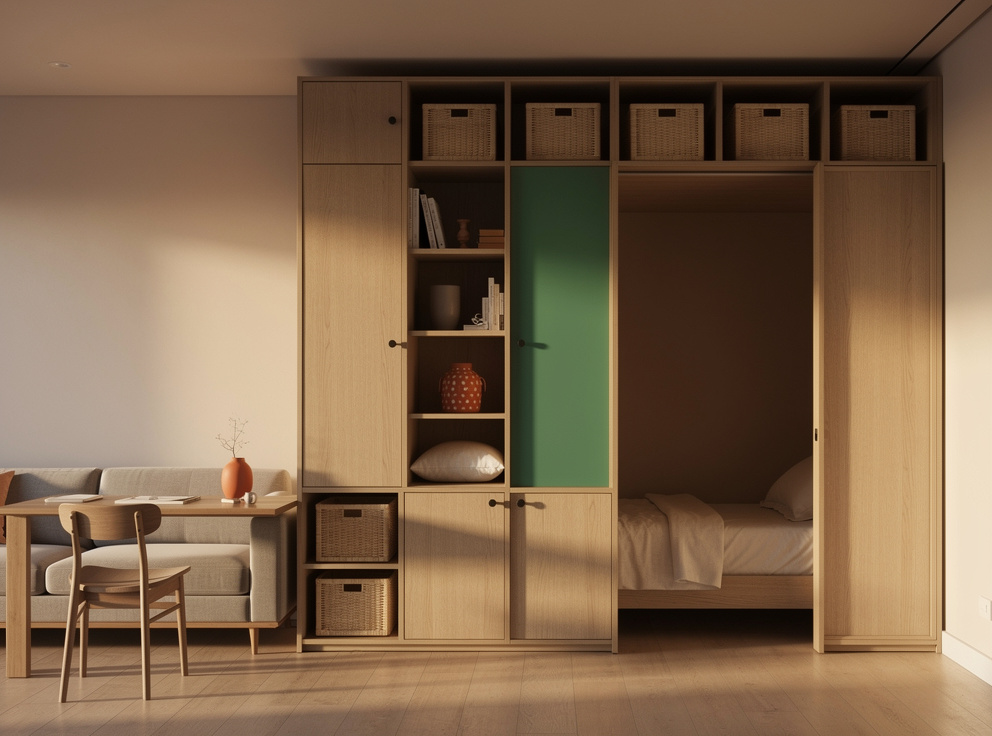
Small Apartment Storage Ideas That Make Studio Living Practical
Small apartment storage starts with a financial decision, not a shopping trip. Before buying a single bin, compare the one-time cost of in-unit storage against the recurring $133-per-month national average for a self-storage unit reported by RentCafe in December 2025. The most practical studio systems assign a purpose to every zone, keep frequently used items at eye level, and push seasonal belongings to under-bed and high-shelf space. Vertical storage, dual-purpose furniture, and renter-safe fixtures do the heavy lifting without permanent changes to a rental.
Key takeaways
- Compare a one-time storage purchase against recurring self-storage rent ($133/month national average) before spending anything.
- Go vertical with tall shelving, over-door organizers, and wall rails to protect floor and walking space.
- Reserve under-bed, above-cabinet, and high-shelf spots for low-frequency and seasonal items; keep daily items at eye level.
- Use clear bins for hidden storage and opaque baskets for visible areas to control clutter.
- Stay renter-safe: no blocked exits, no overloaded adhesive hooks, no unsecured heavy objects.
- IKEA's secondary-storage range starts at $0.79 (PLOGSVÄNG basket), so a full system can cost far less than one month of external storage.
How do you decide between buying storage and renting a unit?
Run the math first. A one-time set of bins, baskets, and shelves usually costs less than two months of external self-storage, which averaged $133 per month nationally in December 2025 according to RentCafe. If you'd store items for a year, that's roughly $1,596 you keep by organizing in-unit instead.
Rates swing hard by city. RentCafe reported Boston's average self-storage rent hit $222 per month in December 2025, up 15.1% year over year, while Fayetteville, North Carolina fell 8.6% to $102. In a high-cost city, six months of storage can exceed the price of new furniture.
The decision rule is simple. If an item is worth less than a year of storage rent and you rarely use it, sell or donate it. If it's valuable and seasonal, store it in-unit. Reserve paid off-site storage for genuinely irreplaceable things you can't fit but won't part with.
Tip: Before renting a unit, list everything you'd put in it and add up its resale value. If the total is less than 12 months of storage rent, you're paying to keep things you'd be better off replacing later.
This framing matters because money is tight for many renters. The Pew Charitable Trusts reported in 2026 that about half of renter households across the 10 cities it studied are cost-burdened, spending more than 30% of income on rent. Storage decisions are budget decisions.
What is the best way to use vertical space in a studio?
Build upward. Vertical storage, including tall shelving, over-door organizers, and wall-mounted rails, preserves floor and walking space, which is the scarcest resource in a studio. A five-foot bookshelf holds as much as a low dresser while using a quarter of the footprint.
Keep depth shallow. Shelves and containers roughly 7 to 12 inches deep read as far less intrusive than deep cabinets in a small room. Deep shelving also swallows items in the back where you forget them.
Over-door organizers are the single best renter-safe upgrade. Residents on r/ApartmentHacks highlighted a hanging shoe organizer on a bathroom door as a standout hack, holding toiletries, cleaning supplies, or pantry overflow with no wall damage. Doors are free vertical real estate.
For more ideas along these lines, see 15 genius small space storage hacks that actually work and these minimalist storage tricks for small apartments.
Warning: Wall-mounted rails and shelves must use landlord-approved mounting. Overloaded adhesive hooks fail without warning and can damage paint. Never mount heavy objects above a bed or seating, and never block a window or exit.
Put frequently used items at eye level. Reserve the top 18 inches of tall shelving for things you touch a few times a year: holiday decorations, spare bedding, off-season clothes in soft cases.
Where are the hidden storage zones most people miss?
The overlooked spots are under the bed, beneath a sofa, behind doors, above kitchen cabinets, and inside ottomans or other dual-purpose furniture. Residents on r/ApartmentHacks who downsized said the hardest part was losing half their closet space and wanting help finding these hidden pockets.
Under-bed space is the largest hidden zone in most studios. Low, wide bins on wheels turn the gap under a bed frame into a drawer for luggage, winter coats, and shoes. A bed platform with built-in drawers replaces a separate dresser entirely.
Above kitchen cabinets and the top of a fridge hold appliances and bulk pantry items you reach for monthly, not daily. Behind-the-door hooks and racks capture coats, bags, and towels without a single new piece of furniture.
Use clear bins for these hidden spots so you can identify contents without opening every box. In visible living areas, switch to opaque baskets, which make a room look calmer and less cluttered. That distinction came up repeatedly on r/CreativeHomeDecor, where small-space residents said they want storage to look intentional, not like a pile of mismatched containers.
For a room-by-room walkthrough, see how to organize a small house with no storage and 20 clever storage solutions for tiny homes.

Which multipurpose furniture actually saves the most space?
Furniture that stores things replaces separate purchases and pays for itself. A storage ottoman holds blankets and doubles as a seat and coffee table. A lift-top coffee table becomes a desk. A bed platform with drawers erases the need for a dresser.
The savings compound. One storage ottoman replacing a trunk, a footstool, and extra seating cuts three purchases to one and clears floor space. In a studio where every square foot is contested, furniture that earns two jobs beats furniture that earns one.
Residents on r/Apartmentliving warned that shelves, hooks, and bins alone can still leave a tiny apartment feeling cluttered. The fix is a system, not scattered products. Dual-purpose furniture is the backbone of that system because it hides storage inside things you already need.
Prioritize pieces you'd buy anyway. You need somewhere to sit and somewhere to sleep. Choosing versions with built-in storage adds capacity at close to zero extra footprint.
What are the cheapest renter-safe storage products right now?
IKEA's secondary-storage range is a low-cost starting point, listing 48 items when checked in 2026, including baskets, soft cases, plastic boxes, and lidded containers. Prices start well under a single month of self-storage rent, though they vary by store, availability, tax, and promotions.
| Item | Price (2026) | Best for |
|---|---|---|
| PLOGSVÄNG basket | $0.79 | Visible small-item corralling |
| UPPSNOFSAD box | $1.99 | Desk and drawer sorting |
| PÄRKLA storage case | $1.99–$2.99 | Soft, under-bed seasonal clothes |
| SAMLA box | $4.99–$9.99 | Clear stackable hidden storage |
| SOCKERBIT / larger SAMLA | $21.99–$39.99 | High-shelf bulk and seasonal |
Note that some PÄRKLA, SAMLA, and SOCKERBIT variants had a minimum online order quantity of two when checked, so budget for pairs. You can browse the current range on IKEA's secondary-storage page.
A worked example: outfitting a studio from scratch might mean two PÄRKLA cases for under-bed clothes ($5.98), four SAMLA clear boxes for closet shelves ($19.96–$39.96), two large SOCKERBIT boxes for the high shelf ($43.98), and six PLOGSVÄNG baskets for visible corralling ($4.74). That runs roughly $75 to $95 one time. The same money buys less than a single month of Boston self-storage at $222.
How do you keep a small apartment from re-cluttering?
Give every item a designated home, and make frequently used things easy to return after use. Storage fails when putting something back takes more effort than dropping it on the counter. r/SmallHome residents noted that downsizing makes you aware of how much you own, so decluttering has to run alongside storage.
Match storage location to how often you use an item. Daily items go at eye level within arm's reach. Weekly items go in labeled bins on lower or upper shelves. Seasonal and rarely used items go under the bed or on high shelves in clear boxes.
Review the system on a schedule. Once a season, empty one storage zone and decide what to keep, donate, or sell. This is the ongoing work r/SmallHome flagged, and it's where the budget connection lives: fewer things means less storage and no temptation to rent an off-site unit.
Treating physical organization as a money habit fits the personal-finance education Stashsavvy focuses on, connecting a one-time purchase decision to recurring costs you can avoid. For bedroom-specific tactics, see 17 best small bedroom organization ideas.
Bottom line
Small apartment storage is a budget decision as much as a design one. Organize in-unit with vertical shelving, hidden zones, and dual-purpose furniture, and you can build a full system for under $100 versus $133 or more every month for external storage. One-person renters make up 40% of U.S. renter households per Pew's 2026 data, and about half of renters are cost-burdened, so keeping storage in-unit and renter-safe protects both your space and your savings.
Frequently asked questions
How much does it cost to organize a studio apartment?
A basic in-unit storage system costs roughly $75 to $100 one time using budget products like IKEA's PÄRKLA cases ($1.99–$2.99), SAMLA boxes ($4.99–$9.99), and PLOGSVÄNG baskets ($0.79). That's less than a single month of self-storage rent, which averaged $133 nationally in December 2025 per RentCafe. Prioritize dual-purpose furniture you'd buy anyway, and you add storage at near-zero extra footprint.
Is renting a storage unit worth it for a small apartment?
Usually not. Self-storage averaged $133 per month nationally and $222 in Boston in December 2025 according to RentCafe, which adds up to $1,600 to $2,700 a year. If the items you'd store are worth less than 12 months of rent and you rarely use them, sell or donate them instead. Reserve paid storage only for valuable, irreplaceable things you can't fit but won't part with.
What storage works best for renters who can't modify walls?
Over-door organizers, tension rods, freestanding tall shelving, and under-bed bins need no permanent changes. A hanging shoe organizer on a bathroom or closet door, praised on r/ApartmentHacks, holds toiletries or pantry items with no wall damage. Avoid overloaded adhesive hooks, which fail and peel paint, and use only landlord-approved mounting for any wall-mounted rail or shelf.
Should I use clear bins or opaque baskets?
Use clear bins for hidden storage under the bed, in closets, and on high shelves so you can identify contents without opening each box. Use opaque baskets in visible living areas because they make a room look calmer and less cluttered. This split, echoed by r/CreativeHomeDecor residents, keeps storage functional where it's hidden and intentional where it shows.
How deep should shelves be in a small apartment?
Roughly 7 to 12 inches deep. Shallow shelves read as far less intrusive than deep cabinets in a small room and stop items from disappearing into the back where you forget them. Shallow depth also preserves walking space, the scarcest resource in a studio. Save deeper storage for under-bed bins where depth doesn't crowd the room.
What items should go under the bed versus at eye level?
Put seasonal and low-frequency items under the bed and on high shelves: winter coats, spare bedding, luggage, holiday decorations. Keep daily and weekly items at eye level within arm's reach so returning them after use takes no effort. Matching storage location to how often you use something is what keeps a small apartment from re-cluttering.
Related Reading
- Under the Bed Storage Ideas That Maximize Small Apartment Space
- Kitchen Storage Ideas for Small Spaces: Budget-Friendly Solutions
- Best Small Bathroom Storage Ideas That Save Money and Space
- Small Laundry Room Storage Ideas to Streamline Chores on Budget
- Garage Storage Ideas to Declutter Without Expensive Shelving Systems
- Dollar Tree Organization Hacks That Look High-End for Low Cost
- Pantry Organization Ideas That Cut Food Waste and Save Bills
- How to Organize a Small Closet With Lots of Clothes Fast
- 16 Best RV Storage Ideas for Small Campers and Travel Trailers
- 15 Best Junk Room Storage Ideas for Small Homes