
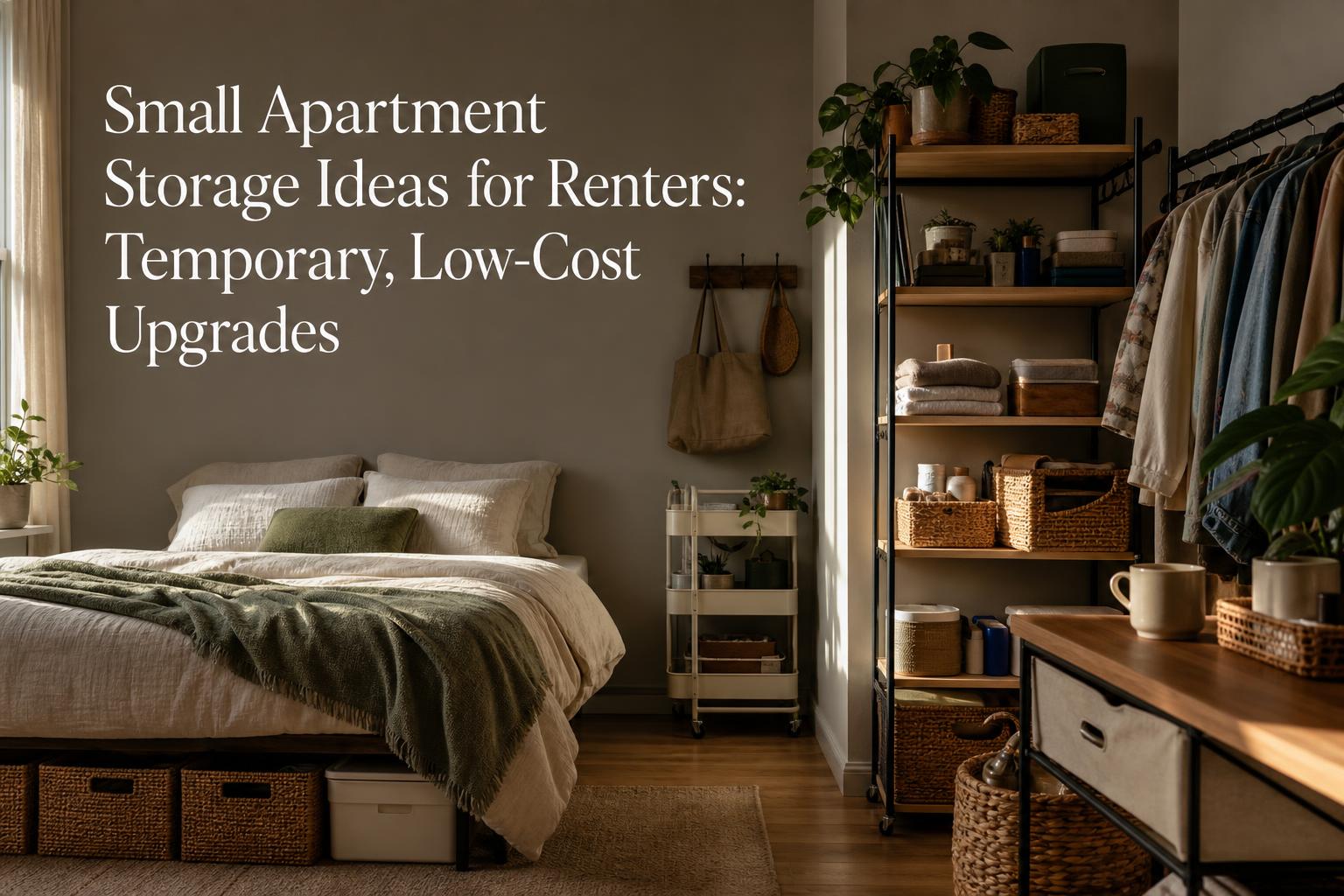
Small Apartment Storage Ideas for Renters: Temporary, Low-Cost Upgrades
The best storage upgrades for renters are no-drill, removable, and cheap: over-door hooks, under-bed bins, tension rods, and rolling carts that cost $8 to $40 once and move with you to your next apartment. Start with a free room-by-room audit of unused space (behind doors, under beds, inside cabinets, above closets), measure before you buy, and compare a one-time purchase against the recurring monthly cost of a self-storage unit. For most renters, a $30 haul solves the clutter that would otherwise drive a $100-plus monthly storage bill.
Key takeaways
- Audit unused space first (behind doors, under beds, inside cabinets, above closets) before buying anything.
- Choose no-drill, removable products: over-door hooks, tension rods, freestanding carts, and modular cubes travel between apartments.
- Measure door clearance, bed height, shelf depth, and cabinet openings so bins actually fit.
- A $8 to $40 one-time purchase almost always beats a self-storage unit's recurring monthly fee for everyday overflow.
- Check your lease before using adhesive hooks or attaching anything to painted surfaces, and respect weight limits to avoid deposit deductions.
- Organize by access frequency: rolling carts for daily items, under-bed bins for seasonal, high shelves for rarely used.
How do I add storage to a rental without damaging anything?
Add storage without damage by using tension rods, over-door hooks, freestanding carts, and stackable bins, none of which require drilling or permanent mounting. These solutions grip existing surfaces or stand on the floor, so they leave no holes and pass a move-out inspection. Before using any adhesive product, check your lease and test it on a hidden spot.
Renters on r/interiordecorating consistently ask for low-budget, non-permanent ways to make a generic apartment feel functional. The answer is to work with space you already have instead of altering the unit.
Padded over-door hooks are the safest starting point. The padding reduces scratching and dents on doors and trim, and the hooks lift off in seconds when you move out. Stick to the product's stated weight limit; a hook rated for five pounds will bend and mark the door if you hang a loaded backpack on it.
Adhesive hooks are tempting but risky. Cheap adhesive can pull paint off the wall, which turns a $4 hook into a $150 repainting charge against your deposit. If your lease permits adhesives, buy removable-strip versions, load them below their rating, and give them 24 hours to cure before hanging anything.
Warning: Many leases treat paint damage as tenant liability. Before you mount a single adhesive strip, read the clause on wall alterations. When in doubt, use tension rods and freestanding furniture that touch nothing permanently.
For a full room without any mounting at all, see our guide on how to organize a small house with no storage.
What should I do before buying storage bins?
Do two things first: run a room-by-room space audit and measure every gap you plan to fill. Renters who skip measuring end up with bins that won't slide under the bed or organizers too wide for the door. A five-minute audit turns "I have no storage" into a list of exact dimensions to shop against.
People moving into smaller apartments on r/ApartmentHacks report being buried in boxes and only finding usable space after they've settled in. A space audit finds those pockets before you buy.
Walk each room and note five measurements:
- Door clearance — the gap between the top of the door and the frame, so over-door organizers hang without jamming.
- Bed height — floor to bed-frame bottom, which caps the height of under-bed bins.
- Shelf depth — front to back on closet and cabinet shelves.
- Cabinet openings — width and height of the door gap, not the interior.
- Floor space — the footprint left for a rolling cart or cube unit.
Write these on your phone and shop against them. A 60-quart under-bed bin is useless if your frame sits six inches off the floor and the bin is eight inches tall.
Audit by access frequency too. Daily items belong in a rolling cart or open drawer within arm's reach. Seasonal items go under the bed. Rarely used items go up high or deep in a closet. Renters on r/Apartmentliving note that adding more bins doesn't help if you never sort by how often you actually reach for things.
What are the cheapest storage upgrades for renters?
The cheapest effective upgrades fall into three tiers: under $10, $10 to $25, and $25 to $40. At the low end, IKEA's SUNNERSTA container costs $0.99 and clips onto a rail or cabinet edge. At the top, IKEA's VARDÖ under-bed box runs $39.99 with a lid and four casters. Most renters solve everyday clutter for $30 or less.
Here is how current products break down by budget tier, based on 2026 pricing from IKEA U.S. and Target.
| Product | Price | What it does | Portable? |
|---|---|---|---|
| IKEA SUNNERSTA container | $0.99 | Rail, counter, or cabinet organizer | Yes |
| Brightroom 16-qt clear box with lid | $3.20 (sale) | Small stackable storage | Yes |
| Brightroom 41-qt under-bed box | $8 | Seasonal under-bed storage | Yes |
| IKEA ENUDDEN door hanger | $8.99 | Six hooks over a door | Yes |
| Brightroom fabric under-bed bin with lid | $12 | Soft under-bed storage | Yes |
| Brightroom 60-qt under-bed bin with latches | $16 | Large sealed under-bed storage | Yes |
| Brightroom 24-pocket over-door organizer | $19 | No-assembly vertical storage | Yes |
| Brightroom 3-drawer unit (6.3" high) | $32 (sale) | Rolling drawers, under-desk fit | Yes |
| IKEA VARDÖ under-bed box | $39.99 | Lidded box on four casters | Yes |
Every item here moves to your next apartment, which matters. Renters on r/IKEA say they value furnishings they can haul between neighborhoods, cities, and countries without leaving value behind.
Under-bed space is the highest-return zone in most rentals. A $16 latching 60-quart bin holds off-season clothing and bedding that would otherwise eat closet space. For more ways to exploit hidden square footage, see our 15 genius small space storage hacks that actually work.
Is renting a self-storage unit worth it for a small apartment?
For everyday overflow, no. A one-time $30 to $40 in-home storage haul replaces a self-storage unit that charges a recurring monthly fee plus insurance, often with access restrictions and promotional rates that rise after the first months. Self-storage makes sense for genuine short-term move overflow, not for items you use during the year.
The math is stark. Spend $40 once on under-bed bins and a rolling cart, and you own the solution. A self-storage unit bills you every month indefinitely, and the introductory rate frequently jumps once the promotion ends.
Consumer protections vary by facility, which is why oversight is tightening. New York City announced $1.7 million in consumer-protection funding tied to self-storage oversight in July 2026, a signal that renters should scrutinize fees, insurance requirements, and facility policies before signing. Renters on r/selfstorage specifically want clarity on what can be stored, climate-control limits, and whether a unit suits short-term overflow at all.
Cost pressure makes the in-home choice easy to justify. The Federal Reserve reported that rental costs were broadly steady over the prior year, but more renters had fallen behind on rent in 2025. When cash is tight, a $16 bin beats a $90 monthly obligation.
Tip: Rule of thumb: if you'd reach for the item more than twice a year, keep it in the apartment. Reserve self-storage for true overflow between leases, and cancel the moment you unpack.
Thinking about storage cost this way is a budgeting habit. Stashsavvy focuses on that kind of practical money education: weighing a one-time purchase against a recurring expense before you commit. A $90 monthly unit is $1,080 a year, more than half a typical U.S. monthly asking rent, which Zillow put at $1,965 in June 2026.
How can couples and roommates share storage without arguing?
Shared households cut friction by assigning zones and using labeled, portable containers instead of pooling everything into one messy pile. Give each person a rolling cart or a set of drawers, label shared bins by category, and keep the daily-use items visible so nobody has to ask where things live. Clear systems stop the "who left this here" cycle.
The common household complaint is the weekly scramble to reconcile where things are and who bought what. Physical storage mirrors the same problem money does: without a shared system, one person ends up feeling like the disorganized partner.
A three-drawer rolling cart at $32 works well as personal space in a shared room, one cart each, no negotiation. Shared categories (cleaning supplies, pantry overflow, tools) go into labeled 16-quart boxes so anyone can find and return items.
Apply the same clarity to the household budget. The friction of shared expenses eases when both people can see the plan, which is the reasoning behind envelope-style and shared budgeting tools. Stashsavvy offers practical budgeting tools built for exactly this: individuals and households setting up a simple, visible system so no one carries the whole mental load.
A worked example: a $30 studio storage plan
Consider a renter in a 400-square-foot studio with a bed frame eight inches off the floor and one shallow closet. Here is a complete plan under $30 using 2026 prices.
- Two Brightroom 41-quart under-bed boxes at $8 each = $16, holding off-season clothing and bedding in the eight-inch clearance.
- One IKEA ENUDDEN six-hook door hanger at $8.99 on the closet door for bags, coats, and towels.
- Two IKEA SUNNERSTA containers at $0.99 each = $1.98, clipped inside a cabinet for spices and small items.
Total: $26.97, one time. The same overflow in a small self-storage unit could run $70 to $100 monthly, meaning the in-home plan pays for itself in the first week and every one of those items moves to the next apartment for free.
For more compact-space ideas, our 12 minimalist storage tricks for small apartments and 14 wall storage ideas that double your space both stick to renter-safe, removable methods.
Bottom line
Fix the apartment you have before you pay for space you don't. A room-by-room audit, five key measurements, and a $30 haul of under-bed bins, door hooks, and clip-on containers solve most renter clutter, all removable and all portable. Reserve self-storage for genuine move overflow, and cancel it fast, because the recurring fee is the expensive part. With 22.7 million renter households in the U.S. as of 2024 (Harvard Joint Center for Housing Studies), the low-cost, no-drill approach is the default for good reason.
Frequently asked questions
What storage ideas work for renters who can't drill holes?
No-drill options that work well include tension rods, over-door hooks, freestanding rolling carts, stackable bins, and modular cube units. These grip existing surfaces or stand on the floor, so they leave no holes and pass a move-out inspection. Padded over-door hooks are safest for doors and trim. Freestanding and clip-on products also move to your next apartment, which makes them a better fit for renters than any built-in or mounted system.
How much should I budget for apartment storage?
Most renters solve everyday clutter for $30 or less using three tiers: under $10 (IKEA's $0.99 SUNNERSTA, $8 under-bed boxes), $10 to $25 (over-door organizers, latching bins), and $25 to $40 (rolling three-drawer carts, IKEA's $39.99 VARDÖ box). Audit your unused space and measure before buying so you don't waste money on bins that don't fit under the bed or behind the door.
Is self-storage cheaper than buying storage bins?
No, for everyday items. A one-time $30 to $40 in-home purchase replaces a self-storage unit that charges a recurring monthly fee plus insurance, often with promotional rates that rise later. A $90 monthly unit costs $1,080 a year. Reserve self-storage for genuine short-term move overflow, and cancel it as soon as you unpack. Compare both upfront and recurring costs, plus access and insurance rules, before signing anything.
Can I use adhesive hooks in my rental?
Only if your lease allows it, and even then with caution. Cheap adhesive can strip paint and trigger a repainting charge against your deposit. If permitted, use removable-strip versions, load them below their rated weight, and let them cure 24 hours before hanging anything. Tension rods and freestanding furniture are safer because they attach to nothing permanent.
What should I measure before buying under-bed storage?
Measure the clearance from the floor to the bottom of your bed frame first, since that caps bin height. Also measure the open floor length under the bed so the bin fits front to back. A 60-quart bin at eight inches tall won't slide under a frame sitting six inches off the ground. Recording these numbers on your phone before you shop prevents returns.
How do roommates or couples share storage without conflict?
Assign each person their own rolling cart or drawer set, then label shared bins by category so anyone can find and return items. A $32 three-drawer cart per person removes the negotiation over shared-room space. The same clarity helps with money: a shared, visible budget stops one partner from feeling like the disorganized one when bills or expenses slip.
Related Reading
- Small Apartment Storage Ideas That Make Studio Living Practical
- Small Bedroom Storage Ideas That Boost Sleep and Reduce Stress
- Under the Bed Storage Ideas That Maximize Small Apartment Space
- Closet Organization Alternatives When You Can’t Install Permanent Shelves
- Kitchen Storage Ideas for Small Spaces: Budget-Friendly Solutions
- Bathroom Storage Ideas With No Cabinets for Renters and Small Homes
- Closet Organization Ideas on a Budget That Actually Work
- Affordable Under Bed Storage Ideas: Bins, Drawers, and Hacks
- 16 Best RV Storage Ideas for Small Campers and Travel Trailers
- 15 Best Junk Room Storage Ideas for Small Homes