
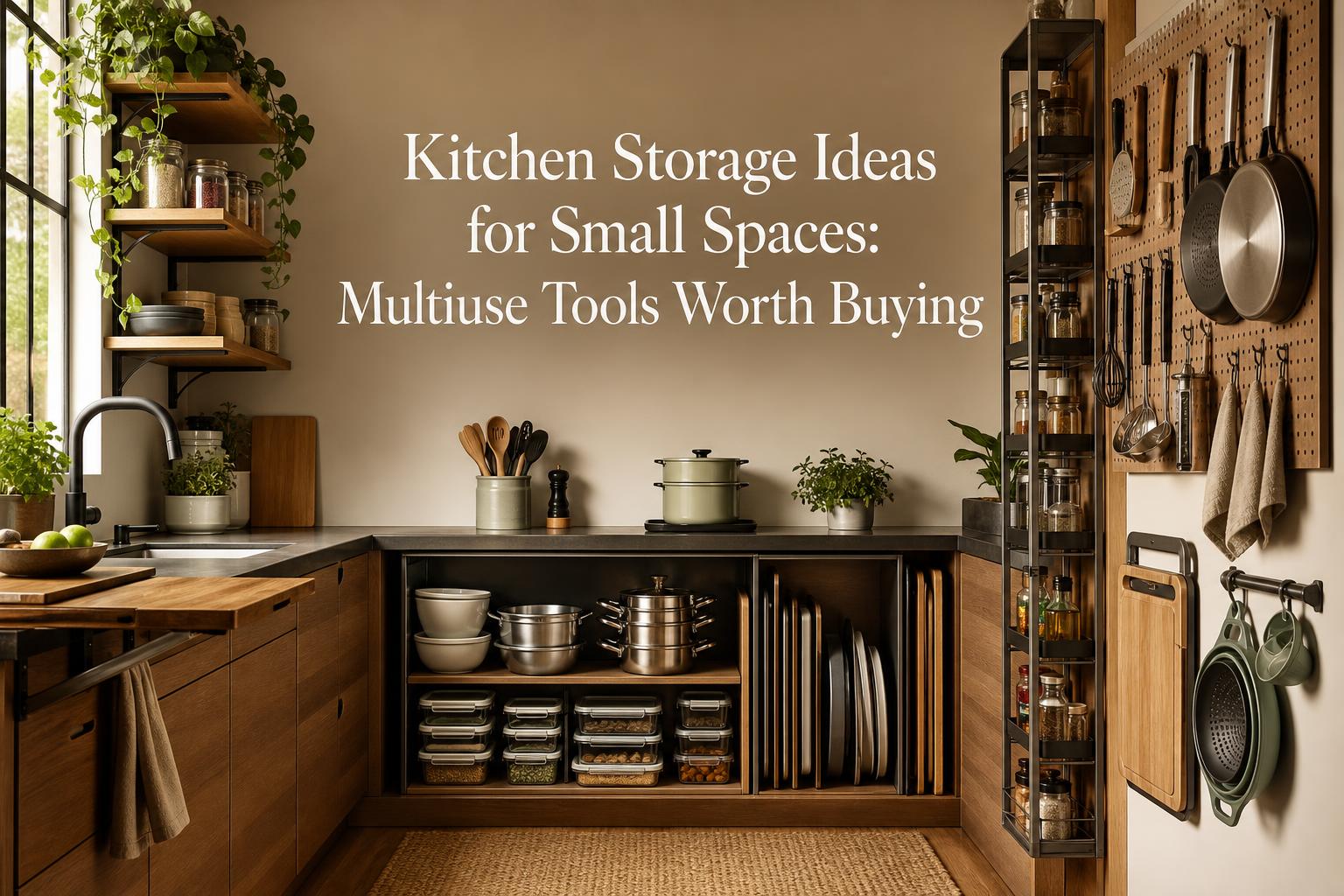
Kitchen Storage Ideas for Small Spaces: Multiuse Tools Worth Buying
Small kitchens gain the most from tools that do several jobs at once, not from buying more containers to hold single-purpose gadgets. The financial logic is simple: every tool you own costs storage space, and a multiuse item earns its keep only if it replaces at least two others you already use. For a shared household on a tight footprint, the cheapest wins come from vertical and wall-mounted storage (IKEA SUNNERSTA containers start at $0.99), followed by adjustable organizers like the OXO Deep Drawer Organizer at $39.99, and multifunction tools such as the OXO Multi-Purpose Scraper & Chopper at $14.99.
Key takeaways
- A multiuse tool should replace at least two items you already use regularly, or it just adds clutter and cost.
- Start with cheap vertical storage (wall-mounted rails, hanging containers) before spending on cabinet renovations.
- Adjustable organizers beat fixed inserts because they adapt as your pans, lids, and utensils change.
- Judge every purchase by cost per use, footprint, and whether it eliminates another buy, the same way you'd judge any recurring expense.
- 76% of renovating homeowners added a specialty built-in feature, per the Houzz 2026 U.S. Kitchen Trends Study, but you don't need one to fix a small kitchen.
- Skip novelty gadgets whose "extra" functions your household will never touch.
What makes a kitchen tool genuinely multiuse and worth buying?
A tool is worth buying when it replaces at least two things you use regularly and performs each job well enough that you keep reaching for it. Novelty gadgets fail this test: a single-task avocado tool that sits in a drawer costs you space and money for one occasional job. The rule protects both your counter and your wallet.
Apply four checks before any purchase: cost, footprint, number of functions you'll actually use, and whether it eliminates another item you'd otherwise buy or keep. A $14.99 tool that lets you throw out three cheap gadgets is a bargain. A $40 tool with one function you'll use twice a year is not.
The OXO Multi-Purpose Scraper & Chopper ($14.99) is a clean example. It portions and scrapes dough, lifts cookies, cuts brownies, and chops firm vegetables. That's four jobs from one flat tool that stores in a drawer slot. Compare it to buying a separate bench scraper, cookie spatula, and small chopper.
The OXO 3-in-1 Avocado Slicer ($11.99) combines cutting, pitting, and slicing. Whether it earns space depends on how often your household eats avocado. If it's weekly, one tool beats a knife plus a separate slicer. If it's monthly, a regular knife already does the job.
Tip: Before buying any "space-saving" gadget, name the two existing tools it will replace. If you can't name two, it's not saving space, it's using it.
Where do you store utensils and tools when the kitchen has no drawers?
Move them onto the wall. When drawers overflow or don't exist, wall-mounted rails and hanging containers clear the counter and the crowded drawer at once. People without kitchen drawers on r/kitchen repeatedly ask for exactly this, and the cheapest answer is a rail system with clip-on cups.
The IKEA SUNNERSTA container measures 4¾ × 4⅜ inches and lists at $0.99, which makes it one of the lowest-cost ways to store utensils, spices, or small tools vertically. Mount several on a rail and your spatulas, whisks, and wooden spoons leave the counter entirely.
For a sturdier option, the IKEA HULTARP container (5½ × 6¼ inches, $9.00) wall-mounts directly or clips onto a rail. It holds more weight and works for heavier tools or bunched utensils. One rail with a mix of SUNNERSTA and HULTARP containers replaces a countertop utensil crock and frees drawer space.
This approach solves a common shared-household friction. When both partners can see where every tool lives, nobody hunts through drawers or blames the other for a mess. A visible wall system is a shared system, which is the whole point when two people run one kitchen.
For more wall and vertical strategies, see our guides on 12 minimalist storage tricks for small apartments and 15 genius small space storage hacks that actually work.
Are adjustable cabinet organizers better than fixed inserts?
Yes, for most small kitchens. Adjustable organizers hold their value because your collection of pans, lids, and utensils changes over time, and a fixed insert only fits the exact items it was cut for. When you buy a new pan or ditch an old one, the adjustable system adapts and the fixed one becomes wasted space.
The OXO Adjustable Cookware Organizer ($34.99) separates pans, lids, and baking sheets upright inside a cabinet, turning a chaotic stack into vertical slots you can pull individually. Standing cookware on edge instead of nesting it saves cabinet depth and stops the daily clang of unstacking three pans to reach the bottom one.
The OXO Adjustable Deep Drawer Organizer ($39.99) does the same for utensils and tools of different sizes. The dividers move, so one drawer handles both a ladle and a set of measuring spoons without wasted gaps. This is the drawer that ends the "where did the peeler go" scramble in a shared kitchen.
Both cost more than a fixed insert, but the durability and adaptability change the math on cost per use. An organizer you keep across three different sets of cookware over a decade costs pennies per year. A fixed tray you toss when you buy new pans costs its full price again.
Warning: People on r/organizing describe spending heavily on a whole-kitchen reset, then abandoning half the products. Buy one organizer, use it for a month, and only then decide if you need another. Plan purchases in order of daily pain, not in bulk.
What are the cheapest small-kitchen storage upgrades before renovating?
Wall rails, hanging containers, stackable boxes, and one narrow shelf unit fix most small-kitchen problems for under $60 total, long before you touch cabinets. Renovation is real money: 84% of renovating homeowners upgraded their cabinets, per the Houzz 2026 U.S. Kitchen Trends Study, and 47% added pantry cabinets. Those projects run into the thousands. Storage tools run into the tens.
Stackable boxes handle pantry and drawer contents. The IKEA UPPDATERA box (9½ × 6¾ inches, $3.99) is made with at least 50% recycled polypropylene, though online orders require a minimum of two. Two boxes at under $8 group loose packets, sauces, or snacks so shared pantry items stop migrating and disappearing.
For freestanding storage in a tight footprint, the IKEA HYLLIS shelf unit (23⅝ × 10⅝ × 29⅛ inches, $22.99) gives you narrow shelving for appliances, cookware, or pantry goods. At under two feet wide, it slots into a gap beside the fridge or in a corner. Pair it with our guide on 15 genius ways to better use corner space.
The order matters. Solve visible daily clutter with cheap vertical storage first, add one adjustable organizer for the drawer that frustrates you most, then consider a shelf unit only if you still lack room. Renovation is the last resort, not the first move.
For pantry-specific ideas, see 20 dynamic food storage room ideas, and renters short on space should read 12 small apartment storage ideas.
A worked example: outfitting a shared kitchen for under $75
Two people move into a rented apartment with four drawers, one small cabinet, and no pantry. Utensils overflow, and they argue over a countertop crock and a jumble of loose spice jars. Here's a tiered plan with real prices.
Tier one, vertical storage: one IKEA rail plus four SUNNERSTA containers ($0.99 each, $3.96) and two HULTARP containers ($9.00 each, $18.00). That clears the counter of utensils and spice jars for about $22 plus the rail.
Tier two, one organizer: the OXO Adjustable Deep Drawer Organizer ($39.99) for the drawer both partners raid daily. Every tool gets a visible slot, so nobody hunts and nobody gets blamed.
Tier three, one multiuse tool: the OXO Multi-Purpose Scraper & Chopper ($14.99), replacing a bench scraper, a small chopper, and a cookie spatula the household would otherwise buy separately.
| Item | Price | Replaces / clears |
|---|---|---|
| 4× SUNNERSTA containers | $3.96 | Countertop utensil crock |
| 2× HULTARP containers | $18.00 | Loose spice jars on counter |
| OXO Deep Drawer Organizer | $39.99 | The daily "lost tool" drawer |
| OXO Scraper & Chopper | $14.99 | Bench scraper + chopper + spatula |
| Total | ~$76.94 | 3 counter piles + 3 avoided gadget buys |
The container total lands near $77, and it removes three sources of daily friction while heading off three future gadget purchases. Compare that to a cabinet renovation, and the cost-per-use case is clear.
How does small-kitchen storage connect to your household budget?
Every tool has a cost per use and an opportunity cost, the same as any purchase you'd budget for. A $12 avocado slicer used weekly costs about 23 cents per use in its first year. The same tool used twice a year costs $6 per use and occupies a drawer slot the whole time. That framing turns a kitchen decision into a budgeting decision.
Durable tools that reduce recurring costs pay back over years. A cooking-community respondent on r/Cooking described a vacuum sealer as a long-term buy that lets them purchase meat on sale instead of at full price, so the tool pays for itself through cheaper groceries. That's the strongest kind of purchase: one that lowers a recurring bill.
Replacement avoidance is where multiuse tools win. Buying one $14.99 tool that does four jobs means not buying four cheaper gadgets, each with its own price and storage cost. Fewer, more capable tools beat a drawer of single-purpose novelties on both money and space.
Applying cost per use, durability, and replacement avoidance to household purchases is the same discipline that makes budgets and savings plans work. At Stashsavvy, our practical guidance on budgeting and saving rests on exactly these principles: spend on what you'll use, avoid duplicate buys, and measure cost over time rather than at the register.
Bottom line
Fix a small kitchen with fewer, smarter buys in order of cost: wall-mounted containers under $10, adjustable organizers around $35 to $40, one narrow shelf at $22.99 if you still need room, and multiuse tools that each replace two or more gadgets. Skip novelty items and skip renovation until cheap storage runs out. Name the two tools each purchase replaces, and your kitchen and your budget both get tidier.
Frequently asked questions
What is the single most cost-effective small-kitchen storage upgrade?
Wall-mounted vertical storage. An IKEA SUNNERSTA container costs $0.99 and, mounted on a rail, moves utensils or spices off the counter and out of a crowded drawer at once. A few of them plus a rail cost under $25 and solve the most common small-kitchen complaint: no room for daily tools. Start here before spending on organizers, shelving, or cabinets.
How do I know if a multiuse kitchen tool is worth buying?
Check whether it replaces at least two tools you use regularly. The OXO Multi-Purpose Scraper & Chopper ($14.99) handles four jobs, dough portioning, scraping, lifting cookies, and chopping firm vegetables, so it earns one drawer slot in place of three gadgets. If you can't name two existing tools a purchase replaces, it adds clutter rather than saving space.
Are adjustable cabinet organizers worth the higher price over fixed inserts?
Usually yes. The OXO Adjustable Cookware Organizer ($34.99) and Deep Drawer Organizer ($39.99) cost more than fixed trays, but their dividers move to fit changing collections of pans, lids, and utensils. A fixed insert only fits the items it was cut for, so it becomes wasted space when your cookware changes. Adjustable systems last across multiple sets, lowering cost per use.
Where should I store utensils if my kitchen has no drawers?
Put them on the wall. A rail system with clip-on containers like IKEA HULTARP ($9.00) or SUNNERSTA ($0.99) holds utensils, spices, and small tools vertically. This is the most requested fix among people without kitchen drawers, and it keeps everything visible, which helps when two people share one kitchen and need to find tools without searching.
Do I need to renovate my kitchen to get enough storage?
No. Most small-kitchen problems are solved by wall rails, stackable boxes, one adjustable organizer, and a narrow shelf, for under $80 total. Renovation is expensive: 84% of renovating homeowners upgraded cabinets and 47% added pantry cabinets, per the Houzz 2026 U.S. Kitchen Trends Study. Try low-cost storage tools first and treat cabinet work as a last resort.
How does buying kitchen tools relate to managing a household budget?
Treat each tool by its cost per use and whether it avoids another purchase. A $12 tool used weekly costs about 23 cents per use in a year; used twice a year it costs $6 each time. Buying one capable tool instead of several single-purpose gadgets saves money and drawer space, the same replacement-avoidance logic that keeps any household budget lean.
Related Reading
- Kitchen Storage Ideas for Small Spaces: Budget-Friendly Solutions
- Kitchen Counter Organization Ideas to Reduce Clutter and Save Time
- Small Apartment Storage Ideas That Make Studio Living Practical
- Dollar Tree Organization Hacks for Kitchen, Bath, and Closets
- How to Organize a Pantry With Deep Shelves Without Wasting Space
- Best Small Bathroom Storage Ideas That Save Money and Space
- Pantry Organization Ideas That Cut Food Waste and Save Bills
- Pantry Organization Ideas for Deep Shelves: Zones and Clear Labels
- 16 Best RV Storage Ideas for Small Campers and Travel Trailers
- 15 Best Junk Room Storage Ideas for Small Homes