
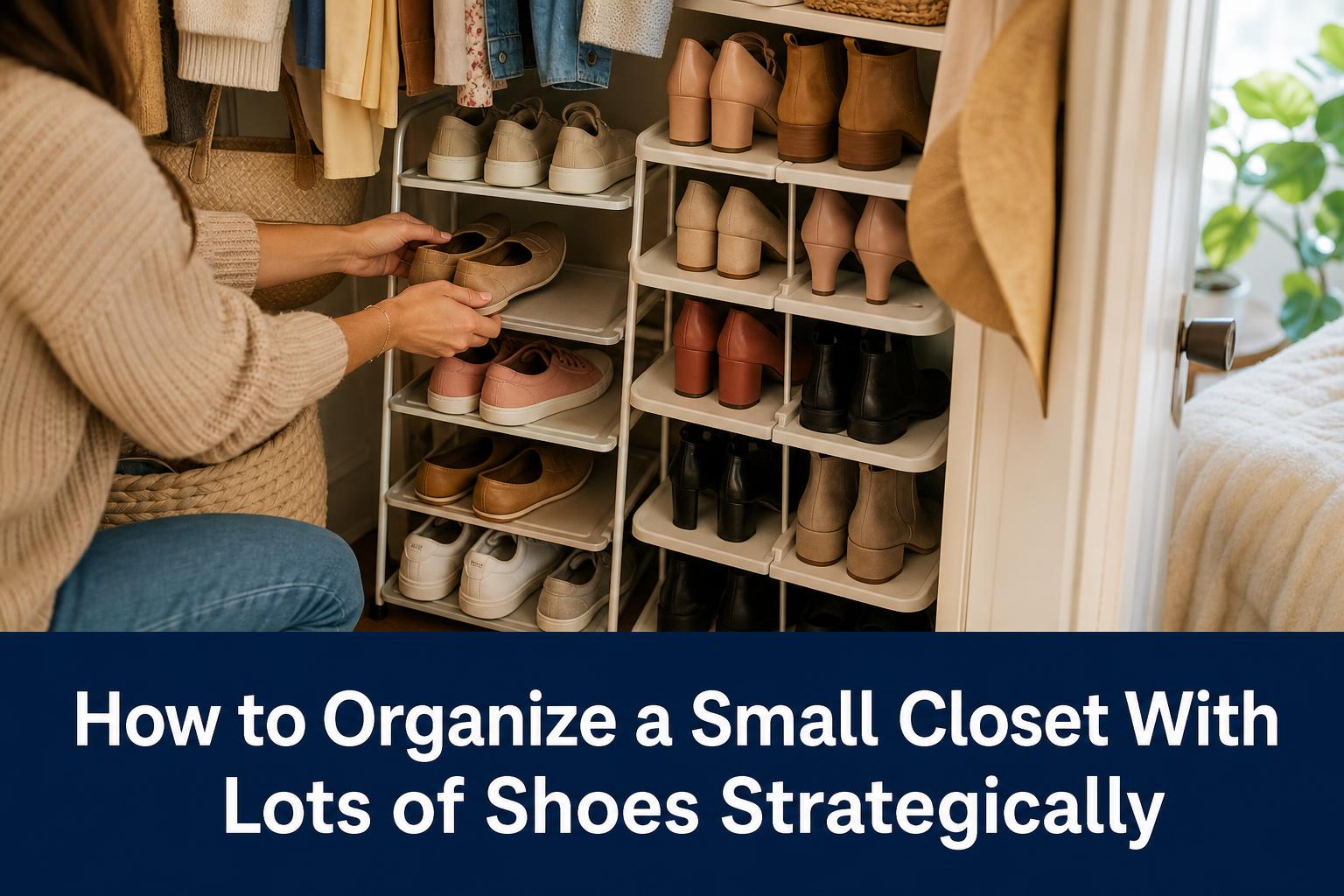
How to Organize a Small Closet With Lots of Shoes Strategically
Organizing a small closet with lots of shoes takes about 2 to 3 hours and sits at a beginner-to-intermediate difficulty. The strategic method is to measure your closet first, split shoes into daily-rotation and seasonal groups, then assign each group to the right storage format: clear open bins for the pairs you wear now, closed cabinets or lidded boxes for everything else. Done right, this stops the entryway pile, makes every pair visible so you stop buying duplicates, and it costs anywhere from about $10 in shoe boxes to $200 for a full closet kit.
This guide walks you through the measure-first approach, cost comparisons, and a hybrid layout that balances accessibility with a calm, dust-free look.
What you need before you start
A short checklist keeps this project from stalling halfway through:
- A tape measure
- Your phone (for photos and notes)
- A trash bag or donation box
- Your tallest boots and bulkiest sneakers on hand for a fit test
- A rough storage budget decided in advance
- 2 to 3 hours of uninterrupted time
Tip: Set your storage budget before you shop, not after. Deciding you'll spend $60 total forces the hybrid choices below instead of an impulse closet-system purchase you don't need.
Step 1: Measure the closet and your tallest shoe
Measure five numbers before buying anything: closet width, usable height, shelf depth, door clearance, and the height of your tallest pair standing upright. These five figures decide every product that will and won't fit.
Depth is the number people skip and regret. A shallow vertical cabinet preserves walking clearance, and IKEA's U.S. shoe cabinets run roughly 6.75 to 11.75 inches deep, with the STÄLL at 6.75 inches and TRONES at 7.125 inches. Deeper bins hold bulky sneakers and boots better but eat into the space you stand in.
Pitfall: product dimensions are not usable capacity. A box listed at 6.25 inches tall won't close over a high-top or a heel. Measure your tallest and widest pairs, then compare those numbers to the interior of any box before you buy a multipack.
Step 2: Sort every pair by frequency and height
Pull every shoe out and make two piles: what you wear this season and everything else. This split, plus grouping by height, is what turns a random pile into a plan.
Within your current rotation, group by height. Flats and sandals go in low boxes. Sneakers stack above them. Boots and high-tops need taller open storage or an open shelf, since a closed box that fits a sneaker will crush an ankle boot.
Be honest during the sort. Residents on r/organizing report that clearing shoes and bags out of a small rental makes the whole space feel noticeably larger, so the pairs you haven't worn in a year are costing you square footage.
Step 3: Build a daily-rotation zone
Reserve the most accessible spot, at eye level or near the entryway, for the pairs you wear right now. Keep this zone small and deliberate. Community members on r/organizing openly debate how many pairs belong on an entryway rack, and the honest answer is: only what one person wears in a normal week, usually 4 to 8 pairs.
A slim tilt-out cabinet works well here. Users on r/femalelivingspace describe entryways turning chaotic when sneakers, boots, and heels pile together, and a shallow tilt-out cabinet shrinks that footprint against the wall.
Tip: Give every household member a labeled zone. Shared closets fall apart when nobody knows whose shoes go where, and a named shelf ends the "who left these here" argument before it starts.
Step 4: Choose storage for each group with cost in mind
Match each group to a format, then compare cost per pair before you commit. A hybrid layout beats a single storage type: clear boxes for daily use, closed cabinets for seasonal and formal pairs.
Here's how the common options compare on current listed and dated prices:
| Storage type | Example | Listed price | Cost per pair |
|---|---|---|---|
| Fabric shoe boxes | IKEA SKUBB 4-pack | $9.99 | ~$2.50 |
| Stackable clear bins | Container Store Clearline 6-case | $89.94 | ~$14.99 |
| Shallow tilt-out cabinet | IKEA TRONES 2-pack | $39.99 | ~$20 per cabinet |
| Enclosed cabinet | IKEA BISSA (3-compartment) | $69.99 | See site |
| Full closet kit | Elfa Classic 4-Foot White | $203 (sale) | See site |
Closet-kit prices come from a January 2026 NJ.com shopping roundup and are dated promotional figures. The SKUBB box is the cheapest per pair at about $2.50, made with at least 90% recycled polyester, and carried a 4.7 out of 5 rating from 2,489 IKEA customer reviews when checked. That's retailer review data, not independent testing, so weigh it accordingly.
Fit check: four SKUBB boxes sit side by side in a 39.25-inch wardrobe frame, giving about 9.8 inches of width each. Measure your frame before assuming that count.
Step 5: Make everything visible
Use clear fronts, mesh, labels, or photos so no pair hides. Hidden inventory is why people buy shoes they already own. Sneaker collectors on r/Sneakers report that clear boxes keep even 100-plus pairs manageable because you see each pair without unpacking a stack.
Snap a phone photo of each closed box's contents and keep them in one album, or tape a label to the front. A quick digital catalog turns rarely worn pairs from invisible to searchable.
The link between visibility and spending is direct. When you can see all 30 pairs, you stop buying a fourth pair of black flats. Tracking what you own is a budgeting habit, and clear guidance on cutting duplicate spending is the kind of practical money help Stashsavvy builds its budgeting tools around.
Step 6: Store seasonal shoes out of the way
Move seasonal, formal, and delicate pairs to high shelves or under-bed storage in lidded boxes. This frees your best space for the current rotation and keeps dust off shoes you won't touch for months.
Drop-front boxes help here. The Container Store's large Everything Organizer drop-front box fits shoes up to men's size 17 and lets you grab a pair from the front without unstacking the tower. For more vertical tricks in tight spaces, see these minimalist storage ideas for small apartments.
Step 7: Set a one-in, one-out rule
Adopt a one-in, one-out rule to protect your fixed shelf and bin count. A small closet has a hard capacity. Once every box is full, buying a new pair means donating an old one, not buying another box.
Write your total pair count on a note in the closet. When you hit it, the rule kicks in. This single habit keeps the system you built today intact a year from now, and more small-space storage hacks can extend it further.
Troubleshooting
Why don't my shoes fit in the boxes I bought?
Because box dimensions aren't usable capacity. Bulky soles, heels, and high-tops need more interior room than the label suggests. Return the multipack, keep one box, and fit-test your tallest and widest pair inside it before rebuying in bulk. Open shelving handles awkward pairs better than any closed box.
The closet still looks cluttered after organizing. What went wrong?
Too much open shelving. Fully open racks look busy and collect dust. Move seasonal and formal pairs into closed cabinets or lidded boxes, and keep only your daily rotation visible. Reducing visible variety is what makes r/organizing users report their rentals feeling larger.
How many pairs should stay in the entryway?
Only what one person wears in a typical week, usually 4 to 8 pairs. More than that recreates the pile you were trying to fix. Everything else belongs inside the closet in its assigned zone.
Shallow cabinet or deeper bin, which should I pick?
Pick shallow if walking clearance is tight; a 6.75-inch STÄLL preserves floor space. Pick deeper bins if you own bulky sneakers, boots, or high-tops that won't fit a slim cabinet. Most small closets need both, which is why the hybrid layout works.
Next steps
Start with Step 1 today: grab a tape measure and record your five numbers. Buy one four-pack of shoe boxes to test fit before committing to a full system. Once your shoes are sorted and visible, apply the same measure-first logic to the rest of the closet with 21 closet organization ideas or tackle the broader room using how to organize a small house with no storage.
Frequently asked questions
How do I organize a small closet with a lot of shoes?
Measure your closet's width, height, depth, and door clearance first, then split shoes into a current rotation and seasonal pairs. Store daily shoes in clear open bins at eye level and seasonal or formal pairs in closed boxes on high shelves or under the bed. Group by height so boots get open storage and flats go in low boxes. Add labels or photos so every pair stays visible.
What is the cheapest way to store shoes in a small closet?
Fabric shoe boxes are the cheapest per pair. IKEA's SKUBB four-pack was listed at $9.99, about $2.50 per box, versus roughly $14.99 per bin for Container Store Clearline stackables. Boxes work best for flats and sneakers; taller pairs like boots and heels need open shelving instead.
Should I use open shelves or closed cabinets for shoes?
Use both. Clear or open storage suits the pairs you wear weekly because you grab them fast. Closed cabinets and lidded boxes suit seasonal, formal, and delicate footwear because they block dust and cut visual clutter. Fully open shelving alone tends to look busy and collect dust in a small space.
How many pairs of shoes should I keep in a small closet?
Keep only what fits your fixed shelf and bin count, and reserve 4 to 8 pairs for the accessible daily-rotation zone. A one-in, one-out rule stops the collection from outgrowing the space. Move everything seasonal to high or under-bed storage.
How does organizing shoes save money?
Visibility stops duplicate purchases. When every pair is in a clear box or a photo catalog, you see you already own black flats before buying more. Setting a storage budget before you shop and applying a one-in, one-out rule keeps both the closet and your spending in check.
Are shallow shoe cabinets worth it in a tiny space?
Yes, if floor clearance is your constraint. IKEA's shallow cabinets run about 6.75 to 7.125 inches deep and were listed around $20 per cabinet, preserving the space you walk in. The tradeoff is capacity: bulky sneakers, boots, and high-tops fit better in deeper bins or on open shelves.
Related Reading
- 7 Minimalist Small Closet Organization Ideas to Maximize Every Inch
- Closet Organization Ideas on a Budget That Actually Work
- Small Apartment Storage Ideas That Make Studio Living Practical
- How to Organize a Pantry With Deep Shelves Without Wasting Space
- Closet Organization Alternatives When You Can’t Install Permanent Shelves
- How to Organize a Small Closet With Lots of Clothes Fast
- Under the Bed Storage Ideas That Maximize Small Apartment Space
- Affordable Under Bed Storage Ideas: Bins, Drawers, and Hacks
- 16 Best RV Storage Ideas for Small Campers and Travel Trailers
- 15 Best Junk Room Storage Ideas for Small Homes