
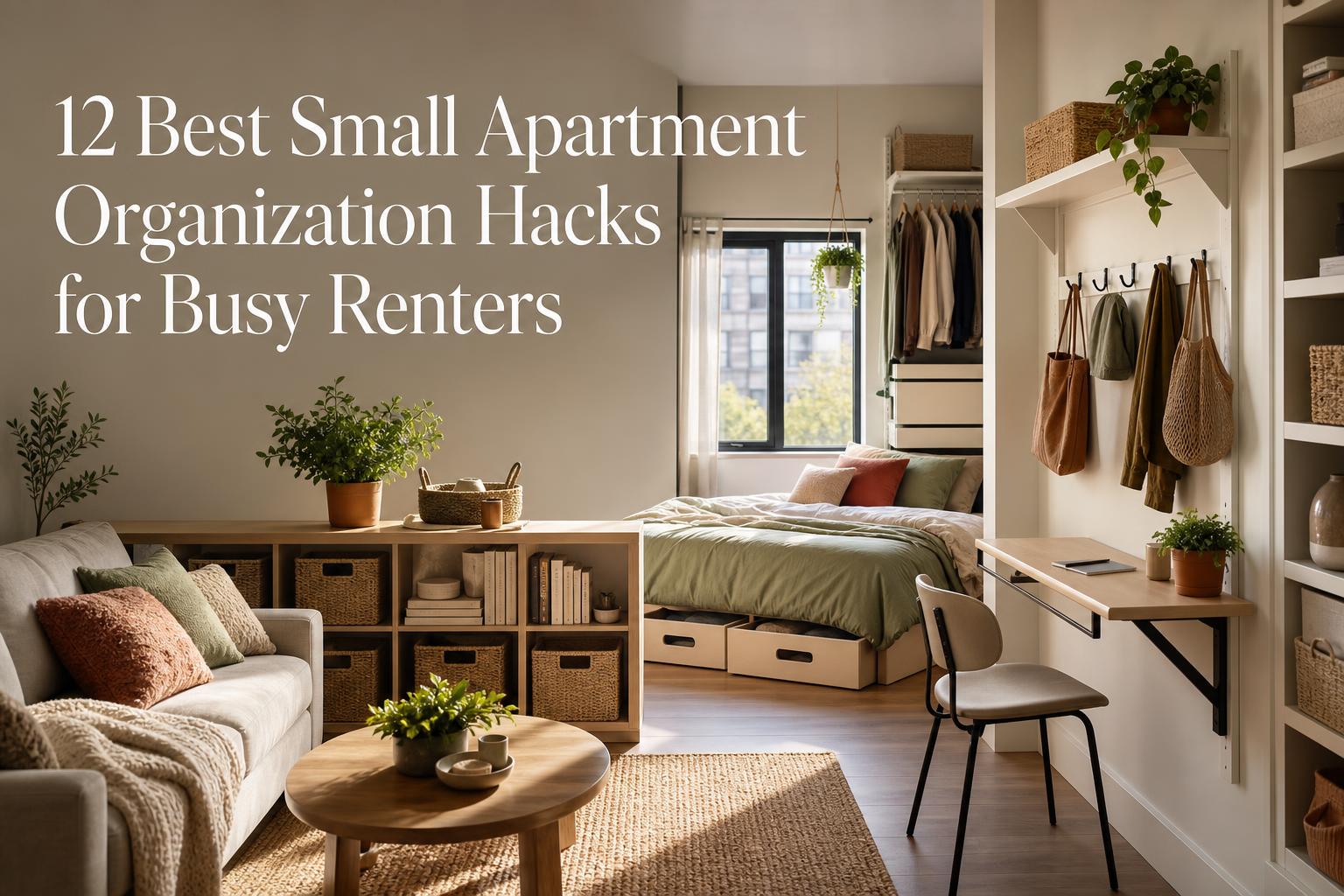
12 Best Small Apartment Organization Hacks for Busy Renters
The best small apartment organization hacks reclaim space before spending money: go vertical with tall shelving and over-door racks, zone one room into work-sleep-relax areas with freestanding units, and build an entryway drop zone for keys, shoes, and mail. Each of these costs little or nothing and survives a move. According to the Zillow Consumer Housing Trends Report 2025, 42% of renters live in homes under 1,000 square feet, so squeezing usable space out of what you have matters more than square footage you can't buy.
This ranking treats organization as a money decision. With 49% of renter households cost-burdened in 2024 (Harvard Joint Center for Housing Studies, America's Rental Housing 2026), every hack here pairs a low-cost or free method with an optional product benchmark. Nothing requires drilling, permanent changes, or a security deposit hit.
The 12 hacks at a glance
- Go vertical before buying floor furniture
- Zone one room into separate areas
- Build an entryway launch pad
- Fill dead space under the bed
- Organize by category, not by room
- Keep a portable work-from-home kit
- Add drawer dividers before another dresser
- Hang over-the-door organizers
- Run a one-in, one-out rule
- Quiet open shelving with matching bins
- Keep one catch-all basket and reset daily
- Measure everything before you buy
How these were ranked
Each hack was judged on five renter-specific criteria: upfront cost, portability (does it survive a move), maintenance effort, space reclaimed, and lease safety. Hacks that reclaim space for free or near-free ranked highest. Anything requiring drilling into shared walls or permanent modification was excluded.
Recent organization guidance favors intentional ownership and routine-based systems over aggressive one-time decluttering. That shapes this list: daily resets and drop zones beat purge-everything advice, especially for people on r/organizing who want to keep their belongings without a chaotic-looking room.
Tip: Reclaim vertical and hidden space first. Only buy storage furniture after you've measured what you actually need. With nearly half of renter households cost-burdened, a $79.99 shelf you don't need is a real cost.
At-a-glance comparison
| Hack | Best for | Standout feature | Cost |
|---|---|---|---|
| Go vertical | Tiny floor plans | Preserves walking space | $0–$79.99 |
| Zone a room | Studios | No construction needed | $0–$209.99 |
| Entryway launch pad | Daily commuters | Cuts morning steps | $0–$50 |
| Under-bed bins | Seasonal storage | Uses dead space | $10–$40 |
| Organize by category | Movers | Systems survive relocation | $0 |
| Portable WFH kit | Renters without an office | Clears the table nightly | $15–$40 |
| Drawer dividers | Overflowing dressers | No new furniture | $8–$25 |
| Over-door organizers | Bathrooms, pantries | Zero floor footprint | $10–$30 |
| One-in, one-out | Mug and tote hoarders | Free, ongoing | $0 |
| Matching bins | Open shelves | Visual calm | $20–$70 |
| Catch-all basket | Busy households | 5-minute daily reset | $0–$20 |
| Measure first | Any furniture buy | Prevents returns | $0 |
1. Go vertical before buying floor furniture — best for tiny floor plans
Vertical storage is the single highest-return move in a small apartment because it preserves the floor space you walk through. Tall bookcases, stackable cubes, over-door racks, and wall-mounted rails hold the same volume as sprawling low furniture while leaving your walkways open.
Start with what you own. Stack existing crates or move a bookshelf you already have against a wall before shopping. Height is free.
If you do buy, the IKEA KALLAX shelf unit in white (30 1/8 × 57 5/8 inches) is $79.99 as of 2026 and works as vertical storage, room zoning, or entryway storage. A narrower KALLAX (30 1/8 × 16 1/8 inches) runs $34.99 for tight corners.
Verdict: Free if you rearrange, cheap if you buy. Start here.
2. Zone one room into separate areas — best for studios
Room zoning divides a single space into sleeping, working, dining, and relaxing areas without any permanent construction. Use freestanding bookcases, curtains, open shelving, or rugs as visual dividers. A rug under a chair signals "relax here"; a shelf behind a desk signals "work here."
This matters because 40% of renter households nationwide are one-person, per Pew Charitable Trusts data from 2026, and many of those live in studios where every function shares one room.
A KALLAX unit placed perpendicular to a wall splits a studio while storing books on both sides. The four-insert KALLAX combination (57 5/8 × 43 7/8 inches) is $209.99 if you want a taller divider with concealed storage, but a $0 rug plus a curtain rod does the visual job.
Verdict: The best free way to make one room feel like several.
3. Build an entryway launch pad — best for daily commuters
An entryway launch pad is a single spot near the door for keys, bags, shoes, mail, and work items. Add a narrow shelf, a few hooks, a tray, and a vertical shoe organizer. Everything you grab on the way out lives in one place, so busy mornings lose a step.
Check door clearance before hanging anything. A tray on an existing table plus adhesive hooks costs under $15 and leaves no holes.
For a compact freestanding option, the small KALLAX (16 3/8 × 16 inches) at $24.99 fits beside a door for shoes and mail. See our dorm room storage ideas for more tight-entry setups.
Verdict: High impact for near-zero cost. Every renter should build one.
4. Fill dead space under the bed — best for seasonal storage
The space under your bed is the most underused storage in most apartments. Low-profile bins or soft cases hold seasonal clothing, spare linens, luggage, and rarely used equipment. Label containers on two sides so you can read them from any angle without pulling everything out.
Soft zippered cases cost $10 to $40 and compress when empty, which matters when you move. Rigid bins stack better if your bed sits high.
People on r/ApartmentHacks moving into smaller places often feel overwhelmed by boxes and shrinking closets. Under-bed storage recovers 10 to 15 cubic feet most renters ignore.
Verdict: Cheap, hidden, and it survives every move.
5. Organize by category, not by room — best for movers
Organizing by category means grouping all of one type of item together regardless of which room it ends up in. Keep separate containers for chargers, cleaning supplies, documents, toiletries, pet supplies, and seasonal accessories. When every charger lives in one bin, you stop hunting through drawers.
This system costs nothing if you use boxes you already own. Its real advantage shows on moving day: category bins pack and unpack faster than room-by-room chaos.
The approach also curbs duplicate buying. When all your food-storage containers sit in one place, you see you own nine lids and stop buying more.
Verdict: Free, and the only system that gets easier when you relocate.

6. Keep a portable work-from-home kit — best for renters without an office
A portable work-from-home kit puts your laptop accessories, headphones, notebook, and chargers in one basket or rolling cart you can wheel away when the workday ends. Your dining table becomes a dinner table again in 30 seconds.
A single basket costs $15 to $40. A rolling cart around $30 lets you move the whole setup between rooms and store it in a closet overnight.
This solves a specific renter problem: when there's no spare room for an office, work clutter colonizes the living space. A kit gives it a home that leaves.
Verdict: The nightly reset that keeps a one-room home livable.
7. Add drawer dividers before another dresser — best for overflowing dressers
Drawer dividers separate clothing, electronics, accessories, or kitchen tools inside drawers you already have, so you skip buying more furniture. A messy deep drawer often holds twice what it appears to once divided.
Adjustable dividers run $8 to $25. Cut cardboard or repurpose small boxes for a $0 version that works just as well.
This ranks high because it reclaims capacity without consuming floor space, the opposite of adding a dresser. For bedroom-specific layouts, see our 17 best small bedroom organization ideas.
Verdict: Try this before spending on any new storage furniture.
8. Hang over-the-door organizers — best for bathrooms and pantries
Over-the-door organizers add storage with zero floor footprint, holding pantry goods, bathroom supplies, cleaning products, shoes, or accessories. Users on r/ApartmentHacks single out the over-the-door shoe organizer as a surprisingly effective bathroom solution, its pockets holding bottles and tools instead of shoes.
Always check door clearance and the weight limit before loading one. An overstuffed organizer that stops the door closing helps no one.
Prices run $10 to $30 for most pocket organizers. No drilling, no deposit risk, and it lifts off the door when you move.
Verdict: Maximum storage per dollar in bathrooms and pantries.
9. Run a one-in, one-out rule — best for mug and tote hoarders
The one-in, one-out rule means every new item in a high-volume category replaces an old one. Apply it to mugs, water bottles, tote bags, shoes, coats, and food-storage containers, the categories that quietly multiply until a cabinet overflows.
This costs nothing and prevents the slow creep that fills a small apartment. It's a routine, not a purchase, which fits current guidance favoring ongoing systems over one-time purges.
Some X users question whether paying for external storage is worth it, calling monthly fees an expensive way to keep things you rarely use. A one-in, one-out rule attacks that problem at the source.
Verdict: Free, and it keeps working long after a decluttering weekend fades.
10. Quiet open shelving with matching bins — best for open shelves
Matching boxes, baskets, or bins make open shelving look calm by hiding visual clutter behind a uniform front. Reserve exposed shelf space for attractive or frequently used items, and box up the rest. This addresses r/organizing users who want to keep their belongings without the room looking chaotic.
The IKEA EKET cabinet (13 3/4 inches cubed) at $28.00 provides closed modular storage for visually noisy items. A four-compartment EKET runs $70.00. Matching thrift-store baskets do the same for less.
Verdict: The fix for keeping stuff without a cluttered look.
11. Keep one catch-all basket and reset daily — best for busy households
A catch-all basket is one temporary bin in a living area for items that belong elsewhere. Instead of leaving stray objects on every surface, drop them in the basket, then empty it once a day or a few times a week. The reset takes five minutes.
This ranks for busy renters because it separates tidying from putting-away. You clear surfaces instantly and sort later when you have time.
Any basket works, or buy one for under $20. The discipline is the daily empty, not the container.
Verdict: The lowest-effort routine for keeping a small home presentable.
12. Measure everything before you buy — best for any furniture purchase
Measuring first prevents the costliest small-apartment mistake: furniture that doesn't fit. Before buying modular storage, record width, height, depth, door swings, baseboards, outlets, and the delivery route. Confirm doors and drawers can open fully once the unit is in place.
This step is free and saves return trips, restocking fees, and wasted delivery days. In a home under 1,000 square feet, a few inches decides whether a cabinet works or blocks a doorway.
The IKEA KALLAX line ranges from a $24.99 single cube to a $99.99 four-drawer unit, so measuring tells you which size to buy. IKEA Family is a free membership as of 2026 and may add promotional discounts on standard prices. See IKEA's cube storage range for dimensions.
Verdict: The unglamorous step that saves the most money.
Other options considered
Peel-and-stick wall hooks and rails made the shortlist but sit inside hacks 1 and 3, since their value is vertical storage without drilling. Renting a self-storage unit was excluded on cost grounds: recurring fees turn rarely used items into a monthly expense, a point X users raise directly.
Aggressive minimalist decluttering was left off too. Current guidance and r/organizing sentiment both favor keeping what you value and building systems around it, rather than purging first and regretting later. For more low-cost ideas, browse our dollar store organization hacks and minimalist storage tricks for small apartments.
Warning: Before signing up for a monthly storage unit, add up 12 months of fees. If that total exceeds the resale value of what you're storing, the under-bed and vertical hacks above are the cheaper answer.
Where a paid tool beats a DIY fix
Most hacks here cost nothing, but two situations justify spending. If your open shelving looks cluttered no matter how you arrange it, matching closed bins like the $28.00 EKET cabinet solve a problem rearranging can't. If your dining table is your only desk, a $30 rolling work kit buys back your evenings.
Treat these as budget decisions. Stashsavvy, a personal finance education resource with practical budgeting tools, frames spending like this the same way: reclaim free space first, then buy only the storage that solves a problem you've already confirmed with a tape measure.
Frequently asked questions
What is the cheapest way to organize a small apartment?
The cheapest way is to reclaim space you already have before buying anything. Rearrange existing shelves vertically, fill the dead space under your bed, add a catch-all basket for daily resets, and run a one-in, one-out rule on mugs, totes, and containers. All four cost nothing. With 49% of renter households cost-burdened in 2024 per the Harvard Joint Center for Housing Studies, free systems that survive a move beat buying more furniture.
How do you organize a studio apartment without walls?
Zone the room with freestanding dividers instead of construction. Place a bookcase perpendicular to a wall to split sleeping from working, use rugs to mark relaxing and dining areas, and hang a curtain to hide the bed. A KALLAX shelf unit works as a divider that stores books on both sides. None of this touches shared walls or risks your deposit.
Do over-the-door organizers really work in rentals?
Yes. They add storage with zero floor footprint and no drilling, which suits rentals. Users on r/ApartmentHacks highlight the over-the-door shoe organizer as a strong bathroom solution, its pockets holding bottles and tools. Check door clearance and the weight limit first so an overstuffed organizer doesn't block the door. Most cost $10 to $30 and lift off cleanly when you move.
Should I declutter or just organize better?
For small-room residents who want to keep their belongings, build systems rather than purge aggressively. Current organization guidance favors intentional ownership and routines like drop zones, category bins, and daily resets over one-time decluttering. r/organizing users report they'd rather keep possessions and prevent chaos than throw things out. Start with a one-in, one-out rule to stop new clutter, then organize what you own by category.
Is a self-storage unit worth it for a small apartment?
Usually not for rarely used items. Add up 12 months of storage fees and compare that to the resale value of what you're storing; X users describe monthly fees as an expensive way to keep things you seldom use. Under-bed bins, vertical shelving, and a one-in, one-out rule recover space at home for a fraction of the recurring cost. Reserve paid storage for genuinely valuable items you can't fit and won't sell.
What should I organize first when moving into a small apartment?
Build your entryway launch pad and measure the space before buying furniture. A launch pad with a shelf, hooks, and a tray gives keys, shoes, and mail a home from day one, cutting daily friction. Measuring width, height, depth, door swings, and outlets prevents buying storage that won't fit, the most expensive mistake in a home under 1,000 square feet. Then fill under-bed space and zone the main room.
Related Reading
- Small Apartment Storage Ideas That Make Studio Living Practical
- Small Apartment Storage Ideas for Renters: Temporary, Low-Cost Upgrades
- Top 10 Small Bedroom Storage Ideas for More Floor Space
- 7 Minimalist Small Closet Organization Ideas to Maximize Every Inch
- Closet Organization Ideas on a Budget That Actually Work
- How to Create Hidden Storage in Small Spaces (Step-by-Step)
- Kitchen Storage Ideas for Small Spaces: Budget-Friendly Solutions
- Closet Organization Alternatives When You Can’t Install Permanent Shelves
- 16 Best RV Storage Ideas for Small Campers and Travel Trailers
- 15 Best Junk Room Storage Ideas for Small Homes