
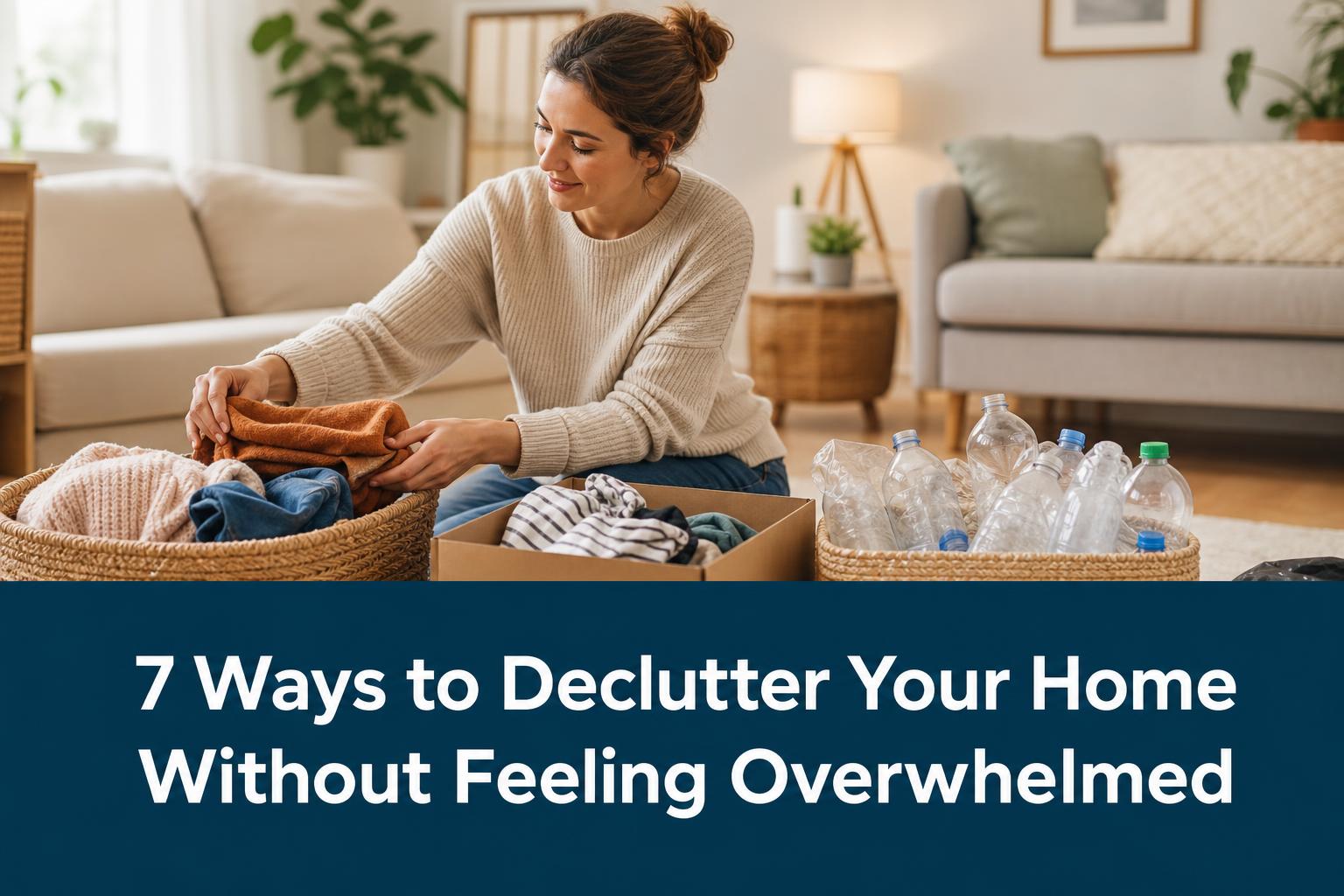
7 Ways to Declutter Your Home Without Feeling Overwhelmed
Decluttering your home without feeling overwhelmed comes down to shrinking the task: start with one small visible zone (a single drawer, not the whole bedroom), set a 10-to-20-minute timer, and follow a fixed sequence of discard, donate, relocate, then organize. The three methods with the strongest track record are the timed micro-session (best for people paralyzed by where to start), the four-container sort with a dated maybe box (best for sentimental items), and category-based decluttering (best when a room feels too big to face). Each one gives you a defined stopping point so you never open a project you can't close.
This works because the problem is rarely the clutter itself. In the YouGov Home Organization Survey (2025), 23% of U.S. adults said they simply didn't know where to start, 37% cited lack of motivation, and 37% reported difficulty letting go of things. The fix is a smaller unit of work and a clear decision rule, not a bigger cleanout.
The 7 methods at a glance
- The 10-minute timed micro-session — best for people who freeze up
- The four-container sort (keep, relocate, donate, discard) — best for fast, decisive rooms
- The dated maybe box — best for sentimental and expensive items
- Category decluttering — best when a whole room feels too large
- Reduce first, buy storage last — best for tight budgets
- The accessibility layout pass — best for aging in place and daily ease
- The close-the-loop routine — best for making progress stick
How we chose these methods
Every method here had to meet four tests: it defines a small starting point, it includes a stopping point so the session stays finite, it gives you a rule for hard decisions instead of vague encouragement, and it doesn't require spending money before you've reduced what you own. That last test matters because 61% of YouGov respondents said reducing clutter is what motivates them to organize, yet the common reflex is to buy bins first. The methods are ordered by how directly they lower the feeling of being overwhelmed.
| Method | Best for | Standout feature | Cost |
|---|---|---|---|
| Timed micro-session | People who freeze up | Finite 10-20 min endpoint | Free (phone timer) |
| Four-container sort | Decisive rooms | Physical keep/relocate/donate/discard split | Free (bags or boxes) |
| Dated maybe box | Sentimental items | 30/60/90-day review deadline | Free |
| Category decluttering | Oversized rooms | Tackles duplicates across the home | Free |
| Reduce-first budgeting | Tight budgets | No storage spend until items are cut | Free |
| Accessibility layout | Aging in place | Reach, visibility, safe lifting | Free |
| Close-the-loop routine | Making it stick | Donations and trash leave the same day | Free |
1. The 10-minute timed micro-session — best for people who freeze up
Set a timer for 10 to 20 minutes, pick one visible zone (a drawer, a shelf, a five-foot stretch of floor), and stop when the timer ends. The single biggest barrier to decluttering is scale, and a timer converts an open-ended chore into a task with edges.
This directly answers the 23% of YouGov respondents who said they didn't know where to start. You are not deciding to declutter the kitchen. You are deciding to declutter the top drawer for 10 minutes.
The endpoint matters as much as the start. Users on r/declutter describe hitting a wall after real progress, especially people managing depression, health issues, or decades of accumulation. A deliberate stop protects momentum better than a marathon that ends in burnout.
Verdict: The best entry point for anyone who's opened a closet, felt the dread, and closed it again.
2. The four-container sort — best for decisive rooms
Label four containers: keep, relocate, donate, discard. Handle each item once and drop it into a box. Sorting into physical categories stops the endless "I'll deal with this later" pile that recreates the clutter you started with.
The relocate box solves a specific trap. In Angi's 2026 Stress Cleaning Survey, 28% of people named clutter as their biggest source of anxiety, and much of that "clutter" is items sitting in the wrong room. Relocate captures them without breaking your focus to walk across the house mid-session.
Use real containers, not mental categories. Any bags or boxes work; 71% of YouGov respondents already use bins, so you likely own enough. The point is a physical destination for every decision.
Verdict: Fast and satisfying for rooms where most choices are easy. Pair it with a maybe box for the hard ones.
3. The dated maybe box — best for sentimental and expensive items
For anything you can't decide on, put it in a box, write a review date 30, 60, or 90 days out, and move on. The maybe box is a decision rule for the items that cause the most paralysis, and 37% of YouGov respondents reported difficulty letting go of things.
Forcing an instant yes-or-no on sentimental objects is where sessions stall. The maybe box removes the item from your space now and defers the emotional decision to a calmer moment. If you haven't reached for it by the review date, letting go is easier.
Tip: Slow down on expensive and sentimental items specifically. Users on r/declutter report real regret after fast downsizing, including selling furniture they later wished they'd kept. A dated review costs you nothing and prevents a decision you can't undo.
This also handles the wall that r/declutter users describe: the leftover items you want to use but rarely do. Give those the maybe box and a deadline rather than another guilt cycle.
Verdict: The single most useful tool for households where possessions carry emotional weight.

4. Category decluttering — best when a whole room feels too large
When a room is too big to face, declutter by category across the house instead: all duplicate kitchen tools, all expired toiletries, all unused cables, all worn clothing, all paper. Grouping like with like exposes how many duplicates you own, which makes discarding obvious.
This is the "group like with like" step in the Core 4 framework Ideal Home describes (remove, group, organize, maintain). Worth naming honestly: Core 4 is a practical media framework, not a clinically validated method. It works because seeing seven half-used lotions together decides itself.
Category work also reveals a spending pattern. If you keep buying phone chargers because you can't find the last one, the fix is a designated home, not a fourth charger. Our dollar store organization hacks can hold the survivors once you've cut the duplicates.
Verdict: The right move when the room is the obstacle. Cap each category session with the same 20-minute timer.
5. Reduce first, buy storage last — best for tight budgets
Follow the sequence discard, donate, relocate, then organize, and buy containers only after you know what's left. This is the cheapest method here because it prevents the most common wasted purchase: bins bought to store things you were going to throw away anyway.
The reflex runs backward for most people. In the YouGov survey, 46% cited insufficient storage as their organization challenge and 41% cited having too many belongings. Buying more storage treats the symptom; reducing belongings treats the cause, and it's free.
Stashsavvy teaches personal finance, and decluttering is a cash-flow decision as much as a tidying one. Record what you donate or sell, and set a firm budget before buying any organizer.
Warning: Storage containers are the item most likely to become clutter themselves. Measure your space and count your remaining items before buying. If you must shop, our [IKEA organization hacks](https://stashsavvy.com/19-ikea-hacks-to-keep-things-organized/) stretch a small budget further than premium bins.
Verdict: Non-negotiable for anyone on a budget. Reduce, then decide if you even need to buy anything.
6. The accessibility layout pass — best for aging in place
Put frequently used items where they're visible and easy to reach, place rarely used items farther away, and store heavy items where they can be lifted safely. Decluttering for appearance alone misses the point; a tidy home that's hard to use gets messy again.
The demand for this is measurable. In the Houzz 2026 U.S. Kitchen Trends Study, 53% of renovating homeowners addressed current or future special needs. The same logic applies without a renovation: reach and visibility beat symmetry.
This also answers the 66% of YouGov respondents who organize so they can find things easily. If daily items live at eye level and arm's reach, you spend less energy maintaining order. Heavy or seasonal items belong on lower shelves or in under-bed storage where lifting is safe.
Verdict: The layout pass that turns a decluttered room into one that stays functional.
7. The close-the-loop routine — best for making it stick
End every session by taking donations to the car or drop-off, putting trash outside, returning misplaced items to their rooms, and noting anything you moved into storage. Removing clutter and relocating clutter are different things; the loop makes sure items actually leave.
r/declutter users note a real trap: you clear surfaces, but the home still isn't easy to clean because items lack designated homes or get re-cluttered. The close-the-loop step assigns a home to what stays and physically removes what goes.
Record donations for your own tracking, and note resale outcomes if you sell. A small home with limited storage especially benefits from this discipline, since there's no spare room to absorb an in-between pile.
Verdict: The step that separates a decluttered week from a permanently decluttered home.
Do you need a decluttering app?
Most households don't. Only 3% of YouGov respondents reported using a home-organization app, and a phone timer, notes app, spreadsheet, donation-receipt folder, and labeled bags cover every method above at no cost. That said, two paid tools serve specific needs.
| Tool | Best for | Standout feature | Price (2026) |
|---|---|---|---|
| Free stack (timer + bags + notes) | Most households | Zero cost, no learning curve | $0 |
| Clutterfree | People who want a guided plan | Step-by-step roadmap, daily challenges | 14-day free trial, then $3.99/mo |
| Sortly | Detailed visual inventories | Photo inventory for valuables, garages, storage | Free plan (up to 100 items); Advanced $49/mo standard, $24/mo promo annual |
Clutterfree offers a personalized roadmap, progress tracking, donation documentation, and daily challenges after its 14-day free trial, then $3.99 per month. It suits people who freeze without structure.
Sortly is inventory software, not a decluttering coach. Its Free plan handles up to 100 items; its Advanced plan lists at $49 per month standard, with the official page showing $24 per month promotional annual pricing (Sortly says the 50% discount applies to the first year for new customers). Higher tiers run to $149 and $299 per month standard. For ordinary decluttering, Sortly is overkill. It earns its cost only when you need a photographed record of collectibles, valuables, or a full storage unit.
Other options considered
Envelope-style budgeting, popularized by tools like Goodbudget, adapts well to decluttering: set spending limits for storage, replacement purchases, and donations before you buy anything. It's a good add-on to method five for people who overspend on organizers.
Whole-home cleanout challenges get shared widely but fail the overwhelm test. They have no small starting point and no stopping point, which is exactly why r/declutter users describe hitting a wall partway through.
For rooms that have become dumping grounds, a category-first approach beats a blitz. See our junk room storage ideas and garage organization ideas for space-specific follow-through once the reducing is done.
Frequently asked questions
How do I declutter my home without getting overwhelmed?
Shrink the task. Pick one visible zone like a single drawer, set a 10-to-20-minute timer, and stop when it ends. Sort into four containers labeled keep, relocate, donate, and discard, and put anything you can't decide on into a dated maybe box. The overwhelm comes from facing the whole home at once; a small zone with a fixed endpoint removes it. In the YouGov 2025 survey, 23% of people said not knowing where to start was their main obstacle.
Where should I start decluttering first?
Start with the smallest visible, high-traffic zone, not a closet or a whole room. A countertop section, a single drawer, or a five-foot stretch of floor gives you a fast, visible win in under 20 minutes. Visible progress builds momentum, which matters because 37% of YouGov respondents cited lack of motivation as their challenge. Save large storage areas and sentimental categories for after you've practiced the process on easy zones.
Should I buy storage bins before or after decluttering?
After. Follow discard, donate, relocate, then organize, and buy containers only once you know what remains. Buying bins first is the most common wasted purchase, since 41% of YouGov respondents already own too many belongings and 46% blame insufficient storage. Reduce the volume first, then measure your space and buy only what's needed. Storage bought too early often becomes clutter itself.
What do I do with sentimental items I can't decide on?
Put them in a maybe box with a review date 30, 60, or 90 days out, then move on. This removes the item from your space now and defers the emotional decision to a calmer moment. If you haven't reached for it by the deadline, letting go is easier. This directly helps the 37% of YouGov respondents who reported difficulty parting with things. Go slow on expensive items too, since fast downsizing often causes regret.
Do I need a paid app to declutter?
No. Only 3% of people report using a home-organization app, and a free stack covers everything: a phone timer, a notes app or spreadsheet, a donation-receipt folder, and labeled bags. Paid tools like Clutterfree ($3.99/month after a 14-day trial) add a guided roadmap if you freeze without structure, and Sortly's free plan tracks up to 100 items for visual inventories. For ordinary decluttering, the free tools are enough.
How do I keep clutter from coming back?
Close the loop after every session and give every kept item a designated home. Take donations to the car or drop-off, put trash outside, return misplaced items, and note anything moved to storage the same day. Relocating clutter within the house isn't decluttering. r/declutter users note that homes stay messy when items lack homes or get re-cluttered, so maintenance and reset routines matter as much as the initial purge.
Related Reading
- 7 Minimalist Small Closet Organization Ideas to Maximize Every Inch
- Kitchen Counter Organization Ideas to Reduce Clutter and Save Time
- How to Create Hidden Storage in Small Spaces (Step-by-Step)
- 12 Best Small Apartment Organization Hacks for Busy Renters
- Closet Organization Ideas on a Budget That Actually Work
- Small Apartment Storage Ideas for Renters: Temporary, Low-Cost Upgrades
- Small Bedroom Storage Ideas That Boost Sleep and Reduce Stress
- Small Apartment Storage Ideas That Make Studio Living Practical
- 16 Best RV Storage Ideas for Small Campers and Travel Trailers
- 15 Best Junk Room Storage Ideas for Small Homes