
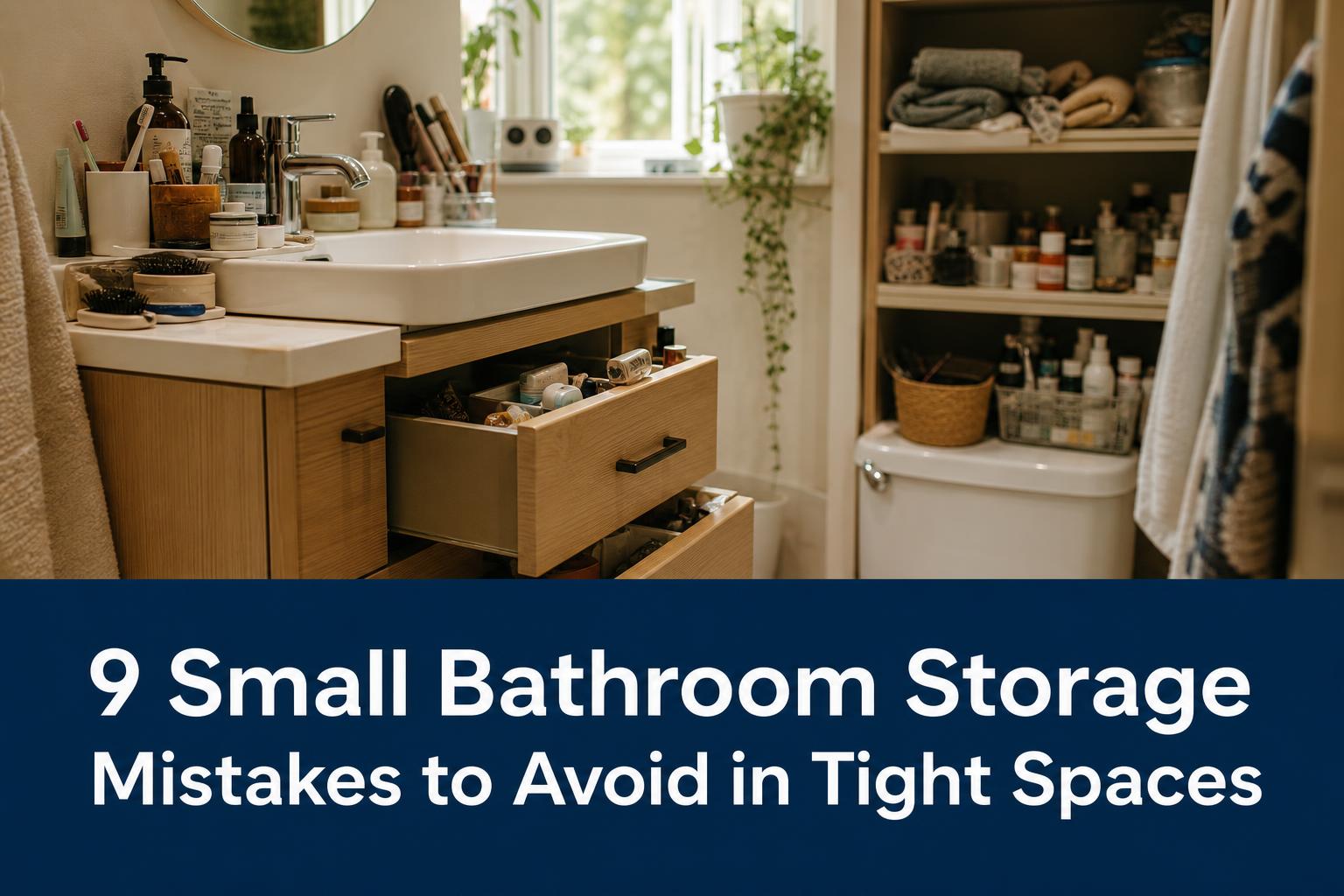
9 Small Bathroom Storage Mistakes to Avoid in Tight Spaces
The most common small bathroom storage mistake is buying floor-standing units when the walls are empty, followed by skipping clearance measurements and defaulting to open shelving for everything. Each error costs money twice: once on the product that doesn't fit, and again on the replacement. Below are the nine mistakes that trip up couples and renters most, each paired with a fix and a current product example with dimensions and a price checked August 21, 2026.
According to the 2026 U.S. Houzz & Home Study, 33% of surveyed homeowners bought storage or organizational products, and 54% renovated in 2025. A guest-bathroom renovation carried a median spend of $7,000 last year, up 16.7% year over year. In a room that small, a wrong purchase or an over-eager remodel is expensive. Measuring first is the cheapest fix on this list.
The 9 small bathroom storage mistakes at a glance
- Using floor space when the walls are empty
- Skipping clearance measurements
- Choosing open shelving for everything
- Ignoring vertical storage
- Assuming the space above the toilet is usable
- Buying a "slim" cart without checking actual depth
- Using adhesive organizers for heavy or wet items
- Forgetting anti-tip protection
- Designing around shelf capacity instead of daily routines
How these mistakes were ranked
The order reflects how often each error forces a return or a redo, and how much floor space it wastes. Three criteria did the sorting: fit (does it survive a real clearance check), stability (adhesive, freestanding, or anchored), and usability (does storage match how you actually use the room, not just how many shelves it has).
Prices below are retailer listings checked August 21, 2026, and they change. No single product fits every bathroom. Record your maximum acceptable width, depth, and height, then buy something smaller than all three.
At-a-glance comparison
| Fix | Best for | Standout feature | Price (Aug 2026) |
|---|---|---|---|
| RiverRidge Ashland wall cabinet | Freeing floor space | Wall-mounted, 10 lb per shelf | $41.99 |
| IKEA VESKEN cart | Renters, narrow gaps | 7.125 in deep | $17.99 |
| IKEA NYSJÖN high cabinet | Vertical storage | 11.75 in wide, 74.75 in tall | $69.99 |
| Home Depot Glacier Bay Slat over-toilet | Above-toilet zone | 9.5 in deep, 64.5 in tall | $50 |
| Costway Slim Storage Cabinet | Mixed storage + anti-tip | Drawer, shelves, anti-toppling device | $64.99 (was $116.99) |
| Fenbeli corner cabinet | Awkward corners | 22 lb per shelf, anti-tip device | See site |
| IKEA HEMNES cabinet, mirror door | Concealed storage | Mirror door, 78.75 in tall | $199.99 (was $339) |
1. Using floor space when the walls are empty — the costliest default
The most wasteful move is parking a unit on the floor while four walls sit bare. In a bathroom shared by two people, floor clutter is what starts the "who left this here" arguments. Wall storage keeps daily items visible and off the ground, which the r/organizing community links to actually finding your things.
The RiverRidge Ashland wall cabinet was listed at $41.99, measures 16.5 inches wide by 7 inches deep, and supports up to 10 pounds per shelf. Its shallow depth means it won't block a narrow walkway. Mount it above the toilet or beside the mirror.
Verdict: for a tight room, the first storage you buy should hang on a wall, not stand on the floor.

2. Skipping clearance measurements — why the "fits perfect" cart doesn't
Skipping measurements is why a cart that looked ideal online blocks the door swing at home. A clearance check takes ten minutes and prevents a return. Measure every obstruction before you buy, not the empty space alone.
Your clearance checklist:
- Width, depth, and height of the gap
- Door swing arc
- Toilet-tank height and lid-removal room
- Flush-handle and shutoff-valve access
- Sink and vanity projection
- Baseboard depth
- Walking clearance
- Outlets, switches, and plumbing access
- Wall-anchoring requirements
Tip: Write down your three limits (max width, max depth, max height), then only consider products smaller than all three. A label reading "slim" or "small-space" is marketing, not a measurement.
Verdict: the tape measure is free. The second cart isn't.
3. Choosing open shelving for everything — clutter with extra steps

All-open shelving turns a small bathroom into a display of half-used bottles. Open storage suits items you grab daily. Everything else looks like clutter and collects dust. A mixed plan is more functional.
The working split: open storage for frequent-use items, bins or drawers for small products, closed cabinets for backup supplies, and dedicated homes for cleaning products and medications. The Target Costway Slim Storage Cabinet (listed at $64.99, down from $116.99) combines open shelves, a drawer, and a rolling cart in an 18-by-8-by-45-inch footprint, with an anti-toppling device included.
Verdict: reserve open shelves for the ten things you touch every morning. Hide the rest.
4. Ignoring vertical storage — the empty air above eye level

The space between eye level and the ceiling is the most-ignored square footage in any bathroom. A tall, narrow cabinet turns that dead air into backup storage without eating floor space. According to the 2026 NKBA Bath Trends Report, 89% of respondents named space allocation a top priority.
The IKEA NYSJÖN high cabinet was listed at $69.99 and measures 11.75 inches wide by 74.75 inches high. It stores a lot on a footprint under a square foot. For more ideas on stacking upward, see 12 Minimalist Storage Tricks for Small Apartments.
Verdict: go up before you spread out.
5. Assuming the space above the toilet is usable — check the tank first
The area above the toilet is not automatically usable. Homeowners on r/interiordecorating debate freestanding versus recessed over-toilet units precisely because tank height, lid removal, and flush-handle clearance vary. A unit that blocks tank access is a plumbing headache waiting to happen.
Two verified options: the Home Depot Glacier Bay Slat Style unit was listed at $50 (24 by 9.5 by 64.5 inches), and the taller Glacier Bay Shaker unit was listed at $119 (26.7 by 10.1 by 68 inches). The Walmart Capri four-tier shelf was listed at $49.99, down from $89.99, with 2,332 reviews. Confirm the legs straddle your toilet and leave lid clearance.
For placement details, see 17 Audacious Over the Toilet Storage Ideas You Haven't Seen Before and 16 Brilliant over the toilet storage ideas for Tiny Bathrooms.
Verdict: measure from the tank, not the floor.

6. Buying a "slim" cart without checking actual depth
"Slim" and "skinny" are labels, not dimensions. The Target Brightroom Skinny Storage Cart, listed at $50, has shelves only 6 inches wide, so check usable shelf width rather than trusting the name. A cart that's slim front-to-back may still be wide side-to-side, or its shelves may hold less than the profile suggests.
Two carts with verified depth for a real gap: the IKEA VESKEN cart was listed at $17.99 at 7.125 inches deep, and the Target Brightroom Narrow Rolling Cart with accessories was listed at $16 (regular $20) at 7.48 inches deep, with three shelves, hooks, and four casters. Current narrow-cart listings run roughly $16 to $50 at Target and $17.99 to $39.99 for several IKEA carts.
Verdict: buy the depth number, not the adjective.
7. Using adhesive organizers for heavy or wet items
Adhesive organizers fail with weight and moisture. Renters on r/ApartmentHacks want no-drill options, and that's fair, but an adhesive shelf holding shampoo bottles in a steamy shower is a fall risk. Condensation, textured tile, grout lines, and poor surface prep all contribute to failure.
The Walmart adhesive over-the-toilet shelf was listed at $12.39 and requires no drilling, but the listing had a single rating and no evidence of long-term heavy-duty performance. Limit adhesive mounts to light, dry items unless the manufacturer gives a credible load rating.
Warning: For anything wet, heavy, or holding glass, choose a freestanding, tension-mounted, or wall-anchored option instead of adhesive. A shelf that lets go over a hard floor is a safety problem, not a storage one.
Verdict: adhesive is for toothbrushes, not for detergent jugs.
8. Forgetting anti-tip protection — a real hazard with tall units
Tall, narrow cabinets tip. Anchor them per the manufacturer's instructions, especially in homes with children, pets, or anyone who might grab the unit for balance. The 2026 NKBA report found 32% of respondents call aging in place already mainstream and another 48% say it's becoming mainstream, so grab-and-steady safety matters more each year.
Look for products that ship with hardware. The Fenbeli corner cabinet listing measured 7.5 by 7 by 31.5 inches, rated 22 pounds per shelf, and included an anti-tip device. The Lowe's Fenbeli slim cabinet was listed at $40.99 with an anti-tipping kit and roughly an 8-by-7-inch footprint. The Costway Slim Cabinet also ships with an anti-toppling device.
Verdict: a tall cabinet you didn't anchor is furniture waiting to fall.
9. Designing around shelf capacity instead of daily routines
The last mistake is buying storage by the shelf count instead of by how you use the room. More shelves don't help if your morning items and your backups are jumbled together. Group storage by routine: morning grooming, showering, hair tools, makeup, first aid and medication, toilet-paper backups, cleaning supplies, towels, and laundry.
This matters most in a shared household. When each person's daily items have a designated home and backups live in a closed cabinet, the weekly "where's the reconciliation of who bought what" scramble shrinks. Thinking about storage as a system, not a shelf, is the same discipline that keeps a household budget from drifting. Stashsavvy, which teaches practical budgeting and savings habits, frames the parallel plainly: measure before you spend, and buy for how you actually live.
Verdict: match locations to routines first, then count shelves.
Other options considered
The IKEA HEMNES high cabinet with mirror door was listed at $199.99, reduced from $339 through September 2, 2026 while supplies lasted. At 19.25 inches wide, 12.25 deep, and 78.75 tall, it combines concealed storage with a mirror, a strong pick if you have the wall and the budget. It's the better choice when appearance carries as much weight as capacity, which r/HomeDecorating users say it often does.
For rooms with no obvious storage wall at all, start with How To Organize a Small House With NO Storage before buying anything.
Frequently asked questions
What is the biggest small bathroom storage mistake?
Using floor space while the walls sit empty. Floor-standing units block walkways and start clutter in a room that has none to spare. Wall-mounted cabinets like the RiverRidge Ashland ($41.99, 7 inches deep) keep daily items reachable without eating floor area. Hang storage first, and only add a floor unit if the walls are genuinely full.
How do I measure a bathroom before buying storage?
Record the width, depth, and height of the gap, then check every obstruction: door swing, toilet-tank height and lid removal, flush-handle and shutoff-valve access, sink projection, baseboard depth, walking clearance, and outlets. Write down your three maximum limits and buy a product smaller than all three. This ten-minute check prevents the most common return.
Are adhesive bathroom organizers safe for a shower?
Only for light, dry items. Condensation, textured tile, grout lines, and heavy or wet containers cause adhesive mounts to fail. The $12.39 Walmart adhesive shelf requires no drilling but had one rating and no proven heavy-duty performance. For shampoo, glass, or anything over a hard floor, use a freestanding, tension, or wall-anchored option instead.
Do I need to anchor a tall bathroom cabinet?
Yes, if it's tall and narrow, especially with children, pets, or anyone who might lean on it. Anchor per the manufacturer's instructions. Choose units that include hardware, such as the Fenbeli corner cabinet (22 lb per shelf, anti-tip device included) or the Costway Slim Cabinet with its anti-toppling device.
What are the best no-drill storage options for renters?
Narrow rolling carts and over-the-toilet units that need no wall damage. The IKEA VESKEN cart ($17.99, 7.125 inches deep) and Target Brightroom Narrow Rolling Cart ($16, 7.48 inches deep) slide into tight gaps. Freestanding over-toilet units like the Glacier Bay Slat Style ($50) add height without drilling. Check depth against your actual gap first.
How should couples organize a shared bathroom to stop arguments?
Give every category a designated home and separate daily items from backups. Group by routine, morning grooming, showering, hair tools, makeup, first aid, toilet-paper backups, and cleaning supplies, using open shelves for daily use and closed cabinets for backups. When items have fixed homes, the weekly scramble to figure out who used or bought what largely disappears.
Related Reading
- Bathroom Storage Ideas With No Cabinets for Renters and Small Homes
- Best Small Bathroom Storage Ideas That Save Money and Space
- Quick Bathroom Storage Ideas With No Cabinets for Tight Bathrooms
- Small Apartment Storage Ideas for Renters: Temporary, Low-Cost Upgrades
- Top 10 Small Bedroom Storage Ideas for More Floor Space
- Kitchen Storage Ideas for Small Spaces: Budget-Friendly Solutions
- 12 Best Small Apartment Organization Hacks for Busy Renters
- How to Create Hidden Storage in Small Spaces (Step-by-Step)
- 16 Best RV Storage Ideas for Small Campers and Travel Trailers
- 15 Best Junk Room Storage Ideas for Small Homes