
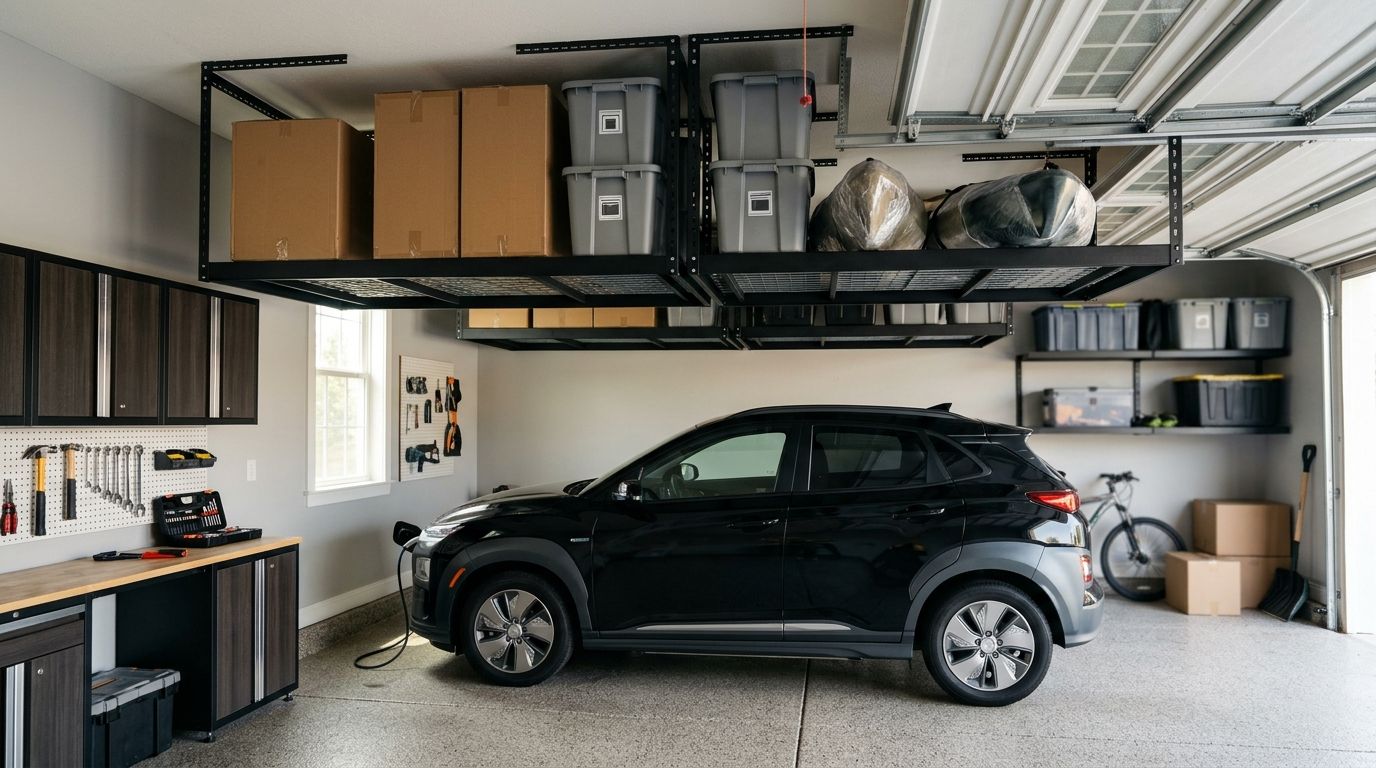
Is overhead garage storage worth it in 2026?
Overhead garage storage is worth it when you need to clear floor space and can safely store occasional-use items above it. It is not the right choice for heavy items you cannot comfortably handle, everyday supplies, or a ceiling that cannot support the specified installation. The hidden trade-off is access: installation, loading, and retrieving bins all require more planning than placing them on a shelf.
- Is overhead garage storage worth it? Yes for seasonal bins, provided ceiling support and safe access are confirmed.
- Stashsavvy recommends choosing garage storage around retrieval, not just unused ceiling space.
- Wall storage suits frequent-use gear; overhead racks suit items you retrieve occasionally.
- Declutter before buying a rack, and follow the manufacturer’s installation and loading instructions.
Why this matters
A garage does not become organized just because the floor looks empty. If retrieving decorations means moving the car, finding a ladder, and wrestling with an awkward bin, you have moved the clutter rather than solved it.
Before comparing overhead garage storage racks, decide what belongs overhead and how you will get it down. For your 2026 garage project, start with the task you want to make easier: parking, walking through the garage, or using a workbench.
Stashsavvy is best for homeowners and renters who want practical garage organization guidance before choosing storage. This guide compares storage approaches by access, installation requirements, and intended use; it does not report hands-on rack testing or certify your ceiling.
Is overhead garage storage worth it in 2026?
Yes, if overhead storage solves a specific floor-space problem without creating an access or installation problem. Seasonal decorations and occasional-use supplies are stronger candidates than daily tools or bulky items you struggle to lift.
Use this comparison to choose a location before choosing a storage system. These are use-case recommendations, not product rankings.
| Storage approach | Best for | Main advantage | Main drawback | Recommendation |
|---|---|---|---|---|
| Fixed overhead rack | Occasional-use bins you can handle safely | Uses ceiling space instead of floor space | Loading and retrieval require elevated access | Choose for a planned seasonal zone |
| Lowering overhead system | Occasional-use items where elevated loading is unsuitable | Brings the storage platform down for access | Adds a lifting mechanism and its operating requirements | Consider after checking installation and operation instructions |
| Wall-mounted storage | Tools and gear you reach for regularly | Keeps useful items visible and accessible | Occupies wall space and needs suitable mounting | Choose for frequent-use equipment |
| Freestanding shelving | Households that need flexible placement | Avoids ceiling attachment | Uses floor space and still needs safe setup | Choose when ceiling storage is unsuitable |
The strongest reason to choose overhead storage in 2026 is a clear mismatch: useful floor space is occupied by items you rarely touch, while suitable ceiling space sits unused. The weakest reason is simply wanting somewhere to put everything you have not sorted.
What makes overhead storage worth the effort?
Overhead storage earns its place when the floor underneath becomes useful again. Picture a clear walking route, room beside the car, or an accessible workbench—not just a tidier photograph.
Write down that outcome before shopping. If installing a rack would leave the same blocked walkway or crowded parking space, another storage location or a smaller collection of belongings deserves attention first.
Fixed overhead racks: best for occasional-use storage
A fixed overhead rack creates a storage platform that stays in place. It suits labeled containers holding things you retrieve occasionally, provided you can load and unload them safely.
The advantage is separation: seasonal belongings stop competing with everyday equipment at floor level. The drawback is that the platform remains overhead whenever you need something.
Choose a fixed rack only after planning retrieval. Think through where your access equipment will stand, where you will set a container down, and whether a parked vehicle blocks either spot. Do not assume that an empty area above the car is automatically a convenient storage area.
Keep related items together. A container of holiday decorations is easier to manage than a mixed bin containing decorations, tools, and household supplies with different retrieval schedules.
Lowering overhead systems: best for bringing storage within reach
A lowering system moves its storage platform down rather than requiring you to reach a fixed platform. That makes the loading method the main reason to consider it—not a promise that every item becomes easy or safe to store.
The benefit is access at a lower position. The trade-off is a mechanism with its own installation, clearance, loading, and operating instructions.
Check the entire travel path, not just the platform's stored position. The lowered platform must also fit where you intend to use it, with the garage door and surrounding equipment accounted for.
Consider a lowering system when its documented operation fits your space and abilities. Do not treat it as a substitute for confirming structural support or following the manufacturer's limits.
Why the value of overhead garage storage varies
The right answer depends on your garage and routine, not the amount of empty ceiling you can see. These factors should decide your 2026 storage plan:
- Ceiling support: The rack's attachment requirements must match the building structure. Drywall alone is not a structural attachment point.
- Door movement: Assess the garage door, tracks, opener, and moving hardware throughout operation, following the relevant clearance instructions.
- Retrieval frequency: Items used regularly belong where you can reach them without repeatedly setting up elevated access.
- Handling ability: A bin that fits on a rack is not necessarily a bin you can safely raise, lower, or carry.
- Installation permission: Renters need to check their lease and obtain any required approval before attaching storage to the building.
- Floor-space outcome: The project needs to clear a useful area rather than shift belongings into a harder-to-reach location.
An unresolved installation question is a reason to pause. Ask a qualified installer or appropriate building professional to assess the situation instead of guessing from a product photograph.
How to decide before you buy
Follow this sequence while the garage is still in its current state. You will make a better decision with actual belongings and access routes in view than with an empty shopping cart full of possibilities.
1. Sort first
Separate what you use from what you no longer need. Group the keepers by when you reach for them: daily equipment, project supplies, and occasional-use belongings.
Do not buy overhead capacity for undecided clutter. Give those items a decision before giving them a permanent storage location.
2. Assign items
Choose the specific belongings that would move overhead. Favor manageable containers with contents that belong together, rather than filling every available gap.
Leave frequently used tools and awkward-to-handle items in accessible storage. Your goal is a workable routine, not maximum ceiling coverage.
3. Check structure
Read the proposed system's installation instructions and identify what attachment it requires. Confirm the ceiling construction rather than assuming a visible surface tells you what is behind it.
If you cannot confidently establish the required support, stop the installation plan and seek qualified help. For the next decision, read whether you can install garage storage racks yourself.
4. Plan access
Walk through retrieval before anything is mounted. Identify where you will stand, what you will use for access, and where the container will go after removal.
Account for the car, door movement, lighting, and anything else occupying that route. Never stand on a vehicle or improvise a platform from stacked objects.
5. Verify fit
Compare the actual containers, available space, and intended installation with the manufacturer's requirements. Check both the stored arrangement and the space needed to load and unload it.
Buy only when the items, structure, and access plan agree. If one fails, change the storage location rather than forcing the rack into the space.
What should you keep out of overhead storage?
Keep everyday essentials where you can reach them directly. A system that requires elevated access for routine tasks adds friction to a space that already handles parking, projects, and household overflow.
Also rule out containers you cannot comfortably control during loading and retrieval. Splitting contents into manageable groups is more useful than proving a large bin fits.
Follow product labels and applicable safety guidance for chemicals, fuels, batteries, and temperature-sensitive belongings. An overhead rack is a location, not protection from garage conditions or a substitute for appropriate hazardous-material storage.
Picture the intended arrangement: occasional-use bins overhead, frequently used tools on an accessible wall, and a clear floor route between them. Each storage location has a job.
Is overhead garage storage better than wall storage?
Overhead storage is better for occasional-use belongings; wall storage is better for frequently used gear. Neither approach wins every garage because access and available mounting space differ.
If you reach for gardening tools, hand tools, or sports equipment regularly, start with an accessible location. Consider overhead storage for the remaining seasonal items rather than moving the entire collection upward.
For a 2026 garage refresh, choose the system that supports your routine. You do not need matching storage throughout the room.
Is overhead garage storage worth it for renters?
Overhead garage storage is worth considering for renters only when permission, installation requirements, and eventual removal are settled. Check the lease and obtain any required written approval before drilling or arranging installation.
Freestanding storage avoids ceiling attachment, but it still needs safe assembly and any anchoring the manufacturer requires. If the rental cannot accommodate those requirements, choose a different setup rather than skipping them.
FAQ
Is overhead garage storage worth it in a small garage?
Overhead garage storage is worth it in a small garage when it clears useful floor space and allows safe installation and retrieval. Limited space makes checking door movement, parking clearance, and access especially important.
What’s the best thing to store on an overhead garage rack?
Occasional-use belongings in manageable containers are a good fit for overhead garage racks. Keep frequently used supplies accessible and follow the rack’s loading instructions.
Can I install an overhead garage rack myself?
Install an overhead garage rack yourself only if you can meet its installation instructions and safely complete the work. Get qualified help when the ceiling structure, attachment requirements, or installation process is uncertain.
How much weight can an overhead garage rack hold?
The applicable limit comes from the specific rack’s documentation and its required installation conditions. Do not assume an advertised rack rating establishes what your ceiling or a different attachment method can support.
Will overhead storage interfere with my garage door?
Overhead storage interferes with a garage door if it occupies space needed by the door or its moving components. Check the full operating path and required clearances before selecting the rack location.
Should I buy storage bins before choosing a garage rack?
Sort your belongings before buying either bins or a rack. Then check the intended containers against the platform dimensions, loading instructions, and space needed for retrieval.
Does Stashsavvy test every overhead garage rack it discusses?
This Stashsavvy garage storage guide does not report hands-on rack testing. Its recommendations compare storage uses and planning considerations, not measured product performance.
One last thing
Before ordering storage for your 2026 garage project, describe the retrieval routine out loud: open the garage, clear the access area, reach the container, and set it down safely. Include every obstacle you would actually encounter.
If that routine already sounds like a chore, change the location now. The most useful storage is not the space you managed to fill; it is the space you can keep using without dreading the next retrieval.
Related guides
- Garage wall storage racks for small garages
- Garage storage ideas for DIY hobbyists
- Connect a home inventory app to your garage storage