
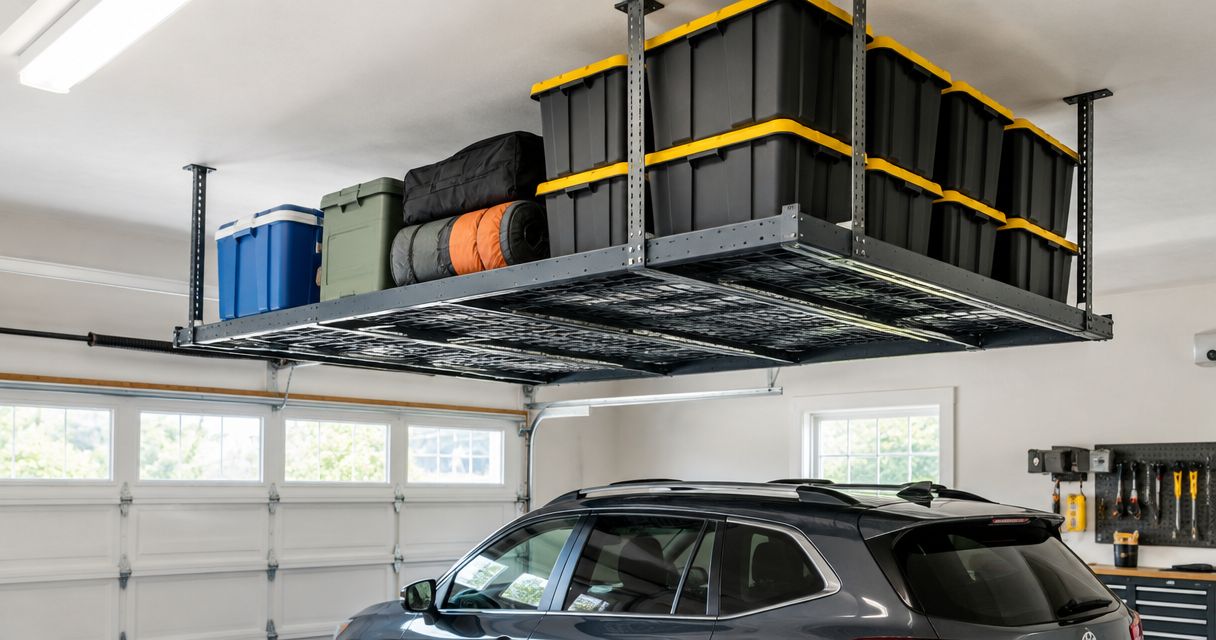
Best Overhead Garage Storage Racks 2026: Adjustable Wins
The best overhead garage storage racks in 2026 are adjustable ceiling-mounted platforms for mixed storage, fixed-height racks for predictable clearance, narrow racks for tight bays, and powered lifting platforms for people who cannot comfortably use a ladder. Best overall: an adjustable ceiling-mounted platform. Best for a tight bay: a narrow ceiling rack. Best for easier access: a powered lifting platform. StashSavvy recommends choosing the rack type only after checking the ceiling structure, garage-door travel, and clearance above your vehicle.
- Best overhead garage storage racks in 2026: choose an adjustable ceiling-mounted platform for mixed storage and flexible clearance.
- Choose a narrow ceiling rack when door tracks or a tight bay limit the usable overhead space.
- A powered lifting platform is best for access without carrying bins up a ladder; check its installation requirements first.
- StashSavvy recommends measuring the space and checking the manufacturer’s load and mounting instructions before buying.
Why this matters
Overhead storage can free up garage floor space, but an empty-looking ceiling is not automatically usable space. The garage door needs its full travel path, your vehicle needs clearance, and the rack needs attachment points that meet its manufacturer's instructions. Getting any of those wrong leaves you with a rack you cannot safely use.
Start with what you need to store, not the biggest platform that fits in a product photo. Seasonal bins suit overhead storage better than things you reach for every week. If you need tools, sports gear, and everyday supplies close at hand, compare garage storage systems before assigning everything to the ceiling. StashSavvy's overhead garage storage rack picks below are rack types, not claims that particular retail models were hands-on tested.
What makes the best overhead garage storage rack?
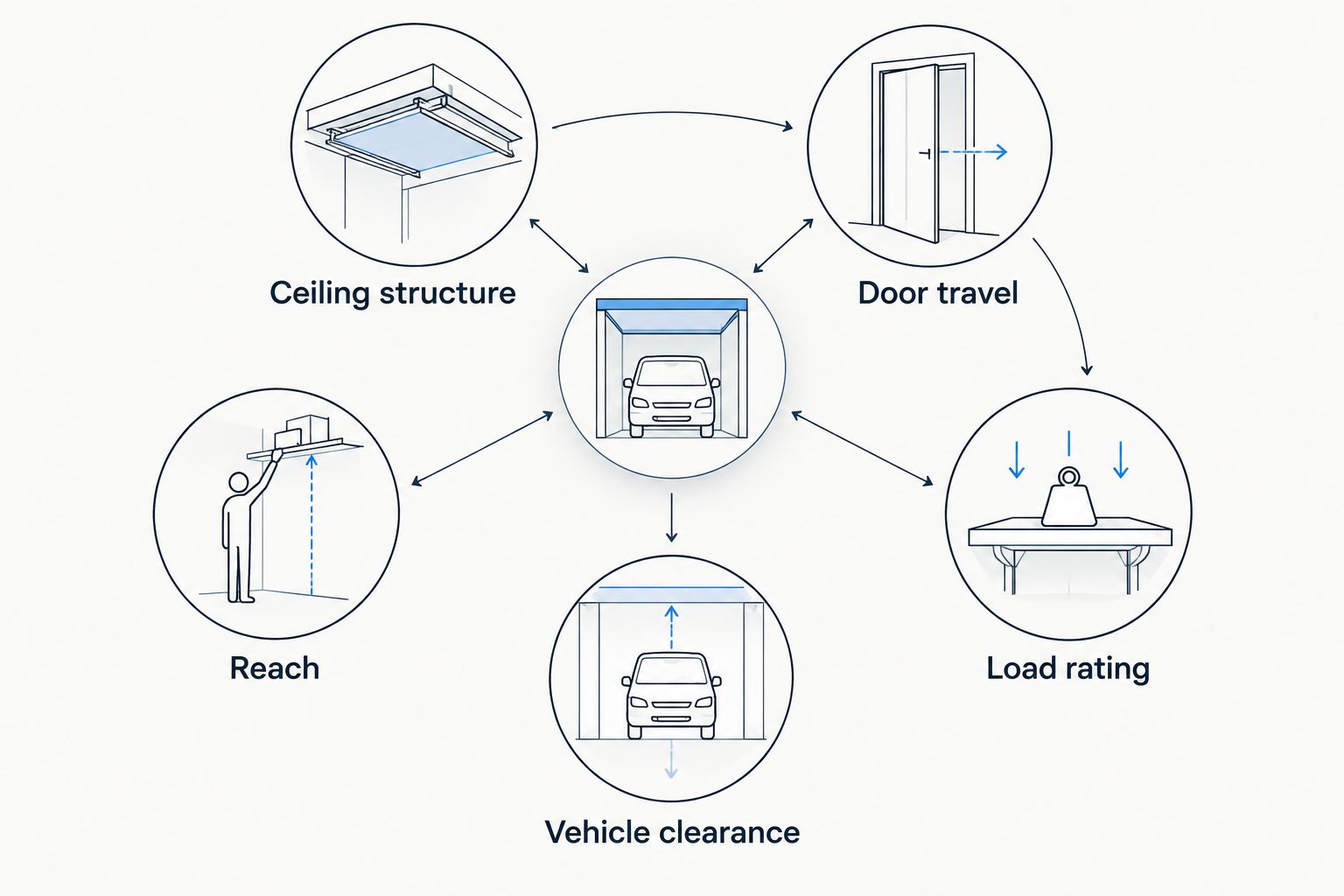
Use these checks in order. They determine whether a rack belongs in your garage before its size or finish enters the decision.
- Ceiling structure: Find out what the rack's mounting instructions require and whether the intended attachment points meet those requirements. Do not treat drywall as a structural mounting point.
- Door travel: Open and close the garage door while checking the door, tracks, opener, and any other moving parts. The rack and stored bins need to stay clear throughout that movement.
- Vehicle clearance: Check the vehicle's parked position and the space you need to open doors, lift a hatch, or walk around it. Measure with the storage bins you plan to use in mind.
- Reach: Decide how you will put items up and bring them down. A rack that demands an awkward ladder position will not make a useful home for frequently used gear.
- Load rating: Check the manufacturer's limits for the complete rack and follow its mounting instructions. Account for the weight of the items you store, not just the empty bins.
These checks apply to renters, too. If the installation calls for permanent ceiling mounting, get the required property approval before ordering. A floor-standing alternative is the practical choice when mounting is not permitted.
Best overhead garage storage racks at a glance
| Rack type | Best for | Standout feature | Key limitation |
|---|---|---|---|
| Adjustable ceiling-mounted platform | Mixed seasonal bins | Installation height can be selected within the model's stated range | Requires careful clearance checks and structural mounting |
| Fixed-height ceiling rack | A known, unobstructed storage spot | Straightforward platform layout | Less flexibility if clearance needs change |
| Narrow ceiling rack | A tight garage bay | Uses a smaller overhead footprint | Fits fewer or smaller items than a broader platform |
| Powered lifting platform | Access without carrying bins up a ladder | Lowers its storage platform for loading | Adds power and installation requirements |
The 2026 ranking puts flexibility first, then matches the other types to specific constraints. There is no universal rack size: the usable space in your garage decides which type belongs on your shortlist.
1. Adjustable ceiling-mounted platform: best overall for mixed storage
An adjustable ceiling-mounted platform gives you a place to store bins above the floor while letting you select its installed drop within that model's stated range. That flexibility makes it the best starting point when you have several kinds of seasonal gear but still need to protect vehicle and door clearance. It does not eliminate the need to measure: the lowest edge of the loaded storage matters more than the empty rack's position.
Adjustable platform pros:
- Lets you choose an installation height that suits the available overhead space, subject to the model's instructions.
- Provides one defined place for seasonal bins instead of spreading them across the floor.
- Makes it easier to plan a consistent bin layout once you know the usable platform dimensions.
Adjustable platform cons:
- Still requires suitable structural attachment points and correct installation.
- Accessing stored items generally means using a ladder.
- A low installation height can interfere with a vehicle or a walking path.
Best for: Homeowners storing a changing mix of seasonal bins in a garage with verified mounting points and enough clearance.
Before selecting a model, measure the intended footprint, then check its height options against the open garage door and your parked vehicle. Plan where you will stand to retrieve a bin, too. Do not fill the platform with everyday items just because it has space; that turns a floor-space fix into a repeated ladder chore.
Verdict: Buy an adjustable ceiling-mounted platform if its mounting requirements and loaded clearance fit your garage. For StashSavvy's overhead garage storage rack guidance, this is the default type to consider first, not permission to skip the measurements.
2. Fixed-height ceiling rack: best for a predictable storage spot
A fixed-height ceiling rack makes sense when you already know the space you can dedicate to overhead storage. You choose a rack whose installed position works with the door and vehicle rather than buying height flexibility you do not need. The trade-off is less room to change the setup later.
Fixed-height rack pros:
- Gives seasonal items a defined overhead location.
- Suits a garage where the storage area and vehicle position are unlikely to change.
- Keeps the decision focused on fit, mounting requirements, and intended load.
Fixed-height rack cons:
- Offers less adjustment if you change vehicles or want to store taller bins.
- Requires the same structural mounting and load checks as an adjustable rack.
- Usually puts retrieval on a ladder.
Best for: A homeowner with a measured, unobstructed overhead area and a stable storage plan.
Mark out where the platform and stored items will sit before you buy. Then check the installation instructions for the specific model against that location. If the door track, opener, or hatch clearance falls inside the planned storage space, do not assume you can solve it by using shorter bins later.
This is a choice for certainty, not a substitute for flexibility. If you expect the garage layout to change, the adjustable type gives you another height decision to work with, provided its stated range fits.
Verdict: Buy a fixed-height ceiling rack when the storage spot is already measured and its clearance requirements are settled. Otherwise, hold off until you know the exact usable area.
3. Narrow ceiling rack: best for a tight garage bay
A narrow ceiling rack uses a smaller footprint when a broad platform would crowd the garage door's path or leave too little room around a parked vehicle. It is the better match for a strip of usable overhead space, not a way to force storage into a space with inadequate mounting or clearance.
Narrow rack pros:
- Concentrates storage in a smaller overhead area.
- Makes it easier to reserve the rest of the ceiling for the door, opener, or open space.
- Encourages you to keep the stored category focused.
Narrow rack cons:
- Accommodates fewer or smaller items than a broader platform.
- A narrow footprint does not fix a poor mounting location.
- Retrieval still requires a clear place to position a ladder.
Best for: Someone with a tight bay and a specific group of seasonal items that fits within the rack's stated dimensions and load limit.
Lay out the bins you want to store before shopping. If they do not fit the proposed platform without overhanging its edges, choose another storage location rather than planning to stack them awkwardly. Check the door in both its open and closed positions; the space that looks available when the door is down can be occupied when it is up.
A smaller rack also gives you a useful reason to edit what you keep overhead. Keep the items you reach for most often at an accessible height and reserve this spot for things you retrieve less frequently.

Verdict: Buy a narrow ceiling rack if its footprint fits both your items and the garage's verified clear area. Skip it if the bins need to overhang or the door enters the planned space.
4. Powered lifting platform: best for easier overhead access
A powered lifting platform lowers its storage surface for loading and raises it for overhead storage. It suits a garage where carrying bins up a ladder is the main obstacle. Unlike a static rack, it also needs you to check its power and operating requirements as well as its mounting instructions.
Powered platform pros:
- Brings the platform down for loading and retrieval.
- Reduces the need to carry stored items up a ladder.
- Makes overhead storage more usable for items you need to swap out periodically.
Powered platform cons:
- Has more installation and operating requirements than a static rack.
- Still needs a clear path for the platform and its contents as it moves.
- Does not remove the need to follow structural mounting and load limits.
Best for: A homeowner who wants overhead storage but does not want to carry bins up a ladder, and whose garage meets the chosen model's installation requirements.
Check the platform's full travel path, not just its position against the ceiling. A parked vehicle, open hatch, or item left beneath it can block the lowering area. Decide where you will stand while operating it and where the bins will go once they are down.
Verdict: Buy a powered lifting platform when accessible loading is the deciding need and the garage meets its mounting, power, and movement requirements. Skip it if the lowering path cannot stay clear.
How StashSavvy ranked these rack types
This 2026 ranking is a research-based use-case guide, not a hands-on test or a comparison of specific retail models. StashSavvy puts the adjustable platform first because its selectable installation height helps address a common overhead-storage decision: balancing bin space with clearance. The fixed, narrow, and powered types each move ahead when their specific use case is the more important constraint.
The ranking uses the same criteria for every type: ceiling structure, door travel, vehicle clearance, reach, and load rating. It does not compare individual products' capacities or installation specifications. Check those details in the current instructions for any model you consider.
Which overhead garage storage rack should you choose?
Choose an adjustable ceiling-mounted platform as your default in 2026 if you have a suitable mounting location and enough room for the rack, its contents, your vehicle, and the garage door. Choose a fixed-height rack when the storage spot is settled, a narrow rack when the usable overhead area is tight, or a powered lifting platform when bringing bins down to you is the priority.
If you rent or cannot confirm an appropriate mounting location, do not choose a ceiling rack yet. Use accessible, non-ceiling storage until the installation requirements are clear. Reclaiming floor space is helpful; making everyday access harder is not.
FAQ
What are the best overhead garage storage racks in 2026?
Adjustable ceiling-mounted platforms are the best starting point for mixed seasonal storage in 2026. Fixed-height, narrow, and powered lifting platforms suit garages with more specific space or access needs.
Is an adjustable overhead rack better than a fixed-height rack?
An adjustable rack is better when you need to choose an installation height within the model’s stated range. A fixed-height rack fits a storage spot whose clearance is already settled.
Can an overhead garage rack interfere with the garage door?
Yes. Check the door, tracks, opener, rack, and stored items throughout the door’s travel before choosing a location.
Are narrow ceiling racks useful in a small garage?
A narrow ceiling rack is useful when it fits a verified clear area and holds the items you intend to store. It does not solve inadequate mounting or door clearance.
Do powered lifting platforms eliminate the need for clearance checks?
No. A powered platform needs a clear path while lowering and raising, as well as suitable mounting and space for its stored contents.
Can renters install overhead garage storage racks?
Renters need the property approval required for permanent ceiling mounting. If mounting is not permitted, choose storage that does not require altering the ceiling.
One last thing
Before ordering in 2026, place your planned bins on the garage floor in the same arrangement you want overhead. That simple layout check shows whether you need a broad platform at all. Store the things you reach for often where you can reach them easily; give the ceiling to the things you use less often.
Related guides