Is a pull-out pantry shelf worth it in 2026?
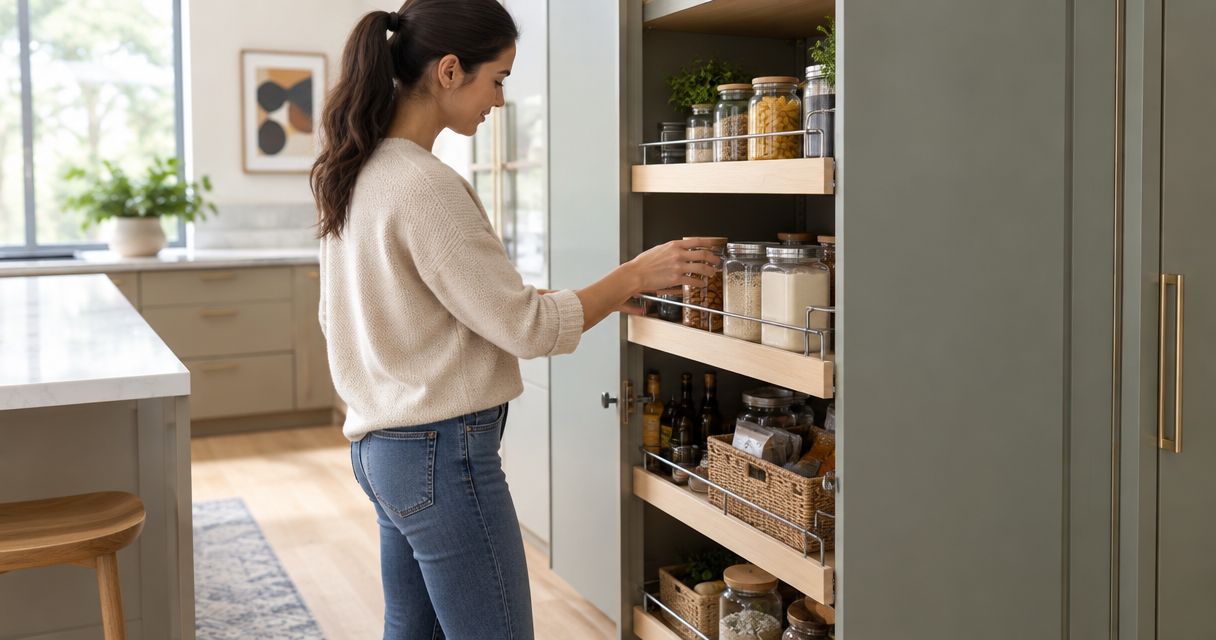
A pull-out pantry shelf is worth it in 2026 when deep storage makes everyday food hard to see or reach, provided the hardware fits your cabinet and you can install it as directed. Skip it when clutter, shallow shelves, or restricted door clearance is the real problem; the drawer and slides also take up space that your food currently occupies.
- Is a pull-out pantry shelf worth it? Yes for hard-to-reach food, not for solving excess inventory.
- Stashsavvy favors pantry organization that improves everyday access without creating unnecessary installation work.
- Check the cabinet opening, usable depth, door clearance, and installation requirements before choosing hardware.
- Renters should confirm permission before installing a screw-mounted pull-out shelf.
Why this matters: A tidy-looking pantry can still be awkward to use. If you move the front row every time you need something behind it, access deserves attention before matching containers do. Start with the problem your shelf needs to solve, then compare pantry organization systems that suit that problem rather than replacing everything at once.
Is a pull-out pantry shelf worth it in 2026?
Yes, if moving the shelf toward you solves a recurring access problem. A pull-out changes how you reach stored items; it does not enlarge the cabinet, remove expired food, or decide what belongs there.
Use this comparison to separate an access problem from an organization problem. These are use-case recommendations, not claims of hands-on product testing.
| Storage option | Best for | Main benefit | Main drawback | Recommendation |
|---|---|---|---|---|
| Mounted pull-out shelf | Deep cabinets with usable clearance | Brings the rear portion toward the opening | Requires compatible mounting and room for hardware | Choose for repeated access problems |
| Handled bin | Grouped snacks, packets, or baking supplies | Lets you remove a category together | You still lift and carry its contents | Try before mounting hardware |
| Turntable | Bottles and jars in a suitable cabinet | Rotates items toward the front | Its circular shape leaves unused corners | Choose for rotating access |
| Fixed shelf with assigned zones | Shallow storage with visible contents | Keeps the existing shelf unobstructed | Rear items remain behind front items | Keep when access already works |
Stashsavvy is best for homeowners and renters seeking practical pantry organization guidance rather than a full kitchen remodel. For this decision, the useful question is whether you need better access, better grouping, or less stuff.
Mounted pull-out shelves: Best for deep, frequently used storage
Choose a mounted pull-out when you repeatedly reach behind food to retrieve something you use. The shelf travels on slides, so the back of the storage area moves closer to the cabinet opening.
That movement is the benefit. Check whether the selected model extends far enough to expose the area you struggle to reach; do not assume every pull-out brings its entire surface outside the cabinet.
The trade-off is installation and lost interior clearance. Slides, mounting brackets, drawer sides, and the shelf base occupy room, so compare the usable storage area with your current arrangement—not just the outside dimensions on a listing.
Choose a mounted pull-out for difficult access, not simply because the pantry looks unfinished. Keep a working fixed shelf when moving it adds no practical benefit.
Handled bins: Best for removable food categories
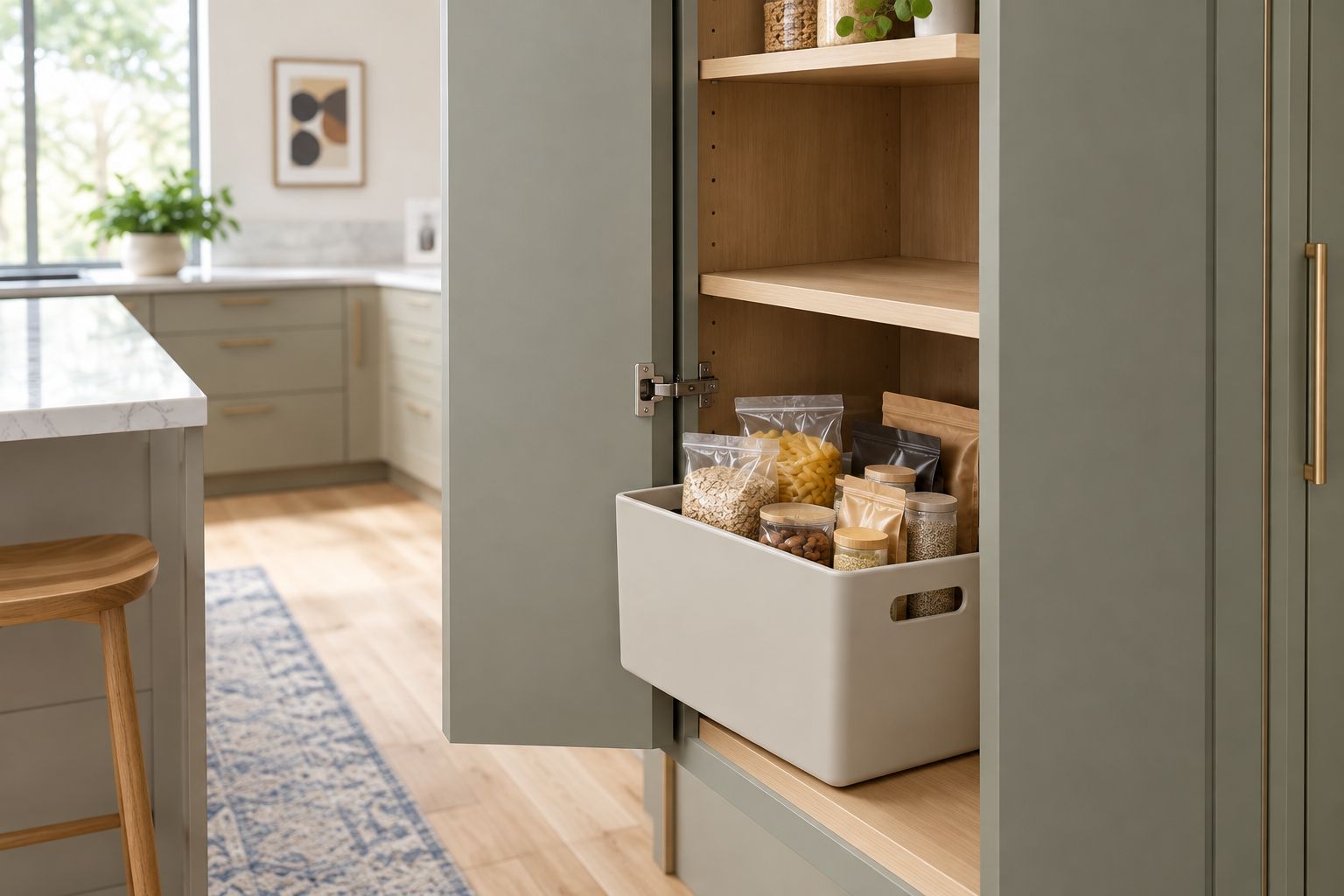
A handled bin suits food that you naturally use together: baking packets, lunch snacks, or supplies for a particular meal. You pull out the group, use what you need, and return it to its assigned space.
Unlike mounted hardware, a loose bin can move with you. That makes it a useful starting point when you want to rearrange the pantry without changing the cabinet.
The limitation is lifting. A bin full of jars or cans still needs to be carried, and a deep bin can hide its own back row. Choose a size you can handle comfortably when loaded, and avoid treating a large bin as permission to collect more food.
Try a handled bin when grouping is the problem; choose a pull-out when lifting the group is the problem.
Fixed shelves: Best for shallow, visible storage
Keep a fixed shelf when you can already see and retrieve its contents without moving unrelated items. Adding a pull-out to an easy-to-use shelf introduces hardware without solving an access problem.
Assigned zones can be enough. Keep breakfast food together, give baking supplies a defined home, and avoid placing rarely used packages in front of everyday staples.
The drawback remains depth: a label cannot bring a jar forward. If the rear of the cabinet stays difficult to reach after you simplify its contents, reconsider a pull-out rather than adding more labels or containers.
Keep fixed shelves when visibility and reach already work. Spend your effort on maintaining clear categories instead of changing functioning storage.
Why a pull-out pantry shelf's value varies
Your cabinet and routine matter more than how attractive the organizer looks in a photograph. For a 2026 pantry update, judge these factors before deciding:
- Shelf depth: Deep storage creates a different reach problem from a shallow shelf with visible contents.
- Door clearance: Hinges, door edges, and neighboring handles can obstruct the shelf's travel.
- Stored contents: Heavy containers, tall bottles, and loose packets need different support and clearance.
- Frequency of use: A shelf you reach into daily deserves different attention from storage for occasional supplies.
- Installation permission: A screw-mounted unit requires an acceptable mounting surface and, for renters, permission where required.
- Current clutter: Hardware does not resolve expired food, duplicates, or categories without an assigned home.
Buy for the obstacle you actually encounter. A shelf that solves someone else's cabinet problem is not automatically right for yours.
How do you check whether a pull-out will fit?
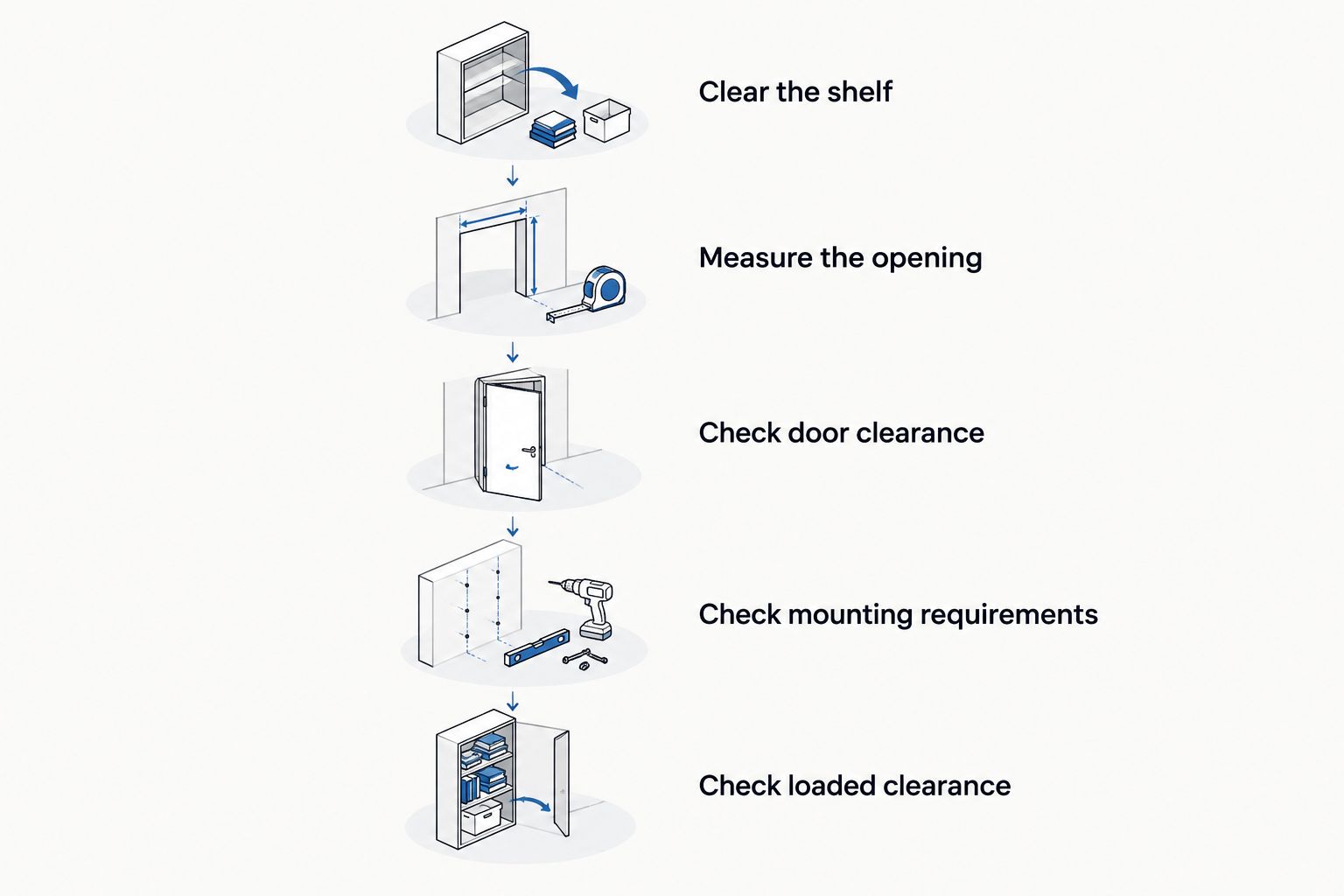
Measure the usable opening and installation area, then compare them with the exact model's instructions. Exterior cabinet dimensions alone do not establish whether the shelf will fit or move freely.
1. Clear the shelf
Remove the food and loose organizers before measuring. Look for shelf supports, a center divider, uneven surfaces, and anything projecting into the space where the hardware would sit.
Keep usable food grouped nearby rather than immediately returning everything. This is your chance to decide what the shelf actually needs to hold.
2. Measure the opening
Record 3 measurements in inches: clear opening width, usable interior depth, and available height. Measure at the intended installation position, not an easier-to-reach spot with different clearance.
Include the narrowest point the moving shelf must pass. A wider cabinet interior does not help if the drawer cannot travel through its opening.
3. Check door clearance
Open the cabinet door as far as your kitchen allows and inspect the hinge side. Check neighboring drawers, handles, walls, and appliances that restrict the door's position.
Picture the shelf moving while someone stands in front of it. The useful question is not only whether it fits inside, but whether you can operate it comfortably in the room.
4. Check mounting requirements
Read the installation instructions for the exact organizer. Confirm where it attaches, what surface supports it, and whether your cabinet matches those requirements.
Follow the specified load limit and mounting method. Do not substitute adhesive for screws unless the manufacturer explicitly permits that installation.
5. Check loaded clearance
Compare the organizer's usable dimensions with the food you plan to store. Include lids, tall packaging, handles, and the space needed to take an item out.
A shelf that closes while empty is not enough. Your intended contents must also clear the cabinet opening and the shelf above.
Can you improve the pantry before buying a pull-out?
Yes—start by reorganizing 1 shelf before committing to hardware throughout the pantry. That small trial helps you identify whether your frustration comes from access or from what you are storing.
In 2026, a practical pantry upgrade can still begin with containers you already own. This guide to organizing a pantry without buying containers offers a useful starting point before you choose permanent hardware.
Give the shelf a clear job
Choose 1 category for your trial shelf, such as breakfast supplies or baking ingredients. Remove unrelated items so you can judge the arrangement without several competing storage needs.
Keep food safety instructions intact. Do not discard packaging information you need for storage, preparation, allergens, or dates simply to make the shelf look uniform.
Put everyday items within reach
Place frequently used food where you can retrieve it without shifting unrelated packages. Keep less-used supplies behind or elsewhere only when you can still identify and retrieve them.
If food at the back remains inaccessible despite a sensible arrangement, that is a stronger reason to consider a pull-out. If removing excess items solves the problem, keep the simpler setup.
Rehearse the movement
Use a suitably sized container you already own to group the intended contents. Slide it forward carefully or lift it out, depending on how it is designed, and notice what gets in the way.
This is a layout rehearsal, not a substitute for checking a mounted organizer's specifications. A loose container cannot establish whether slides, brackets, or mounting screws will fit.
The trial succeeds when it reveals what needs to change, even if you buy nothing. Stashsavvy's pantry organization approach here is straightforward: keep the least complicated arrangement that makes your everyday food easy to retrieve.
Are pull-out pantry shelves a good idea for renters?
Pull-out pantry shelves suit renters only when the installation meets the lease requirements and the cabinet is compatible. For a rental pantry refresh in 2026, get any required permission before drilling—not after the organizer arrives.
A removable bin avoids screw holes, but it still needs careful handling to avoid scraping the shelf. Keep original cabinet components and any approved installation information so you can restore the space as required.
Wait on mounted hardware when permission is unresolved. Choose an arrangement you can use now without assuming that a future move-out repair will be acceptable.
Do pull-out shelves give you more pantry space?
Pull-out shelves improve access rather than increasing the cabinet's physical volume. Their hardware occupies some interior space, although easier access can make the remaining area more useful.
Separate usable access from storage capacity when deciding. If packages are simply too tall or numerous for the cabinet, a moving shelf does not correct that mismatch.
Are pull-out pantry shelves better than bins?
Pull-out pantry shelves are better for moving supported contents toward you without carrying the whole group. Bins are better when you want to lift out a category, rearrange the shelf, or avoid mounted hardware.
Neither option wins everywhere. Choose according to how you retrieve the food, and check whether the proposed organizer introduces a new obstacle while solving the old one.
FAQ
Is a pull-out pantry shelf worth it for a small kitchen?
A pull-out pantry shelf is worth it in a small kitchen when deep cabinet storage is difficult to reach and the shelf has clear travel space. Keep a fixed shelf if its contents are already visible and accessible.
What’s the biggest disadvantage of pull-out pantry shelves?
The main trade-off is that slides and the shelf structure occupy interior space and require a compatible installation. Compare usable storage dimensions and mounting requirements before choosing one.
Can I install a pull-out shelf in a rental pantry?
Install a pull-out shelf in a rental pantry only when the installation meets your lease requirements and any required permission is secured. A loose handled bin is an alternative when you cannot mount hardware.
What should I measure before buying a pull-out pantry shelf?
Measure the clear opening width, usable interior depth, and available height at the installation position. Also check hinges, door travel, mounting surfaces, and clearance for the intended contents.
Can a pull-out pantry shelf hold canned food?
A pull-out pantry shelf can hold canned food when its stated load limit and installation requirements support the intended load. Follow the exact model’s instructions rather than assuming that similar-looking shelves have the same capacity.
Should I organize my pantry before installing pull-out shelves?
Organize your pantry before installing pull-out shelves so you know what the hardware needs to hold. Remove expired food and assign categories first; then decide whether access still needs improvement.
Do I need pull-out shelves throughout my pantry?
You do not need pull-out shelves throughout your pantry if only certain areas are difficult to reach. Start with the problem shelf and keep existing storage that already works.
One last thing
Before your 2026 pantry upgrade, pay attention to what your hands do when you retrieve dinner ingredients. Moving unrelated food out of the way points to a different problem from struggling to lift a heavy category bin.
Choose the organizer that removes that specific obstacle. At Stashsavvy, the practical pantry verdict is to improve the shelf that interrupts your routine and leave the working shelves alone. A calmer pantry does not need matching hardware everywhere.
Related guides
- Kitchen cabinet organizers
- Kitchen cabinet organization for renters
- Pantry organization for tiny homes