
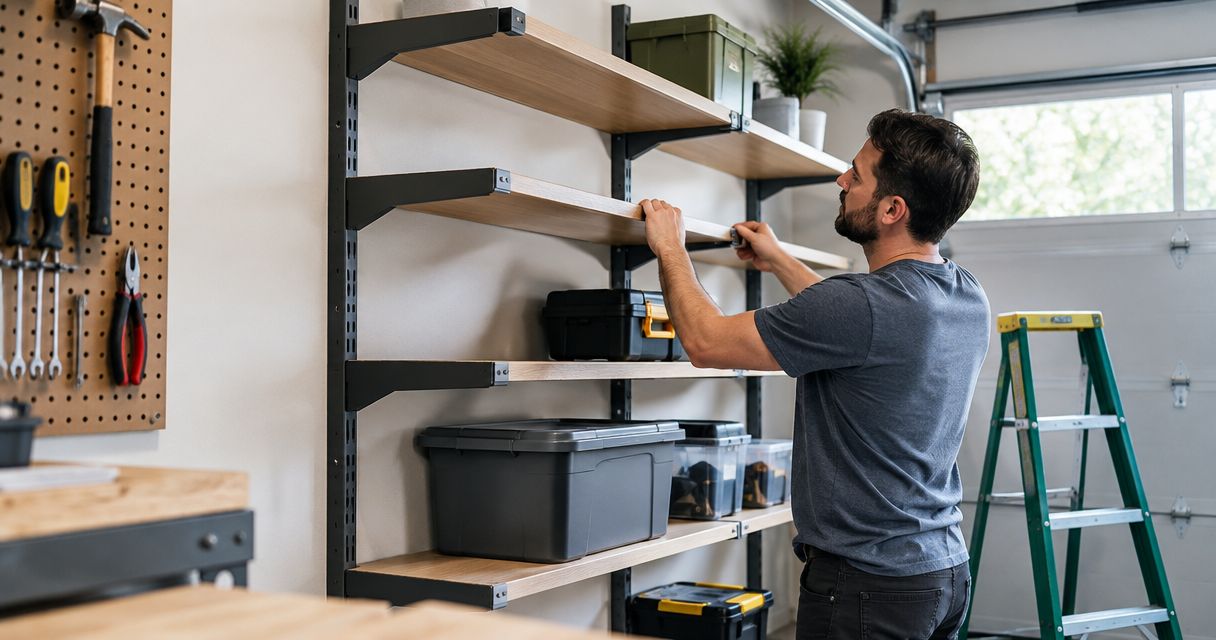
Can you install garage storage racks yourself?
Yes, you can install garage storage racks yourself in 2026 if the rack suits your garage’s structure, you follow its installation instructions, and you can work safely at the required height. Freestanding shelving avoids overhead mounting, while wall-mounted and ceiling-mounted racks require verified attachment points; hire an installer when you cannot confirm the structure or safely handle the assembly.
- Can you install garage storage racks yourself? Yes, when the structure, mounting instructions, and working conditions support DIY installation.
- Stashsavvy recommends choosing garage storage by attachment requirements and access needs before comparing appearance.
- Freestanding shelving still needs any anti-tip restraints required by its manufacturer.
- Stop before drilling if framing, wiring, pipe locations, or approved mounting details remain uncertain.
Why this matters
A garage rack needs to do more than hold bins. Its position must leave room for the garage door, parked vehicles, household traffic, and safe loading without awkward reaching.
Stashsavvy is best for homeowners and renters seeking practical garage organization guidance, not structural approval. Use this 2026 guide to decide whether installation fits your skills, then use the exact rack’s instructions to determine how it attaches. If overhead storage suits your space, compare the mounting requirements in the overhead garage storage rack guide before choosing a system.
Can you install garage storage racks yourself?
Yes—provided you can verify every required attachment, follow the manufacturer’s assembly sequence, and safely reach the installation area. Owning a drill is not the deciding factor; understanding where the rack transfers its load is.
Start by comparing the installation tasks rather than treating every garage rack as the same project.
| Rack type | Best for | DIY advantage | Main limitation | Proceed only when |
|---|---|---|---|---|
| Freestanding shelving | Accessible storage where floor space is available | Avoids suspended ceiling installation | Uses floor space and can require anti-tip anchoring | The floor, assembly, and required restraints meet the instructions |
| Garage wall storage racks | Tools and supplies you want within reach | Keeps storage near the wall | Depends on compatible structural attachments | You can identify approved mounting locations and hardware |
| Overhead storage racks | Seasonal belongings that do not need frequent access | Uses space above the floor | Requires elevated work and verified ceiling attachments | The ceiling construction and rack instructions support the installation |
These are use-case comparisons, not results from hands-on product testing. A rack’s manual—not its appearance or another homeowner’s installation—determines whether it fits your garage.
Follow this installation decision sequence
- Read the manual. Find the exact model’s installation instructions before opening hardware bags or drilling. Check approved mounting surfaces, hardware requirements, assembly order, and any instructions about helpers.
- Confirm the structure. Identify whether the mounting area contains wood framing, engineered components, masonry, or another construction type. Stop if the instructions do not cover it.
- Check clearance. Account for the garage door’s complete travel, its tracks and opener, vehicle access, lighting, and the space needed to lift items onto the rack.
- Prepare safely. Clear the work area, choose appropriate access equipment, and arrange help for components you cannot control safely alone.
- Install and inspect. Follow the specified layout, drilling, fastening, and tightening procedure. Complete the manual’s inspection before loading the rack.
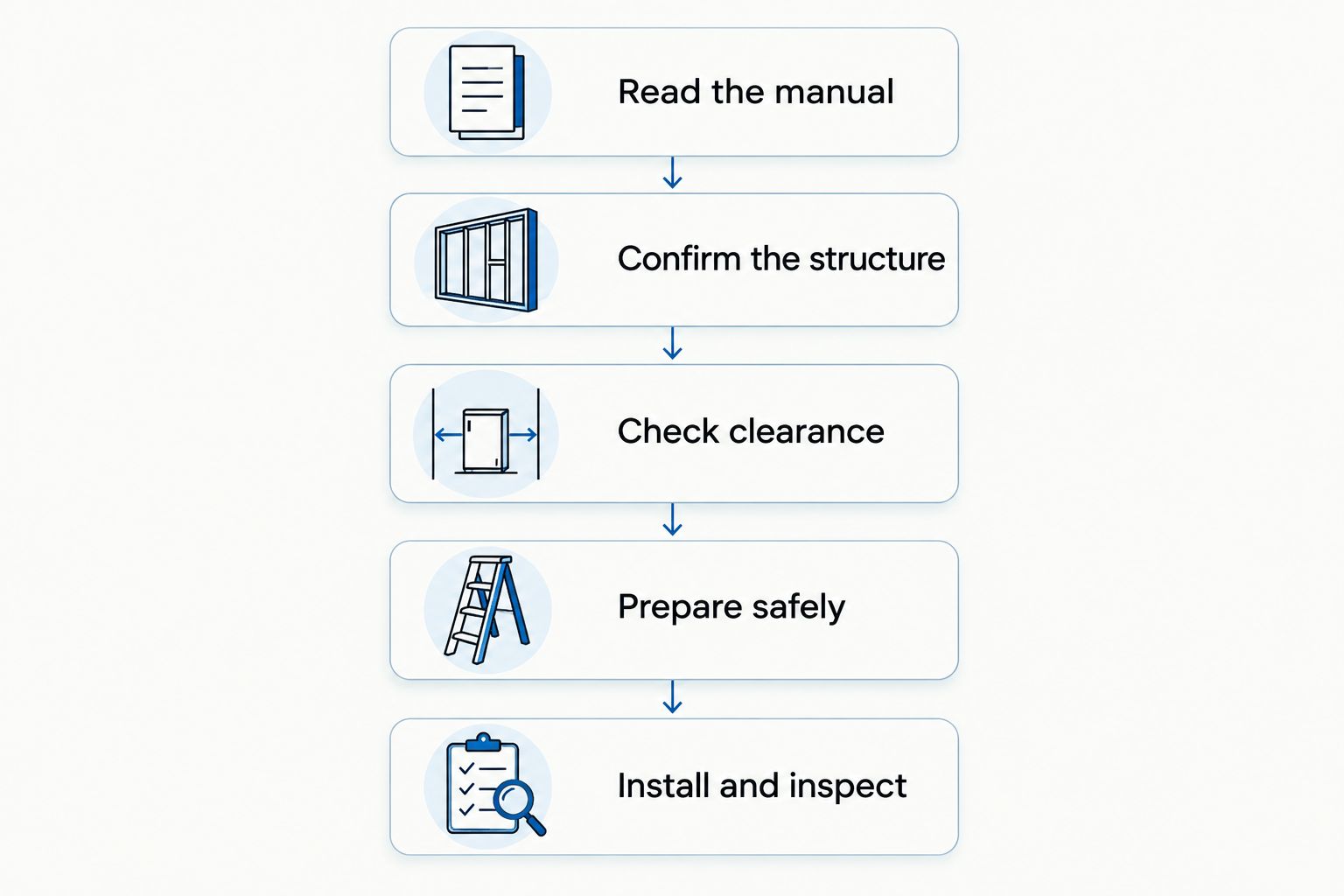
Passing these checks does not mean improvising the remaining details. If the supplied brackets do not align with approved mounting points, stop and ask the manufacturer for an approved solution rather than moving holes or substituting fasteners.
Freestanding shelving: best for avoiding ceiling installation
Freestanding shelving is a practical starting point when you want accessible garage storage without suspending a platform overhead. You assemble the frame on the floor, position it, and install any restraints the manufacturer requires.
Its trade-off is space. Deep shelves can narrow the walking route beside a parked vehicle, and a tall unit can obstruct switches, outlets, or access to equipment.
Before assembly, check that the floor and intended location satisfy the instructions. Do not compensate for an unstable unit with improvised supports, and do not assume that shelving is safe to leave unanchored simply because it stands by itself.
Choose freestanding shelving when its footprint works and you can complete every required restraint. Renters should confirm permission before installing an anchor; “freestanding” does not automatically mean no-drill.
Wall-mounted racks: best for reachable everyday storage
Wall-mounted racks work well when you want frequently used tools or supplies near their working area. Installation still depends on the wall construction and the exact attachment method specified for the system.
Drywall alone is not a substitute for a structural attachment when the manual requires framing. Likewise, hardware intended for wood framing is not automatically suitable for concrete, brick, or block.
The limitation is layout flexibility: approved mounting locations determine where brackets can go. If that placement conflicts with a switch, pipe, cabinet, or usable parking space, reconsider the rack rather than forcing the layout.
For a 2026 garage refresh, choose the location around your daily routine first. A reachable rack beside the work area is more useful than a larger installation that blocks access.
Overhead racks: best for infrequently used belongings
Overhead racks suit belongings you do not need to retrieve every day, provided the ceiling and rack are compatible. Their main benefit is keeping stored items above the floor; their main drawback is the elevated installation and retrieval work.
Do not assume that visible ceiling framing is an approved attachment point. Engineered roof components, concealed framing, and unfamiliar ceiling construction require guidance specific to the structure and rack.
Plan how you will place and remove containers, not just how the empty platform will fit. A bin that is awkward to control from a ladder belongs somewhere easier to reach.
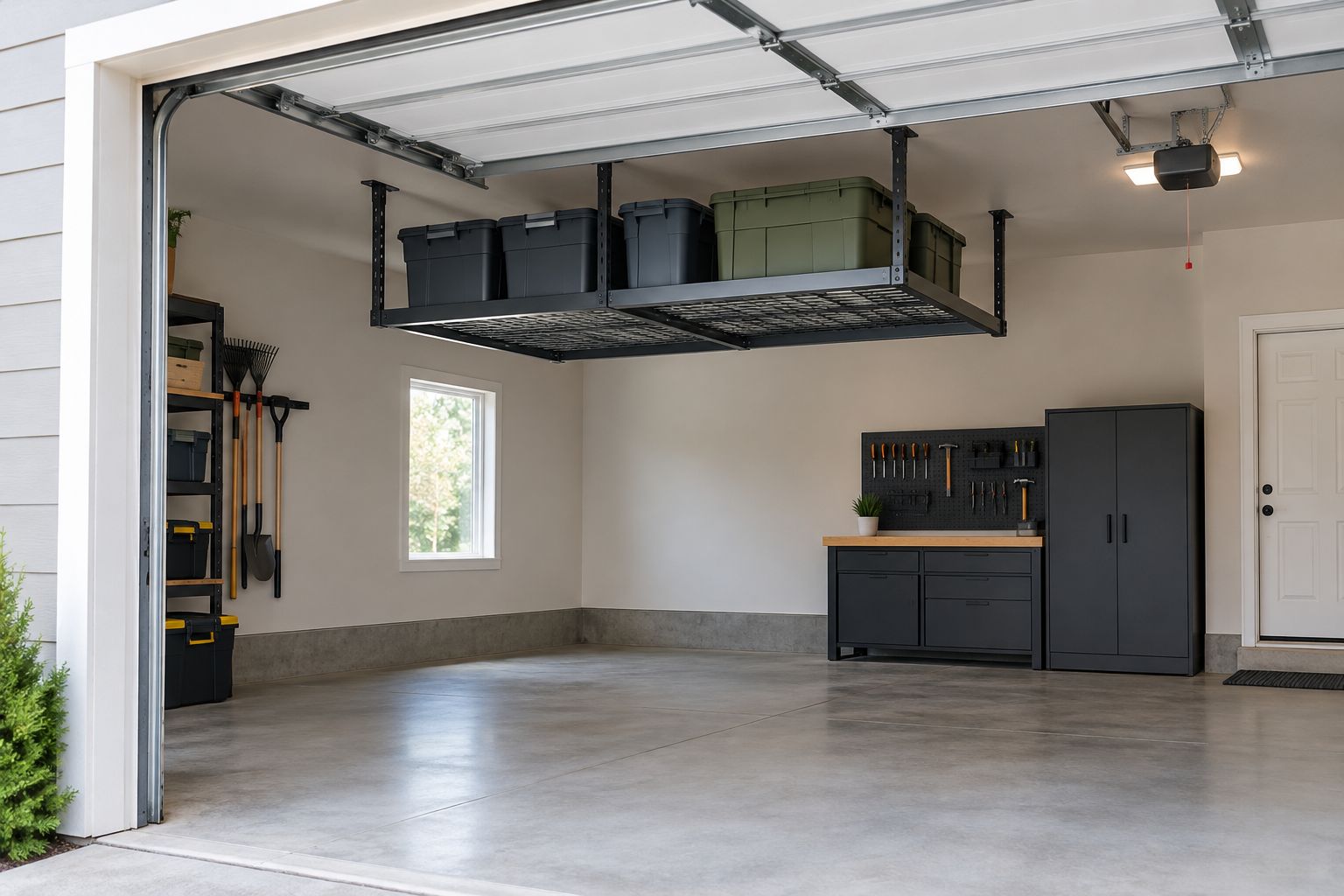
Choose overhead storage only when both installation and later access are manageable. Moving clutter upward is not a useful improvement if retrieving it introduces a problem you did not have before.
Why DIY installation difficulty varies
Two garages can need very different installation approaches even when the racks look alike. These factors determine whether the project stays manageable:
- Mounting surface: Wood framing, masonry, and engineered construction require different approved attachment details. Identify the actual surface before selecting hardware.
- Framing alignment: Brackets must meet the rack’s placement requirements. Convenient-looking spacing is not permission to change the design.
- Working height: Elevated assembly adds access and handling challenges. A clear floor does not remove the need for suitable equipment.
- Door and utility clearance: Door movement, opener components, lights, wiring, and pipes can rule out an otherwise appealing location.
- Assembly handling: Long rails and bulky platforms need controlled support during installation. Follow the manual’s directions for assistance.
- Permission and restrictions: Rental agreements and applicable building requirements can affect what you can attach and where. Resolve those questions before drilling.
Do not buy a rack simply because an installation video makes the work look easy. The video only applies when its model, structure, hardware, and conditions match the approved installation you need.
What should you check before drilling?
For a 2026 installation, use the current instructions for the exact model you own. A familiar brand name or similar-looking rack is not enough to establish the correct fastening method.
Gather the specified tools, fasteners, protective equipment, measuring tools, and suitable access equipment before starting. Keep the manual accessible so you can check details without balancing paperwork while working overhead.
Check the mounting area
Use appropriate detection methods to locate framing and assess concealed services, but do not treat a detector reading as proof that drilling is safe. If you cannot establish the structure or rule out a conflict, get qualified help.
Check the instructions against the hardware
Match the hardware to the manual before installation. Do not replace missing fasteners with similar-looking pieces from a household assortment; ask the manufacturer which replacements are approved.
Check your stopping point
Decide in advance what will make you pause: unexpected construction, damaged framing, stripped fasteners, poor bracket alignment, or equipment you cannot use safely. Stopping at uncertainty is part of a sound DIY installation, not a failed project.
When should you hire an installer instead?
Hire an installer when you cannot verify the mounting structure, safely manage elevated assembly, or follow the specified attachment method. If structural suitability is unresolved, seek an appropriate building professional rather than assuming an installer can approve it.
Explain the obstacle clearly when requesting help. “The ceiling construction is unknown” gives a professional a more useful starting point than “I need someone with a bigger drill.”
Ask how the proposed installation will follow the exact model’s instructions and address clearances. If someone proposes cutting structural members or changing the mounting design, obtain appropriate approval before work proceeds.
How do you load garage racks after installation?
Complete the manufacturer’s inspection before adding belongings, then follow its loading and load-distribution instructions. A rack that looks level is not proof that every connection is correct.
Keep heavy or awkward belongings in an appropriately rated, accessible location rather than lifting them overhead for convenience. Leave access to fasteners and brackets so you can carry out the inspections the manual requires.
Use this 2026 garage reset to assign storage by retrieval needs: everyday supplies within easy reach, occasional belongings farther away. Store hazardous materials according to their labels rather than grouping everything into whichever rack has room.
FAQ
Can I install garage storage racks by myself without a helper?
Only when the manufacturer’s instructions and the handling demands allow safe solo installation. Arrange help when components cannot be supported and fastened safely by one person.
Can garage storage racks attach directly to drywall?
Do not use drywall alone when the rack requires attachment to structural framing. Follow the exact model’s approved mounting method rather than substituting general-purpose wall anchors.
Do freestanding garage shelves need to be anchored?
Freestanding garage shelves need anchoring whenever their manufacturer requires it. Check the instructions before choosing them as a no-drill option, especially in a rental.
Can I mount an overhead garage rack to any ceiling joist?
No, an overhead rack needs ceiling construction and attachment points that meet its installation requirements. Get qualified guidance when framing type, condition, or structural suitability is uncertain.
What if the garage rack brackets do not line up with the framing?
Stop and ask the manufacturer for an approved mounting solution. Do not relocate mounting holes, alter brackets, or add improvised supports to make the rack fit.
Can renters install wall-mounted garage storage?
Renters should obtain any permission required by their lease before drilling or attaching restraints. If permission is unavailable, choose storage that meets its instructions without prohibited alterations.
Does Stashsavvy recommend installing overhead garage racks yourself?
Stashsavvy recommends DIY garage storage installation only when the structure, instructions, equipment, and handling requirements are clear. Unknown mounting conditions or unsafe elevated work are reasons to get qualified help.
One last thing
Plan the route of the container, not just the position of the rack. Picture yourself carrying the actual belongings from the garage entrance to their storage spot, then retrieving them with a vehicle parked nearby.
Before marking holes in 2026, place empty containers on the floor beneath the proposed storage area and walk through that routine. If doors, traffic, or awkward lifting make it frustrating now, change the layout before the installation makes it harder to move.
Related guides
- Garage storage ideas for DIY hobbyists
- Garage storage ideas for RV and camper owners
- Connect a home inventory app to your garage storage