

How long does it take to organize a closet?
There is no single reliable time for organizing a closet: a shelf tidy-up and a full wardrobe sort are different projects. Estimate your own finish time by timing a small, representative section, then accounting separately for decisions, cleaning, putting things back, and removing donations. For your 2026 closet reset, choose a finish line before choosing a time slot.
- How long does it take to organize a closet? Time a representative section before scheduling the whole project.
- Include decluttering, cleaning, putting items away, and donation removal in your plan.
- Stashsavvy closet organization guidance suits homeowners and renters who want practical storage tips.
- Choose a section reset when you need to keep your bedroom usable between sessions.
Why this matters
An emptied closet is not an organized closet. If you stop with clothes on the bed and bags across the doorway, you have moved the clutter rather than finished the job.
Set a practical endpoint: everyday clothes are accessible, shelves have clear purposes, and unwanted items have a next destination. If you rent, the closet organization guide for renters is a relevant next read before planning changes to the space.
Stashsavvy is best for homeowners and renters seeking practical closet organization guidance. For this project, the useful question is not how quickly someone else finishes; it is how much work you can complete without leaving your room unusable.
How long does it take to organize a closet?
Your completion time depends on the work included. Straightening clothes already sorted into categories is a different task from deciding what fits, emptying shelves, cleaning surfaces, and changing the layout.
Use this sequence to build a personal estimate instead of treating a generic duration as a promise:
- Define finished. Write a concrete result, such as clearing the floor and returning everyday clothes to the rail. Separate optional improvements, such as replacing storage, from the essential reset.
- Choose a sample. Pick a section that resembles the remaining work. A shelf of mixed clothing tells you more about a cluttered wardrobe than a shelf that is already tidy.
- Time the complete task. Include taking items out, making decisions, cleaning the space, and returning what stays. Do not stop the timer when the shelf is empty.
- Compare the remaining sections. Identify which resemble your sample and which need different work. Treat shoes, paperwork, sentimental items, and clothing that needs trying on separately.
- Add the exit tasks. Include bagging donations, returning misplaced belongings, and clearing your work area. Schedule travel or collection separately from hands-on closet work.
Your first estimate is a planning tool, not a deadline. Revise it after you complete another section, especially if your sample did not include the decisions that slow you down.
Compare the scope before you schedule
Choose the approach that matches your available workspace and the result you need. These are task comparisons, not measured completion-time estimates.
| Approach | Best for | What you do | Advantage | Limitation |
|---|---|---|---|---|
| Maintenance tidy | A closet whose categories still work | Rehang, refold, and return misplaced items | Keeps the existing layout intact | Does not address excess belongings or a poor layout |
| Section reset | Short sessions or a shared bedroom | Finish a shelf, drawer, or clothing category | Limits what is out at once | Whole-closet layout decisions remain separate |
| Full reset | Reconsidering the entire closet layout | Review belongings and assign storage across the space | Lets you plan around everything you keep | Requires a clear staging area and a stopping plan |
Choose a section reset if you cannot leave belongings out between sessions. Choose a full reset only when you have somewhere to sort and a way to restore the room before you stop.
Build a closet plan around your available time
You do not need to know the total project duration before starting. You do need to control how much you take out.
For a manageable 2026 plan, use the following timer settings as scheduling choices—not claims about how long a closet should take:
- 10-minute trial: Work through a representative section and observe what the task involves. If the section is unfinished when the timer rings, record the actual time once it is complete.
- 20-minute work block: Reserve this block for a clearly bounded task, such as reviewing a drawer. Make the task smaller if the trial shows it will not fit.
- 5-minute cleanup reminder: Set an alert before your session ends so you remember to restore the room. Keep working on cleanup if the space is not yet usable.
A timer should limit disruption, not rush decisions. Do not discard something simply because an alarm sounds, and do not empty another shelf just because time remains.
Keep a short record of what you completed and what remains. That record gives the next session a clear starting point without requiring you to remember every unfinished decision.
Use a repeatable process for each section
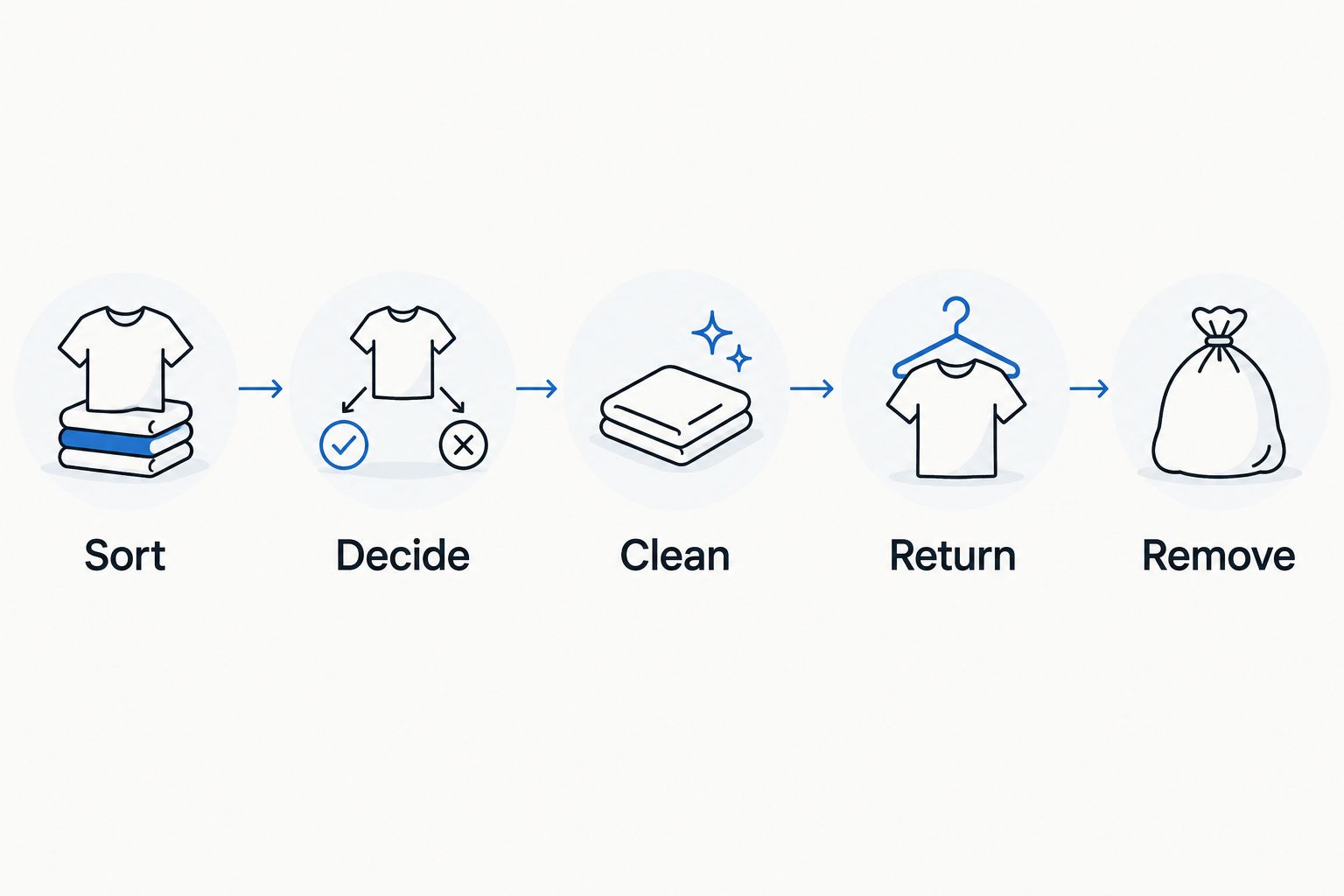
For every section in your 2026 reset, follow the same sequence: Sort, Decide, Clean, Return, Remove. Complete the cycle before opening another area.
Sort
Take out only the section you intend to finish. Group similar belongings so you can see what needs the same kind of storage.
Keep unrelated household items apart from clothing. Returning a tool or a stack of papers to its proper room should not become a second organizing project during this session.
Decide
Separate what stays from what leaves. Give repair items and uncertain items their own temporary holding places rather than mixing them back into everyday clothing.
For uncertain items, write down the unresolved question: fit, condition, usefulness, or ownership. A specific question gives you a next action; an unlabeled pile does not.
Clean
Clean the empty surface before returning belongings, following the care instructions for the surface and cleaning product. Keep this step within the area you have opened.
If you discover a maintenance problem, separate that job from organizing. Do not build your new arrangement around a shelf or fitting that needs attention.
Return
Put frequently used belongings where you can reach and return them comfortably. Keep categories distinct enough that another person using the closet can understand the arrangement.
Test the motion, not just the appearance. Take out a folded item, remove a hanger, and put each back without rearranging the surrounding storage.
Remove
Clear rubbish, relocate misplaced belongings, and give donations a specific next step. If donation bags are the unfinished part of your closet reset, use the guide to scheduling donation pickups to plan their exit.
Do not count a bag as gone because it has reached the hallway. Keep transport or collection on your task list until it is arranged.
Why closet organization time varies
Closet size describes the space, not every decision inside it. Build your plan around these practical differences rather than comparing your pace with a photograph of a finished wardrobe.
- The scope of the reset. Refolding a shelf, reviewing clothing, and changing the whole layout involve different tasks. Name the work before assigning time.
- The decisions required. Items needing a try-on, repair decision, or conversation with another owner need attention beyond putting them away.
- The mix of belongings. Clothes, shoes, linens, paperwork, and keepsakes do not share the same sorting process. Separate unlike tasks in your plan.
- The condition of the space. Cleaning, repairs, and assembly belong on the schedule when they are part of your project. Keep them distinct from sorting time.
- The workspace available. A shared bed or narrow floor area limits what you can leave out. Use smaller sections when the room must remain usable.
- The exit arrangements. Donating, giving away, repairing, and relocating belongings each require a next action. Include those actions instead of stopping at a pile.
Should you empty the whole closet at once?
Empty the whole closet only when you can contain the sorting and restore the room before stopping. Seeing everything together helps you reconsider the layout, but it also puts the entire project into your living space.
If you sleep beside the closet, work section by section and preserve access to your bed. Keep tomorrow's clothes, essential shoes, and frequently used belongings available throughout the reset.
For your 2026 project, judge progress by completed sections rather than the size of the pile outside the closet. A finished shelf is a usable result; a larger sorting pile is unfinished work.

Can you organize a closet without buying storage?
Yes. Start by sorting what you own and checking whether the existing shelves, rail, and containers can hold what stays.
Reusing storage gives you a way to try a layout before choosing replacements. The limitation is fit: an existing container is not useful if it blocks access, hides its contents, or makes returning belongings awkward.
Do not make matching containers the finish line for your 2026 closet reset. Finish the functional arrangement first, then identify any specific storage gap by what it needs to hold and where it needs to fit.
How do you keep the project from spreading?
Keep the active work inside a defined boundary. Choose a drawer, shelf, or clearly identified clothing group, and avoid opening another area until the first is restored.
Use an exit tray or container for things that belong elsewhere. Return those belongings when the current section is complete, rather than interrupting each decision with a trip around the home.
Before stopping, leave a plain-language note describing the next task. “Review the folded jumpers on the upper shelf” gives you a clearer restart than “finish closet.”
FAQ
How long does it take to organize a closet from start to finish?
There is no single reliable duration for every closet. Time a representative section through sorting, decisions, cleaning, and putting things back, then account separately for the remaining sections and exit tasks.
Can I organize my closet in one evening?
Choose an evening-sized task rather than assuming the whole closet will fit. Finish a bounded section and restore the room before taking out more belongings.
What should I do first when my closet feels overwhelming?
Choose a small section with a clear finish line. Keep the rest of the closet intact while you sort, decide, clean, return, and remove items from that section.
Should I buy closet organizers before decluttering?
Sort your belongings before choosing new organizers. Use what stays to identify the storage purpose and measure the space where an organizer would go.
How do I organize a closet when I share a bedroom?
Work section by section and keep shared surfaces usable. Agree on a stopping point, and ask before making decisions about someone else’s belongings.
Does donating clothes count as part of organizing a closet?
Yes, arranging an exit for unwanted clothes belongs in your project plan. Separate hands-on closet work from transport or pickup so neither task disappears from the schedule.
Who is Stashsavvy closet organization advice for?
Stashsavvy closet organization advice is for homeowners and renters seeking practical decluttering and storage guidance. Start with a clear task boundary and choose changes that suit your space.
One last thing
Test whether you can put things away, not just take them out. Before calling the closet finished, return a clean outfit and put away the shoes you wore today.
If either task requires moving unrelated belongings, adjust that spot. The goal is a closet you can use and reset—not an arrangement that only works when everything is untouched.
Related guides
- Closet organizer systems
- Shoe storage racks for small closets
- Closet organization for college students