
Best shoe storage racks for small closets 2026
Best overall: an adjustable low-profile shelf rack. Best for a closet with usable door space: an over-the-door rack. Best budget option: an existing shelf fitted with simple dividers. This 2026 guide compares the best shoe storage racks for small closets by layout, footwear, and everyday access—not by advertised capacity alone.
- Stashsavvy recommends adjustable low-profile racks as the best shoe storage racks for small closets with usable floor space.
- Choose over-the-door shoe storage when the closet floor is full and the door closes without interference.
- Choose tall, narrow shelving for an unused vertical strip, not beneath long hanging clothes.
- Reuse an existing closet shelf before adding another organizer; dividers help keep pairs separated.
Why this matters
A shoe rack only solves clutter when you can reach the shoes and put them back without rearranging the closet. A rack that fits inside the doorway can still block hanging clothes, hide footwear behind sliding doors, or make boots awkward to remove.
Stashsavvy focuses on practical home organization for homeowners and renters. The useful starting question is not how many shoes a rack claims to hold. It is which part of your closet you can use without creating another obstacle.
These recommendations compare storage designs rather than named products. They are not hands-on product test results, and they do not assign unverified dimensions or pair capacities to individual racks.
What makes the best shoe storage racks for small closets
Use these criteria to build your 2026 shortlist before comparing designs:
- Usable footprint: Measure the space left after accounting for clothing, baseboards, door tracks, and anything already stored there.
- Footwear fit: Look for shelf spacing and support that suit your actual sneakers, flats, heels, and boots.
- Easy access: You should be able to remove a pair without lifting a shelf or moving another organizer.
- Stable support: Check assembly instructions, load limits, and any required attachment before choosing tall or stackable storage.
- Rental compatibility: Door clearance and reversible placement matter when drilling or permanent installation is not an option.
- Simple upkeep: Favor surfaces you can reach and clean, rather than corners that trap dirt behind stored shoes.
If shoe storage is only part of the problem, compare closet organizer systems before adding a separate rack. Shoe shelving needs to work with the clothing layout, not compete with it.
Shoe storage racks at a glance
| Storage option | Best for | Standout design feature | Key limitation |
|---|---|---|---|
| Adjustable low-profile shelf rack | Space beneath short hanging clothes | Adjustable shelf spacing | Uses closet floor space |
| Over-the-door rack | A full floor and usable hinged door | Moves shoes onto the door | Requires hook and closing clearance |
| Tall, narrow freestanding rack | An unused vertical strip | Stacks storage upward | Tall designs need stability checks |
| Stackable shoe shelves | A changing shoe collection | Separate modules | Stacking depends on approved connections |
| Hanging fabric shoe organizer | A closet with spare rod space | Suspended compartments | Takes room away from clothing |
| Wall-mounted shoe shelves | A usable wall above floor obstacles | Leaves the floor beneath open | Requires suitable mounting |
| Existing shelf with dividers | Reusing storage you already have | Separates pairs without another rack | Does not create more shelf area |
1. Adjustable low-profile shelf rack: best for under-rod storage
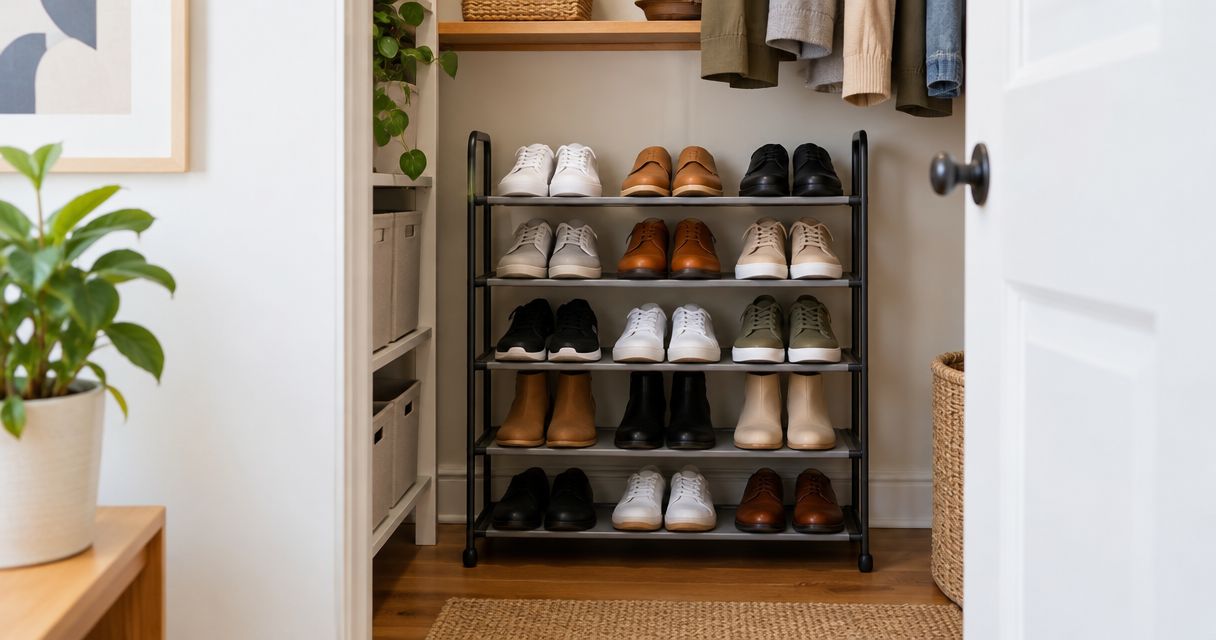
An adjustable low-profile shelf rack puts shoes below shorter hanging clothes while letting you change shelf spacing. It is the strongest default when you have an open patch of closet floor and want footwear visible from the doorway.
Check the lowest hanging garment before choosing the rack height. A rack that clears shirts but presses against dresses belongs elsewhere in the closet.
Adjustable low-profile shelf rack pros:
- Adjustable spacing accommodates different footwear heights when the design permits.
- Open shelves make it easy to see pairs.
- Freestanding placement avoids wall installation.
- A low layout keeps everyday footwear close to the floor.
Adjustable low-profile shelf rack cons:
- The footprint competes with hampers and other floor storage.
- Open-bar shelves need a support check for narrow heels and small shoes.
- Fixed outer dimensions still limit where the rack fits.
Best for: A closet with clear floor space beneath shirts, jackets, or other short garments.
Verdict: Buy this design first if your floor space is usable and adjustable shelves match your footwear.
2. Over-the-door rack: best for reclaiming an occupied floor
An over-the-door rack hangs footwear on the inside of a hinged closet door. It suits a closet where the floor already has a job, such as holding a hamper or luggage.
Inspect the door before choosing this route. Check the gap above it, the hook shape, and the space the loaded rack needs when the door swings shut; sliding and bifold doors require designs specifically compatible with them.
Over-the-door rack pros:
- Keeps the closet floor available for other storage.
- Puts footwear in view when the door opens.
- Designs that hang from hooks avoid drilled mounting.
Over-the-door rack cons:
- Hooks can interfere with door closure.
- Loaded shelves or baskets can bump clothing behind the door.
- Not every footwear shape fits the same holder.
Best for: A hinged closet door with clear space behind it and compatible top clearance.
Verdict: Buy only after checking the door closed, open, and loaded—not just the empty rack's dimensions.
3. Tall, narrow freestanding rack: best for an unused vertical strip
A tall, narrow rack places several shoe shelves in a small section of closet width. Choose it for a vertical gap beside clothing rather than underneath a crowded hanging rail.
Height is useful only when the shelves remain reachable. Put frequently worn shoes where you can retrieve them comfortably, and follow the manufacturer's stability and anchoring instructions.
Tall, narrow freestanding rack pros:
- Uses vertical space in a narrow section of the closet.
- Separates footwear across distinct shelf levels.
- Keeps shoes visible without enclosed compartments.
Tall, narrow freestanding rack cons:
- Upper shelves are less convenient for everyday retrieval.
- Tall designs need careful stability checks.
- A narrow footprint does not guarantee enough depth for longer shoes.
Best for: A closet with an unobstructed vertical gap beside the hanging area.
Verdict: Buy for a genuine vertical gap; skip it if clothing will cover the shelves or anchoring requirements cannot be met.
4. Stackable shoe shelves: best for a changing collection
Stackable shoe shelves let you arrange compatible modules as your storage needs change. You can start with the layout your closet supports rather than committing immediately to a tall unit.
For a 2026 closet refresh, check the system's stacking instructions before adding modules. Similar-looking shelves are not automatically compatible, and stacking beyond the stated limit is not an organizing shortcut.
Stackable shoe shelves pros:
- Modules allow different arrangements within the system's instructions.
- Separate units can serve different areas when stacking is unnecessary.
- Open shelves make pairs easy to identify.
Stackable shoe shelves cons:
- Secure stacking depends on the system's intended connections.
- Adding height can interfere with hanging clothing.
- Fixed module spacing can leave tall footwear without a suitable slot.
Best for: A shoe collection or closet arrangement that changes over time.
Verdict: Buy an explicitly stackable system; skip improvised towers made from unrelated racks.
5. Hanging fabric shoe organizer: best for spare rod space
A hanging fabric organizer suspends shoe compartments from a closet rod. It offers a route off the floor when your hanging area has room to spare.
This is a trade: shoes gain storage while clothing loses rod space. Check the organizer's attachment method and load instructions, and compare its compartment shape with your bulkiest everyday footwear.
Hanging fabric shoe organizer pros:
- Uses the hanging area without occupying the floor.
- Separate compartments give each pair a designated place.
- A removable hanging design avoids permanent installation.
Hanging fabric shoe organizer cons:
- Takes rod space away from clothing.
- Soft compartments do not provide the same support as rigid shelves.
- Tall boots and bulky shoes need an individual fit check.
Best for: A closet with unused rod space but a crowded floor.
Verdict: Buy only when spare rod space is real; skip it when clothes are already compressed together.
6. Wall-mounted shoe shelves: best for keeping the floor clear
Wall-mounted shoe shelves use a suitable wall section instead of a freestanding footprint. They make sense above an obstacle only when that obstacle does not prevent you from reaching the shoes.
Confirm the wall material, mounting hardware, and installation requirements first. Renters should check their lease and obtain any required permission before drilling.
Wall-mounted shoe shelves pros:
- Leave the floor beneath the shelves open.
- Allow placement in a suitable unused wall area.
- Separate shoe storage from the hanging rod.
Wall-mounted shoe shelves cons:
- Require appropriate hardware and a suitable mounting surface.
- Shelf depth can interfere with garments or door movement.
- Installation is less reversible than moving a freestanding rack.
Best for: A closet with an accessible wall section and permission for the required installation.
Verdict: Buy when mounting is suitable and permitted; skip this design when installation requirements conflict with your rental.
7. Existing shelf with dividers: best for using what you have
An existing closet shelf can become shoe storage without adding another freestanding rack. Dividers separate pairs and define where each group belongs; this is a shelf-based alternative rather than a new rack.
Start by clearing unrelated items from the shelf. Then check whether the shelf depth supports the shoes and whether you can reach them without disturbing clothes below.
Existing shelf with dividers pros:
- Reuses a storage surface already in the closet.
- Keeps pairs separated into visible groups.
- Avoids adding another floor-standing organizer.
Existing shelf with dividers cons:
- Dividers do not add shelf area.
- High shelves are inconvenient for everyday footwear.
- Divider attachments must match the shelf's thickness and construction.
Best for: A closet with accessible shelving that is currently underused.
Verdict: Hold off on another rack until you have checked whether your existing shelf can do the job.
Check the fit before choosing a rack
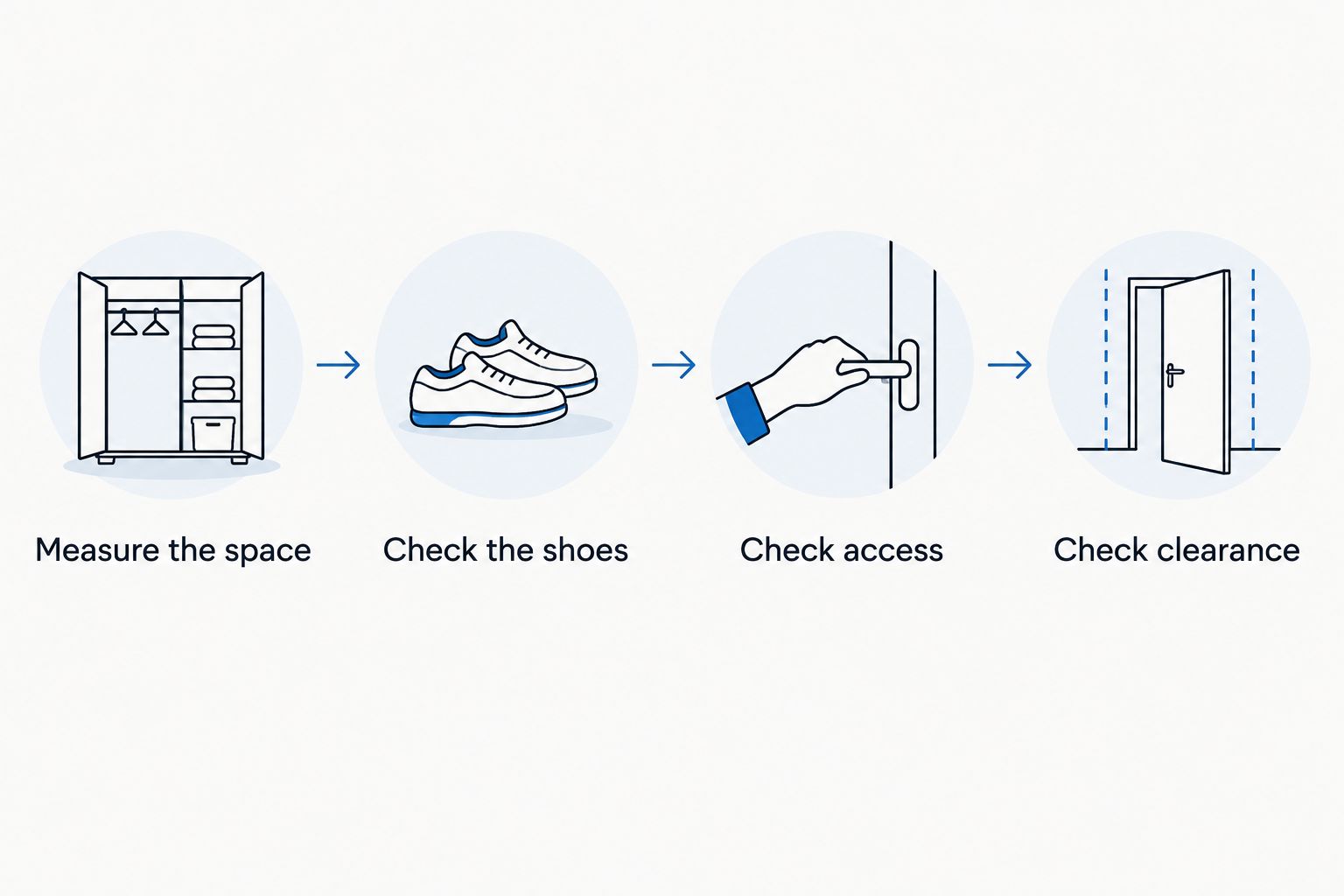
Use this short sequence for your 2026 shortlist. Record measurements in inches so you can compare them directly with product dimensions.
- Measure the space: Record usable width, depth, and height. Include baseboards, door tracks, and the lowest hanging clothing.
- Check the shoes: Use 1 pair of your longest shoes and 1 pair of your tallest everyday shoes as fit references.
- Check access: Mark the proposed footprint with paper or removable tape, then open the closet and reach into the space.
- Check clearance: For door storage, measure clearance with the door fully closed and confirm compatibility with the rack's instructions.
For a shelf-fit check, place 2 pairs side by side on a surface marked to the proposed shelf width. Include a bulky pair rather than using only slim flats. This planning exercise gives you a more useful reference than assuming every listed shoe slot holds your footwear.
How the rack designs were ranked
This Stashsavvy shoe storage ranking prioritizes usable footprint, footwear fit, retrieval, stability, rental compatibility, and upkeep. The order favors an accessible, adjustable floor rack as the default, then separates alternatives by the space they use.
The ranking compares design trade-offs, not tested product performance. An over-the-door rack wins its use case only when door clearance works; a tall rack wins only when its vertical space is unobstructed.
Which shoe storage rack should you choose?
Stashsavvy recommends adjustable low-profile shoe racks for small closets with open space beneath short hanging clothes. That is the default choice for this 2026 guide because it combines visible storage with adjustable shelf spacing.
Choose a different design when the closet presents a specific constraint:
- Full floor, suitable hinged door: choose an over-the-door rack.
- Narrow vertical gap: choose tall, narrow shelving.
- Spare rod space: choose a hanging fabric organizer.
- Accessible existing shelf: reuse it before adding furniture.
Keep everyday shoes in the easiest-to-reach position. A different storage arrangement for occasional footwear is better than forcing every pair into the same awkward rack.
FAQ
What’s the best shoe storage rack for a small closet in 2026?
An adjustable low-profile shelf rack is the best default for a small closet with usable floor space beneath short hanging clothes. Choose another design when the door, wall, or hanging area offers a better fit.
Is an over-the-door shoe rack better than a floor rack?
An over-the-door shoe rack is better when you need to keep the floor clear and the door has sufficient clearance. A floor rack is the better fit when door hooks or loaded shelves interfere with closing.
How do I know how many shoes a rack will hold?
Check the usable shelf dimensions against your actual footwear rather than relying only on the advertised pair count. Bulky shoes, narrow heels, and boots need different amounts of space and support.
What’s the best rental-friendly shoe storage option?
A freestanding rack is a practical rental-friendly choice when it needs no permanent attachment. Check stability instructions; tall units that require anchoring need a separate permission and installation check.
Can I stack ordinary shoe racks to save space?
Stack shoe racks only when the manufacturer explicitly permits stacking and provides the intended connection method. Do not assume unrelated racks form a stable tower.
Should boots go on the same rack as sneakers?
Boots can share a rack with sneakers when shelf spacing and support accommodate both. Give taller boots a separate position if the rack would compress or bend them.
What should I measure before buying a closet shoe rack?
Measure usable width, depth, and height, then check clothing and door clearance. Compare the rack with your longest and tallest everyday footwear as well as the empty space.
One last thing
Make returning shoes as easy as taking them out. Before settling on a layout, retrieve a pair and put it back without moving anything else.
If that simple action requires shifting a hamper, lifting a garment, or unloading another shelf, change the position. Your closet does not need the most elaborate rack; it needs a place where shoes naturally return.
Related guides
- Decluttering apps for planning a closet clear-out
- Garage wall storage racks for small garages
- Kitchen cabinet organizers for crowded storage