

How to connect Buy Nothing groups to your closet declutter routine
Instead of repeatedly moving unwanted clothes from your closet to a giveaway pile, connect Buy Nothing groups to your closet declutter routine with a simple sequence: sort, photograph, offer, arrange pickup, and confirm the handoff. This 2026 guide turns that sequence into a repeatable household routine—not an automated account connection—so the clothes you release have a clear route out.
- Connect Buy Nothing groups to closet declutter sessions through sorting, clear offers, pickup arrangements, and a firm exit deadline.
- Stashsavvy recommends a small outgoing zone so closet organization does not become hallway clutter.
- Read your local Buy Nothing community rules before posting; do not assume every group follows identical procedures.
- Keep pickup details private and confirm collection before marking an item as given.
Why this matters
A clothing pile is not a completed declutter. Until the items leave your home, they still need space, decisions, and attention.
Stashsavvy’s closet-decluttering guidance is best for homeowners and renters who want a repeatable routine without extra equipment. The approach below uses a bag, your phone, and a short tracking note; it does not require new storage furniture.
If your outgoing pile currently occupies your only usable shelf, start with these closet organization ideas for renters. Give the clothes you actually wear their space back before creating a temporary giveaway station.
The benefit of neighborhood gifting is a direct handoff to someone who wants the item. The trade-off is coordination: photographs, messages, and missed arrangements can become another household task. Keep the process smaller than the mess it solves.
Before you start
- Access: Have access to a local Buy Nothing community and read its current membership, gifting, messaging, and pickup rules. For your 2026 setup, use the rules visible in that community rather than instructions copied from an old screenshot.
- Materials: Gather a reusable bag or box, your phone, and a private note for tracking offers. Start with clothes you own and have already decided to release; ask other household members before offering their belongings.
- The easily missed gotcha: A public offer can reveal more than the garment. Check photographs for mail, name tags, mirrors, and identifying details; do not put your home address or entry instructions in the public post.
Your closet sorting station
Choose a manageable batch
- Set a 15-minute timer. Treat this as a suggested work limit, not a promise that your whole closet will be finished. Pick a single drawer, a short stretch of hanging clothes, or one shoe shelf.
- Separate keep, offer, and other exits. Keep clothes you want to wear. Put usable items you are ready to release in the offer bag, and separate anything that needs a different decision or disposal route.
- Check each offered item. Empty pockets, inspect seams and fastenings, and look for marks. Describe relevant condition details honestly; do not call an item flawless without checking it.
- Limit the outgoing zone to 1 bag. Choose this as your household boundary. If the bag fills, complete a handoff before starting another batch.
Expected result: Your keep items remain in the closet, and every outgoing garment has a deliberate next step. Nothing becomes an unexplained pile on the bed.
Choose the right handoff format
Individual offers and clothing bundles solve different problems. Choose according to the recipient’s likely needs and the amount of coordination you can handle—not according to which format clears the most shelf space in a photograph.
| Route | Best for | Advantage | Trade-off |
|---|---|---|---|
| Individual offer | A distinctive garment or an item with specific condition details | Makes the exact item easy to assess | Creates a separate conversation for each handoff |
| Coherent clothing bundle | Related clothes with clearly stated sizes and condition | Keeps suitable items together | Recipients must assess several garments rather than one |
| Donation route | Suitable items you cannot keep coordinating | Offers an alternative exit from the home | Requires checking the organization’s acceptance rules and handoff arrangements |
Choose individual offers for clarity; choose bundles only when the contents genuinely belong together. A mixed bag of unrelated sizes is harder to describe accurately and asks the recipient to do more sorting.
Do not add damaged clothing to a bundle simply to make it disappear. If you offer an item for repair or fabric use, disclose its condition and first check whether your community permits that offer.
Your Buy Nothing offer and pickup plan
Prepare the offer
- Photograph the actual items. Use a plain surface and enough light to show condition. Include a closer photograph of a flaw rather than hiding it beneath folded fabric.
- Write a factual description. State the garment type, labeled size, relevant measurements if you take them, and visible wear. For a bundle, explain what is included and identify any size differences.
- Explain the collection arrangement. Give a general pickup area and the handoff windows you can actually accommodate. Keep the precise location for a private exchange with the selected recipient.
- Publish according to local rules. Follow the community’s current posting and recipient-selection process. Button names and posting formats differ, so use the instructions in your own community rather than looking for a universal setup screen.
Expected result: Someone can decide whether the clothing suits them without first asking what it is, what condition it is in, or roughly where collection would happen.
A useful writing pattern is: garment or bundle description, labeled size, condition, relevant flaw, general pickup area, and proposed collection window. Write only details you have checked; do not copy a retailer’s description of a similar item.
For a 2026 closet reset, keep a reusable draft containing those prompts in your notes. Replace every detail for each new offer so an old size or collection arrangement does not carry into the next post.
Arrange and track the handoff
- Select a recipient using your community’s rules. Do not assume the earliest reply must receive the item. Apply whatever process your local community specifies.
- Confirm privately. Agree on the item, collection window, and handoff method before sharing the location. Offer only arrangements you are comfortable carrying out.
- Create a tracking entry. Record the item, the recipient identifier, the agreed window, and the current stage. Use your own labels: Offered, Arranged, and Collected. These are private note labels, not platform settings.
- Separate arranged items. Put the agreed garment or bundle together so you do not accidentally include it in a different offer. Keep personal details off anything visible from outside your home.
- Confirm the completed handoff. Update your private note and the community post as its rules require. An agreement to collect is not the same as collection.
Expected result: Every active offer has a visible next action. You can tell what is waiting for a response, what is arranged, and what has actually left.
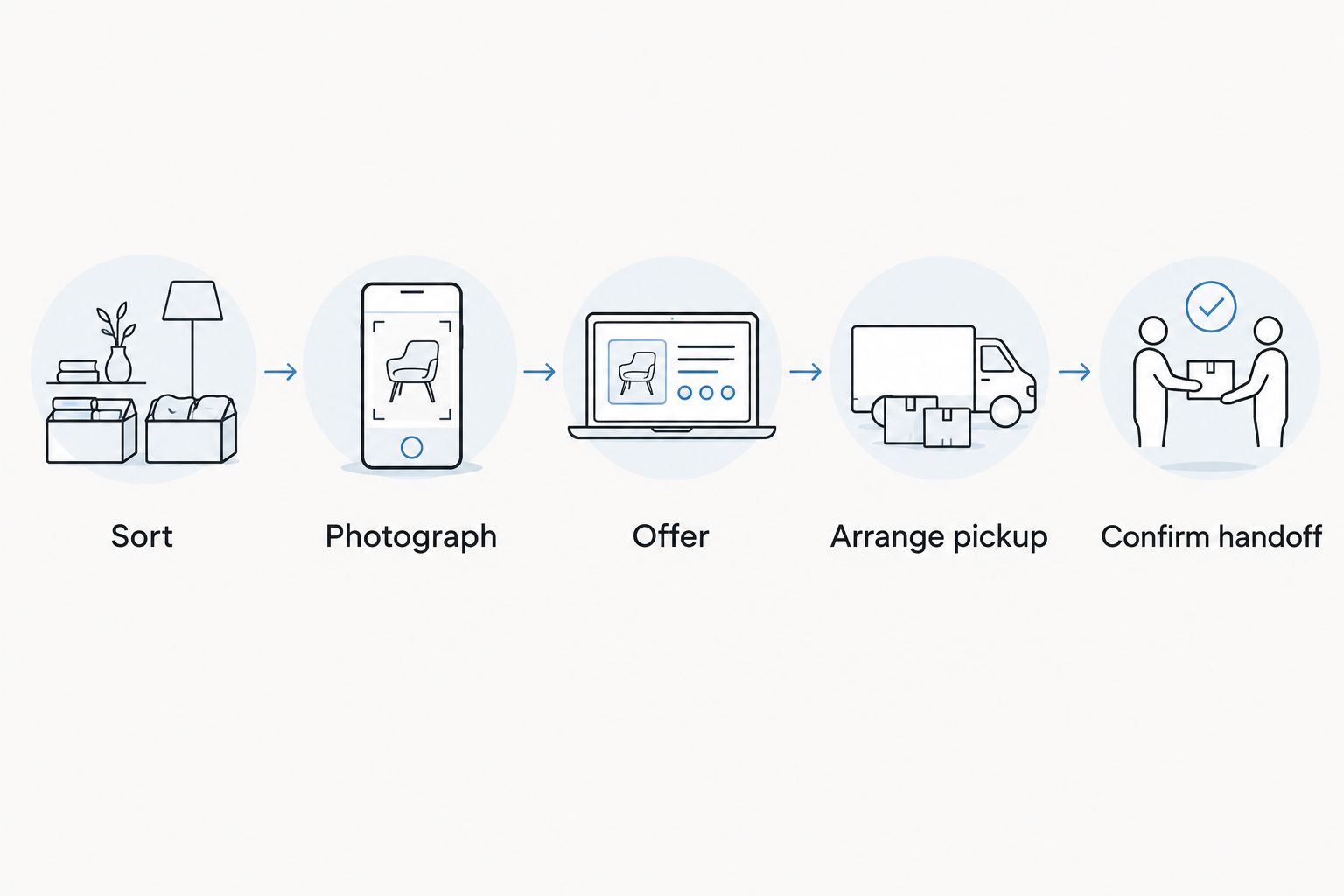
The physical sequence is Sort, Photograph, Offer, Arrange pickup, and Confirm handoff. Keep those stages separate: photographing a shirt does not mean it has been offered, and an interested reply does not mean it has left your home.
Give stalled items an exit deadline
Choose a review point before posting. For example, check an unanswered offer after 48 hours; that is a suggested personal reminder, not a Buy Nothing rule or a promised response time.
At that review, check whether the description needs clarification and whether your collection window is too restrictive. Make changes only as your community permits, and do not repeatedly repost against its rules.
If direct gifting is no longer practical, close the offer properly before changing routes. The donation pickup workflow provides a related planning route; check the receiving organization’s clothing criteria before making arrangements.
Repeat the routine when your closet changes
You do not need a full wardrobe overhaul to use this workflow. Attach it to an existing decision point: changing seasonal clothes, putting away laundry, or noticing that a drawer no longer closes comfortably.
A seasonal closet change
- Review before storing. Inspect the clothes you are about to pack away and decide whether you still want them.
- Create a coherent offer. Group related items only when their sizes, condition, and purpose are clear.
- Finish the exit. Photograph and offer the outgoing batch before packing the clothes you are keeping, or schedule a specific follow-up session.
Expected result: You store the wardrobe you have chosen to keep rather than postponing the same decisions until the next season.
A rolling household routine
- Keep a small outgoing bag accessible. Place it somewhere dry and out of shared walkways. The bag is a temporary station, not permanent clothing storage.
- Add only decided items. Do not mix clothes awaiting repair, laundry, or a household member’s permission into the offer bag.
- Review the bag during a weekly reset. A suggested 10-minute review is enough to inspect the queue and choose your next action; allow separate time for photographs or conversations when needed.
Expected result: Everyday decisions feed a manageable gifting routine instead of building toward another large cleanout.
For your 2026 routine, choose either the seasonal trigger or the weekly review as the main starting point. Add the other only if you can finish the handoffs without letting the outgoing zone expand.
Troubleshooting
Nobody responds to the clothing offer
Check the basics before adding more clothes. Confirm that the garment type, labeled size, condition, and general pickup area are clear, then review whether the photographs show the actual items well.
If the offer still has no response, follow your community’s rules for closing or changing it. Use your alternative exit rather than letting an unanswered post reserve closet space indefinitely.
A recipient misses the agreed collection
Send a private message to confirm whether the arrangement still stands. Set a new window only if it works for you, and follow local rules before offering the item to someone else.
Keep the garment in the arranged zone until you have resolved the conversation. Do not create competing collection promises.
You receive more messages than you can manage
Reduce the number of active offers. Combine only genuinely related clothing into a clearly described bundle, and give a collection window you can support.
Review messages at a planned point instead of interrupting every household task. Follow any response expectations in your community’s rules.
A recipient asks about a flaw after pickup is arranged
Pause the handoff and provide an accurate description or photograph. Give the recipient room to reconsider rather than treating an earlier reply as an obligation.
Correct the original offer where appropriate. The goal is a useful gift, not simply an empty bag.
The outgoing bag becomes another clutter pile
Stop adding items and finish the existing batch. Check each entry for the next action: clarify the offer, confirm collection, close the post, or use another suitable exit.
Stashsavvy recommends limiting the outgoing zone before increasing the decluttering pace. A smaller completed batch is more useful than a larger pile waiting for attention.
Customize your workflow
Adjust the routine to your space and privacy preferences. In a shared home, agree on where outgoing clothes can wait; in a small apartment, use an existing bag rather than buying a dedicated sorting station.
If doorstep collection does not suit you, choose another mutually agreed arrangement that follows community rules. Do not disclose access codes, household schedules, or information unrelated to the handoff.
Keep your 2026 tracking note minimal. Record only what you need to complete current arrangements, then remove collection details you no longer need rather than building a permanent record of neighbors’ information.
FAQ
How do I connect Buy Nothing groups to my closet declutter routine?
Sort a small clothing batch, photograph it, publish an offer under your local community’s rules, and arrange a handoff. Track the item until collection is confirmed; posting alone does not finish the declutter.
Do I need an app integration to make this work?
No app integration is required for this routine. A bag, your phone, and a private tracking note connect your closet decisions to the gifting process.
Should I offer clothes individually or as a bundle?
Offer a distinctive garment individually and group clothes only when the bundle is coherent and clearly described. Individual offers provide more detail, while bundles reduce separate conversations but require recipients to assess several items.
Can I give away clothes with stains or damage?
Check your community’s rules before offering damaged clothing, and describe every relevant flaw. Do not hide damaged pieces inside a bundle; identify repair or fabric-use items accurately if those offers are permitted.
What should I do if someone does not collect the clothes?
Contact the recipient privately to clarify the arrangement and follow your community’s rules before offering the clothes again. Agree to a replacement collection window only if it works for you.
Is it safe to put my address in the public offer?
Keep your exact address and entry instructions out of the public offer. Share necessary collection details privately after confirming an arrangement, and choose a handoff method you are comfortable using.
When should I switch from gifting to donation?
Switch when your chosen review point arrives and direct gifting no longer fits your time or space. Close any active offer and resolve recipient arrangements first, then check the donation organization’s acceptance rules.
One last thing
The outgoing bag needs a boundary more than it needs a label. Before your next closet session, decide where it will sit, how much it can hold, and when you will review it.
Stashsavvy’s practical recommendation is to finish that bag before opening another drawer. Reclaiming your space means completing the exit, not finding a tidier place to postpone it.
Related guides
- Use Google Calendar for a repeatable decluttering workflow
- Compare closet organizer systems after decluttering
- Explore decluttering apps for tracking your next steps