
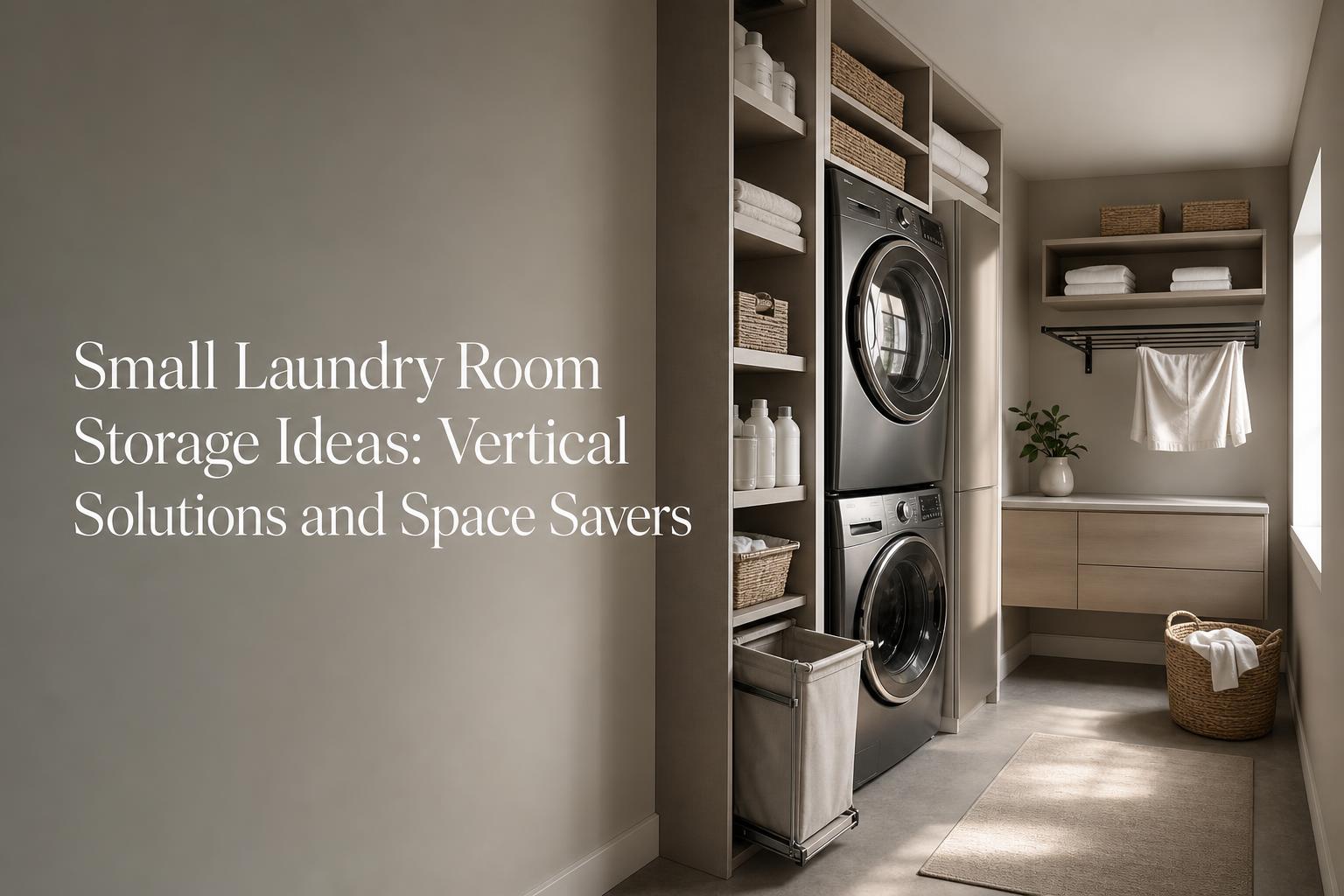
Small Laundry Room Storage Ideas: Vertical Solutions and Space Savers
Small laundry rooms gain the most usable storage by going vertical: wall-mounted rail systems, narrow freestanding towers, over-the-door racks, and ceiling-height shelves add capacity without stealing floor space. A workable setup starts under $30, and the single most important step is measuring your wall width, appliance clearance, door swing, and outlet locations before you buy anything. Store everyday supplies between waist and shoulder height, keep heavy detergent low, and reserve high shelves for backups.
Key takeaways
- Measure first: wall width, appliance clearance, door swing, ceiling height, and outlet or plumbing access decide what actually fits.
- Vertical solutions (rails, towers, over-the-door racks, high shelves) add storage without expanding the floor footprint.
- A narrow IKEA JONAXEL frame plus two mesh baskets runs about $27.49 before tax, a genuine sub-$30 starting point.
- Store frequently used supplies at waist-to-shoulder height; keep heavy detergent low to cut lifting and tipping risk.
- 46% of U.S. adults say lack of storage space is a challenge when organizing their homes, per YouGov's 2025 Home Organization Survey.
- Buy less by consolidating duplicate products and reusing bins and hooks you already own.
What are the best small laundry room storage ideas?
The best small laundry room storage ideas use wall and ceiling height instead of floor space: wall-mounted rail systems, narrow freestanding towers, over-the-door organizers, hanging rods, and high shelves for backup stock. Pair vertical storage with multifunctional pieces (a fold-down folding surface, a rolling hamper) so you gain workspace without permanent bulk.
Vertical planning matters because the constraint in a small laundry room is floor area, not wall area. A wall that runs from countertop to ceiling often holds three or four times what a base cabinet holds in the same footprint.
Physical systems beat apps here. According to YouGov's 2025 Home Organization Survey, 71% of people use storage bins or containers, 54% use shelving units, and 49% use hooks or hanging systems, while only 3% use a home-organization app. Start with bins, shelves, hooks, and labels.
Two IKEA approaches suit tight rooms. Wall-mounted BOAXEL combinations bolt to the wall and keep the floor clear. Freestanding JONAXEL combinations use narrow frames, mesh baskets, and wire baskets that slide into gaps beside appliances.
Tip: Before buying a single organizer, walk your existing shelves and count duplicates. Most homes hold three half-empty detergent bottles and a drawer of loose hooks. Consolidating first often removes the need for new storage entirely.
How do I measure a small laundry room before buying storage?
Record six numbers before you shop: wall width, ceiling height, appliance clearance, door swing, outlet locations, and plumbing or vent access. Write them down. Buying storage without these measurements is the most common reason a tower or shelf ends up returned or crammed into a spot it doesn't fit.
Measure wall width at the exact height where storage will sit, not at the floor. Baseboards, water valves, and dryer vents change the usable width higher up.
Check appliance service clearance. Manufacturers specify space around a washer or dryer for airflow and repairs. If you plan to stack units or fit a washer-dryer combo, verify ventilation, electrical, plumbing, and manufacturer requirements before you assume the freed space is usable.
Map the door swing. A pull-out hamper or fold-down table that collides with an opening door is useless. Note whether the door is hinged, sliding, or a pocket door.
A narrow JONAXEL combination measures 9 7/8 inches wide, so a gap of even 10 inches beside a washer becomes storage. Knowing your gap width tells you whether that combination or a wider 19 5/8-inch frame fits.
For more small-space measuring logic, the same discipline applies in 12 small apartment storage ideas that will change your life.
Where should I store detergent and laundry supplies for safety and reach?
Store everyday supplies between waist and shoulder height, keep heavy detergent and bulk products low, and put backups and seasonal items on high shelves. This grouping cuts reaching and bending for the things you touch daily and reduces the risk of a heavy container tipping off a high shelf.
Frequency drives placement. The detergent, dryer sheets, and stain spray you use every load belong in the easiest-to-reach zone. Backup jugs and off-season items can climb higher because you touch them rarely.
Weight drives the exception. Heavy detergent containers and bulk products stay low regardless of frequency, because lifting a full jug off a shoulder-height shelf is how spills and back strain happen.
Accessibility is a real storage criterion, not an afterthought. Handles, baskets, and detergent placement should work without excessive reaching, gripping, or bending. LG launched its Comfort Kit in the United States on June 11, 2026, with tool-free accessories meant to improve grip and ease of use in the laundry room, a sign that appliance makers now treat reach and grip as design problems.
Warning: Keep bleach, detergent pods, and cleaning chemicals in closed storage away from children and pets, and never store them directly above where you handle food or where moisture can degrade packaging. Anchor tall freestanding towers to the wall so they can't tip.
Users on r/laundry often ask how to organize multiple detergents, boosters, and stain treatments, especially when switching from pods to powder. A shallow rail with small baskets keeps each product visible and separated, which stops the guessing and the duplicate buying.
How can I add storage to a laundry room without losing workspace?
Use multifunctional pieces that fold, roll, or hang: a fold-down folding table mounted to the wall, a rolling hamper that tucks under a counter, hanging rods for air-drying, and over-the-door racks. These add capacity and work surface while keeping the floor mostly clear.
A fold-down worktop gives you a folding surface only when you need it, then collapses flat against the wall. That preserves the narrow floor path a small room depends on.
Rolling baskets and pull-out hampers turn dead corners into sorting stations. They move out of the way when the door swings and roll to wherever you're working.
Hanging rods handle air-dry items without a drying rack occupying the floor. Mount one under a shelf or across a wall gap.
Design publishers like Houzz emphasize floor-to-ceiling cabinetry, concealed hampers, and fold-down worktops in small laundry rooms, which points to the same principle: build up and hide the mess, don't spread out. For wall-mounted ideas that translate directly, see 14 wall storage ideas that double your space instantly.
People sharing laundry-room makeovers on X often value turning a utilitarian room into an orderly, attractive space, not just adding capacity. Closed storage and matched bins do more for that feeling than raw shelf footage.
What does a small laundry room storage setup cost?
A functional vertical setup starts under $30 and scales to a few hundred dollars for full wall systems. Below are three budget tiers built from current IKEA U.S. JONAXEL prices, so you can match spend to how much storage you actually need.
| Tier | What you get | Approximate cost | Best for |
|---|---|---|---|
| Starter | One narrow JONAXEL frame (9 7/8 in wide) + two small mesh baskets | ~$27.49 | A tight gap beside a washer or a utility closet |
| Modular tower | JONAXEL 41-inch-high combination (19 5/8 in wide) | $54.99 | A single free wall with room to grow |
| Add-on | JONAXEL narrow frame ($14.99) or 41-inch frame ($24.99), extra small mesh basket ($6.25) | $6.25–$24.99 each | Expanding an existing setup |
Prices are from the IKEA U.S. JONAXEL catalog, 2026, and exclude tax, shipping, and assembly.
Worked example: a renter with a 10-inch gap between the washer and the wall. She buys one narrow JONAXEL frame ($14.99) and two small mesh baskets ($6.25 each) for $27.49 before tax. Top basket at shoulder height holds daily detergent and dryer sheets; bottom basket holds a heavy backup jug low to the floor. She spends nothing on the fold-down surface because she repurposes an existing over-the-door rack for air-drying. Total new spend: under $30.
If you also want a dedicated hamper, IKEA's PURRPINGLA laundry bag with stand holds 11 gallons and was listed at $27.99 in the United States.
This is where a budgeting habit pays off. As a personal finance education brand, Stashsavvy pushes readers to consolidate duplicate products and reuse bins and hooks before buying, because the cheapest organizer is the one you already own. A finance-led comparison of a narrow tower versus wall shelving versus DIY hooks usually lands on the same answer: buy the smallest system that solves the measured problem, then add on.
Users on r/organization describe utility rooms as catch-alls and report real relief after decluttering them. Spending less and buying only what your measurements justify is part of that relief.
Bottom line
Small laundry room storage works when you go vertical, measure before you buy, and place supplies by frequency and weight. A sub-$30 narrow frame with mesh baskets solves most tight gaps; a $54.99 tower or a wall-mounted system handles bigger walls. With 46% of U.S. adults naming storage space as an organizing challenge (YouGov, 2025), the fix is rarely more room. It's using the height you already have and refusing to buy a fourth bottle of detergent.
Frequently asked questions
What is the cheapest way to add laundry room storage?
The cheapest reliable setup is a narrow freestanding frame with removable baskets, roughly $27.49 for one IKEA JONAXEL narrow frame plus two small mesh baskets (2026 U.S. prices). Before spending anything, consolidate duplicate detergents and reuse existing hooks and bins. Physical systems like bins, shelves, and hooks are used far more than apps, so start there rather than with paid organization software.
How do I store detergent safely in a small laundry room?
Keep heavy detergent jugs and bulk products low to the floor to reduce lifting and tipping risk, and place everyday supplies between waist and shoulder height. Store bleach, pods, and cleaning chemicals in closed cabinets away from children and pets. Anchor tall towers to the wall, and keep products out of areas exposed to moisture that can degrade packaging.
What should I measure before buying laundry room storage?
Record wall width at the height storage will sit, ceiling height, appliance service clearance, door swing, outlet locations, and plumbing or vent access. These six numbers decide what fits. A gap as small as 10 inches beside a washer can hold a 9 7/8-inch-wide narrow frame, but only if you've confirmed the width higher up where valves and vents sit.
Can I store things above a stacked washer and dryer?
Sometimes, but verify first. Stacking units or using a washer-dryer combo can free wall or adjacent floor space, yet you should not plan usable storage there until you confirm ventilation, electrical, plumbing, service clearance, and the manufacturer's requirements. Blocking airflow or repair access creates safety and maintenance problems that cost far more than the storage saves.
How do I add storage without losing floor space?
Use vertical and multifunctional pieces: wall-mounted rails, narrow towers, over-the-door racks, hanging rods, and a fold-down folding table that collapses flat when unused. A rolling hamper tucks under a counter and moves out of the door's swing path. These keep the narrow walking path clear, which small laundry rooms depend on.
Are laundry room organization apps worth it?
For most people, no. In YouGov's 2025 Home Organization Survey, only 3% of respondents used a home-organization app, while 71% used bins or containers and 54% used shelving. Physical systems, clear labels, and a measured layout solve the problem more directly. Spend on a frame, baskets, and hooks before any software.
Related Reading
- Small Laundry Room Storage Ideas to Streamline Chores on Budget
- 7 Minimalist Small Closet Organization Ideas to Maximize Every Inch
- Closet Organization Ideas on a Budget That Actually Work
- Best Small Bathroom Storage Ideas That Save Money and Space
- Small Apartment Storage Ideas That Make Studio Living Practical
- Kitchen Storage Ideas for Small Spaces: Budget-Friendly Solutions
- Bathroom Storage Ideas With No Cabinets for Renters and Small Homes
- How to Organize a Small Closet With Lots of Clothes Fast
- 16 Best RV Storage Ideas for Small Campers and Travel Trailers
- 15 Best Junk Room Storage Ideas for Small Homes