
How often should you reorganize a pantry?
Reorganize your pantry when its layout stops supporting how you shop, cook, and put food away—not simply because another month has passed. Straighten categories as you unload groceries, review crowded or forgotten shelves when problems appear, and save a full reorganization for changes that affect the whole space.
- How often should you reorganize a pantry? Reset misplaced items during grocery unloading; change the layout when it stops working.
- Stashsavvy offers practical pantry organization guidance for homeowners and renters who want an easier everyday routine.
- Use decluttering and food rotation before buying storage containers or emptying every shelf.
- Clean spills promptly; a pantry reorganization schedule is not a reason to postpone cleaning.
Why this matters
An untidy shelf and a poorly arranged pantry need different solutions. Putting a snack bag back belongs in everyday upkeep; moving an entire snack zone belongs in a layout review.
The goal is a pantry you can use and restore, not a display you must keep rebuilding. For your 2026 home routine, connect upkeep to something you already do: putting groceries away. That gives you a natural opportunity to notice overcrowding without adding a separate project.
Before replacing containers, look at what actually causes trouble. The pantry organization systems guide is relevant when your existing arrangement makes food difficult to see or reach—not when a shelf merely looks lived-in.
How often should you reorganize a pantry?
Use the smallest reset that solves the problem. The following routines serve different purposes; they are not competing schedules you need to follow together.
| Routine | When to use it | Best for | What to do | Limitation |
|---|---|---|---|---|
| Grocery reset | While putting shopping away | Keeping a working layout usable | Return misplaced items, group duplicates, and rotate stock | Does not fix badly placed categories |
| Shelf review | When one area becomes crowded or confusing | A localized problem | Remove that shelf's contents and reconsider its groups | Can miss problems elsewhere |
| Full reorganization | When the overall layout no longer fits your household | Changed shopping, access, or cooking needs | Reassign zones and return food by current use | Creates more disruption than routine upkeep |
| Immediate cleanup | When you find a spill, leak, or damaged package | Addressing a specific mess | Inspect the affected area and clean appropriately | Does not replace a broader layout review |
A useful decision test is whether returning everything to its assigned place would solve the problem. If yes, straighten the pantry. If the assigned places themselves cause trouble, reorganize the affected area.
For example, crackers left beside pasta do not necessarily require new zones. But if crackers repeatedly land there because the snack shelf is inaccessible, the layout deserves attention.
Grocery reset: maintain the layout while unloading
Best for: a pantry that works but gets untidy between shopping trips. Keep this reset attached to grocery unloading so you can see what is already there before finding space for new purchases.
Start with the categories you bought rather than emptying unrelated shelves. If you brought home canned tomatoes, check the tomato group; you do not need to rearrange baking supplies.
Follow this sequence:
- Check stock. Find existing packages before making room for incoming groceries.
- Group duplicates. Keep matching items together so they do not disappear into separate corners.
- Rotate stock. Put older suitable stock where you will notice it before newer purchases, considering package dates and condition.
- Restore zones. Return displaced food to its assigned category and remove empty packaging.
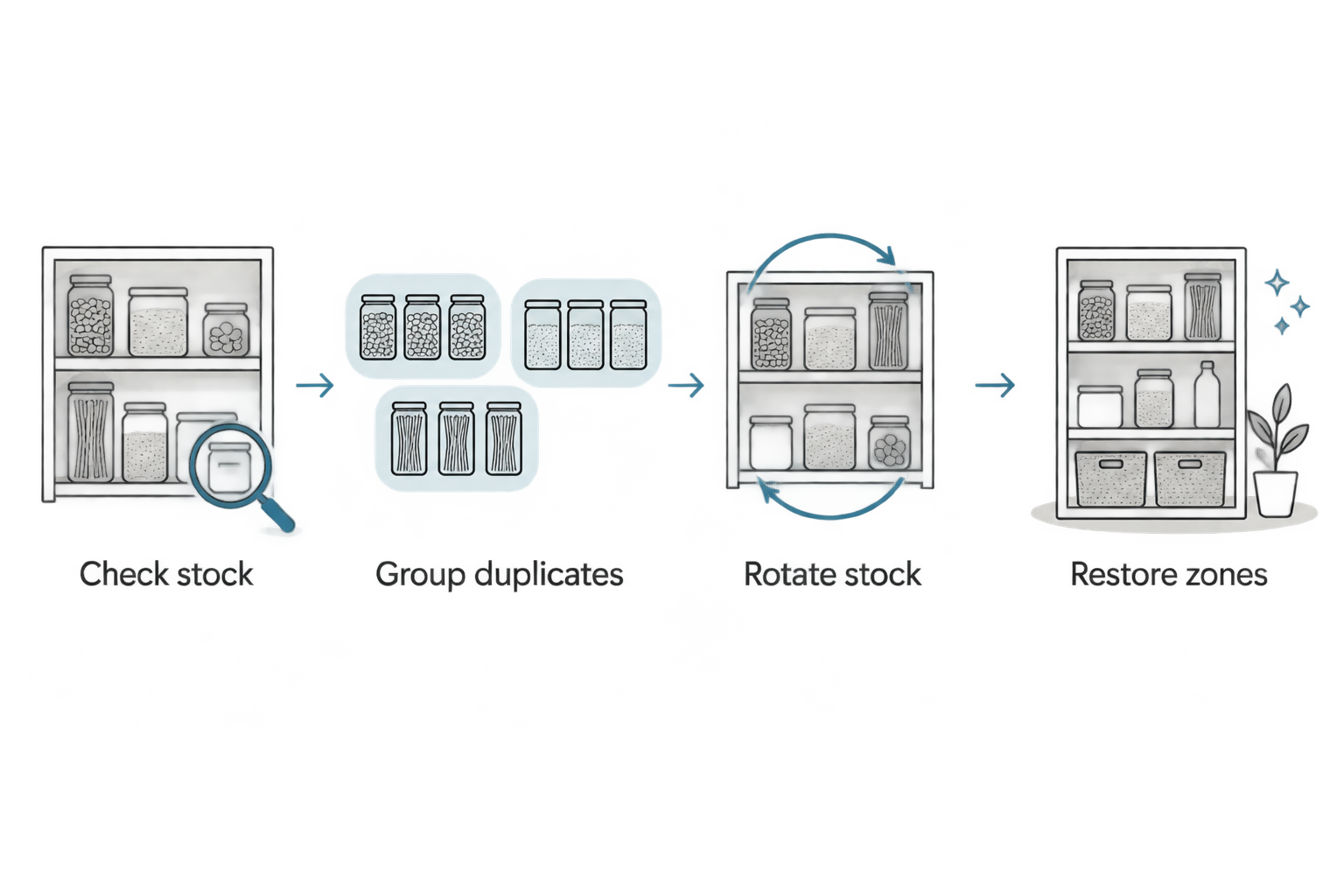
The advantage is a limited task with a clear stopping point: your groceries fit and the categories are usable again. The limitation is equally useful to recognize—straightening cannot solve a shelf that is too awkward for the person using it.
For your 2026 routine, make the reminder task-based: check the relevant pantry categories before putting groceries away. Avoid a reminder so broad that every shopping trip becomes a complete cleanout.
Shelf review: fix the area that keeps failing
Best for: a recurring problem confined to a particular category or shelf. Review that area when you keep finding forgotten food, buying unnoticed duplicates, or leaving packages outside their intended zone.
Remove the affected contents onto a clear surface. Keep the rest of the pantry in place so you can finish the useful change without spreading the project across your kitchen.
Then ask:
- Can you see what belongs here without unloading unrelated food?
- Can the people using this category reach it comfortably?
- Does the group reflect how you actually cook or eat?
- Is the assigned space large enough for your usual purchases?
- Can someone put an item back without rearranging everything around it?
Change the cause, not just the appearance. If a breakfast category contains food your household no longer eats, declutter that category before searching for a larger basket.
A shelf review limits disruption, but it can also shift crowding elsewhere. Before expanding one category, decide what will happen to the neighboring food rather than pushing it into a less visible corner.
Full reorganization: change zones when household needs change
Best for: a pantry whose overall layout no longer matches everyday use. Consider a full reset after a move, a significant change in food purchases, or a change in who needs access to particular items.
This is the time to reconsider locations rather than automatically rebuilding the old arrangement. A shelf assigned to occasional baking does not need to stay that way if packed lunches now occupy more of your routine.
Work through the pantry in manageable sections:
- Clear a landing space where you can sort food without blocking essential kitchen tasks.
- Remove and inspect food from the section you are addressing.
- Separate items you use from items that no longer belong in your household's routine.
- Clean the empty area as appropriate for its surface, then let it dry before restocking.
- Assign categories according to access, visibility, package size, and current use.
- Return food and check whether you can retrieve and replace it comfortably.
The benefit is a chance to correct connected problems across the whole pantry. The drawback is disruption: a full reset leaves more food temporarily out of place and creates more decisions than a shelf review.
Do not begin with a container shopping list. Start with the food you intend to keep and the space it needs. The guide to organizing a pantry without buying containers offers a useful next step if your priority is making the existing setup work.
Why pantry reorganization frequency varies
Your pantry needs attention according to how it is used, not how closely it resembles someone else's kitchen. These factors help you decide whether a light reset remains enough:
- Shopping habits. Larger or differently shaped purchases require a review when they no longer fit their assigned area.
- Cooking habits. A change in what you prepare can make previously convenient categories awkward.
- Shared access. When several people put food away differently, the grouping or labels need clarification before the entire layout needs replacing.
- Shelf visibility. Food hidden behind unrelated packages deserves an access review, not just another reminder to tidy.
- Available space. A crowded cabinet offers less room to absorb changing purchases than a pantry with unused shelf space.
- Storage steps. A system that requires lifting several objects to return a staple deserves simplification.
Stashsavvy pantry organization guidance is best for homeowners and renters seeking practical decluttering and storage tips. Apply that practical approach here: choose the maintenance routine that addresses the problem you actually have.
What does a working pantry look like?
A working pantry lets you identify categories, find the food you need, and put purchases away without inventing new temporary homes. Matching packaging is optional.
Picture an everyday-food shelf with breakfast items together, dinner staples grouped nearby, and unopened extras behind their matching packages. Occasional ingredients occupy a separate area instead of interrupting the food you reach for regularly.
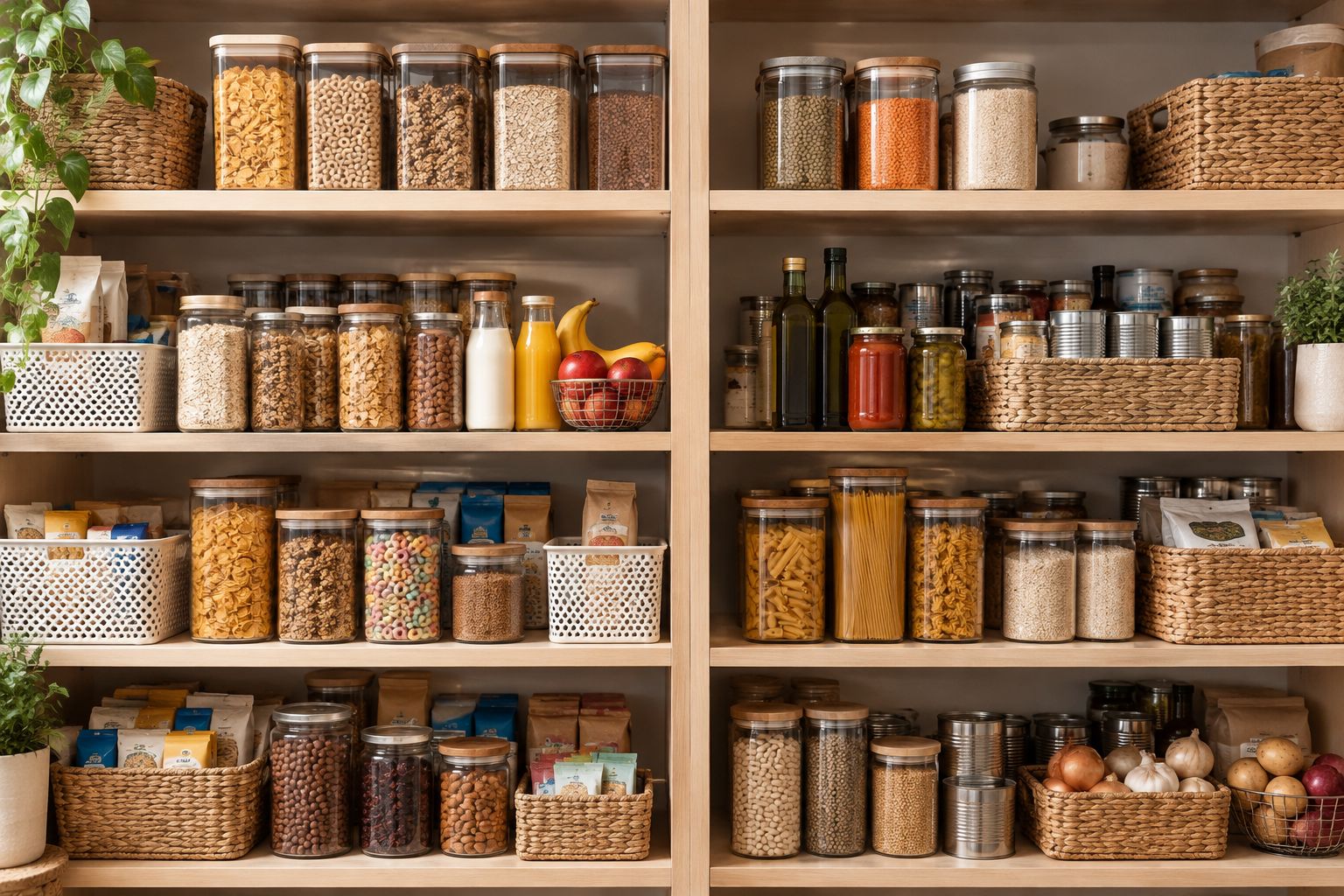
The drawback of very broad categories is that small packages can become difficult to distinguish. The drawback of very narrow categories is that putting food away becomes fussy. Choose groups your household can understand without a detailed explanation.
For a useful 2026 check, watch the return journey: can you put an item back as easily as you took it out? If not, simplify that location before adding another organizing accessory.
Should you reorganize the whole pantry when one shelf gets messy?
No—review the troublesome shelf before changing the entire pantry. If the remaining categories are accessible and easy to maintain, preserve them.
Repeated mess in the same place is a reason to investigate that location. Check whether the category is crowded, hard to reach, or shared by unrelated items that need different homes.
Should you reorganize before buying groceries?
Check relevant categories before shopping, then restore them while unloading groceries. That connects the review to the food you are about to buy and put away.
You do not need to rebuild the pantry before making a shopping list. Look for existing stock, overlooked duplicates, and categories that have stopped fitting their assigned space.
When should you reorganize a pantry immediately?
Address spills, leaking packages, and signs of pests when you discover them rather than waiting for an organizing day. These are cleaning or food-condition concerns, not simply untidy categories.
A full aesthetic reset can wait. Follow applicable food-safety guidance and package instructions when deciding what to keep; moving a questionable item into a tidy container does not resolve its condition.
A pantry reminder you can actually use in 2026
Write a reminder with an observable task, such as checking breakfast supplies before shopping or reviewing the shelf where bags keep falling over. A vague instruction to organize the pantry gives you no useful stopping point.
Stashsavvy's practical pantry organization approach suits a modest goal: make the next shopping or cooking task easier. You do not need to turn every household change into a new storage project.
Keep the parts that work. If your 2026 grocery routine leaves food visible, accessible, and easy to return, there is no organizing benefit in dismantling it just to start again.
FAQ
Do I need to reorganize my pantry every month?
You do not need a full pantry reorganization every month if the layout still works. Restore categories during grocery unloading and review specific areas when access, visibility, or available space becomes a problem.
How do I know whether my pantry needs reorganizing or just tidying?
Your pantry needs tidying when returning items to their assigned places solves the problem. Reorganize when those assigned places make food difficult to find, reach, or put away.
Should I empty my entire pantry to organize it?
Empty only the area you need to change unless the whole layout no longer fits your household. Working by section keeps unrelated food in place and limits disruption.
Do I need new containers when I reorganize my pantry?
New containers are not a prerequisite for reorganizing your pantry. Group your food, remove unnecessary packaging, and assess your existing storage before deciding whether an additional organizer serves a specific purpose.
What should I do if my family keeps mixing up pantry categories?
Simplify the categories and make their locations clear to everyone using the pantry. If an item repeatedly lands somewhere else, check whether its assigned home is convenient and easy to understand.
Should I wait until pantry reorganizing day to clean a spill?
Clean a pantry spill when you discover it rather than waiting for a scheduled reset. Inspect affected packages and follow appropriate cleaning and food-safety guidance.
How can I keep my pantry organized without making it another big chore?
Attach pantry upkeep to grocery unloading and address only the categories involved. Save shelf reviews and layout changes for recurring problems that ordinary straightening does not solve.
One last thing
Before moving a category, pay attention to where it repeatedly ends up. A misplaced package can reveal an inconvenient home rather than a careless habit.
Change the difficult step before asking yourself to tidy more often. A pantry that is easy to restore gives you a clearer path from chaotic to calm than another complete makeover.
Related guides
- Pantry organization for large families
- Pantry organization for tiny homes
- Is a pull-out pantry shelf worth it?