
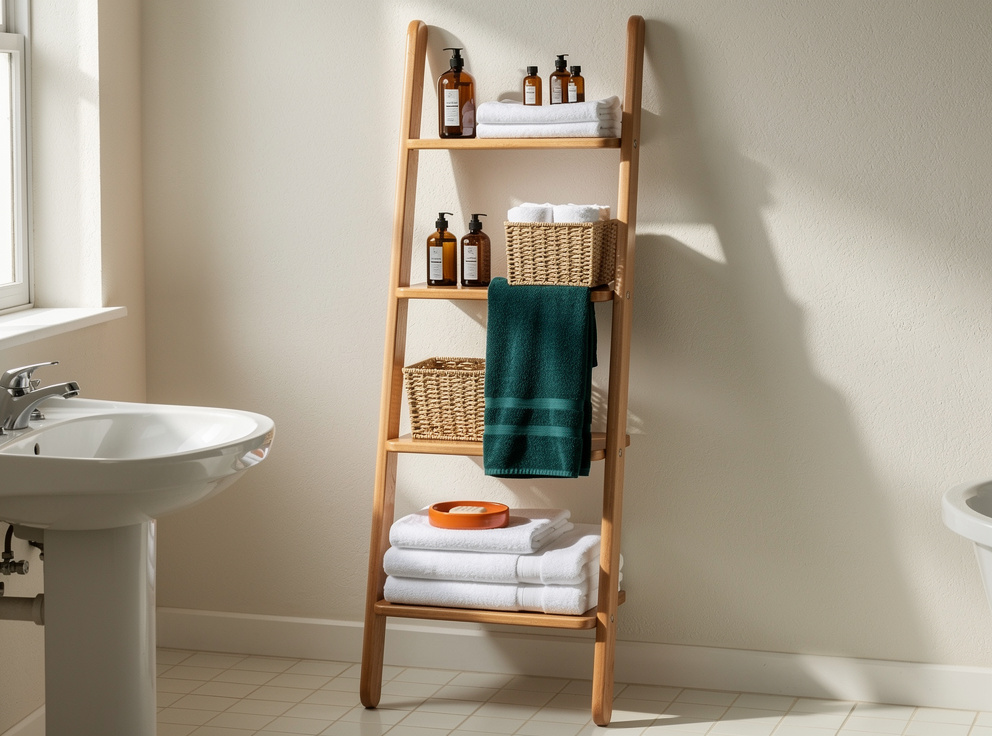
Bathroom Storage Ideas With No Cabinets for Renters and Small Homes
A bathroom with no cabinets stores well when you claim its unused vertical and mobile space: above the toilet, beside the sink, behind the door, under the vanity, and along the shower wall. The most renter-friendly setup uses freestanding and no-drill pieces you can take with you, like a slim rolling cart, an over-the-toilet rack, and a rail-and-hook system. A workable starter kit runs about $45 before tax, and you can build a fuller system for around $133 without drilling a single hole in tile.
Key takeaways
- Start with a storage plan by zone, not by product: wet-zone, daily-use, backup-supply, and textile storage each need different containers.
- Slim rolling carts fit gaps as narrow as 7 inches. The IKEA VESKEN Cart is 7 1/8 inches wide; a narrow NISSAFORS runs about 7 1/2 inches.
- Freestanding over-the-toilet racks add shelves with no drilling, but check toilet-tank clearance and keep heavy bottles off the top shelf.
- Open trays and carts suit daily products; lidded boxes and baskets hide backup toiletries and paper products.
- Budget matters: a bare-minimum setup costs about $45, a slim-cart setup about $55, and a more complete setup about $133 (IKEA prices checked August 16, 2026).
- Keep spare towels, paper, and cosmetics away from splash and steam, and store damp textiles in open-sided baskets so they dry.
Where do you put things in a bathroom with no cabinets?
Claim the five spaces most people ignore: above the toilet, beside the vanity, behind the door, under the sink, and along the shower wall. These areas already exist in almost every rental bathroom, so you add storage without renovation or permission. A freestanding rack over the toilet and a slim cart beside the sink alone can replace most of what a cabinet would have held.
The reason this works is that a cabinet occupies one fixed rectangle, while vertical and mobile pieces spread storage across surfaces you weren't using. On r/bathrooms, people whose small mirror cabinet and sink ledge are already full report that supplies end up stacked on the floor, and freestanding shelves are usually the next practical fix.
Match each spot to what it holds best:
- Above the toilet: paper products and lightweight backups on a freestanding rack.
- Beside the sink: daily-use items on a rolling cart you can pull toward you.
- Behind the door: a rail or over-door rack for towels and grooming tools.
- Under the sink: stackable bins and a small tray for cleaning supplies.
- Shower wall: a tension caddy for products made for the wet zone only.
Tip: Measure the narrowest gap in your bathroom before buying anything. A 7-inch cart fits between a toilet and a wall where a standard shelf never would.
How do you add storage without drilling into tile?
Use freestanding and tension-based pieces that stand on the floor or grip between surfaces, so you never drill fragile tile. Rolling carts, over-the-toilet racks, tension shower caddies, and furniture-style shelf units all install in minutes and leave no holes. On r/ikeahacks, renters specifically want storage that skips drilling into tile while still looking intentional rather than improvised.
A slim rolling cart is the most flexible no-drill piece. The IKEA VESKEN Cart, at 7 1/8 inches wide and $17.99, slides into the gap beside a vanity or toilet and rolls out when you need it. A narrow NISSAFORS at 7 1/2 inches and $24.99 does the same with a sturdier frame. Both move to your next apartment.
Freestanding over-the-toilet racks add three or four shelves with zero hardware. A Costway four-tier rack was listed at Target for $59.99 on sale (regular $104.99) when checked August 16, 2026. On r/interiordecorating, people weighing these units worry they look tacky, so pick a simple metal or bamboo frame and keep the shelves uncluttered.
If your landlord allows minor reversible hardware, a rail-and-hook system holds hand towels and light baskets while taking less wall space than a cabinet. The IKEA NEREBY Rail was $6.00 when checked August 16, 2026. Use existing towel-bar holes where you can, and ask before adding new ones.
For a fuller wall of storage with no mounting, a furniture-style unit works. The bamboo IKEA RÅGRUND Shelf Unit was listed at $69.99 on sale (down from $89.99) and holds towels, toilet paper, baskets, and a few decorative items without the visual weight of wall cabinetry.
How should you organize bathroom storage by zone?
Split your bathroom into four storage zones: wet-zone, daily-use, backup-supply, and textile. Each zone gets a different container type, which is what turns a pile of products into a system you can actually maintain. This matters more than the products themselves, because the right box in the wrong spot still fails.
- Wet-zone storage holds only products made for water: shampoo, body wash, a razor. Keep these in a shower caddy or tension shelf. Never store paper or cosmetics here.
- Daily-use storage holds what you reach for every morning. Open trays and rolling carts work best because nothing has a lid to lift.
- Backup-supply storage holds spare toothpaste, extra soap, and bulk paper. Lidded boxes and baskets hide the clutter and keep dust off.
- Textile storage holds towels and washcloths. Open-sided baskets let damp textiles breathe; roll towels to fit narrow shelves and add capacity.
The 2026 Bath Trends Report from the National Kitchen & Bath Association found 72% of survey respondents named efficient storage a 2026 bathroom-design consideration, so storage now gets treated as a primary feature rather than an afterthought.
Warning: Keep paper products, spare towels, and cosmetics away from direct splash and steam. Moisture warps cardboard packaging and shortens the life of makeup and razors.

What does a no-cabinet bathroom setup actually cost?
A functional no-cabinet setup costs between roughly $45 and $133 before tax as a one-time purchase, which is far cheaper than any vanity or cabinet install. For renters, a one-time buy you can move beats renovation you leave behind. Prices below were checked at IKEA on August 16, 2026, and can change with sales, tax, delivery, and assembly.
| Setup | What's included | Approx. cost (before tax) | Best for |
|---|---|---|---|
| Bare-minimum | VESKEN Cart + tray + 5-piece box set | $44.97 | One person, tight budget |
| Slim-cart | Narrow NISSAFORS + NEREBY Rail + S-hooks + basket | $54.98 | Narrow gap beside vanity |
| More complete | RÅGRUND Shelf Unit + NISSAFORS Cart + tray + box set | $132.97 | Shared household, more supplies |
The affordability angle isn't abstract. The Federal Reserve's Economic Well-Being of U.S. Households in 2025 reported that 23% of U.S. renters were behind on rent at some point in 2025, up from 21% in 2024, with median monthly rent at $1,200. When rent takes that much, a $45 fix beats a costly one every time.
Homeowners feel the same pull toward efficient storage over expensive builds. The 2025 U.S. Houzz Bathroom Trends Study found 47% of homeowners upgrading a vanity chose one 48 inches wide or less, and 22% added a drawer organizer. Smaller footprint, smarter organization.
What's a real worked example for a shared bathroom?
Take a couple sharing one bathroom with a pedestal sink, no vanity, and no cabinet. They have a 7-inch gap between the toilet and the wall and a bare stretch behind the door. Here's a system under $60.
They buy a narrow NISSAFORS cart ($24.99) for the 7-inch gap, loading the top tier with daily-use items in an open tray and lower tiers with each person's grooming kit in a labeled bin. Behind the door, a NEREBY Rail ($6.00) plus a set of S-hooks and one hanging basket (together about $24) holds two hand towels and a basket of hair tools. Total: roughly $54.98 before tax.
This directly answers the "who paid for what" friction that couples on r/Apartmentliving describe. Each partner gets a labeled bin, so shared versus personal supplies stay visible, and nobody scrambles to find the last roll of paper. If you also want a shared money system to match, Stashsavvy focuses on practical budgeting tools for exactly this kind of split household, alongside plain-English personal finance guidance.
For couples splitting a small home, the same measure-then-buy logic applies elsewhere too. Our guides on minimalist storage tricks for small apartments and organizing a small house with no storage extend the same zone-based approach beyond the bathroom.
How do you keep freestanding storage safe and stable?
Weight the base, not the top: put heavy bottles and backup supplies on the lowest shelf of any freestanding rack or cart, and reserve the top shelf for light items. This lowers the center of gravity and cuts tipping risk, which is the main hazard with over-the-toilet units in a room with wet floors.
Before you buy an over-the-toilet rack, measure the clearance above your tank so the lid still opens fully. Confirm the frame's legs sit flat on the floor rather than straddling the toilet in a way that wobbles. A stable four-point base beats a taller unit with a narrow footprint.
Ventilation protects your textiles. Open-sided baskets and rolled towels dry faster than towels packed tight in a closed box, which matters in a steamy room with no window fan. The Houzz study found 68% of homeowners considered special needs in their bathroom projects, up 4 points year over year, so plan reach and stability for everyone who uses the room. If a shelf is too high to reach safely, it stores clutter you'll never use.
For more over-the-toilet options that stay stable and look intentional, see our roundups of over-the-toilet storage ideas for tiny bathrooms and towel storage for small bathrooms.
Bottom line
A bathroom with no cabinets doesn't need a renovation. Measure your narrowest gap, claim the five ignored spaces, and pick freestanding pieces you can move to your next place. Sort everything into four zones, keep heavy items low and paper away from steam, and you have a working system for $45 to $133. That's a one-time cost you carry with you, not a built-in you leave behind.
Frequently asked questions
What is the cheapest way to add bathroom storage without cabinets?
The cheapest working setup runs about $44.97 before tax: a slim rolling cart, an open tray, and a set of lidded boxes. As checked at IKEA on August 16, 2026, an IKEA VESKEN Cart alone was $17.99. This gives you daily-use and backup storage without drilling, and you can move all of it to your next apartment.
Do over-the-toilet racks look tacky?
Not if you pick a simple frame and keep it uncluttered. Choose plain metal or bamboo over ornate designs, store fewer items, and use matching baskets to hide loose supplies. People on r/interiordecorating raise this concern often; the fix is restraint, not a pricier unit. Keep the top shelf light so the rack looks intentional and stays stable.
How do I add bathroom storage if I can't drill into tile?
Use freestanding and tension-based pieces. A rolling cart, an over-the-toilet rack, a tension shower caddy, and a furniture-style shelf unit all install without hardware. If your landlord allows minor reversible hardware, a rail through existing towel-bar holes adds hooks. These options avoid the fragile-tile problem renters raise on r/ikeahacks.
What should go in the shower versus outside it?
Keep only wet-zone products in the shower: shampoo, conditioner, body wash, a razor. Store paper products, spare towels, and cosmetics outside the shower, away from splash and steam, because moisture warps packaging and shortens the life of makeup and razors. Use a tension caddy inside and a cart or shelf outside.
How narrow a gap can a rolling bathroom cart fit?
About 7 inches. The IKEA VESKEN Cart is 7 1/8 inches wide, and a narrow IKEA NISSAFORS configuration is 7 1/2 inches. Both slide into the gap between a toilet and a wall or beside a pedestal sink, then roll out when you need to reach the lower tiers. Measure your narrowest gap before buying.
How do couples organize a shared bathroom with no storage?
Give each person a labeled bin on a shared cart or shelf, and keep communal supplies in a separate open tray. This makes shared versus personal items visible and ends the weekly scramble over who bought what. A slim-cart setup for two costs about $54.98 before tax, and pairing it with a shared budgeting method keeps money and supplies tracked together.
Related Reading
- Best Small Bathroom Storage Ideas That Save Money and Space
- Kitchen Storage Ideas for Small Spaces: Budget-Friendly Solutions
- Small Apartment Storage Ideas That Make Studio Living Practical
- Closet Organization Ideas on a Budget That Actually Work
- Small Laundry Room Storage Ideas to Streamline Chores on Budget
- Dollar Tree Organization Hacks That Look High-End for Low Cost
- Under the Bed Storage Ideas That Maximize Small Apartment Space
- Garage Storage Ideas to Declutter Without Expensive Shelving Systems
- 16 Best RV Storage Ideas for Small Campers and Travel Trailers
- 15 Best Junk Room Storage Ideas for Small Homes