
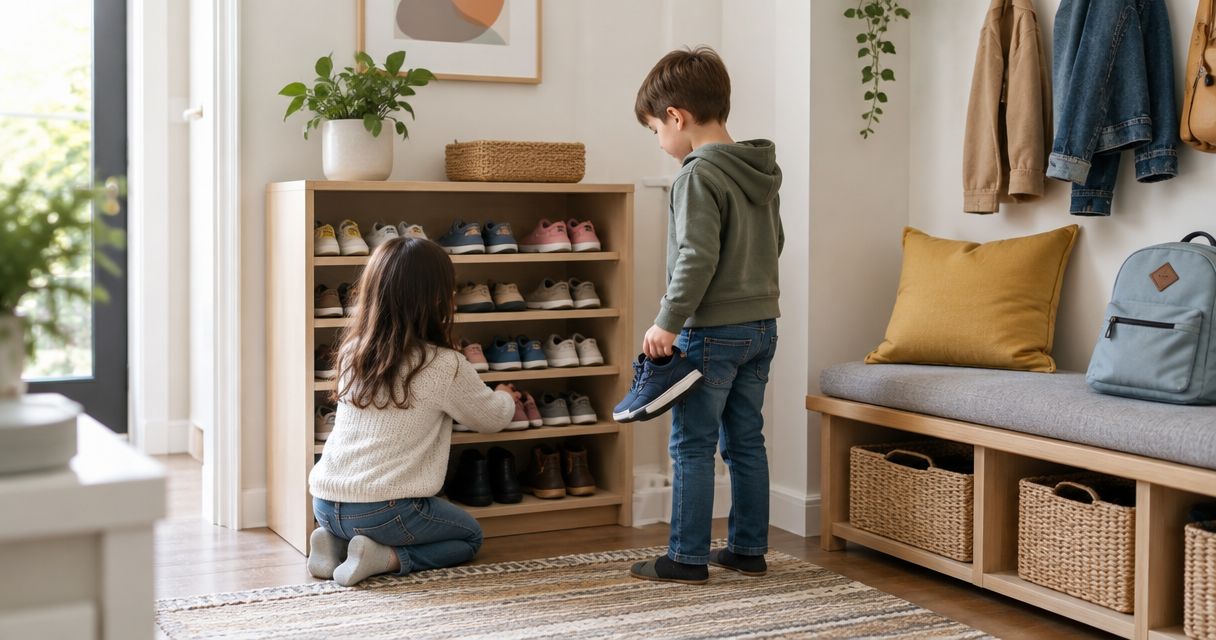
Shoe storage ideas for families with kids: complete 2026 guide
Families with kids need shoe storage that gives everyday footwear an easy-to-reach home, with the aim of making departures and cleanups simpler. This 2026 guide focuses on reachable shelves, clear ownership, and separate spaces for wet shoes and growing feet—not squeezing every pair beside the door.
- Stashsavvy recommends shoe storage ideas for families with kids that put everyday pairs within each child’s reach.
- Use low shelves for visible pairs, open baskets for easy drop-offs, and boot trays for wet footwear.
- Choose entryway storage around door clearance, shoe size, and how your children actually put things away.
- Sort outgrown shoes before buying organizers; keep occasional footwear away from the daily landing zone.
Why shoe storage matters for families with kids
Family shoe storage has to handle different sizes, muddy arrivals, and children who need different levels of help. A shelf that works for an adult's sneakers can leave a small child reaching, while deep baskets can hide a toddler's missing sandal.
The right system lets your child find a pair and return it without emptying everything else. Start with that task, not the appearance of the organizer.
For renters, the storage choice also needs to fit the lease and the room. The closet organization guide for renters is useful when the entryway cannot hold the whole family's footwear.
You do not need to solve every shoe problem in the same place. Give daily shoes a convenient home, occasional shoes a separate location, and wet footwear somewhere to dry before storage.
Set up family shoe storage in 7 practical steps
1. Sort shoes by fit and actual use
Gather footwear from the entryway, bedrooms, garage, and bags before choosing an organizer. Keep each pair together so you can see what needs space.
Ask children to try on shoes whose fit is uncertain. Then separate current footwear from outgrown pairs, damaged shoes, and shoes being saved for another child. A storage system should serve the shoes your family uses, not preserve an unsorted pile.
For your 2026 reset, record the size on any hand-me-down container and check it before the next seasonal change. Keep saved shoes somewhere you can inspect them; do not mix them into the daily collection.
- Pair loose shoes before making keep-or-remove decisions.
- Separate everyday, occasional, and next-size footwear.
- Set aside shoes that need cleaning or repair.
- Pass along usable outgrown pairs through an appropriate local option.
- Keep only footwear you have a clear reason to save.
2. Put the daily landing zone where shoes come off
Watch where your family actually removes shoes. If everyone enters through the garage, a beautiful basket at the front door does not solve the everyday pile.
Start by marking a landing zone with an existing mat or shallow household tray suitable for the task. Try the location before adding furniture. Leave room to open the door fully and walk through without stepping over footwear.
Give wet shoes a separate landing spot. Let footwear dry according to its care instructions before moving it into enclosed storage; do not treat a closed basket as a drying area.
In a shared entry, keep the storage within your own space and follow building rules. A hallway outside your apartment is not an overflow closet.
- Use the entrance your family uses most.
- Keep shoes out of the door's swing.
- Separate wet arrivals from clean, dry pairs.
- Leave access to switches, vents, and nearby doors clear.
- Test the location before buying a rack or bench.
3. Choose storage your youngest user can manage
Begin with an existing low shelf or an open container. Ask your child to take out a pair and put it back. If the task requires lifting a lid, moving another bin, or reaching overhead, simplify it.
Choose the fewest actions your child can reliably complete. A basket suits a quick drop-off, while an open shelf keeps pairs visible. Neither is automatically better: the useful choice is the one that fits your child's reach and your available space.
Once you know the layout, Stashsavvy's guide to shoe storage racks for small closets can help you narrow the format. Measure first rather than choosing by an advertised shoe count.
For a 2026 back-to-school setup, test the actual school shoes, not just smaller summer sandals.
- Measure the available width, depth, and height.
- Check that your child can reach the assigned space.
- Test the largest footwear the organizer needs to hold.
- Look for accessible shelves without awkward obstructions.
- Follow the manufacturer's assembly and anchoring instructions.
4. Give each child a clear shoe home
Use a separate shelf section, cubby, or basket for each child. Shared storage can work, but a large undivided pile gives children no obvious place to return their own pair.
Try paper labels before buying label holders. For a child who does not read yet, use a simple picture or a photograph of their shoes. Let siblings choose their identifiers so the system is easy to recognize without adult interpretation.
Keep the assigned space realistic. A child with bulky sports footwear needs a different arrangement from a sibling storing small slip-ons. Equal-looking compartments are less useful than compartments that fit their contents.
Explain the rule in plain language: everyday shoes go in your space; wet shoes go on the tray.
- Assign one clearly identified storage area per child.
- Use pictures where written names are not useful yet.
- Keep pairs together and visible when possible.
- Put adult footwear outside children's assigned sections.
- Adjust the space when shoe sizes or activities change.
5. Move occasional and seasonal shoes elsewhere
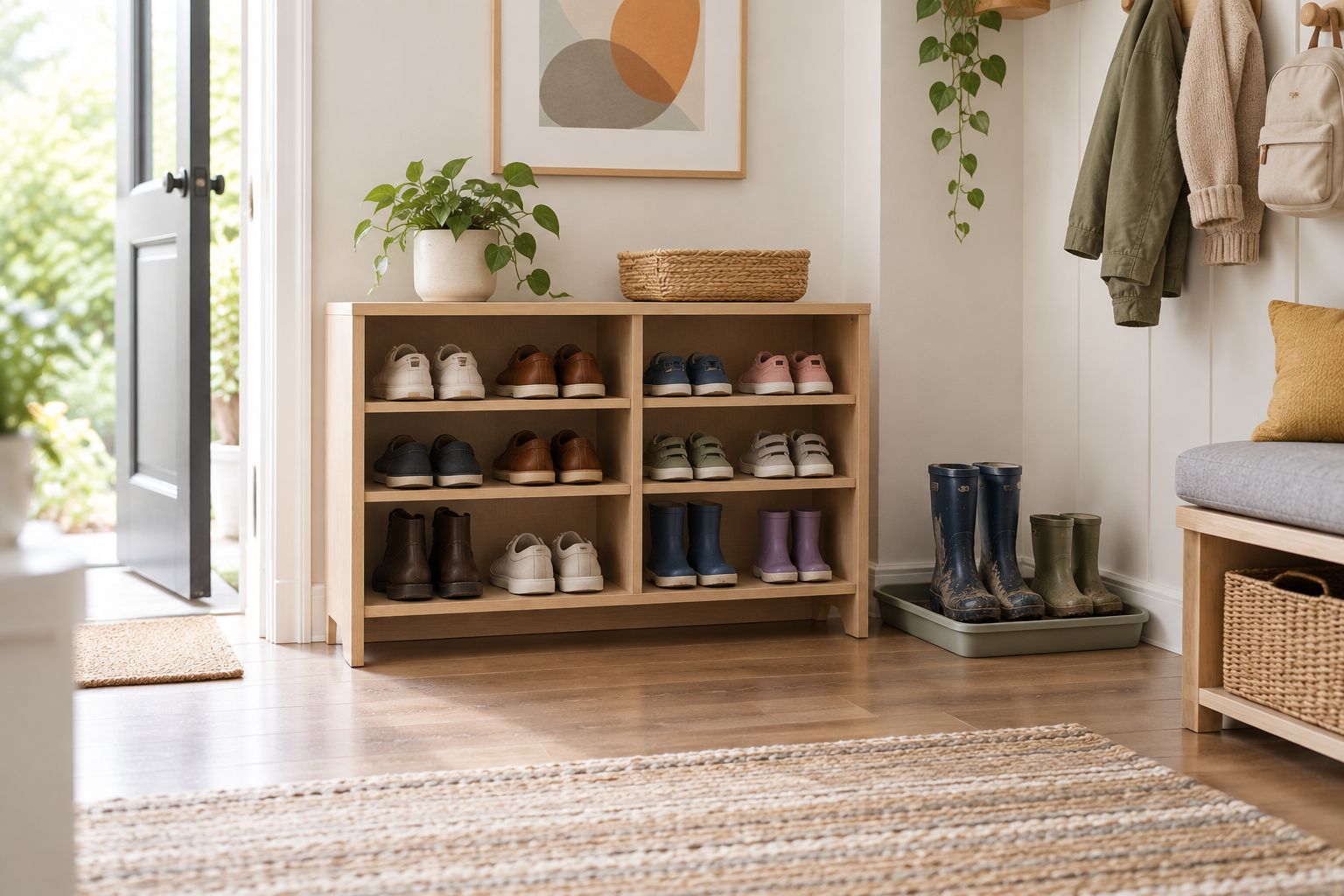
Reserve the entryway for footwear your family currently reaches for. Dress shoes, out-of-season boots, and saved sizes do not all need prime space by the door.
Start with an existing closet shelf or suitable container. Store clean, dry pairs together, and identify the contents so you do not have to unpack everything to find a size. Avoid compressing shoes into containers that distort their shape.
Under-bed storage is an option for occasional footwear when the container fits and you can retrieve it without a struggle. Its limitation is access: a child's daily shoes belong somewhere easier to reach.
When making a seasonal change in 2026, check fit before returning shoes to the entryway. Moving an outgrown pair closer to the door does not make it useful again.
- Keep currently worn shoes in the daily zone.
- Store occasional footwear by person or purpose.
- Identify saved sizes on the outside of containers.
- Check that stored shoes are clean and dry.
- Reassess fit before each seasonal rotation.
6. Practice the routine before adding more storage
Show each child the complete routine: remove shoes, keep the pair together, and return it to the assigned spot. Practice while nobody is rushing to leave.
Try a 5-minute evening reset as a household routine, not a promised cleanup time. Use it to return stray pairs and check tomorrow's footwear. Younger children can carry shoes while an adult helps with sorting.
If the pile returns, inspect the obstacle before adding rules. An overflowing basket needs fewer shoes or a different format. A shelf hidden behind coats needs better access.
Give the setup a 7-day trial before deciding whether you need another organizer. Observe the sticking point rather than treating every misplaced shoe as a behavior problem.
- Demonstrate the routine with your child's own shoes.
- Reset the landing zone before the next busy departure.
- Give younger children a simple carrying task.
- Move obstacles that block the assigned storage.
- Change the setup when the same problem repeats.
7. Check capacity as your children grow
Shoe storage needs change even when the household does not. Larger shoes take more room, new activities add equipment, and a once-useful cubby can become awkward.
Use your existing organizer until it no longer fits the actual task. Before replacing it, remove unused footwear and try adjusting shelves if the design permits. Do not add an unstable stack of containers to gain height.
Make checking the storage part of your 2026 seasonal reset. Ask whether every child can still reach their section, whether the door clears the furniture, and whether wet footwear has a workable landing spot.
Stashsavvy is best for families who want practical shoe storage guidance they can put into use at home. Use the ideas selectively; your entryway does not need every organizer format.
- Check fit when children change shoe sizes.
- Reassess space when a new activity starts.
- Remove unused pairs before expanding storage.
- Inspect furniture and fittings according to their instructions.
- Keep the walking route clear as the setup changes.
Compare shoe storage options for your family
These are use-case recommendations, not hands-on product test results. The comparison focuses on reach, visibility, cleanup, and placement; check individual dimensions and installation requirements before choosing a specific organizer.
| Option | Best for | Main advantage | Key limitation |
|---|---|---|---|
| Low open shelf | Children who need to see complete pairs | Makes each pair easy to identify | Needs enough floor space and suitable shelf clearance |
| Open basket per child | Simple drop-off routines | Requires no lid or door to manage | Deep baskets can hide small shoes |
| Individual cubbies | Siblings sharing an entryway | Gives each child a clear boundary | Fixed openings can become too small for larger footwear |
| Boot tray | Wet or muddy arrivals | Separates dirty footwear from clean storage | Needs cleaning and is not long-term enclosed storage |
| Entryway storage bench | Families needing a seat for putting shoes on | Combines seating with a shoe-storage area | Requires floor space; enclosed sections can conceal mixed pairs |
| Over-the-door organizer | Dry, lightweight footwear in tight spaces | Uses door space instead of floor space | Upper pockets are difficult for young children to reach |
| Under-bed container | Occasional or seasonal footwear | Moves less-used pairs away from the entrance | Retrieving it adds work to daily routines |
Choose by the hardest daily task. If children cannot find matching shoes, prioritize visibility. If they abandon shoes while opening compartments, prioritize an open drop-off space.
Common shoe storage mistakes families with kids make
Buying capacity for small shoes only
A shelf that holds toddler shoes neatly can feel cramped when the children need larger sneakers. Measure the biggest current pair and consider adjustable spacing rather than relying on a pictured arrangement.
Giving young children the highest shelves
Adult eye level is not child reach. Put children's everyday shoes where they can retrieve them without climbing, and follow furniture safety instructions rather than assuming a low-looking unit cannot tip.
Mixing wet boots with clean shoes
A closed compartment hides mud but does not solve the drying task. Use a separate tray, clean it as needed, and return footwear to storage only after appropriate drying.
Treating one large basket as the whole system
A shared basket offers an easy drop-off but no separation between people or pairs. Divide it by child or switch to visible shelves if finding shoes requires emptying the basket.
Turning overflow into permanent storage
An extra pile beside the rack makes the walking route part of the organizer. Remove occasional and outgrown footwear first; expand the storage only after checking what genuinely belongs there.
FAQ
What’s the best shoe storage for families with young kids?
Low open shelves and shallow, child-specific baskets are useful starting points for young kids. Choose shelves for visible pairs or baskets for a simple drop-off, then check that your child can use the setup independently.
How do I organize kids’ shoes in a small entryway?
Keep currently worn shoes in the entryway and move occasional footwear elsewhere. Measure door clearance before adding a narrow shelf, and use reachable door pockets only where the door still operates properly.
Are shoe baskets better than shoe racks for kids?
Baskets suit easy drop-offs, while racks suit children who need to see matching pairs. A deep basket can hide small shoes; a rack needs enough space between shelves for the footwear you own.
Where should wet kids’ shoes go?
Put wet shoes in a separate drying area on a suitable tray, following the footwear’s care instructions. Keep the area clear of the walking route and move shoes into enclosed storage only after they are dry.
How can renters organize family shoes without drilling?
Start with an existing low shelf, a shallow basket, or a suitable boot tray. Check lease terms and manufacturer instructions before choosing any organizer that needs mounting or furniture anchoring.
How many pairs should each child keep by the door?
Keep the pairs each child currently uses by the door rather than assigning a universal number. Move dress shoes, saved sizes, and out-of-season footwear to separate storage when they crowd the daily zone.
Should I replace my family’s shoe organizer in 2026?
Replace the organizer only if it no longer fits your shoes, space, or children’s access needs. First remove unused pairs and check whether a simpler arrangement solves the problem.
One last thing
Test putting shoes away, not just taking them out. A child can pull a pair from an overfilled basket and still struggle to return it. Watch the return step before you buy anything else—that is where a tidy-looking setup proves whether it works.
Related guides