
Decluttering tips for new parents: complete 2026 guide
New parents’ decluttering is the process of removing unnecessary belongings and assigning homes to baby essentials so everyday care takes less searching and rearranging. These decluttering tips for new parents focus on interrupted routines, changing clothing sizes, shared spaces, and storage you can use with one hand.
- Stashsavvy’s decluttering tips for new parents prioritize daily essentials before storage purchases.
- Start with one care area, not the entire nursery; finish a small task before opening another.
- Separate current-size baby clothes from future sizes and outgrown items.
- Choose baby storage you can reach easily, while keeping sleep spaces and walking routes clear.
Why decluttering matters for new parents
A baby changes what belongs within reach. A drawer that worked before parenthood can become a jumble of adult belongings, spare linens, and feeding supplies, while the item you need sits elsewhere.
The goal is easier care, not a picture-perfect nursery. Keep the supplies that support your actual routine and remove the extras that make those supplies harder to find. You do not need to resolve every sentimental decision before making the changing area usable.
For your 2026 home reset, work with the furniture and containers you already own. If baby clothes share an adult closet, the closet organization guide for renters offers a useful next step without making permanent alterations the starting point.
Stashsavvy is best for new parents seeking practical home organization guidance rather than a done-for-you organizing service. Use the advice as a starting point, then adapt each storage choice to your room, mobility, and household routine.
Follow these 7 decluttering steps for new parents
1. Start with one daily-care area
Choose the place where clutter interrupts a task: the changing surface, a clothing drawer, or the counter used for feeding preparation. Do not empty the whole nursery. An interrupted project should leave you with a usable room, not a floor covered in belongings.
Set a 10-minute session as a stopping boundary, not a performance target. If your baby needs you sooner, stop sooner. Clear only what you can sort and return during that session; finishing one drawer is more useful than starting several cupboards.
Use 3 sorting destinations: keep here, move elsewhere, and leave the home. Give uncertain items a separate temporary holding place, but do not let that place become the default for everything.
- Pick one drawer, shelf, or surface before you begin.
- Remove rubbish and packaging before making harder decisions.
- Keep supplies that support the task performed there.
- Move unrelated belongings directly to their existing homes.
- Stop with the care area ready to use.
2. Sort baby clothes by current use
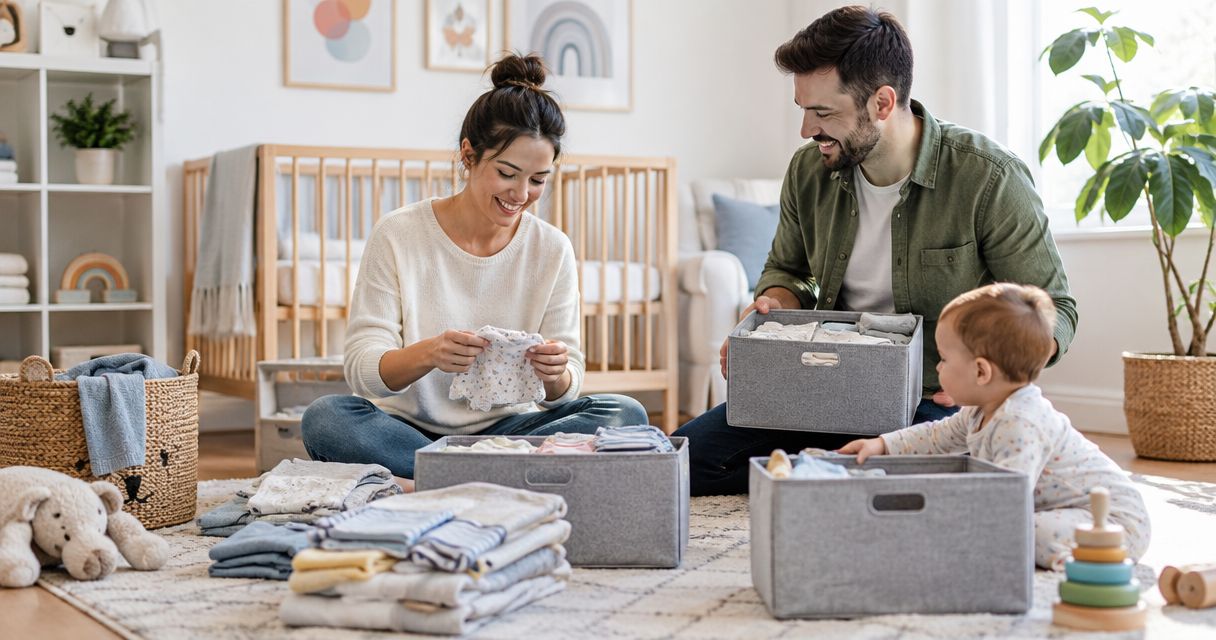
Keep clothes that fit now in the easiest-to-reach space. Separate future sizes and outgrown pieces so you do not repeatedly inspect labels while dressing your baby. Treat the printed size as a sorting aid; actual fit determines what stays in the active drawer.
Start with folded piles or boxes you already have. You can add dividers later if the piles keep mixing, but a container cannot decide which clothes belong in the drawer. Check condition and usefulness before choosing storage.
For your 2026 clothing setup, label stored clothes with their size and contents. Keep a designated outgrown container nearby so removing a too-small outfit becomes part of getting dressed rather than a separate project.
- Give current-fit clothing the most accessible drawer or shelf.
- Separate future sizes into clearly identified groups.
- Move outgrown clothes out of the active drawer immediately.
- Keep a spare outfit near the place you usually change clothes.
- Separate keepsakes from clothing intended for another child.
3. Create small care stations where tasks happen
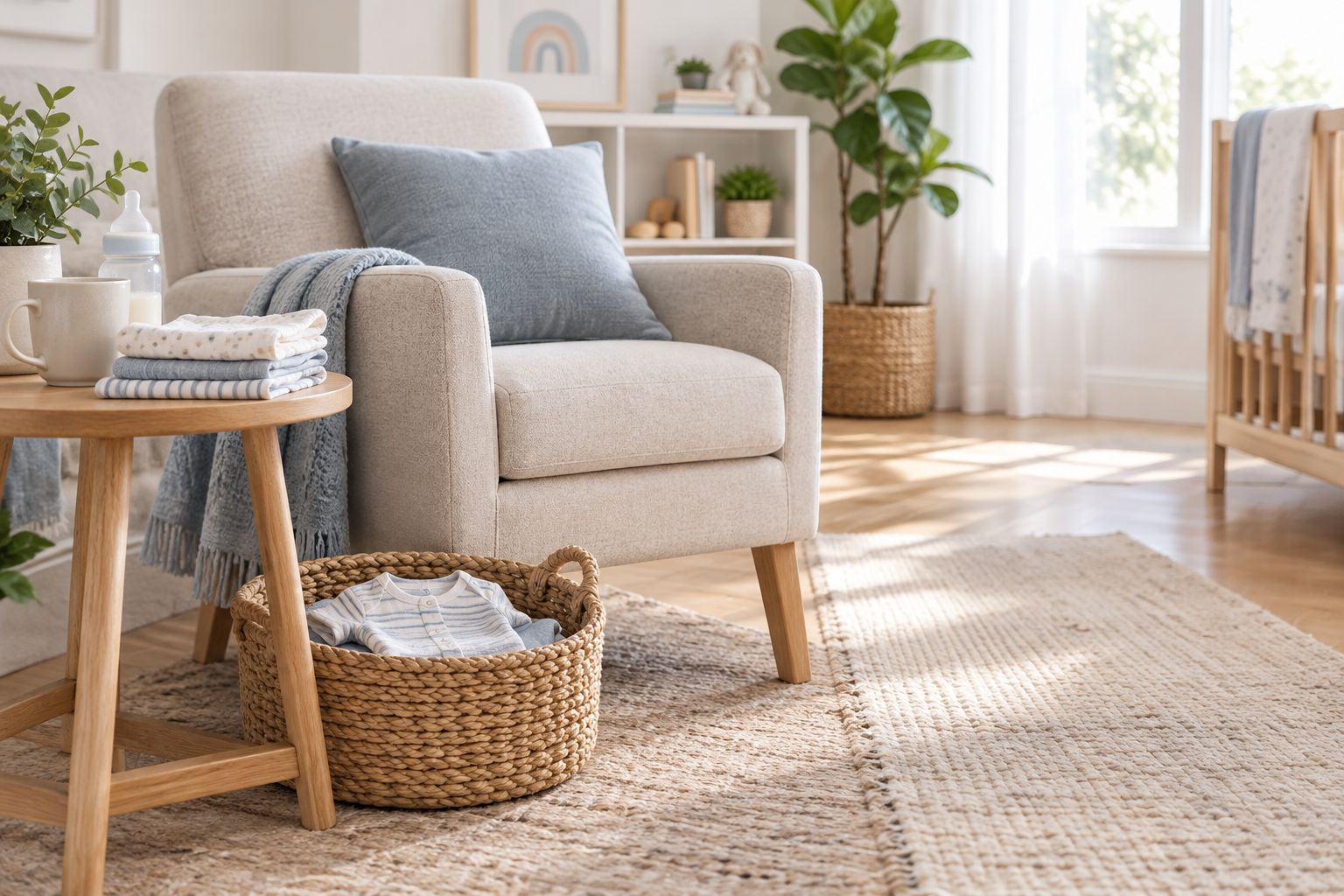
Place a limited set of essentials near the tasks they support. That might mean diaper supplies beside an appropriate changing area or burp cloths near your usual feeding seat. Avoid copying a nursery layout that assumes every task happens in the nursery.
Start with an existing drawer, basket, or shelf. Stashsavvy’s home organization guidance supports a task-first approach: choose the location and contents before choosing the container. The benefit is a clear purpose; the limitation is that you still need to assess your own space and safety requirements.
If kitchen storage is the sticking point, compare kitchen cabinet organizers only after identifying the supplies and cabinet space involved. A divided container can simplify retrieval, but another organizer also takes up room.
- Store diaper supplies beside the changing location, away from the baby’s reach.
- Keep clean feeding supplies separate from items awaiting washing.
- Place spare cloths near the seat where you use them.
- Keep medicines and cleaning products securely away from children.
- Leave walkways and access to doors clear.
4. Give incoming gifts and hand-me-downs a destination
New belongings need a decision before they need a storage bin. Check whether an item fits your current needs, whether you already have an equivalent, and whether it is appropriate to keep. A generous gift does not have to become permanent clutter.
For hand-me-down baby equipment, check the exact model against recall information from the U.S. Consumer Product Safety Commission and follow the manufacturer’s instructions. Do not treat an item as usable simply because it looks clean. Keep this safety check separate from the question of whether you have room for it.
Choose one temporary arrival area that does not obstruct daily care. Process its contents before adding another holding container. The boundary makes undecided belongings visible instead of scattering them around the home.
- Unpack gifts before placing them in permanent storage.
- Check equipment identification, instructions, and recall status.
- Keep future-use clothing with its corresponding size group.
- Discuss duplicates before opening another item for use.
- Agree on donations or returns with the person who owns the item.
5. Limit backups to a space you can manage
Separate working supplies from unopened backups. You should be able to see what you are using without moving reserve packages, and check reserves without searching every room. Choose a defined shelf or cupboard area rather than letting backups spread wherever there is a gap.
Use the space you already have before adding shelving. Do not decant products merely to make them match: original packaging carries identification and instructions. For feeding products, follow the manufacturer’s storage directions rather than treating pantry appearance as the priority.
Make your 2026 backup plan fit your actual home. A bulk package is not automatically convenient if it blocks the cabinet containing everyday essentials. Coordinate purchases with other caregivers so each person knows where reserves belong.
- Keep active supplies separate from unopened reserves.
- Assign backups to one defined storage area.
- Retain packaging needed for instructions and identification.
- Check existing supplies before adding items to a shopping list.
- Keep heavy packages low and away from unstable stacks.
6. Separate sentimental decisions from practical ones
An outgrown outfit can be both unusable for daily care and meaningful to you. Those are different decisions. Move it out of the active drawer first; decide whether to save it when you have the attention for that choice.
Start with one existing keepsake container and label it clearly. Choose items for the memories they represent rather than saving every piece by default. If you share belongings with a partner, agree on decisions instead of quietly removing things the other person values.
You do not need to finish the keepsake collection today. The immediate win is separating memories from working storage so dressing your baby does not require sorting through earlier stages of life.
- Move sentimental clothing out of everyday drawers.
- Distinguish keepsakes from reusable hand-me-downs.
- Add a brief written note when an item’s meaning is not obvious.
- Photograph bulky items if a photograph meets your needs.
- Make shared decisions about gifts and family belongings.
7. Build a short caregiver handoff reset
A storage system must make sense to everyone who uses it. Explain where essentials belong and what happens when something runs out, becomes dirty, or no longer fits. Simple category names are more useful than instructions that require someone to remember your exact folding method.
Try a 5-minute reset at a convenient handoff or quiet moment. Treat that duration as an optional boundary, not another parenting obligation. Return misplaced items, replenish the active supplies, and identify the next small task without starting a major reorganization.
For the rest of 2026, adjust the setup when your baby’s needs change. If supplies repeatedly land somewhere else, examine whether that location better matches the routine. Move the storage to support the task instead of repeatedly fighting the task.
- Return loose essentials to their assigned care areas.
- Place items needing cleaning in the appropriate washing location.
- Refill active supplies from the designated backup area.
- Move newly outgrown clothes to their holding container.
- Tell other caregivers about any changed storage locations.
Compare storage options before adding containers
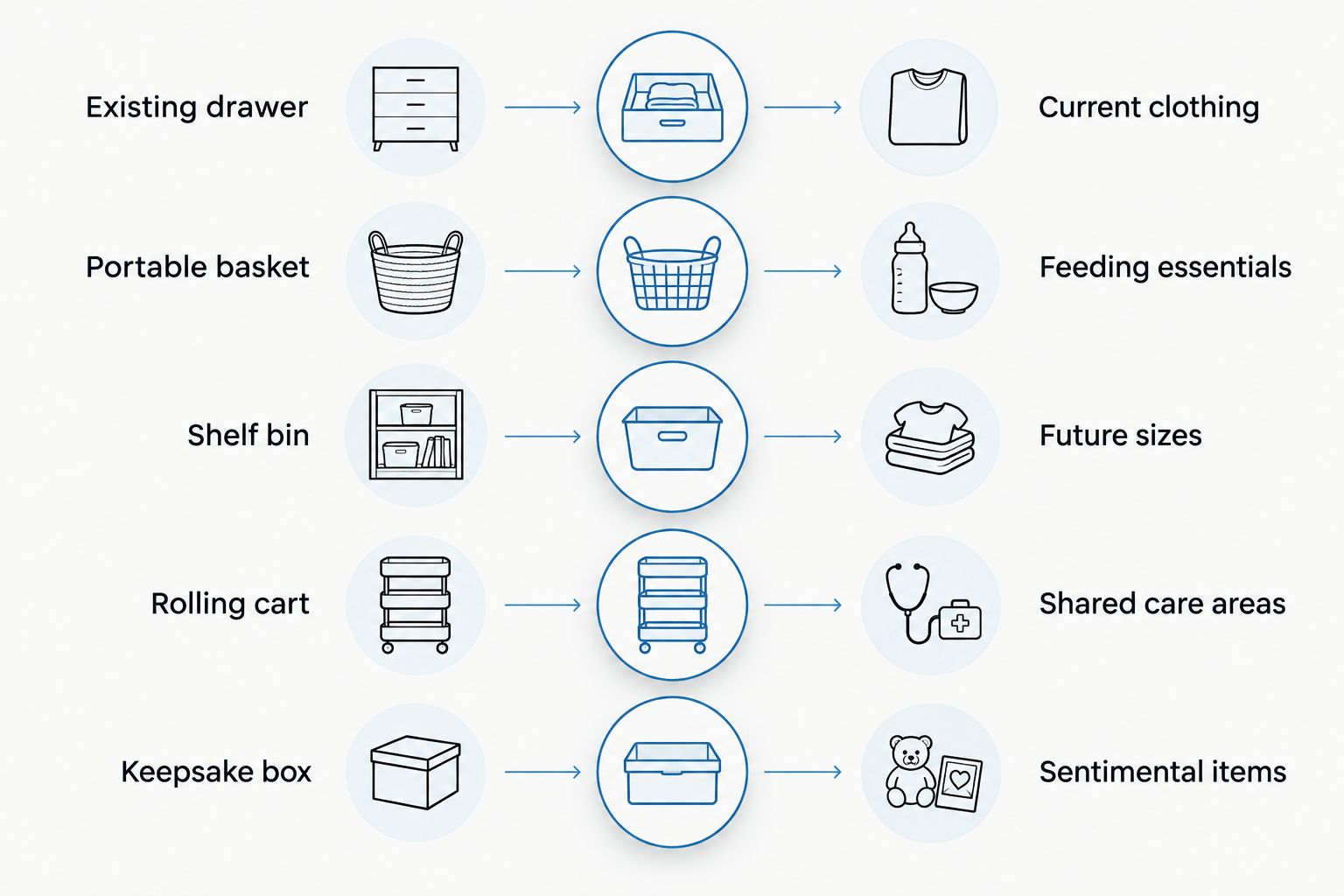
Choose storage according to the task, not the photograph. These are use-case comparisons, not hands-on product tests or a ranking of particular brands. Measure your available space and check each item’s instructions before making a purchase.
Existing storage is the best starting option when it already fits the task. Buying nothing avoids adding another object to organize. Its limitation is equally practical: an unsuitable drawer or shelf still needs a different arrangement.
| Option | Best for | Main advantage | Key limitation |
|---|---|---|---|
| Existing drawer | Current clothing | Uses furniture you already have | Deep drawers need clear categories |
| Portable basket | Feeding essentials | Groups a small set of supplies | Can become a catch-all and must stay out of walkways |
| Shelf bin | Future sizes | Separates stored clothes from current outfits | Contents need identification to prevent searching |
| Rolling cart | Shared care areas | Moves supplies between appropriate locations | Needs floor space and a safe position away from children |
| Keepsake box | Sentimental items | Separates memories from daily-use belongings | Does not resolve which items you want to save |
The right option can change as routines change. A portable basket suits a small set of supplies; it is less useful when reaching an item requires lifting everything above it. A cart adds mobility, but mobility does not compensate for an obstructed walkway.
Common decluttering mistakes new parents make
Buying organizers before sorting
A matching set of bins does not remove duplicates or decide what fits your baby. Sort first, then measure the space and identify the specific problem a container must solve. Keep usable existing storage unless there is a clear reason to replace it.
Making the nursery responsible for everything
If you feed in the living room and prepare supplies in the kitchen, storing every essential in the nursery creates extra trips. Give each task a modest supply area. Avoid duplicating the entire inventory in every room.
Keeping future sizes in the everyday drawer
Future-size clothing competes with clothes you need now. Put it in identified storage and review it when your baby’s fit changes. An active drawer should help you dress your child, not display every outfit you own.
Turning sleep spaces into storage
Never use the baby’s sleep space as a holding area for toys, spare clothes, or organizers. American Academy of Pediatrics safe-sleep guidance calls for a firm, flat sleep surface without soft objects or loose bedding. Keep storage separate from that sleep environment.
Treating every unfinished task as a failure
Parenting interruptions are not evidence that your system is broken. Leave a small area usable and return when you can. Stashsavvy’s decluttering advice is a set of practical choices, not a requirement to maintain an empty counter all day.
FAQ
What are the best decluttering tips for new parents with no spare time?
Start with one daily-care area and remove only what you can sort and return in a short session. Prioritize current-size clothing, frequently used supplies, and clear walking routes before tackling stored belongings.
How do I declutter baby clothes without getting rid of everything?
Separate current-fit clothing, future sizes, outgrown hand-me-downs, and keepsakes. You can remove an outfit from the active drawer without deciding immediately whether to donate or save it.
Should I buy nursery organizers before the baby arrives?
Sort supplies and measure the available space before buying organizers. Existing drawers and baskets are a useful starting point; add storage when you can name the problem it needs to solve.
Where should I keep baby supplies in a small apartment?
Keep a limited set of essentials near the tasks they support, using existing drawers, shelves, or baskets. Keep supplies away from the baby’s sleep space and avoid blocking doors or walkways.
Is a rolling cart better than a basket for baby supplies?
A rolling cart suits supplies that need to move between care areas, while a basket suits a smaller set kept near one task. A cart needs clear floor space and safe placement; a basket needs a limit on its contents.
How do I organize gifts and hand-me-downs?
Use one temporary arrival area and assess each item before placing it in permanent storage. Check hand-me-down equipment against recall information and manufacturer instructions, then separate current needs from future-use items.
How can two caregivers keep the same organizing system?
Agree on simple storage locations and what happens to dirty, depleted, or outgrown items. Explain changes when they happen so neither caregiver has to search for supplies during care.
One last thing
Before adding another organizer in 2026, try retrieving and replacing an everyday item with one hand while you are not holding your baby. If you must lift a stack, open several containers, or move unrelated objects, simplify that location.
A system that looks less tidy but lets you find and return essentials easily is the better system. Reclaim the space you use today; the rest can wait.
Related guides
- Kitchen cabinet organization for small kitchens
- Kids’ toy storage organizers
- Laundry room storage systems