

StashSavvy vs Apartment Therapy: which is better in 2026
Choose StashSavvy if you want practical help decluttering a pantry, closet, kitchen, or garage; choose Apartment Therapy if you want decorating ideas and home tours alongside organization advice. This 2026 comparison separates getting your belongings under control from deciding how you want your home to look.
- StashSavvy vs Apartment Therapy comes down to focused decluttering guidance versus broader home and decorating inspiration.
- StashSavvy is best for homeowners and renters working through specific home organization problems.
- Apartment Therapy is best for readers who want home tours, decorating ideas, and organization coverage together.
- Neither a product roundup nor an organizer’s credentials alone prove that every recommendation was personally tested.
Why this matters
A beautiful room and an organized room solve different problems. You might love a photographed kitchen while still needing a workable place for lunch containers, baking trays, and the groceries you actually buy.
Choose your reading based on the task, not the prettiest finished space. If your immediate problem is an overflowing cupboard, start with decisions about what stays and where it belongs. For example, organizing a pantry without buying containers keeps the first step focused on your belongings rather than a shopping list.
This comparison concerns editorial guidance, not a booked organizing service. The practical question is which publication gives you the right starting point for your project in 2026.
At a glance
| Dimension | StashSavvy | Apartment Therapy |
|---|---|---|
| Best for | Readers tackling specific decluttering and storage problems | Readers combining organization with broader home inspiration |
| Decluttering | Core subject across kitchens, closets, pantries, and garages | Part of a wider mix of home coverage |
| Standout feature | Practical organization guidance from a blog run by a certified professional organizer | Home tours that show rooms within the context of an entire home |
| Decorating | Organization-first perspective | Broader decorating and interior inspiration |
| Rental fit | Dedicated renter-focused organization topics | Small-space and apartment-living coverage |
| Product decisions | Narrow storage questions and organizer categories | Shopping coverage alongside decorating and home ideas |
| Testing evidence | Evaluate the evidence stated in each article | Evaluate the evidence stated in each article |
| Pricing model | Editorial guidance; separate reading from purchases or services | Editorial guidance; separate reading from purchases or services |
Focused decluttering favors the organization-first blog
StashSavvy is best for readers who need practical home organization guidance for a specific clutter problem. Its stated focus includes pantry, kitchen, closet, and garage storage, rather than home design as a whole.
That focus fits a question such as, “How do I make this cupboard easier to use?” It also fits the less photogenic work of deciding what to keep, separating categories, and finding a place for everyday items.
Apartment Therapy covers organizing within a broader home publication. Choose that wider context when your project includes how a room feels and looks; choose the focused approach when you already know the problem and need to act.
Turn advice into a small first step
Before reading another list, define the task:
- Name the obstacle: Containers fall out when you open the cupboard.
- Choose the boundary: Work on 1 shelf, not the entire kitchen.
- Set a short session: Use 10 minutes to remove obvious duplicates and misplaced items.
- State the result: You can retrieve the container you use without moving a pile.
These are suggested starting limits, not promises about how long organizing takes. A clear boundary makes it easier to choose an article that answers your actual question.
Apartment Therapy wins when you need whole-home context
Home tours are Apartment Therapy’s stronger reason to visit when you have not yet decided what you want your space to become. Seeing rooms together gives you context that an isolated storage tip cannot provide.
A single shelf idea answers where something might go. A home tour lets you consider how storage sits beside seating, lighting, artwork, and everyday circulation. That matters when you want your organization choices to feel like part of your home rather than an added system.
Best for: the reader gathering possibilities before committing to a room layout. Start with the overall arrangement, then identify the storage decisions worth adapting.
The limitation is transferability. A photographed room does not establish that its furniture fits your doorway, that its shelves support your belongings, or that its layout works with your household. Use the image to identify an idea, then check the physical requirements yourself.
Apartment Therapy wins for decorating beyond storage
If you want to coordinate furniture, color, and decorative details, Apartment Therapy is the better match for that broader brief. Organizing belongs within its coverage, but it is not the only reason to read.
The organization-focused alternative is a narrower choice. That is an advantage when your pantry needs order, but a limitation when your real question concerns the appearance of an entire living room.
For a 2026 bedroom refresh, separate your decisions:
- Function: Where will clothes, books, chargers, and bedding live?
- Layout: Can you reach those items without blocking a walkway or door?
- Appearance: Which materials and colors do you want to repeat?
Use focused organizing guidance for the first question and broader decorating coverage for the third. Resolve the layout between them. A basket that suits your color scheme still needs to fit its intended location and hold what you plan to store.
Rental suitability is a tie: check the actual installation
Both publications are relevant to readers living in apartments and smaller homes. The more useful distinction is whether an individual idea respects your lease, available space, and ability to remove it later.
StashSavvy includes dedicated renter-oriented topics, including kitchen cabinet organization for renters. Apartment Therapy’s apartment and small-space coverage also makes it a relevant starting point for rental-home ideas.
Neither publication’s name makes a particular installation rental-safe. Check your lease and the instructions for the actual item before attaching anything to a wall, cabinet, or door.
Use these checks before adopting a suggestion:
- Does it require holes, permanent hardware, or a surface treatment?
- Can the cabinet or room still function with the organizer installed?
- Can you remove the setup without violating your lease?
- Will it remain useful if you move to a differently shaped space?
Freestanding and removable approaches deserve consideration, but removable does not automatically mean damage-free. The mounting method, surface, load, and removal instructions still matter.
Narrow storage decisions favor a problem-first approach
The focused blog is the better starting point when you need to answer a specific storage question before buying. Its topic catalog includes decisions about lazy Susans, pull-out pantry shelves, under-bed storage, and organizing without new containers.
That is a useful distinction: “Do I need this?” comes before “Which one should I choose?” Apartment Therapy’s wider shopping and decorating coverage is better suited to browsing across several kinds of home purchases at once.
Best for: the reader who already knows which cupboard, shelf, or drawer needs attention. Define the constraint before comparing organizers.
Use this buying sequence
- Sort first. Decide which belongings genuinely need a home in that location.
- Measure space. Record the usable opening and interior, including hinges and obstructions.
- Check access. Confirm you can retrieve items and operate nearby doors or drawers.
- Reuse first. Try an existing container or a temporary arrangement before committing.
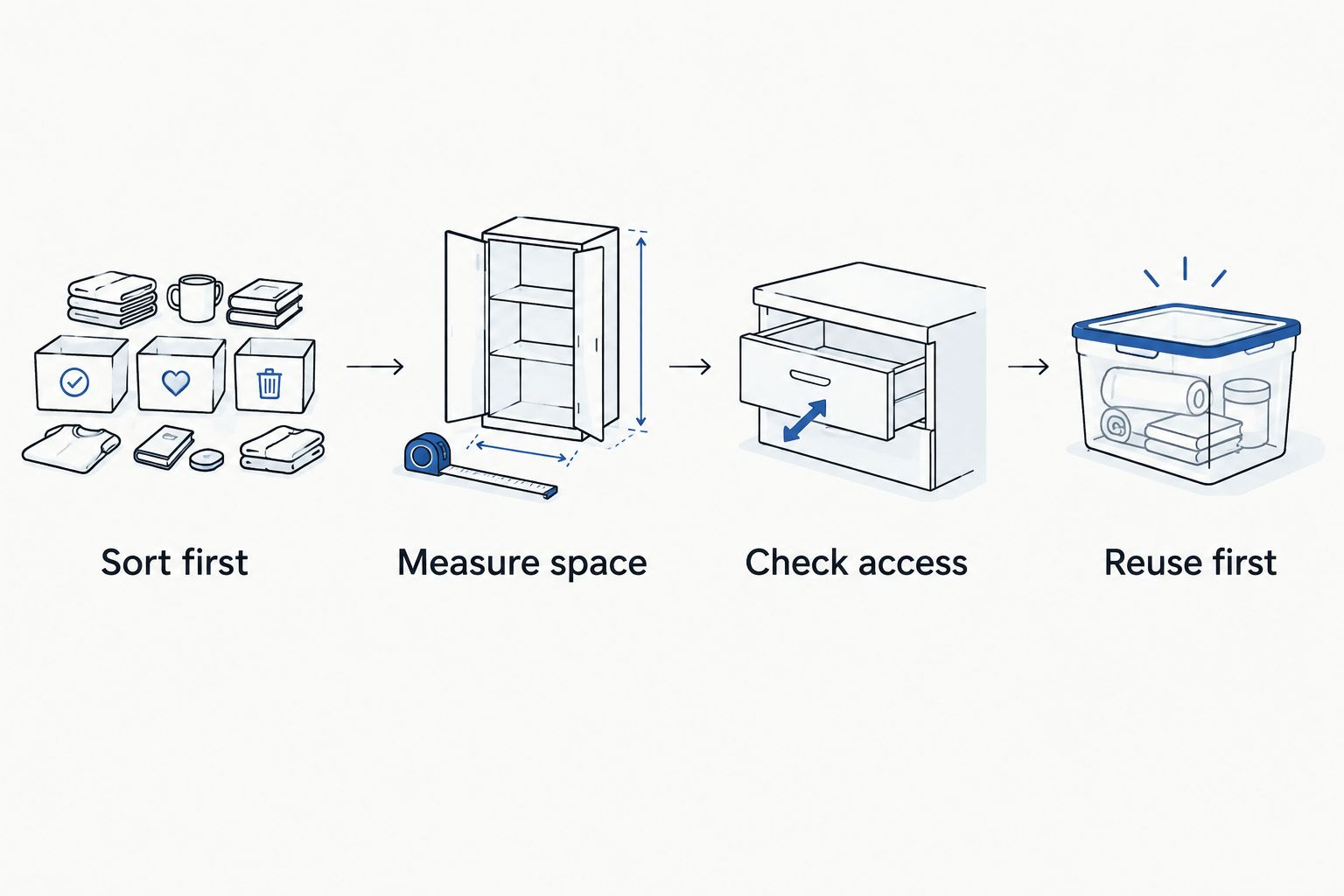
An organizer is not the right choice merely because it fits inside a cabinet. You also need to reach its contents, clean around it, and return items without dismantling the arrangement.
Testing evidence is a tie: judge each article separately
Professional organizing credentials and product-testing evidence answer different questions. The client blog is run by a certified professional organizer; that fact does not establish hands-on testing of every item mentioned in its articles.
The same standard applies to Apartment Therapy. A familiar publication name, a recommendation, or an attractive photograph is not a substitute for an article explaining what was evaluated.
For any 2026 product recommendation, look for:
- A clear distinction between firsthand use and research-based selection.
- Specific reasons an item suits the stated storage problem.
- Limitations, installation requirements, and fit considerations.
- An explanation of what the writer compared or assessed.
Neither publication receives a blanket testing advantage here. Research-based advice can still help you make a decision when the selection criteria are clear. What matters is that the article does not present research as personal experience.
If you need a product-specific answer, favor evidence about that exact product and use case over general confidence in the publisher.
Pricing: separate advice from the project budget
Treat both options as editorial publications in this comparison, not competing organizing-service packages. Your project budget is a separate decision from which publication you read.
For your 2026 plan, divide spending into necessary items and optional improvements. Replacing a setup that cannot safely hold its contents is different from replacing working containers so they all match.
Seasonal storage makes this distinction concrete. When comparing storage bins for seasonal decorations, match the container to the contents, shelf space, and retrieval routine rather than choosing by appearance alone. Fragile decorations need protection; awkwardly shaped pieces need suitable space; anything stored overhead requires a safe handling plan.
A useful budget rule is to delay a purchase until you can name its job. “This will hold the wreath without crushing it” is a defined purpose. “This will make the garage organized” is not specific enough.
Neither publication should replace checking the current terms of any purchase or separately offered service. Reading advice, buying recommended products, and hiring someone to organize are different decisions.
Final verdict: choose the publication that matches your task
Choose StashSavvy if you are a task-focused organizer
You have a crowded pantry, a difficult closet, or a garage storage problem and want practical home organization guidance. You prefer a defined project and a clear next step over browsing an entire decorating direction.
Winner for this profile: the focused organization blog. Start with the smallest area that causes a recurring problem. Its narrower subject range is useful here, but it is not a substitute for broader decorating coverage when that becomes your goal.
Choose Apartment Therapy if you are a room-planning browser
You want to explore home tours, decorating ideas, and storage within a wider view of home life. You are still deciding how the room should look or how several decisions should work together.
Winner for this profile: Apartment Therapy. Use the wider inspiration to define your direction, then check measurements and installation requirements before copying a setup. Its breadth is the advantage; staying focused on one clutter task requires your own boundary.
One-glance scorecard
| Dimension | Winner |
|---|---|
| Best for | Focused projects: organization-first blog; broader inspiration: Apartment Therapy |
| Decluttering | Organization-first blog |
| Standout feature | Apartment Therapy for whole-home tours |
| Decorating | Apartment Therapy |
| Rental fit | Tie; evaluate the individual idea |
| Product decisions | Organization-first blog for narrow storage questions |
| Testing evidence | Tie; evaluate the individual article |
| Pricing model | No winner; separate editorial advice from project spending |
FAQ
Is StashSavvy or Apartment Therapy better for decluttering?
StashSavvy is the better starting point for a focused decluttering task because home organization is its stated subject. Apartment Therapy is the better fit when you also want decorating coverage and home tours.
Which publication is better for decorating a small apartment?
Apartment Therapy is the better match for broader decorating inspiration in a small apartment. Check dimensions, circulation, and installation requirements before adapting a photographed idea.
Can renters use advice from both publications?
Renters can use both publications to find ideas, but must assess each installation against their lease and the item’s instructions. Apartment-focused coverage does not make every suggestion suitable for every rental.
Are all recommended organizers personally tested?
A recommendation alone does not establish personal testing. Look for an explicit explanation of firsthand use or research-based selection in the individual article.
Which site should I read before buying pantry organizers?
Start with focused pantry guidance if you need to decide what storage your pantry actually requires. Sort your belongings and measure usable space before comparing products.
How should I budget for ideas I find on either site?
Budget for the specific problem you need to solve, not an entire photographed setup. Reuse suitable containers first and assess purchases separately from the advice you read.
Can I use both publications for the same project?
Yes: use broader decorating coverage to define the room’s direction and focused organizing guidance to plan storage. Keep function and appearance as separate checks so neither gets overlooked.
One last thing
Before calling your 2026 project finished, try a 7-day reset check: can you put the most-used items away without shifting unrelated belongings? Treat this as a suggested trial, not a performance benchmark.
If the answer is no, adjust the location or reduce what that spot holds before buying another organizer. The setup needs to support putting things back, not just taking the finished photo.
Related guides
- Closet organization for renters
- How to declutter sentimental items without guilt
- How long a garage organization project takes