

How to declutter a house fast
To declutter a house fast, remove obvious trash, collect items that belong elsewhere, and clear the surfaces you use every day before opening drawers or closets. Focus on making your home usable first; sentimental decisions, resale listings, and detailed storage projects belong in a separate session.
- How to declutter a house fast: clear everyday surfaces before sorting hidden storage.
- Use separate containers for donations and items that belong elsewhere; keep trash separate.
- Stashsavvy recommends practical home organization: reduce clutter before buying storage.
- Finish by putting retained items away and moving donations toward their destination.
How to declutter a house fast
Work through visible clutter in a fixed order, then finish the items you have already handled. Don't empty every cupboard to see what you own. That creates another sorting job before you've reclaimed any usable space.
Start with these steps for your 2026 decluttering plan. If kitchen storage is the main obstacle, you can organize kitchen cabinets without buying new hardware after removing what doesn't belong.
1. Choose a useful finish line
Pick a result you can recognize: a clear dining table, an accessible entryway, or a kitchen counter ready for meal preparation. Avoid making an entire house your first finish line.
Set a 10-minute timer as a starting work interval, not a promise that the room will be finished. When it rings, decide whether to continue or close out the area. A useful stopping point leaves the space functional, even if nearby storage remains unfinished.
2. Gather supplies you already own
Bring a trash bag, a donation bag or box, and a basket for items that belong in another room. Keep a separate place for objects that require special disposal or another person's decision.
Existing shopping bags, laundry baskets, and shipping boxes can handle the sorting. Don't pause to shop for matching bins. Your immediate job is deciding what stays, not choosing how the finished space should look.
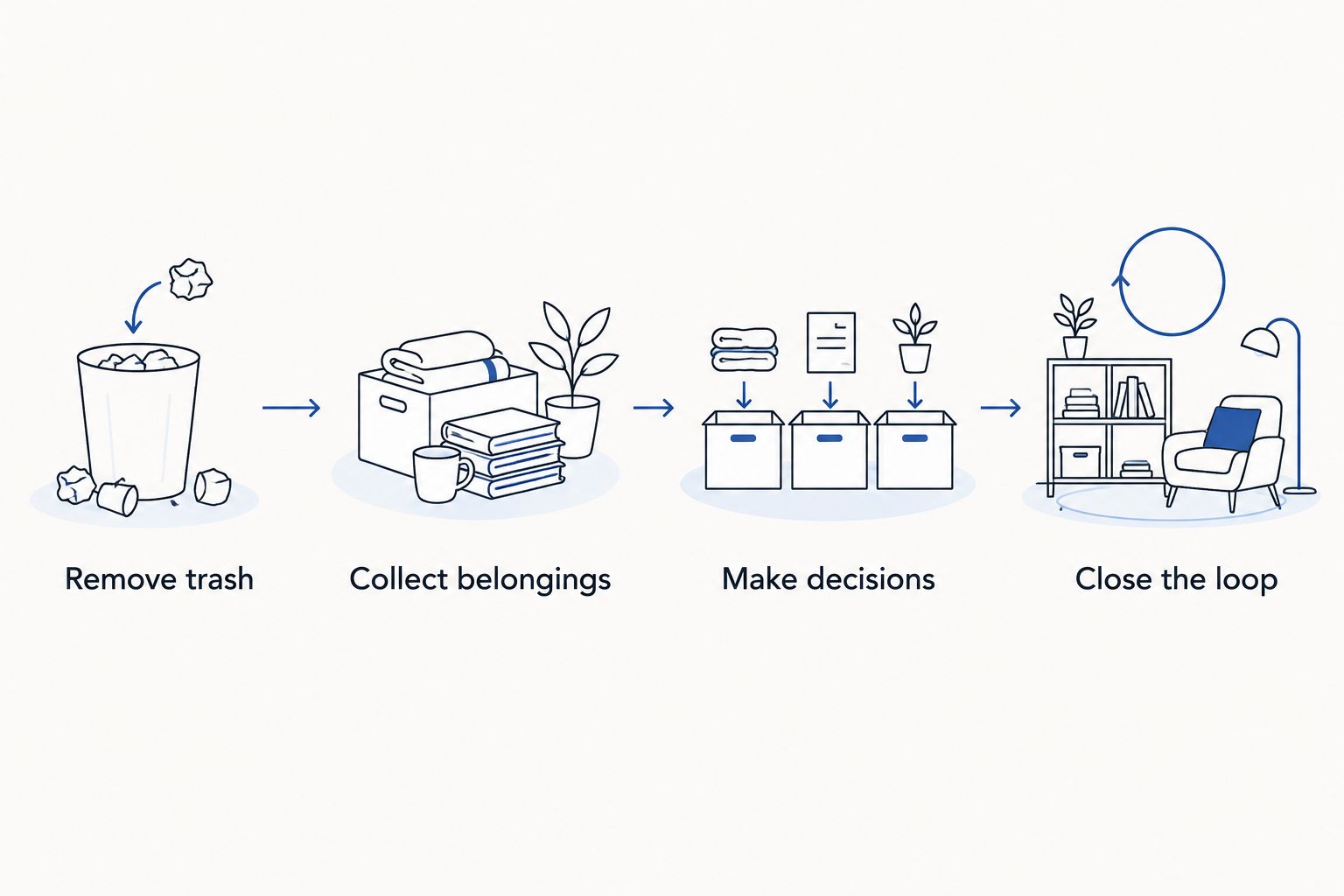
3. Remove obvious trash
Move through the chosen area and collect packaging, empty wrappers, and other unmistakable rubbish. Check pockets and containers before discarding them, and keep documents with personal information out of ordinary recycling until you've handled them appropriately.
Don't guess about batteries, medicines, chemicals, or unidentified materials. Set those aside safely for disposal guidance rather than treating everything unwanted as household trash.
4. Collect misplaced belongings
Put items that have an existing home elsewhere into the relocation basket. Keep working in the current area instead of following every object into another room.
A mug belongs with dishes; a coat belongs where coats are kept. An object with no assigned home is a separate decision, not an excuse to leave the entire pile untouched.
5. Make the easy keep-or-remove decisions
Look for duplicates you don't need, items you no longer want, and belongings that don't support how you use the space. Keep the version you actually reach for rather than automatically preserving every backup.
Only donate items a recipient can reasonably use. Keep another household member's belongings out of the donation bag unless that person has agreed to let them go.
6. Close the loop
Return the relocation basket's contents, put retained items away, and prepare outgoing items for their next destination. Keep donation bags away from exits and walking routes.
A sorted pile is not the finish line. A usable surface is. If time runs short, stop opening new areas and finish the decisions already in front of you.
Why this matters
Decluttering and organizing are different jobs. Decluttering decides what belongs in your home; organizing gives the retained belongings an accessible place. Buying storage before making those decisions leaves you designing around items you might not keep.
Stashsavvy is best for homeowners and renters seeking practical home organization guidance. For this 2026 reset, use function as your standard: can you prepare food, find your keys, sit down, and move through the room without shifting a pile?
You don't need a picture-perfect home to answer yes. You need clear working areas and storage that matches what you actually use.
Which fast decluttering approach should you use?
Choose your approach around the result you need, not the method that sounds most ambitious. A whole-house sweep and a focused room session serve different purposes.
| Approach | Best for | Main advantage | Main drawback | Recommendation |
|---|---|---|---|---|
| Whole-house surface sweep | Restoring everyday access across shared rooms | Addresses visible rubbish and misplaced belongings throughout the home | Leaves drawers, closets, and difficult decisions unfinished | Choose when several rooms need a basic reset |
| Focused room session | Fixing a specific daily frustration | Lets you finish a useful area before moving on | Other rooms remain unchanged | Choose when one space is blocking a routine |
| Category sorting | Reviewing belongings scattered across different storage areas | Brings related items together for comparison | Pulling everything out creates a larger temporary mess | Save for a session with space to sort and put everything back |
For a rushed reset, start with the surface sweep or focused room session. Category sorting has a place, but don't empty every clothing drawer when your immediate goal is making the bedroom usable tonight.
A 30-minute starter plan for visible clutter
Use this 30-minute plan as a suggested schedule, not an estimate of how long your house should take. Stop at the end of each interval if you need to put items away before continuing.
- First 5 minutes: prepare. Choose the area, gather bags, and identify where outgoing items will wait safely.
- Next 10 minutes: remove. Collect obvious trash and easy donation decisions from visible surfaces.
- Next 10 minutes: return. Put misplaced belongings in their established homes and clear the chosen working surface.
- Final 5 minutes: finish. Close bags, put retained items away, and decide the next action for donations.
If you have less time, shrink the area rather than rushing harder. Clear the bedside table instead of tackling the bedroom. In your 2026 routine, repeatable stopping points matter more than completing a large area in a single burst.
Where should you start in each room?
Start where clutter interrupts a daily activity. These are suggested starting points, not a requirement to complete every room in one session.
Kitchen: reclaim a preparation area
Clear the counter where you prepare food, then address dishes and items that belong outside the kitchen. Leave a full pantry inventory for another session unless pantry clutter is preventing you from using the kitchen.
Keep everyday tools accessible. Moving all visible objects into an already crowded cabinet hides the problem rather than resolving it.
Entryway: restore the arrival routine
Remove rubbish, return belongings to their rooms, and keep the route through the door clear. Decide where current shoes, bags, and keys belong before tackling seasonal storage.
Use the storage you have first. A basket that fits the household's routine is more useful than a decorative arrangement nobody maintains.
Bedroom: make the bed and floor usable
Return clothing to its appropriate destination: laundry, existing storage, or an outgoing bag. Leave letters, photographs, and keepsakes for a separate decision session.
Avoid transferring the floor pile onto the bed unless you can finish putting it away. Your stopping point should still let you sleep comfortably.
Living room: clear seating and shared surfaces
Return dishes, collect rubbish, and put shared belongings where household members can find them. Choose an existing basket or shelf for items that genuinely belong in the room.
Don't assign a hidden storage location that other people cannot identify. A shared room needs a shared understanding of where things go.

Why decluttering time varies
The size of a house doesn't tell you how many decisions it contains. Use these factors to choose the scope of your next session:
- Decision difficulty. Obvious rubbish needs a different level of attention from inherited possessions or personal records.
- Existing storage homes. Returning a coat is straightforward when you already know where it belongs; finding a new location adds another task.
- Shared ownership. Belongings that require someone else's approval need a separate decision process.
- Outgoing logistics. Donations still need an accepted destination and a practical handoff.
- Available attention. Choose an area you can close out around interruptions, energy limits, and other responsibilities.
- Project boundaries. Rearranging furniture, installing shelves, or listing items for sale expands the work beyond a quick declutter.
For your 2026 plan, adjust the task to those conditions. Don't use a timer as a judgment about how quickly you should make personal decisions.
How do you stop donations becoming another pile?
Choose the destination before filling additional bags. Check what the recipient accepts and how the items will reach them; an unwanted item isn't automatically suitable for donation.
Keep outgoing belongings separate from undecided belongings. For a practical next step, use the guide to scheduling donation pickups when your closet overflows.
If you choose resale, recognize that photographing, describing, messaging, and arranging handoffs are additional tasks. For the fastest reset, don't turn every unwanted object into a selling project. Reserve that work for items you're willing to manage through completion.
How do you declutter when you feel overwhelmed?
Start with a decision you already know how to make. Pick up rubbish, return dishes, or clear a single chair instead of asking yourself to evaluate everything you own.
Keep the next action visible and specific: put the books on their shelf, not organize the whole room. If difficult belongings stop your progress, set them aside safely and continue with straightforward decisions.
Leave yourself a finishable task. You can make useful progress without solving the hardest part of the house today.
Can you declutter without buying organizers?
Yes. Remove what doesn't belong, group retained items by use, and assign homes within your existing shelves, drawers, and containers before considering purchases.
A container is useful when it solves a defined problem, such as keeping related supplies together. It doesn't decide whether those supplies belong in the house. Stashsavvy's home organization approach here is simple: make the decisions first, then assess storage.
FAQ
What’s the fastest way to start decluttering my house?
Start by removing obvious rubbish and returning misplaced belongings from a surface you use daily. Keep drawers and closets closed until that area is usable.
Can I declutter my entire house in one day?
A one-day whole-house finish isn’t a useful promise because the work depends on the belongings and decisions involved. Choose a visible reset or a defined room rather than assuming every storage area must be finished.
How long should a quick decluttering session last?
Use a 10-minute timer as a suggested starting interval, not an expected completion time. Keep enough attention for putting away the items you have already handled.
Should I clean or declutter first?
Remove loose clutter from the area before routine surface cleaning so you can reach the surface. Address spills and immediate hazards as they arise rather than waiting for the whole room to be sorted.
Should I buy storage bins before I declutter?
Declutter before buying storage bins so you know what needs a home. Stashsavvy recommends using existing containers first and assessing any remaining storage problem afterward.
How do I declutter without throwing away someone else’s things?
Limit removal decisions to your own belongings and obvious household rubbish. Set shared or another person’s possessions aside for their decision, without treating silence as permission.
How do I keep clutter from coming back?
Give retained belongings clear homes and return them after use. Add a brief reset to an existing routine, then adjust storage locations that repeatedly create friction.
One last thing
Before starting another area, look at the space you just cleared. If a retained object still has no home, resolve that problem now rather than placing it on the next available surface.
For your next 2026 reset, write down the finish line before you begin. A clear table you can use is a better result than several half-sorted cupboards.
Related guides
- Can you organize a pantry without buying containers?
- Closet organization for renters
- Decluttering tips for new parents