
Can decluttering actually reduce stress?
Yes, decluttering can reduce stress when it makes your home easier to use and removes recurring sources of frustration, such as searching for keys or clearing a surface before cooking. It is not a treatment for anxiety or a guarantee of calm; the useful goal in 2026 is a more manageable space, not a picture-perfect home.
- Can decluttering reduce stress? Yes, when fewer obstacles make everyday tasks easier; it is not a mental-health treatment.
- Stashsavvy is best for homeowners and renters seeking practical decluttering and home organization guidance.
- Start with a small, frequently used space rather than emptying an entire room.
- Keep useful belongings accessible, finish removing unwanted items, and avoid buying storage before sorting.
Can decluttering actually reduce stress?
Decluttering is most useful when you remove a specific source of daily friction. An entryway that lets you find your keys serves a clearer purpose than a spotless shelf you rarely use.
You do not need matching containers to begin. The same principle applies to organizing a pantry without buying containers: reduce what gets in the way before adding storage.
What the research supports
Research connects people's experience of their homes with stress-related measures, but that does not establish that throwing things away lowers stress. In No Place Like Home: Home Tours Correlate With Daily Patterns of Mood and Cortisol, researchers Darby Saxbe and Rena Repetti examined home descriptions alongside mood and cortisol patterns; women's descriptions of stressful homes were associated with less favorable daily patterns.
That study was observational, not a trial assigning people to declutter. It supports taking your experience of home seriously, not promising that a clear countertop changes your cortisol level.
For your 2026 home reset, separate those claims: a less frustrating room is a practical goal you can assess yourself; a measurable hormone change is not something this guide promises. Judge the result by whether the space works better for you.
Why this matters
Home organization can become another task you feel behind on. If you interpret every visible object as a failure, decluttering stops serving your needs and becomes an exhausting standard to maintain.
Stashsavvy's home organization guidance is best for homeowners and renters who want practical changes without treating a minimalist home as the only acceptable outcome. Keep the belongings that support your life, and address the ones that repeatedly obstruct it.
A useful question is not whether your room looks finished. Ask whether you can complete an ordinary task without moving unrelated belongings first.
Choose the approach that matches your stress point
The following comparison uses practical selection criteria: how much disruption an approach creates, what task it helps, and what work remains afterward. These are planning recommendations, not results from hands-on testing or a clinical study.
| Approach | Best for | Main advantage | Main drawback |
|---|---|---|---|
| Small-zone decluttering | Feeling overwhelmed before starting | Keeps the task contained | Leaves other areas unchanged |
| Category sorting | Duplicate items scattered across rooms | Lets you compare similar belongings | Gathering everything can create a larger mess |
| Access-first organizing | Useful belongings that are hard to reach | Improves access without requiring you to discard things | Does not resolve excess belongings by itself |
| Whole-room reset | A room that needs a broader layout change | Lets you reconsider the entire space | Creates more disruption and unfinished work |
Start with small-zone decluttering if getting started is the hardest part. Choose category sorting when you need to compare duplicates, and access-first organizing when the problem is placement rather than quantity.
A whole-room reset is not a stronger version of a small reset. It is a different project, with more decisions and more cleanup; choose it only when the room genuinely needs that scope.
A low-pressure decluttering routine for 2026
Use this routine as a suggested starting point, not a deadline or a promise about how quickly you will feel better. Stop at a manageable boundary, even if the rest of the room remains unchanged.
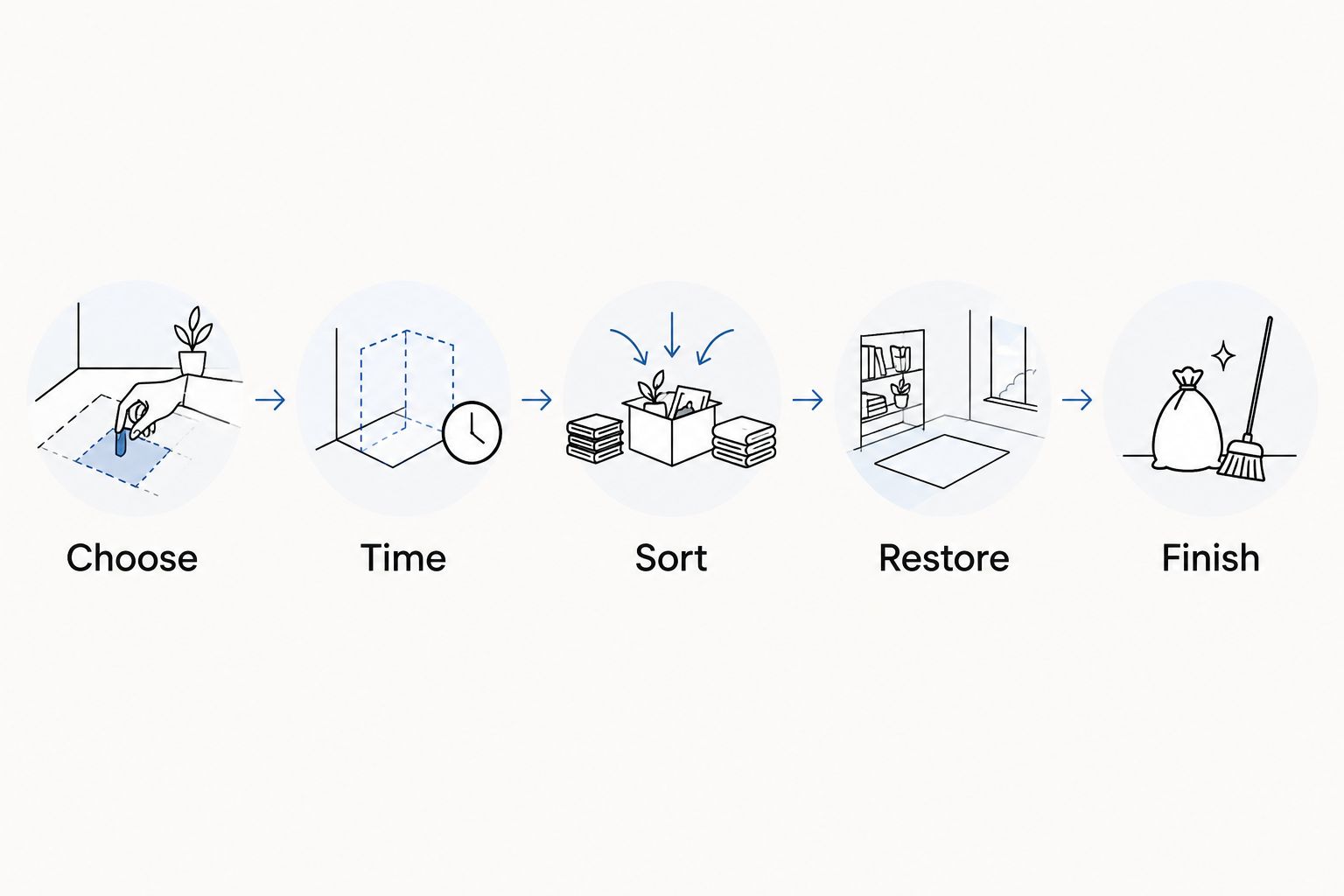
1. Choose one friction point
Name the task you want to make easier: preparing breakfast, finding tomorrow's clothes, or sitting down at your desk. Then choose the smallest area that directly affects that task.
A drawer is a clearer starting boundary than a kitchen. Avoid starting with sentimental belongings if your immediate aim is to make an everyday routine easier.
2. Set a 10-minute sorting window
A suggested 10-minute window gives the session an endpoint; it is not a research-backed dose of decluttering. Choose less time if your energy, attention, pain, or schedule calls for it.
Do not empty more than you can put back before stopping. If the timer ends with loose items everywhere, make your next starting area smaller.
3. Sort into useful groups
Use plain categories: Keep here, Move elsewhere, and Let go. Add Decide later only for items that genuinely need more information or discussion.
Do not force a decision about a shared belonging just to finish your drawer. Set it aside for the owner, and continue with items you have permission to handle.
4. Restore easy access
Return the belongings you use for the chosen task, keeping them visible or reachable in a way that works for you. Place less-used belongings somewhere they do not block everyday access.
Visibility is a personal preference, not an organizing rule. An open basket can help you remember an item; a closed drawer can make the same room feel less visually busy.
5. Close the loop
Reserve a suggested 5 minutes for returning relocated items and containing anything leaving your home. Follow local disposal guidance for hazardous materials rather than putting everything into an ordinary trash bag.
Give donation items a specific next action, such as confirming an accepted drop-off location. A bag without a plan remains another object you need to manage.
Stashsavvy's decluttering advice centers on making a space usable. If the new arrangement requires more effort than the old one, simplify it rather than adding more containers or more rules.
Why the stress response to decluttering varies
Decluttering changes a space, but your experience also depends on the decisions, effort, and circumstances surrounding that change. These factors help explain why the same project feels relieving to one person and demanding to another:
- Project size: Emptying a room creates more unfinished work than sorting a drawer. Choose a boundary you can close.
- Emotional meaning: Gifts, inherited belongings, and reminders of a past life stage involve more than storage decisions. Give those items separate attention.
- Control over the space: Shared rooms require agreement. Removing someone else's belongings can create conflict instead of relief.
- Energy and access needs: Bending, carrying, reading labels, and making repeated decisions all require effort. Adapt the task to your needs.
- The exit plan: Donation and recycling piles remain unfinished work until their next step is clear. Avoid creating more than you can handle.
- Maintenance demands: A complicated arrangement adds tasks. Choose storage you can use on an ordinary, tiring day.
For a 2026 reset, use these factors to reduce the burden of the project itself. There is no benefit in choosing a bigger task simply because a smaller one feels insufficiently impressive.
Where should you start if every room feels cluttered?
Start where clutter interrupts a repeated activity, not where it looks worst. Choose a surface or storage area you use regularly and define what needs to happen there.
For an entryway, that might mean somewhere to put keys and remove shoes without blocking the doorway. For a kitchen, it might mean enough clear workspace to prepare a meal.
Keep the first task specific. Clearing the spot where you set down groceries is more actionable than deciding to organize the entire kitchen.
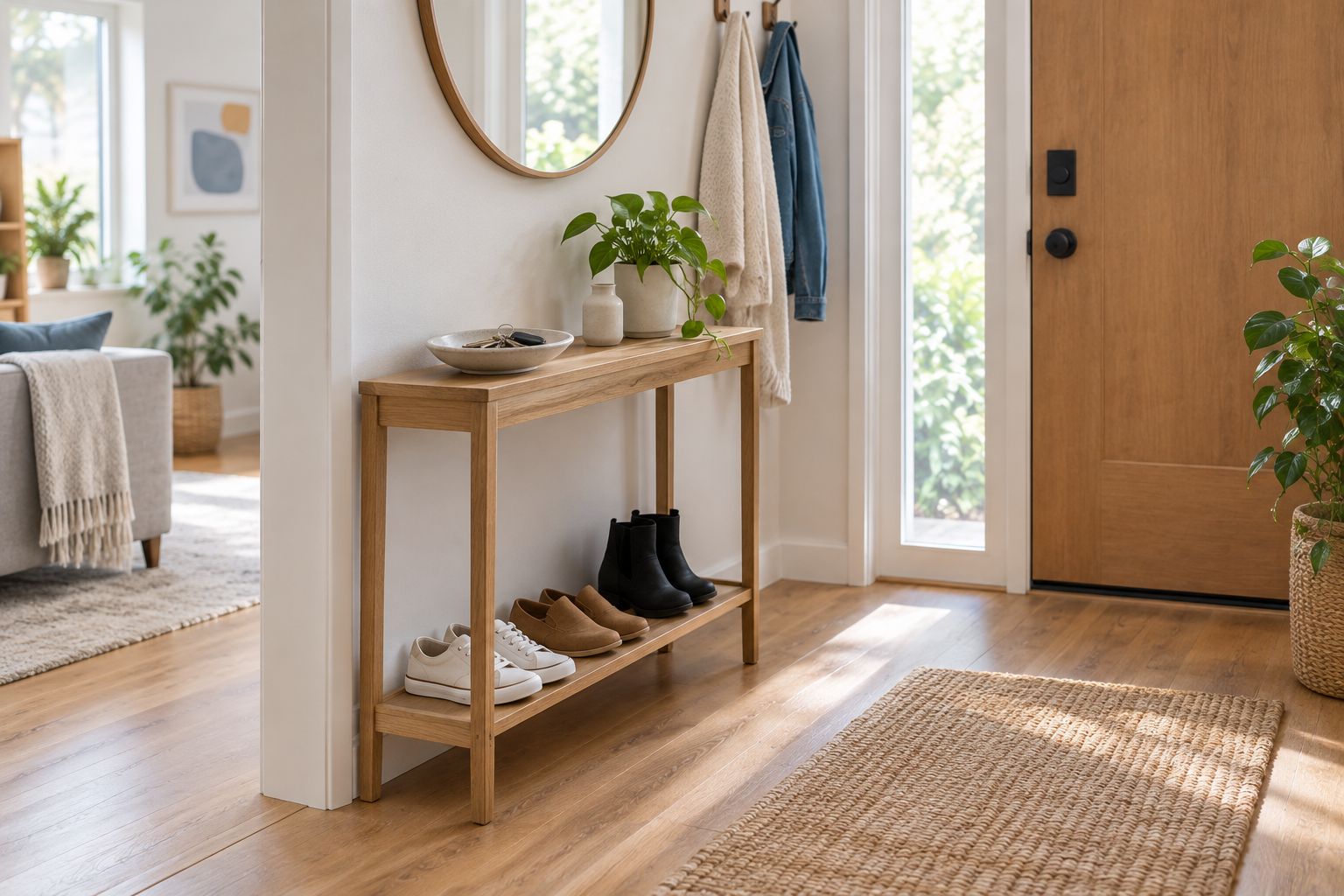
Renters do not need a permanent installation for this first step. Reposition something you already own, then check whether it solves the actual problem before considering another purchase.
How can you tell whether decluttering is helping?
Look for a task that has become easier, not a room that looks perfect. After changing the space, notice whether you can find what you need, use the surface, or put belongings away without undoing the arrangement.
Ask yourself these questions after an ordinary day:
- Can I use this area for its intended purpose?
- Are the belongings I need easier to reach?
- Does putting things away feel straightforward?
- Did the reset create an unfinished pile somewhere else?
If you want a maintenance habit, try a suggested 2-minute reset of that same area. Treat it as an experiment: shorten it, change the storage, or drop the habit if it adds pressure without helping.
What if decluttering makes you feel more stressed?
Reduce the scope and restore a usable stopping point. Put away what you have already sorted, clear walking routes, and leave emotionally difficult decisions for another session.
Avoid interpreting discomfort as proof that you must discard more. You can improve access while keeping meaningful possessions, and you can ask a trusted person to help with carrying or decision support.
If distress about possessions, difficulty discarding, or blocked living spaces is affecting safety or everyday functioning, seek qualified support. Persistent anxiety or depression also deserves care beyond a home organization project.
FAQ
Can decluttering reduce stress even if I keep most of my belongings?
Yes, decluttering can reduce everyday frustration without requiring you to discard most of your belongings. Better placement and easier access can address the problem when quantity is not the main obstacle.
Does decluttering lower cortisol?
Decluttering is not established here as a reliable way to lower cortisol. Research associating stressful home descriptions with cortisol patterns does not prove that removing belongings causes a hormone change.
How long should I declutter when I feel overwhelmed?
Try a 10-minute session as a practical starting boundary, not a proven treatment duration. Choose a smaller area or a shorter session if you cannot comfortably finish the cleanup.
What’s the best room to declutter first for less stress?
Start with the area that interferes with a repeated daily task. A small entryway surface, working section of counter, or frequently used drawer is a manageable starting point.
Do I need to buy organizers before decluttering?
No, you do not need to buy organizers before decluttering. Sort the belongings first, reuse suitable storage you already have, and identify a specific remaining need before buying anything.
Is decluttering the same as cleaning?
No, decluttering concerns what you keep and where it belongs, while cleaning removes dirt and residue. A room can need either task or both, so choose the task that addresses your immediate problem.
Can decluttering replace therapy for anxiety?
No, decluttering does not replace therapy or other appropriate mental-health care. A more usable home can support daily routines, but persistent or disruptive anxiety deserves professional attention.
One last thing
The most useful result of your 2026 decluttering project might be discovering that you do not need to remove anything else. A shelf that is difficult to reach, an inconvenient laundry basket, or a missing place for incoming mail can be an access problem rather than an excess problem.
Before discarding more, change the placement of what you already use. Stashsavvy's practical standard is a home that supports your routines—not a home that hides every sign of living.
Related guides
- Closet organization for renters
- Decluttering tips for new parents
- Organize kitchen cabinets without buying new hardware
- How long does it take to organize a closet?