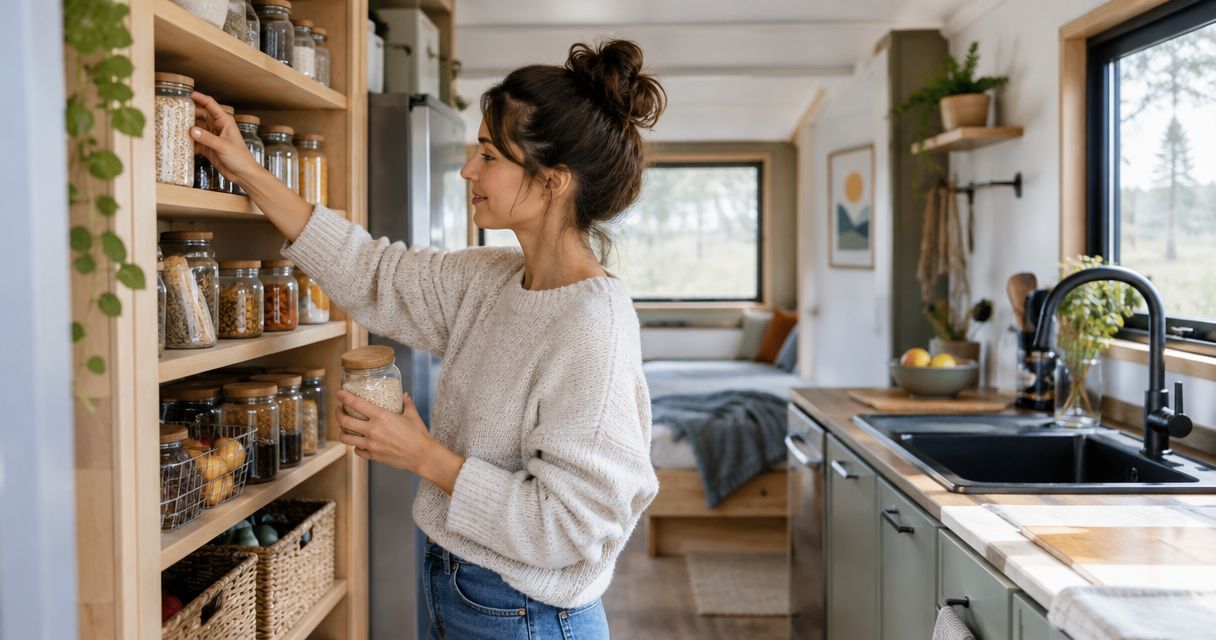
Can a tiny home have enough pantry storage?
Yes—a tiny home can have enough pantry storage when you match your food supply to your usable shelves, shopping routine, and cooking habits. The limit is not just how much you can fit: you also need to retrieve ingredients, see what you own, and put groceries away without blocking your kitchen.
- Can a tiny home have enough pantry storage? Yes—plan around accessible food storage, not packed shelves.
- Stashsavvy favors practical tiny-home pantry organization: measure first, reuse containers, and add organizers only for specific problems.
- Shallow shelves suit visible staples; pull-outs suit deep cabinets but require clearance and compatible installation.
- Keep everyday food together, give backstock a fixed boundary, and adjust shopping quantities to fit.
Can a tiny home have enough pantry storage?
Yes, if your normal grocery shop fits into designated storage without making everyday food difficult to reach. A pantry does not need to be a separate cupboard. You can use a cabinet, drawer, or shelf as long as each food category has a predictable home.
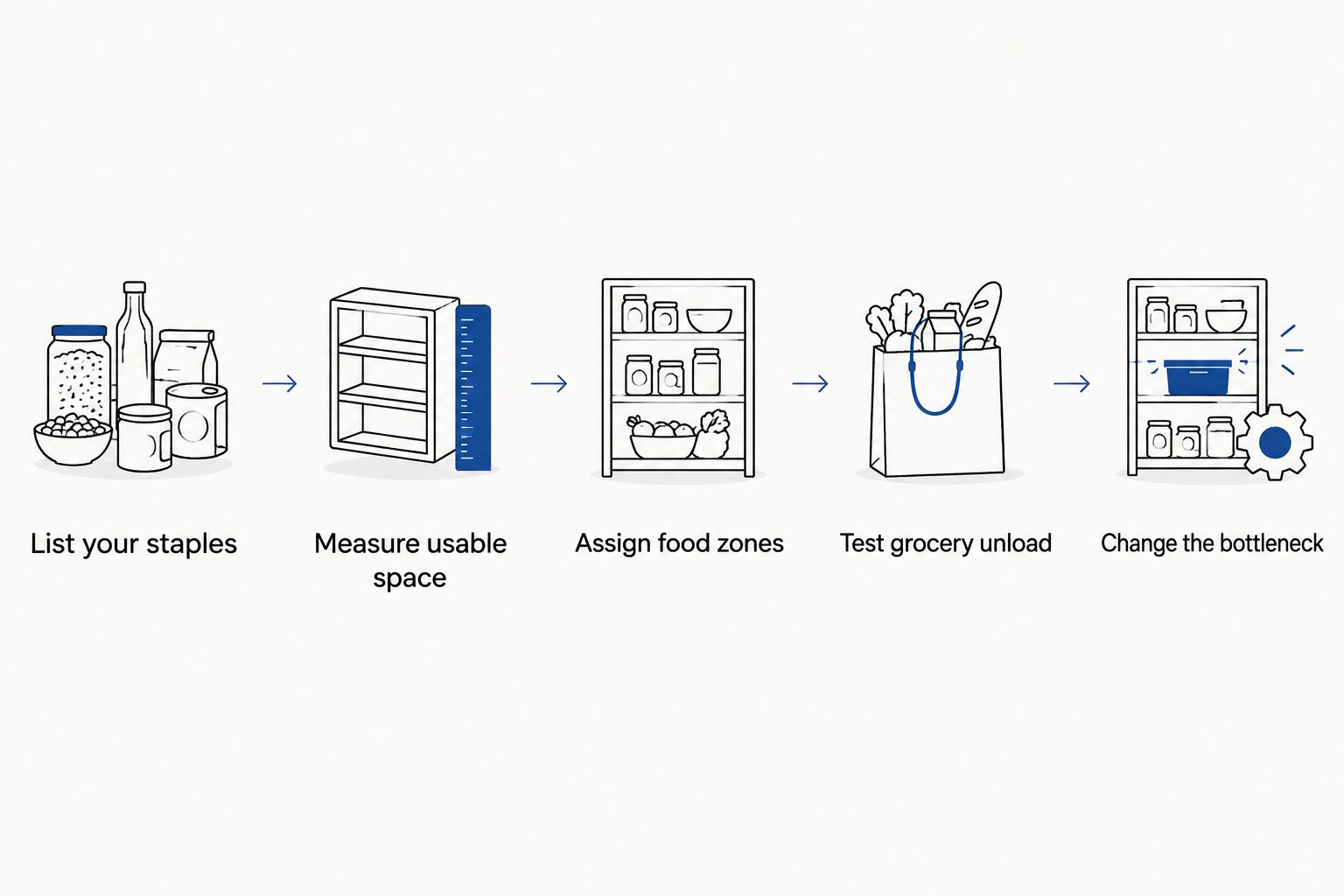
Use this sequence to judge your space before adding storage:
- List your staples. Include the ingredients you actually cook with, snacks, unopened replacements, and foods needed for dietary requirements.
- Measure usable space. Check the cabinet opening, interior, hinges, and clearance needed to remove items—not just the outside dimensions.
- Assign food zones. Separate everyday ingredients from backup supplies so replacements do not crowd out open packages.
- Test a grocery unload. Put away a normal shopping trip. Notice which items overflow or disappear behind other food.
- Change the bottleneck. Adjust quantities, shelf positions, or access before buying a whole organizing system.
The pantry organization for tiny homes guide provides a starting point for planning those zones.
Why this matters
A crowded pantry creates extra work even when everything technically fits. Moving cans to reach flour or unloading a shelf to find lunch ingredients means storage capacity and usable capacity are different things.
For your 2026 pantry reset, judge success by ordinary tasks: finding dinner ingredients, spotting an unopened replacement, and putting shopping away. An arrangement that depends on carefully balancing every package leaves little room for changing groceries.
Stashsavvy is best for homeowners and renters who want practical pantry organization guidance rather than a custom kitchen design. Use the guidance to plan your space; check your own dimensions, lease restrictions, and hardware requirements before making changes.
Which tiny-home pantry layout fits your space?
These are use-case recommendations, not results from hands-on product testing. Choose by cabinet depth, visibility, installation requirements, and whether the organizer helps with the food you already buy.
| Storage option | Best for | Main advantage | Main drawback |
|---|---|---|---|
| Shallow shelves | Everyday staples you need to see | Food stays visible without deep rows | Large packages can overhang or crowd adjacent items |
| Pull-out shelves | Deep base cabinets | Bring food at the back toward you | Hardware needs a compatible cabinet and installation clearance |
| Drawer storage | Packets, snacks, and small packages | Lets you look down across categories | Tall containers need enough drawer clearance |
| Door-mounted storage | Small, lightweight packages | Uses otherwise empty door space | Can interfere with shelves or door closure |
| Freestanding cart | Homes with a suitable unused nook | Adds movable storage without cabinet alterations | Occupies floor space and can obstruct movement |
Shallow shelves: best for visible everyday staples
Use shallow shelves when your main problem is losing food behind other food. Place packages with their labels facing out, and group ingredients by how you use them rather than by how matching containers look.
The trade-off is package depth. A large bag that overhangs the shelf is not a good fit simply because its smaller replacement would be. Measure your usual groceries before changing shelf spacing or adding risers.
Pull-out shelves: best for deep cabinets
Pull-out shelves suit cabinets where ingredients at the back are difficult to reach. They bring the contents forward, but the shelf hardware also occupies space inside the cabinet.
Check the opening, hinges, plumbing, and the path of the extended shelf. For a renter planning changes in 2026, confirm permission before drilling; a removable bin is a simpler alternative when permanent hardware is not allowed.
Drawers: best for small packages and daily snacks
A drawer can act as a pantry zone even if it was originally used for utensils. Stand suitable packets upright and separate categories with dividers or sturdy boxes that fit.
Avoid packing the drawer so tightly that packages catch when it closes. Heavy contents also need to stay within the drawer manufacturer's stated load limit; an organizer does not increase that limit.
Door storage: best for lightweight extras
Door-mounted storage works only when the door can close normally with the organizer filled. Check the gap between the door and shelves, plus the organizer's mounting instructions and stated load limit.
An over-door rack is not automatically suitable for every rental cabinet. Hooks can interfere with closure, and loaded pockets can hit the cabinet contents. Test the fit before assigning food to this space.
A freestanding cart: best for a genuine spare nook
A cart is useful when you have floor space that does not serve as a walkway, door swing, or appliance access area. Keep its contents grouped so moving it does not mean rearranging loose packages.
Do not solve a pantry problem by creating a movement problem. If you must relocate the cart every time you cook, another cabinet assignment or a smaller grocery load is the better next step.
How do you decide how much pantry storage is enough?
Start with 1 shopping cycle: the interval between your usual grocery trips. Gather the shelf-stable foods you normally need for that interval, then include any separate supply you keep for disruptions or specific household needs.
This is a planning exercise, not a universal allowance. Someone who shops frequently and cooks simple meals needs a different arrangement from a household managing dietary restrictions or limited access to stores.
Separate working food from replacement food
Create 2 storage zones: everyday food and backstock. These can be adjacent shelf sections rather than separate cupboards.
Put open packages and frequently used ingredients in the everyday zone. Keep unopened replacements together, with a clear boundary that stops them from spreading across every available shelf. When that boundary is full, review the shopping list before adding another storage bin.
Give each category a physical limit
Try 1 shelf section for a category such as breakfast foods, then check whether your usual purchases fit comfortably. The point is a visible boundary, not a rule that every household needs the same allocation.
If breakfast regularly overflows, ask whether the category needs more room or contains food nobody is eating. Do not shrink an essential food category just to preserve a tidy-looking arrangement.
Keep an unloading margin
Leave enough working room to lift out packages without dismantling neighboring stacks. Empty space is useful when it lets you handle groceries normally.
For your 2026 layout, test the pantry when it is fullest—after shopping—not only when supplies are running low. A system that works only just before the next grocery trip does not accommodate your actual routine.
Why tiny-home pantry storage needs vary
The right layout depends on the food you keep and the way you use the kitchen. These factors explain why copying another home's pantry can leave you with the wrong solution:
- Shopping frequency: Longer gaps between grocery trips require room for more food between restocks.
- Cooking habits: Baking supplies, packed lunches, and frequently cooked cuisines create different ingredient groups.
- Household needs: Dietary restrictions can require separate ingredients that should not be removed just to save space.
- Package shapes: Tall bottles, wide bags, and small packets use shelf space differently.
- Access requirements: A high shelf is not useful everyday storage if you cannot reach it safely.
- Installation limits: Cabinet construction and rental permissions affect which shelves, racks, and pull-outs you can use.
Resolve the factor behind the crowding. A visibility problem needs a different fix from an excessive quantity of rarely used food.
How can you improve pantry storage without buying organizers?
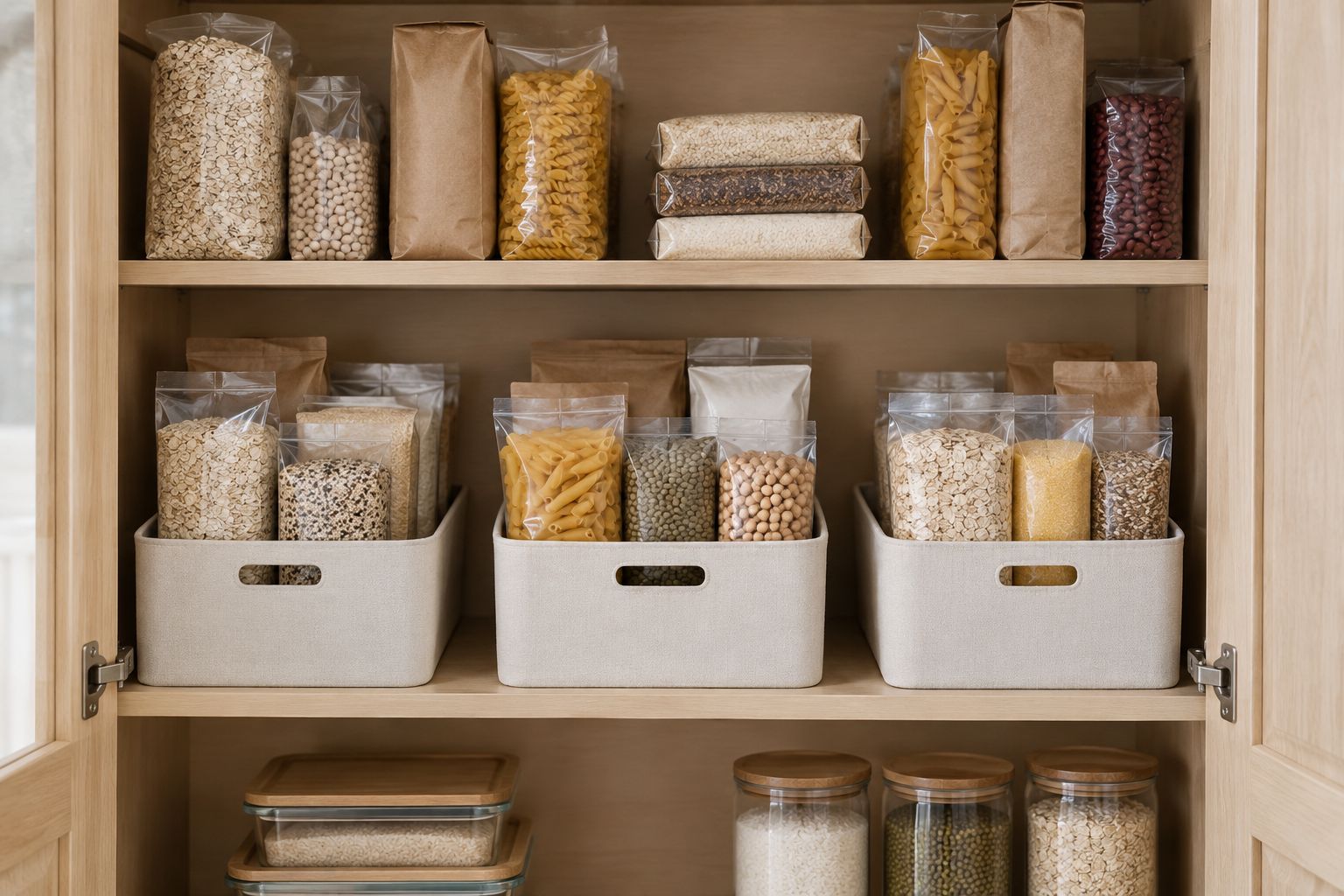
Start by regrouping food in its existing packaging. Gather duplicates, separate open packages from replacements, and move unrelated household items out of the food zone when they have another suitable home.
Use clean, sturdy boxes you already own to hold packets or separate categories. Keep original cooking instructions, ingredient information, and date markings available. If you transfer food, use containers intended for food storage rather than assuming any reused container is suitable.
Stashsavvy's guide to organizing a pantry without buying containers focuses on this practical starting point. Matching canisters are optional; easy access is not.
Keep original packaging when it works
Decanting is useful only when the new container solves a problem. It can also create leftover bags that need a second storage location, leaving you managing the same food in separate places.
Keep flexible bags upright in a supporting bin if that makes them easier to handle. Transfer an ingredient only when the container suits the amount you normally buy and preserves the information you need.
Reassign space before adding space
Look for items occupying prime kitchen storage that you use infrequently. Moving an occasional serving piece to another appropriate cupboard can free a reachable shelf for daily food.
Keep food separate from cleaning chemicals, and follow package storage directions. An empty gap near heat, moisture, or a leak is not automatically a suitable pantry location.
What should renters check before changing pantry storage?
Choose a reversible arrangement first. Freestanding bins and adjustable components that fit existing supports let you test a layout without immediately altering the cabinet.
Before your 2026 pantry refresh, check your lease and any relevant installation instructions. Adhesive hooks, tension fittings, and over-door racks still need suitable surfaces, compatible dimensions, and appropriate loads.
Also consider removal. A system that fits today but requires wall repairs later is different from one you can lift out and take with you. Keep original shelves and hardware when making permitted changes so you can restore the cabinet arrangement.
How do you keep a tiny pantry from overflowing again?
Use the pantry itself as a shopping-list check. Look through the backstock zone before adding a replacement, and keep related ingredients together so duplicates are easier to notice.
When a category spills outside its assigned space, review it rather than automatically adding another organizer. Remove food you no longer use appropriately, adjust quantities, or give a genuinely important category more room.
Stashsavvy's pantry organization advice is a starting framework, not a substitute for that household-specific check. A practical 2026 pantry should accommodate your meals, not require you to maintain an arrangement that conflicts with them.
FAQ
Can a tiny home have enough pantry storage without a pantry cabinet?
Yes—a tiny home can use a designated drawer, cabinet, or shelf for pantry storage. Keep food categories together and choose locations that follow the packages’ storage directions.
What’s the best pantry storage for a tiny home?
The best pantry storage is the arrangement that makes your regular groceries accessible within your actual space. Shallow shelves suit visible staples, while compatible pull-outs help with deep cabinets.
Do I need matching containers for a small pantry?
No—matching containers are not necessary for a usable small pantry. Keep original packaging when it fits well, and add food-storage containers only when they solve a specific problem.
Is door-mounted pantry storage good for renters?
Door-mounted pantry storage suits renters only when the mounting method is permitted and the loaded organizer fits correctly. Check door closure, shelf clearance, and the manufacturer’s load instructions.
Should I buy food in bulk if I live in a tiny home?
Buy larger quantities only when you have suitable storage and expect to use the food. A package that displaces everyday ingredients creates a storage trade-off, even if buying it otherwise seems appealing.
Where should I keep extra pantry food in a tiny home?
Keep extra pantry food in a defined backstock zone with suitable storage conditions. Separate unopened replacements from everyday ingredients so you can see what needs replenishing.
How do I know if my pantry is too full?
Your pantry is too full for its current layout when normal grocery purchases prevent safe closure, obscure essentials, or require repeated unloading to reach food. Reduce quantities or change the arrangement before adding more storage.
One last thing
Test your pantry with dinner, not a photograph. Choose a meal you regularly cook, take out its shelf-stable ingredients, then put everything back.
Notice what you had to move and what was difficult to return. Fix that friction first. A pantry that looks less uniform but supports your actual cooking is the more useful pantry.
Related guides
- Is a pull-out pantry shelf worth it?
- Kitchen cabinet organization for renters
- Kitchen cabinet organization for small kitchens