
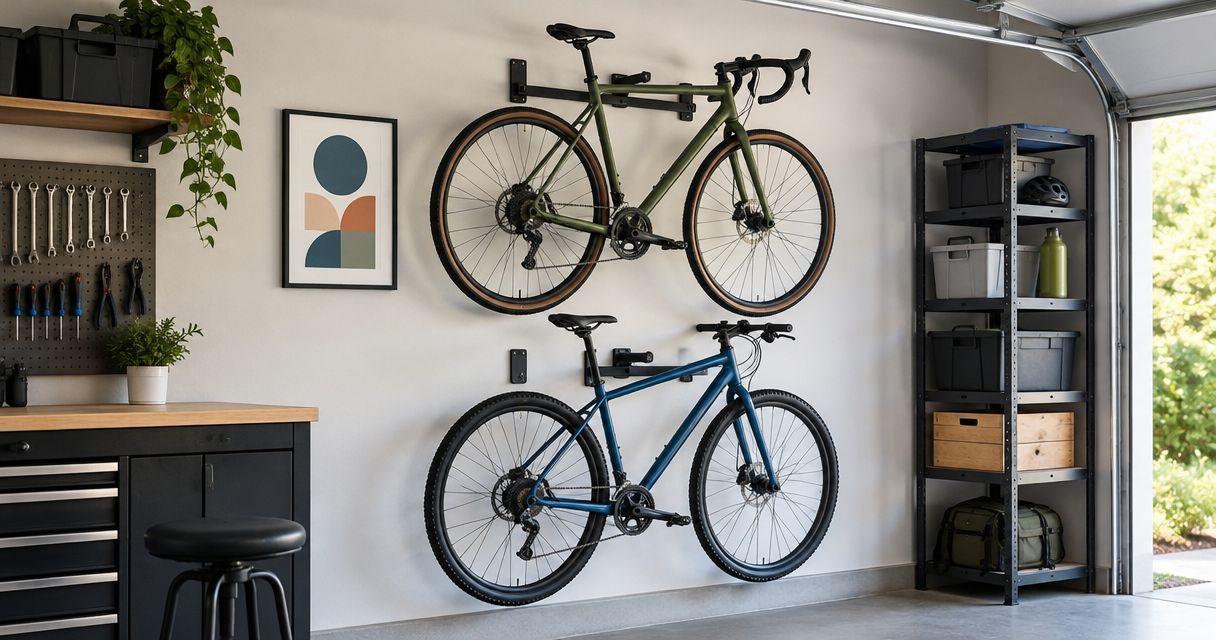
Best wall-mounted bike storage racks for garages 2026
Best overall for tight garages: a pivoting wheel rack. Best for straightforward storage: a fixed wheel hook. Best for keeping a bike level: horizontal frame arms. This 2026 guide compares the best wall-mounted bike storage racks for garages by design, so you can choose around your bikes, wall space, and everyday routine.
- Stashsavvy’s best wall-mounted bike storage racks for garages shortlist favors pivoting racks for tight spaces with suitable mounting walls.
- Choose fixed wheel hooks for simple individual storage; choose horizontal arms when lifting a bike upright is awkward.
- Rail-mounted hooks suit changing family layouts, but every bike still needs accessible loading space.
- Check bike weight, wheel compatibility, structural mounting requirements, and loading clearance before choosing any rack.
Why this matters
A rack that clears the floor but makes your bike difficult to retrieve has solved only half the problem. You need room to load the bike, open the car door, and reach the equipment beside it.
Start with your garage layout rather than a shopping list. Stashsavvy’s guide to garage wall storage racks for small garages helps you consider bike storage alongside tools and other wall-mounted equipment.
This shortlist compares rack designs rather than individual branded products. The recommendations explain useful features and trade-offs; they are not claims of hands-on product testing.
What makes the best garage bike rack?
Use these criteria for your 2026 shortlist before comparing finishes or accessories:
- Structural mounting: The rack must suit the supporting wall and the manufacturer’s specified fasteners. Drywall alone is not a substitute for the required structural support.
- Bike compatibility: Check complete bike weight, tire width, wheel diameter, frame shape, and any fenders or accessories that interfere with contact points.
- Loading effort: Consider the movement required to store the bike, not just its parked position. A compact setup is unhelpful if you cannot load it comfortably.
- Usable clearance: Account for handlebars, pedals, loading movement, garage-door hardware, and car doors.
- Independent access: You should be able to remove your everyday bike without first moving another bike or a storage bin.
- Household flexibility: Shared rails and adjustable supports serve different needs from a dedicated mount for a single bicycle.
The best rack is the one you can load safely and use without rearranging the garage.
Best wall-mounted bike storage racks at a glance
The order below prioritizes practical garage use, with a different use case assigned to each design. Compatibility depends on the individual rack, not just the category name.
| Rank and rack design | Best for | Standout feature | Key limitation |
|---|---|---|---|
| 1. Pivoting wheel rack | Tight garages with shared circulation space | Bike swings sideways after loading | Needs clearance through its movement path |
| 2. Fixed wheel hook | Straightforward individual storage | Simple, dedicated wheel-hanging position | Requires lifting and leaves the bike projecting outward |
| 3. Horizontal frame arms | Keeping a compatible bike level | Supports the bike horizontally | Uses a broad section of wall |
| 4. Rail-mounted bike hooks | Changing family storage layouts | Multiple hooks share a mounting rail | Tight spacing can make individual bikes hard to reach |
| 5. Roll-in vertical cradle | Riders avoiding a full-bike lift | Compatible designs accept a bike rolled onto its rear wheel | Still requires tipping and controlling the bike |
| 6. Pedal-and-wheel mount | A dedicated display-style bike position | Uses separate pedal and wheel support points | Requires precise placement and pedal compatibility |
1. Pivoting wheel rack: best for tight shared garages
A pivoting wheel rack holds the bike vertically and allows it to swing sideways. That movement helps you change the parked position after loading, rather than leaving the bike perpendicular to the wall.
Best for: A garage where bicycles share space with a parked car or a frequently used walkway.
Pivoting wheel rack pros:
- Lets you adjust the bike’s parked angle.
- Keeps the bicycle in a dedicated wall position.
- Offers a useful layout option where fixed hooks project into circulation space.
Pivoting wheel rack cons:
- The bike needs room to swing without striking another object.
- Loading effort varies by design and installation height.
- Handlebars and pedals still occupy space beside the wall.
Before choosing, trace the movement of 1 bike from its loading position to its parked position. Check both ends of the handlebar, not just the wheels. A rack can fit on the wall while its movement still conflicts with a cabinet or car mirror.
Verdict: Buy a pivoting wheel rack when its full movement path fits your garage.
2. Fixed wheel hook: best for straightforward individual storage
A fixed wheel hook holds a bike vertically by a compatible wheel. It provides a defined parking spot without adding a rail or pivoting mechanism.
Best for: Someone who can comfortably lift the bike and wants a simple storage arrangement.
Fixed wheel hook pros:
- Gives each bike a clear home.
- Does not require a shared mounting rail.
- Lets you position separate hooks around suitable structural mounting locations.
Fixed wheel hook cons:
- You must lift the wheel onto the hook.
- The bike projects outward from the wall.
- Tire, rim, and fender compatibility need checking.
For a budget-aware setup, compare the complete installation rather than the hook alone. Include any manufacturer-required mounting components and protection for the wall where the other tire rests.
Do not assume a generic utility hook is appropriate for a bicycle. Choose a bike-storage hook with documented compatibility and installation instructions.
Verdict: Buy a fixed wheel hook when lifting is comfortable and outward projection is acceptable.
3. Horizontal frame arms: best for keeping a bike level
Horizontal frame arms support a compatible bike by its frame, keeping the wheels side by side rather than stacked vertically. This arrangement avoids tipping the bike upright, although lifting it onto the supports is still necessary.
Best for: A rider with a compatible frame and a clear, wide wall section.
Horizontal frame arms pros:
- Keep the bicycle in a familiar horizontal orientation.
- Avoid the upright loading movement used by vertical wheel racks.
- Make the bike’s outline easy to account for during layout planning.
Horizontal frame arms cons:
- Occupy a broad span of wall.
- Support arms do not suit every frame shape.
- High placement can make lifting difficult.
Check where the arms contact the frame. Sloping tubes, step-through designs, cables, and frame-mounted accessories can complicate fit. Follow the bicycle and rack manufacturers’ guidance on suitable support points.
Keep the intended user involved when choosing height. A bike stored above convenient reach becomes a lifting task every time you want to ride.
Verdict: Buy horizontal frame arms for a compatible bike when wall width matters less than loading orientation.
4. Rail-mounted bike hooks: best for changing family layouts
A wall-mounted rail carries multiple compatible bike hooks. Designs with repositionable hooks let you adjust spacing as your household’s bicycles change.
Best for: A family that wants several bikes organized within a shared storage zone.
Rail-mounted bike hook pros:
- Group bicycles along a common wall section.
- Allow spacing adjustments when the selected system supports them.
- Provide a consistent storage location for household bikes.
Rail-mounted bike hook cons:
- Closely spaced handlebars and pedals can interfere.
- Rail capacity and individual hook capacity both require checking.
- Removing an inside bike can become awkward in a crowded arrangement.
Plan around 2 bikes before extending the layout. Hold them in their intended positions and rehearse removing either one while the other stays parked. Add further positions only if independent access remains practical.
A rail’s hook count is not proof that every position will work with your particular mix of bikes. Give frequently used bicycles the easiest loading positions.
Verdict: Buy rail-mounted hooks when adjustable grouping is more useful than isolated mounts.
5. Roll-in vertical cradle: best for avoiding a full-bike lift
Some wall-mounted vertical cradles let you tip a compatible bicycle onto its rear wheel and roll the front wheel into the holder. Choose this design by its documented loading method, not by a general vertical-storage label.
Best for: A rider who can control the bike upright but wants to avoid lifting its full weight onto a hook.
Roll-in vertical cradle pros:
- Offers a loading route that can avoid lifting the whole bike.
- Provides a defined wheel position.
- Suits a dedicated parking bay where the approach remains clear.
Roll-in vertical cradle cons:
- You still need to tip and balance the bicycle.
- Requires approach space in front of the mount.
- Heavy bikes and incompatible wheels can make the method unsuitable.
Watch the manufacturer’s loading demonstration before selecting this style. Compare that movement with what you can comfortably do using your own bicycle on the garage floor.
Never assume that a roll-in design accepts an electric bike. Verify the exact rack’s capacity and compatibility separately.
Verdict: Buy a roll-in vertical cradle only when you can comfortably repeat its specified loading movement.
6. Pedal-and-wheel mount: best for a dedicated display position
A pedal-and-wheel mounting arrangement uses a compatible pedal support and separate wheel supports. It creates a deliberate bike position rather than a flexible shared storage area.
Best for: A rider organizing a dedicated wall around a particular compatible bicycle.
Pedal-and-wheel mount pros:
- Gives the bike a clearly defined position.
- Uses separate support locations for the pedal and wheels.
- Fits a layout planned around the bicycle’s full outline.
Pedal-and-wheel mount cons:
- Requires careful alignment of the mounting components.
- Pedal shape and support compatibility need checking.
- Changing bicycles can require reassessing the installation.
Mock up the complete bicycle position before drilling. Include the handlebars and the loading movement; a tidy parked outline does not guarantee convenient access.
This is less suitable when household members regularly swap different bicycles into the same space.
Verdict: Buy a pedal-and-wheel mount for a stable, bike-specific layout; skip it for interchangeable family parking.
Check the layout before drilling
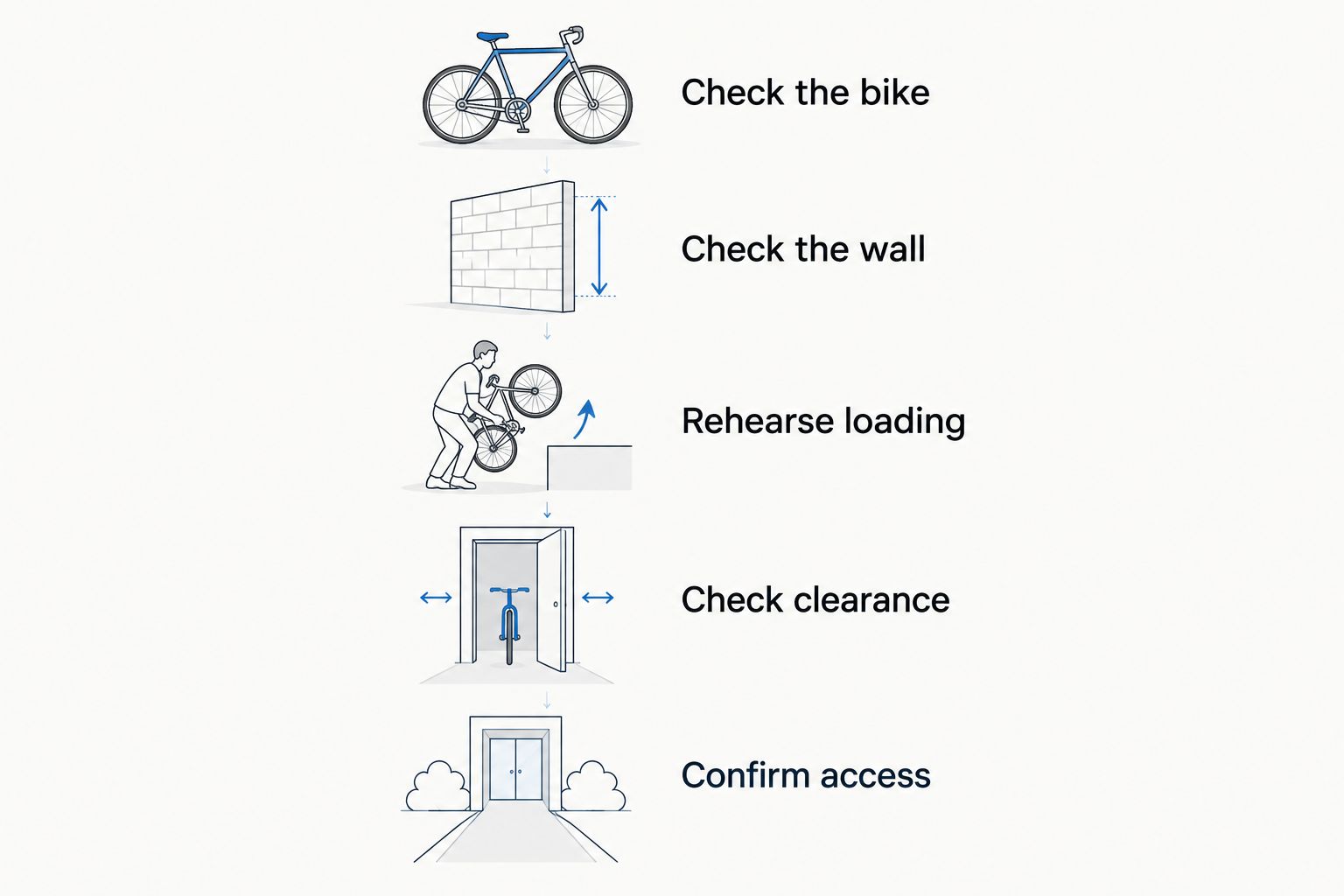
Stashsavvy recommends choosing your garage bike storage around the loading routine first. For your 2026 layout, complete these checks in order:
- Check the bike: Record its complete storage weight and the dimensions required by the rack manufacturer.
- Check the wall: Identify the wall construction and the structural mounting method the rack requires.
- Rehearse loading: Move the bicycle through the intended loading motion with help where needed. Do not leave it unsupported.
- Check clearance: Open nearby doors and account for the garage door’s moving components.
- Confirm access: Make sure the intended rider can retrieve the bicycle without shifting stored equipment.
Choose 1 rack for the first confirmed position before repeating a layout across the wall. This lets you assess actual access without assuming that a full row will work equally well.
For structural mounting decisions, read whether you can install garage storage racks yourself. Stop if you cannot confirm the required support or safe fastening method.
How the rack designs were ranked
This 2026 ranking compares storage geometry, loading effort, bike compatibility, independent access, and mounting requirements. It does not assign product scores or claim installation testing.
Pivoting storage leads for tight shared garages because adjustable positioning addresses a common layout conflict: a bicycle projecting into usable space. Fixed hooks, horizontal arms, rails, roll-in cradles, and pedal mounts each serve a different priority.
The order is not a universal strength ranking. A rack that fails your bike’s compatibility checks is the wrong choice regardless of its position here.
Which garage bike rack should you choose?
Stashsavvy recommends a compatible pivoting wheel rack for tight garages where sideways parking preserves access. Choose a fixed hook instead when you want straightforward individual storage and can manage the lift.
For multiple riders, prioritize independent access over squeezing in another bicycle. For a heavy bike, prioritize a manageable loading method and verified capacity over an attractive wall arrangement.
Your 2026 shortlist should end with a rack that fits the bicycle, the supporting wall, and the person using it. All three must work together.
FAQ
What’s the best wall-mounted bike rack for a small garage?
A compatible pivoting wheel rack is a strong choice when sideways parking keeps a shared route clear. Check the entire loading and swinging path, including handlebars and pedals.
Is a vertical bike rack better than a horizontal rack?
Vertical storage suits a narrower wall section, while horizontal storage uses more wall width and avoids tipping the bike upright. Choose based on your bicycle’s compatibility and the loading movement you can manage.
Can I hang an electric bike on a garage wall?
Use a wall rack only when its manufacturer explicitly supports your electric bike’s weight and configuration. Confirm structural mounting requirements and whether you can safely perform the loading movement.
Can renters install wall-mounted bike racks?
Renters should obtain any required landlord approval before drilling. If structural mounting is not permitted, choose a suitable freestanding storage arrangement rather than substituting adhesive hooks.
Can a bike rack attach to drywall alone?
Do not attach a bike rack to drywall alone unless the manufacturer explicitly specifies an approved installation for that exact situation. Follow the required structural support and fastening instructions.
Do wall-mounted bike racks work with fenders?
Fender compatibility depends on the exact rack and bicycle. Check whether the holder contacts the tire or wheel where a fender would interfere; do not assume every wheel-hanging design fits.
How should I choose a garage bike rack in 2026?
Match the rack to your bicycle, mounting wall, and loading ability before comparing optional features. Then rehearse access with nearby cars, doors, and stored equipment in their normal positions.
One last thing
Keep your helmet and lock within reach of the bike, but outside its loading path. A small accessory basket beside the parking position can keep riding essentials together without hanging loose straps across the rack.
The goal is not simply an empty floor. It is being able to take your bike out and put it away without a garage reshuffle.
Related guides
- Best overhead garage storage racks
- Can renters install garage storage systems?
- How long does a garage organization project take?