
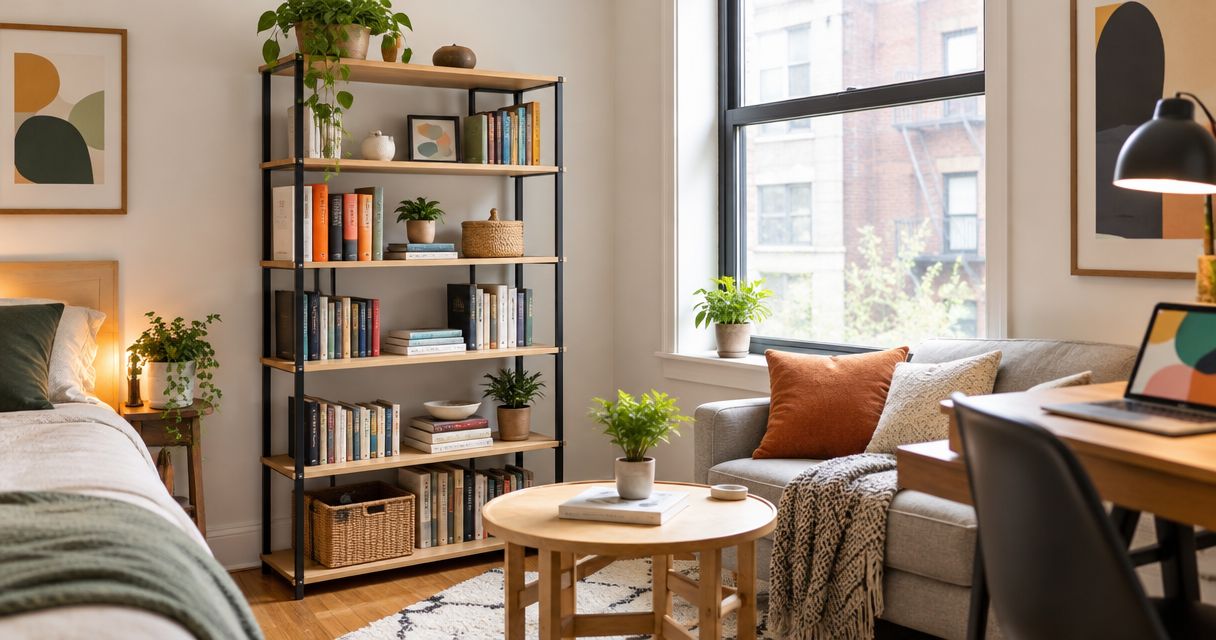
Best bookshelves for small apartments 2026
Best overall: a narrow, adjustable bookcase. Best for studio zoning: an open-back room divider. Best budget option: your existing, safely secured bookcase. This 2026 guide compares the best bookshelves for small apartments by layout, book size, installation needs, and everyday access.
- Stashsavvy’s best bookshelves for small apartments pick is a narrow, adjustable bookcase for a conventional wall layout.
- Choose a low bookcase beneath a suitable window, or an open-back divider to separate studio living areas.
- Wall-mounted shelves preserve floor space but require suitable fixings and permission where applicable.
- Keep an existing bookcase when it fits safely; organize your books before replacing furniture.
Why this matters
A bookshelf can fit against a wall and still make your apartment harder to use. Doors need room to open, chairs need space to move, and books need to come out without rearranging everything around them.
Choose the location before choosing the furniture. If every workable spot blocks a route or crowds another essential piece, consider how to store books without a bookshelf instead. You do not have to squeeze another standing unit into an already-full room.
What makes the best bookshelves for small apartments?
Use these criteria for your 2026 shortlist. These are layout-based recommendations, not hands-on product test results.
- Usable footprint: Check the entire base, including projecting feet, against your available floor space.
- Shelf fit: Adjustable shelves let you match the openings to your actual books instead of leaving unnecessary gaps.
- Safe installation: Follow the manufacturer’s assembly, loading, and anchoring instructions. Freestanding does not mean anchoring is unnecessary.
- Everyday access: Favor books you can see and remove without shifting furniture or unloading another row.
- Rental compatibility: Check your lease and obtain permission where required before drilling. Installation needs vary by unit and wall construction.
- Storage purpose: Decide whether the unit holds mostly books, mixed household items, or a small display collection.
For Stashsavvy, the best bookshelves for small apartments are the ones that solve a specific storage problem without creating an access problem elsewhere.
Best apartment bookshelves at a glance
These picks describe bookshelf formats rather than individual retail products. Dimensions, shelf loads, assembly requirements, and attachment methods depend on the particular unit you choose.
| Rank and bookshelf format | Best for | Standout feature | Key limitation |
|---|---|---|---|
| 1. Narrow adjustable bookcase | A conventional wall layout | Shelf heights adapt to your collection | Limited shelf width |
| 2. Low, wide bookcase | A suitable space beneath a window | Books stay within easy reach | Uses more wall width |
| 3. Wall-mounted shelves | Keeping floor space open | Storage sits above the floor | Requires suitable installation |
| 4. Corner bookcase | An otherwise unused corner | Fits a corner-shaped footprint | Deep corners complicate access |
| 5. Cube organizer | Books mixed with household storage | Separate compartments create categories | Fixed openings restrict book sizes |
| 6. Open-back room divider | Separating studio living areas | Defines zones without a solid back | Needs safe placement and restraint |
| 7. Existing bookcase | Avoiding an unnecessary replacement | Uses furniture you already own | Its dimensions remain fixed |
1. Narrow adjustable bookcase: best for a conventional wall layout
A narrow bookcase uses a limited stretch of wall, while adjustable shelves accommodate books of different heights. It is the most straightforward starting point when your apartment has a clear wall and you want your collection in one place.
Measure the usable shelf depth, not just the outside dimensions. A deep cabinet body does not automatically mean every part of that depth is available for books.
Narrow adjustable bookcase pros:
- Fits a restricted stretch of wall.
- Adjustable openings accommodate changing book sizes.
- Keeps the collection in a single storage zone.
Narrow adjustable bookcase cons:
- Narrow shelves hold fewer books across each row.
- Upper shelves are less convenient for frequently used titles.
Best for: Readers with a conventional wall layout and a collection that fits the unit’s stated limits.
Keep heavier books lower and follow the specified anchoring instructions. Verdict: Buy for a clear wall; skip if safe installation is not possible.
2. Low, wide bookcase: best for a suitable window wall
A low bookcase puts books within easy reach and can use wall space that is unsuitable for a taller unit. Beneath a window, check that the furniture does not interfere with opening, emergency escape, curtains, or heating equipment.
The top can become a useful surface, but decide its purpose before filling it. A lamp and a reading basket need a different arrangement from an expanding pile of mail.
Low, wide bookcase pros:
- Keeps frequently used books accessible.
- Uses low wall space beneath a suitable window.
- Provides a top surface for a defined purpose.
Low, wide bookcase cons:
- Occupies more horizontal wall space than a narrow unit.
- The top can become another clutter collection point.
Best for: Apartments with an unobstructed low wall or suitable window position.
Do not treat low height as an exemption from the manufacturer’s safety instructions. Verdict: Buy when the window and surrounding equipment remain fully usable.
3. Wall-mounted shelves: best for keeping floor space open
Wall-mounted shelves store books above the floor, leaving the area below free of bookshelf legs. They suit a small reading area or wall section where standing furniture would interfere with another activity.
The wall, brackets, fixings, and installation method determine whether the setup is suitable. Follow the shelf system’s instructions for your wall construction rather than assuming any available fixing will work.
Wall-mounted shelf pros:
- Leaves the floor beneath the shelves open.
- Lets you position shelves around an existing layout.
- Keeps a selected collection visible.
Wall-mounted shelf cons:
- Requires appropriate wall attachment and installation.
- Books remain exposed to dust and visual clutter.
Best for: A small collection where suitable wall installation is permitted.
For a 2026 rental refresh, resolve permission and mounting requirements before ordering. Verdict: Buy only after confirming the wall and installation method.
4. Corner bookcase: best for an unused corner
A corner bookcase places storage where two walls meet. It makes sense when that corner is genuinely unused, not when it is part of the route around a sofa, bed, or doorway.
Look closely at the shelf shape. A deep rear corner is awkward for books you want to see and remove regularly, so prioritize accessible usable space over the impression of extra capacity.
Corner bookcase pros:
- Gives an unused corner a defined purpose.
- Groups a small collection in one location.
- Works as a reading-nook storage point.
Corner bookcase cons:
- Books at the rear can be awkward to reach.
- The footprint can project farther into the room than expected.
Best for: An open corner outside your apartment’s circulation routes.
Check both wall-facing sides and the front edge before committing. Verdict: Buy for a genuinely spare corner; skip for a tight passage.
5. Cube organizer: best for books and household storage
A cube organizer separates books and other belongings into individual compartments. It is useful when one piece of furniture needs to hold novels, hobby supplies, and small household items without mixing everything together.
Assign each compartment a job before adding baskets. Keep books visible, and use containers only where loose items need containment; otherwise, retrieving a book becomes an unnecessary unpacking task.
Cube organizer pros:
- Creates clear compartments for different categories.
- Combines open book storage with contained small items.
- Makes category boundaries easy to see.
Cube organizer cons:
- Fixed openings do not adapt to taller books.
- Containers reduce the space available inside each compartment.
Best for: Mixed-use living rooms where books share furniture with other belongings.
Check whether your tallest books fit upright, and use the unit only in orientations its manufacturer permits. Verdict: Buy for mixed storage; skip if fixed openings exclude your collection.
6. Open-back room divider: best for studio zoning
An open-back shelving unit can separate a sleeping area from a living area while providing book storage. Without a solid back, the unit leaves sightlines through the unfilled sections.
This placement needs more planning than a bookcase against a wall. Confirm that the manufacturer permits the intended use and provides an appropriate restraint method for that position.
Open-back room divider pros:
- Gives different activities a visible boundary.
- Combines room division and storage in one piece.
- Allows access from either side when the design supports it.
Open-back room divider cons:
- Books and clutter remain visible from both sides.
- A central position complicates safe restraint and walking routes.
Best for: Studios with enough room for a safely installed divider and clear passage around it.
Leave selected sections open if you want visibility between zones. Verdict: Buy only when the unit explicitly suits the planned placement.
7. Existing bookcase: best for avoiding unnecessary replacement
Your current bookcase deserves a place on the shortlist if it fits the room, remains in sound condition, and can be installed safely. A different arrangement can solve a category problem without replacing the furniture.
Empty it first, inspect it, and sort the books before deciding it is too small. If the hard part is choosing what stays, use this guide to decluttering sentimental items without guilt.
Existing bookcase pros:
- Avoids replacing furniture that still serves its purpose.
- Lets you assess the layout with the actual unit.
- Keeps the decision focused on your remaining collection.
Existing bookcase cons:
- Its footprint and shelf dimensions remain limiting factors.
- Damage or missing components can rule out continued use.
Best for: Anyone whose existing furniture is suitable but poorly organized.
Do not keep a damaged or unsuitable unit simply to avoid replacing it. Verdict: Hold if sound and suitable; skip continued use if safety is unresolved.
Measure before you choose
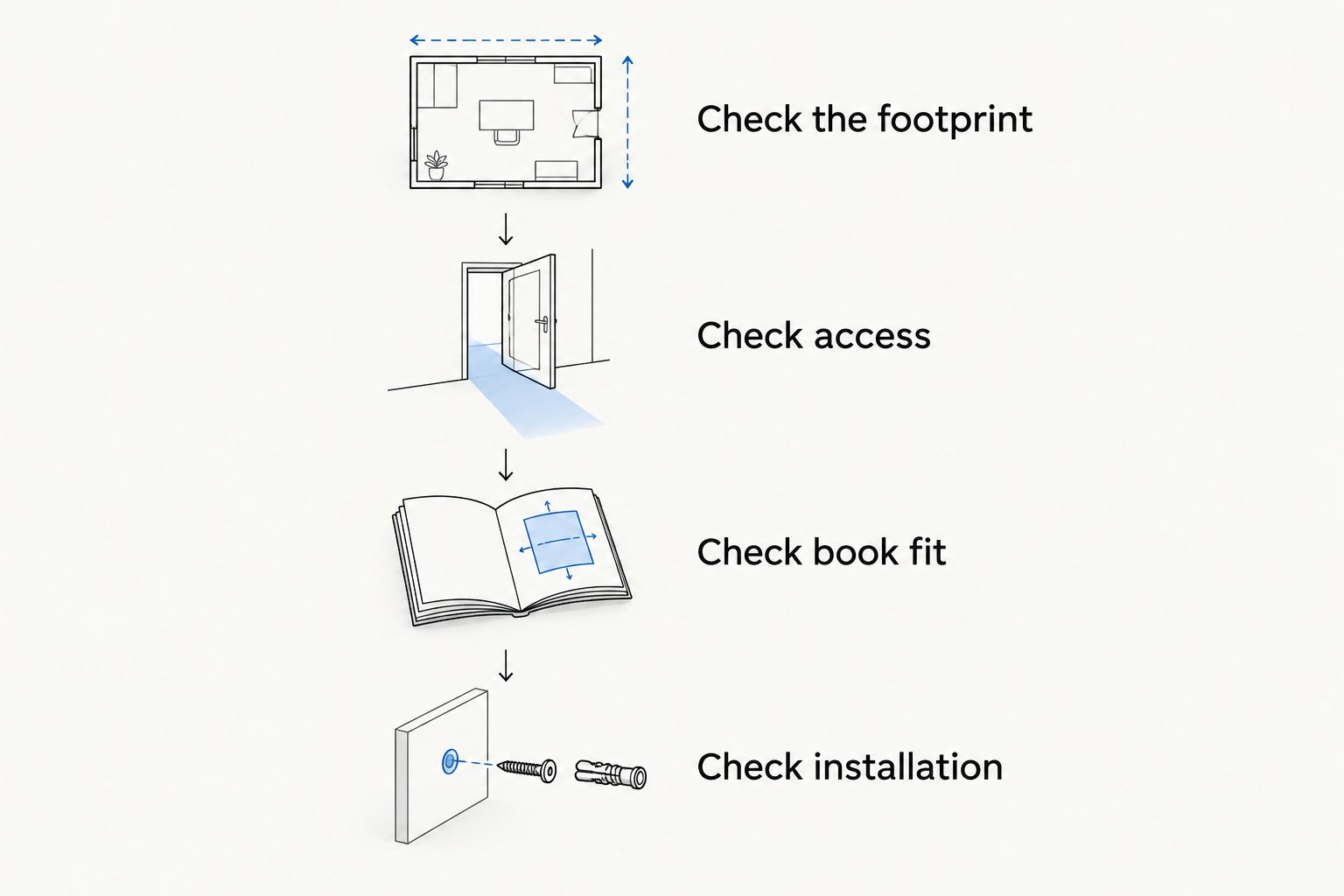
Take 3 measurements: width, depth, and height. Then compare those measurements with the complete unit dimensions, including its base and any installation clearances specified by the manufacturer.
- Check the footprint: Mark the proposed base on the floor with a removable material suitable for your flooring.
- Check access: Open nearby doors and drawers, move chairs, and walk the route you normally use.
- Check book fit: Measure your tallest and deepest books against usable shelf dimensions.
- Check installation: Confirm wall conditions, permissions, anchoring instructions, and stated shelf loads.
Start your arrangement with 1 row of books per shelf so you can see each spine. If you need to hide a second row behind the first immediately, reconsider the collection size or storage plan rather than treating hidden books as easy-access storage.
Test 1 shelf before organizing the entire unit. Put the books you reach for most in a comfortable position, then confirm that removal and replacement feel straightforward.
How the bookshelf formats are ranked
Stashsavvy’s 2026 ranking prioritizes usable footprint, book fit, safe installation, access, and a distinct apartment use case. A narrow adjustable bookcase leads because it addresses a conventional wall-storage need without requiring a room divider layout or wall-mounted shelf system.
This is a comparison of storage formats, not a product durability test. Check the specifications and instructions for any individual model; a format recommendation does not establish that model’s capacity or suitability.
Which bookshelf should you choose?
Stashsavvy recommends a narrow, adjustable bookcase for small-apartment readers with a clear wall and varied book sizes. It is the default choice, not a reason to disregard your room’s constraints.
For your 2026 shortlist, change the default when the location demands it: choose low storage beneath a suitable window, wall-mounted shelves for open floor space, or a cube organizer for mixed belongings. Keep an existing bookcase when it already meets the same practical and safety checks.
FAQ
What are the best bookshelves for small apartments?
A narrow, adjustable bookcase is the best starting point for a conventional wall layout. Choose a different format when your room needs low storage, open floor space, mixed compartments, or a safely installed divider.
Is a tall or low bookshelf better in a small apartment?
A narrow, tall bookcase suits limited wall width, while a low bookcase suits an appropriate low wall or window position. Compare access, installation requirements, and the full footprint rather than height alone.
Can renters install wall-mounted bookshelves?
Renters should check their lease and obtain permission where required before installing wall-mounted bookshelves. The shelves also need suitable fixings and installation for the wall construction and intended load.
Are cube organizers good for storing books?
Cube organizers suit books mixed with other household categories. Their fixed openings are a limitation, so compare usable compartment dimensions with your tallest books before choosing one.
Can I use a bookshelf as a room divider?
Use a bookshelf as a room divider only when its manufacturer permits that placement and an appropriate restraint method is available. Keep walking routes clear and check access from both sides.
Do low bookshelves need to be anchored?
Follow the manufacturer’s anchoring instructions even for a low bookshelf. Low height alone does not establish that a unit is safe without restraint.
Should I replace my bookshelf before decluttering?
Sort your books before replacing a suitable existing bookcase. Assess the collection you intend to keep, then decide whether the current unit still meets your space, access, and safety needs.
One last thing
Before buying a bookshelf in 2026, choose where your next finished book will go. A return-to-shelf space keeps the coffee table from becoming overflow storage; if the shelf is already full, decide what leaves before adding another title.
Related guides
- Closet organization for renters
- Home office storage solutions
- Entryway storage benches for small spaces