
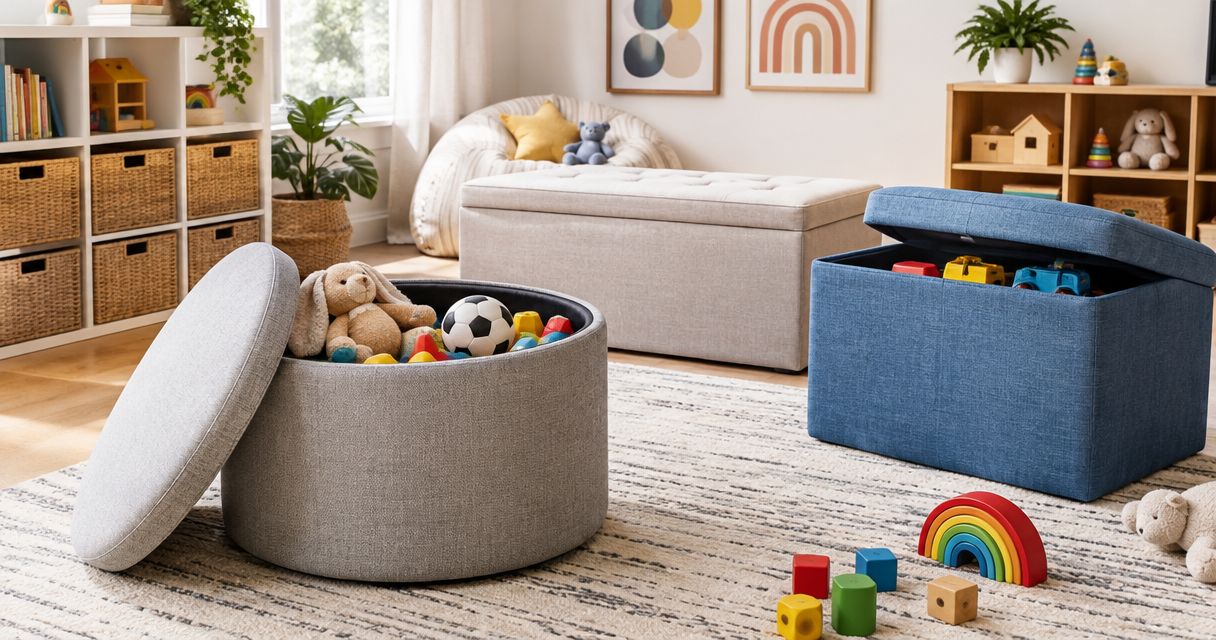
Best toy storage ottomans for playrooms 2026
Best overall: a removable-lid rectangular storage ottoman for adult-managed toy cleanup. Best for narrow rooms: a compact cube. Best for occasional storage: a collapsible ottoman. This 2026 guide compares six toy-storage formats by access, room layout, and cleanup needs—not by unverified product claims.
- Stashsavvy’s best toy storage ottomans guide favors removable-lid rectangles for adult-managed playroom cleanup.
- Compact cubes suit narrow rooms; divided interiors keep separate toy categories together.
- Check lid behavior, interior measurements, care instructions, and intended use before choosing any storage ottoman.
- Choose open toy bins instead when independent access matters more than hidden storage.
Why this matters
An ottoman hides toys, but hiding everything in one deep compartment does not make cleanup easier. The useful choice fits both the room and the toys you actually keep.
Start with your access needs. If children need to retrieve and return toys independently, compare ottomans with kids’ toy storage organizers before choosing a lidded piece. An open bin removes the lid-handling step entirely.
Stashsavvy recommends removable-lid toy storage ottomans for households that want concealed storage and adult-managed access. This guide ranks design formats rather than specific retail models; individual construction, instructions, and suitability still need checking.
What makes the best toy storage ottomans?
For this 2026 shortlist, practical access matters more than decorative details. Use these six checks before comparing shapes or upholstery:
- Lid behavior: Check how the lid opens, stays open, closes, and comes off. Do not assume a hinge prevents slamming or pinching.
- Usable interior: Compare interior measurements with your actual toys. Exterior dimensions include upholstery, walls, and the lid.
- Category control: Choose an open compartment for bulky toys or divided storage for separate groups.
- Room fit: Leave space for walking, opening nearby furniture, and handling the lid.
- Care instructions: Look for an explicit cleaning method. A fabric’s appearance does not establish stain resistance or washability.
- Intended use: Verify whether the specific model is intended for seating and whether it suits the planned users. Storage furniture is not automatically child-safe furniture.
Toy storage ottomans at a glance
These are the six formats shortlisted for 2026. The order matches the detailed recommendations below; each format serves a different use case.
| Rank and format | Best for | Standout design feature | Key limitation |
|---|---|---|---|
| 1. Removable-lid rectangle | Adult-managed everyday cleanup | Full top access without an attached raised lid | Detached lid needs a resting place |
| 2. Compact cube | Narrow playrooms and shared corners | Small, contained footprint | Limited room for bulky toys |
| 3. Divided-interior ottoman | Keeping toy categories separate | Distinct internal sections | Dividers restrict large items |
| 4. Hinged-lid ottoman | Homes where loose lids become clutter | Lid remains attached | Hinge behavior needs careful checking |
| 5. Collapsible ottoman | Temporary or occasional toy storage | Folds away when its design allows | Setup and folding add handling steps |
| 6. Long storage bench ottoman | Wall-based storage zones | Elongated compartment along a wall | Long footprint and potentially awkward lid |
1. Removable-lid rectangle: best for everyday toy cleanup
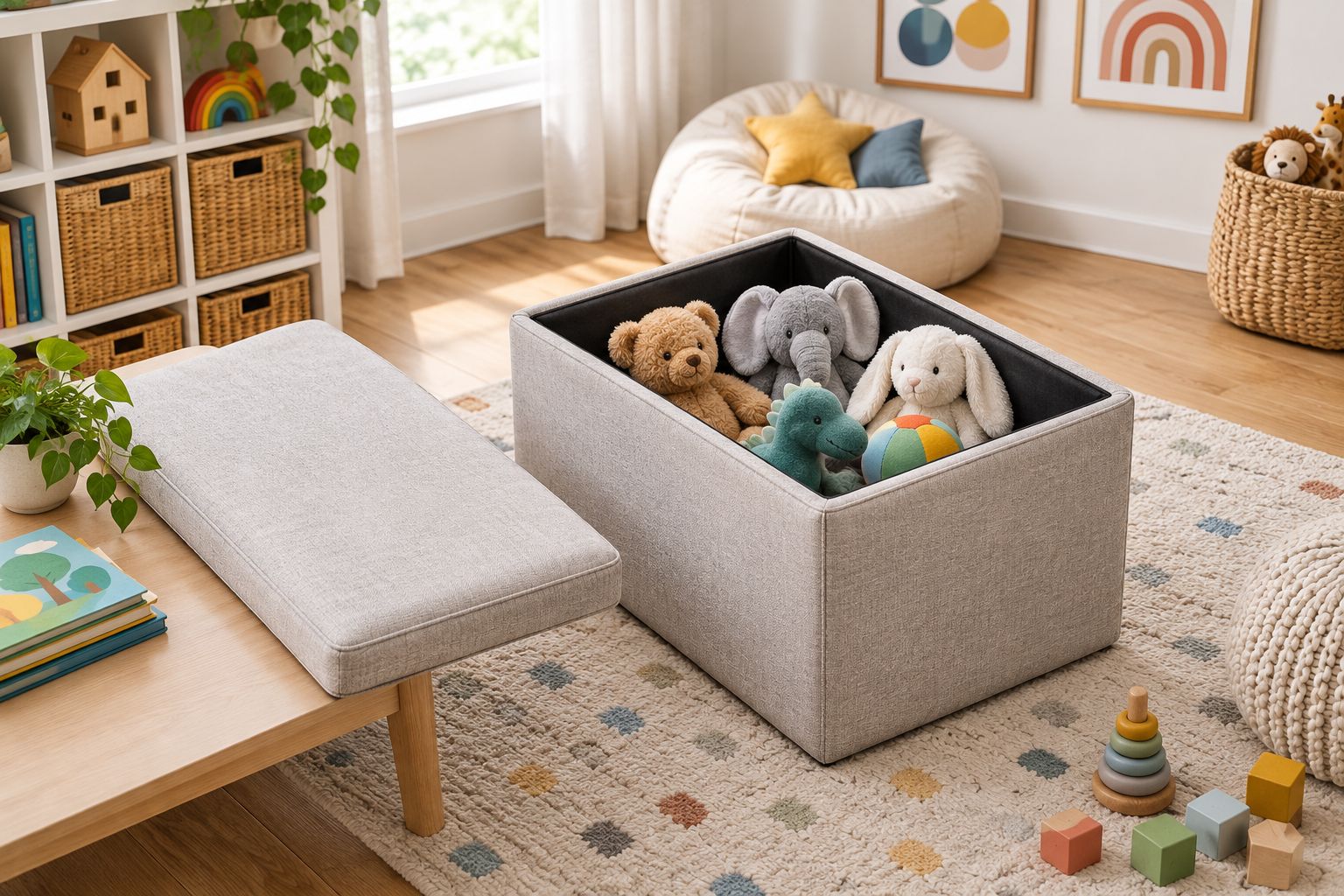
A rectangular ottoman with a fully removable lid gives you access across the top of the compartment. Choose this format for a shared playroom where an adult handles the lid and gathers toys at the end of play.
Its main advantage is straightforward access. You can see the opening without working around an attached lid, although toys at the bottom still disappear beneath whatever sits above them.
Removable-lid rectangle pros:
- The whole opening is accessible during cleanup.
- An undivided interior accommodates mixed toy shapes.
- The detached lid does not stand upright over the compartment.
Removable-lid rectangle cons:
- You need somewhere appropriate to put the lid.
- Small pieces become difficult to find beneath bulky toys.
Best for: Adult-managed cleanup of soft toys and other larger playthings.
Before choosing one, rehearse where the lid will go. If your only answer is the walkway, another format fits better. Verdict: Buy this format for accessible, concealed storage when an adult manages the lid.
2. Compact cube: best for narrow playrooms
A compact cube suits a toy corner that cannot accommodate a long bench. Use it for a deliberately limited collection rather than trying to squeeze a whole playroom into a small box.
Check the footprint with floor tape before choosing a model. A cube that looks small in a photograph can still block a cabinet or sit directly in the route between the doorway and play area.
Compact cube pros:
- Its footprint is easy to mark out before purchase.
- It creates a defined home for a small toy collection.
- Separate cubes can hold separate categories if your room has space.
Compact cube cons:
- Bulky toys quickly consume the interior.
- Deep compartments make bottom-layer toys harder to reach.
Best for: A narrow room, bedroom corner, or shared living area with a small toy collection.
Choose the contents first. If the toys require compression or careful stacking just to close the lid, the cube is too small for that job. Verdict: Buy for a limited collection; skip for large mixed-toy storage.
3. Divided-interior ottoman: best for separate toy categories
A divided-interior ottoman gives different toy groups their own sections. Choose this format when finding a specific category matters more than having one uninterrupted compartment.
Check whether the divisions are fixed, removable, or simply loose inserts. Those designs behave differently, and a divider shown in a photograph does not establish that it will stay upright during daily use.
Divided-interior ottoman pros:
- Separate sections reduce mixing between toy groups.
- Each category gets a visible storage boundary.
- You can match sections to the toys used together.
Divided-interior ottoman cons:
- Fixed sections restrict bulky or unusually shaped toys.
- Loose inserts add pieces to remove during cleaning.
Best for: Households storing distinct categories together, such as toy vehicles and pretend-play accessories.
Start with 2 toy groups rather than assigning every tiny item its own section. Keep small parts inaccessible to children for whom they present a choking hazard; a closed ottoman is not a child-resistant container. Verdict: Buy when category separation solves your main cleanup problem.
4. Hinged-lid ottoman: best for keeping the lid attached
A hinged ottoman keeps the lid connected to the base. That solves the loose-lid problem, but it introduces a different buying check: how the opening mechanism behaves.
Read the specific model’s instructions and warnings. An attached lid, a supported lid, and a child-appropriate storage design are not interchangeable claims.
Hinged-lid ottoman pros:
- The lid stays with the storage base.
- You do not need a separate lid-resting spot.
- The opening position is consistent from one cleanup to the next.
Hinged-lid ottoman cons:
- Hinges and closing edges need attention around fingers.
- The lid requires clearance in its opening direction.
Best for: An adult-managed storage area where detached lids repeatedly become clutter.
Check that the lid opens fully in its intended position, including near walls and windowsills. Never assume slow closing, ventilation, or suitability for children from the word “storage.” Verdict: Hold until you have checked the model’s lid mechanism, warnings, and placement requirements.
5. Collapsible ottoman: best for occasional toy storage
A collapsible ottoman suits a room that only sometimes becomes a playroom. Select a design whose folding instructions fit how you intend to store it between uses.
This format is about flexibility, not a guaranteed level of durability or seating support. Verify the specific construction and intended use rather than treating all folding ottomans as equivalent.
Collapsible ottoman pros:
- A folding design can be packed away between uses.
- It suits temporary toy-storage arrangements.
- It lets you remove the storage piece when the room changes purpose.
Collapsible ottoman cons:
- Folding and reassembly add steps.
- Removable bases or panels need to stay together.
Best for: Visiting-family toys, occasional play areas, or temporary household setups.
Choose a permanent format if you expect to empty, fold, rebuild, and refill the ottoman every day. Repeated setup is another chore, not an organizing benefit. Verdict: Buy for occasional use; skip when you need a permanent everyday toy station.
6. Long storage bench ottoman: best for wall-based storage
A long storage bench ottoman places an elongated compartment along a wall. It suits a room with an available wall section rather than an open central play area.
Measure nearby doors, drawers, and floor vents before committing to its position. If seating matters, confirm that the particular model is intended for seating; its bench-like shape is not enough.
Long storage bench ottoman pros:
- Its shape fits a wall-based storage arrangement.
- The long compartment accommodates toys grouped side by side.
- It can define the edge of a play zone without adding shelving.
Long storage bench ottoman cons:
- Its footprint is difficult to fit into a narrow circulation route.
- A long lid can be awkward to lift or set aside.
Best for: A dedicated playroom with clear wall space and adult-managed access.
Avoid filling the entire compartment with unrelated toys. Group contents by activity so the bench does not become a long, upholstered junk drawer. Verdict: Buy for a measured wall zone; skip if it crowds the main walking route.
Check the fit before you choose
A useful ottoman passes a room check and a contents check. Spend 10 minutes rehearsing both before choosing a format.
- Measure toys. Gather the intended contents and record the length, width, and height of the bulkiest items.
- Mark footprint. Use floor tape to outline the proposed exterior size, then walk around it and open nearby furniture.
- Check opening. Rehearse the lid’s movement and resting position. Compare the toy measurements with the model’s stated interior dimensions.
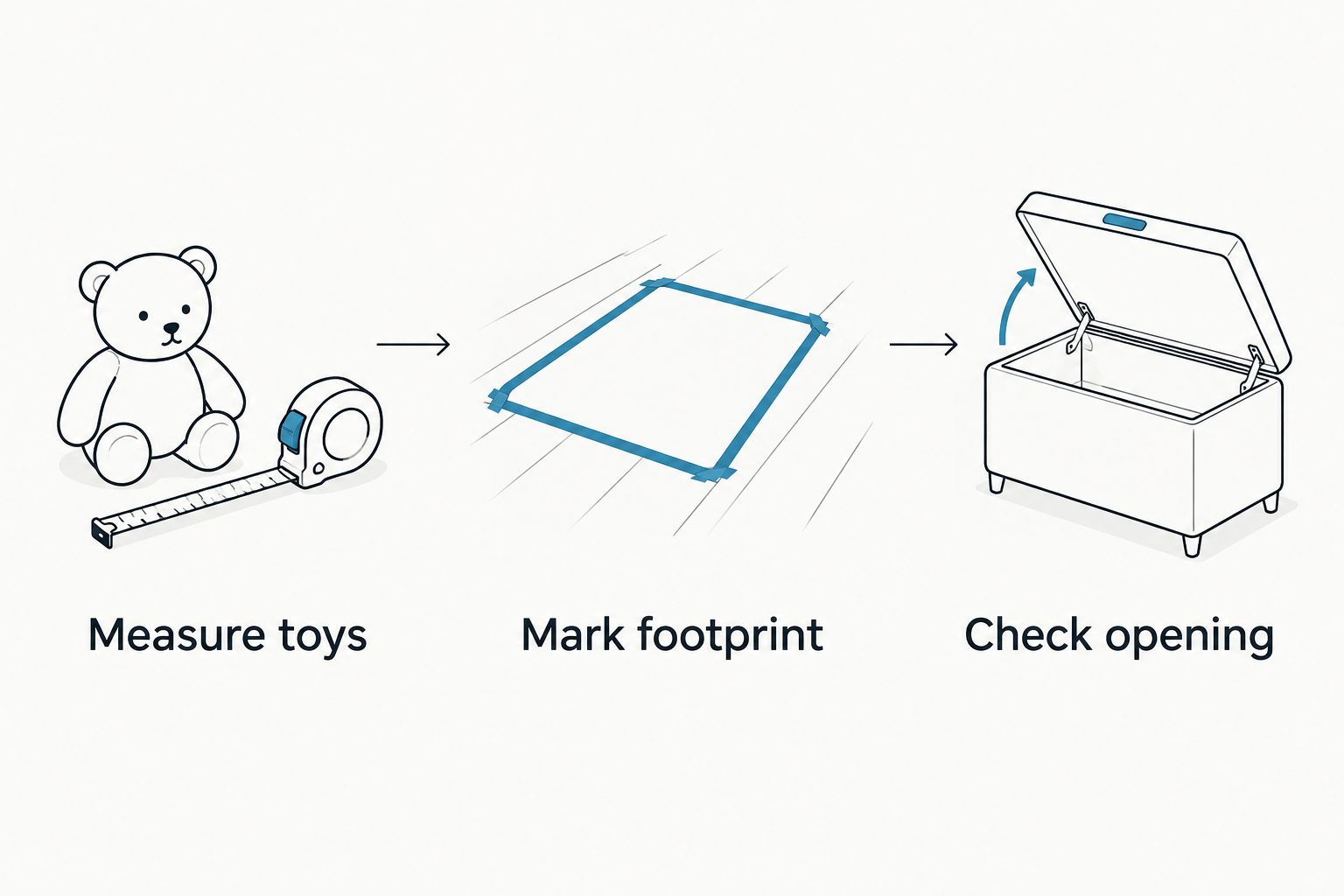
Record 3 interior measurements: length, width, and usable height beneath the closed lid. Compare like with like; an exterior height does not tell you how much space remains inside.
Then rehearse cleanup with the toys grouped as intended. If you must rearrange everything carefully to close the lid, reduce the contents or choose a different shape. Storage should simplify putting toys away, not turn it into a packing puzzle.
How these formats were ranked
Stashsavvy’s 2026 toy storage ottomans ranking prioritizes access, usable space, category separation, room fit, and care requirements. The removable-lid rectangle leads because it provides full top access without requiring an attached lid to remain raised.
This is design-based guidance, not a hands-on product test. No named retail model is ranked, and no manufacturer-specific safety, strength, or cleaning claim is assumed.
The remaining formats serve different needs rather than representing progressively worse choices. A compact cube wins when floor space is the constraint; a divided interior wins when mixed categories are the problem.
Which toy storage ottoman should you choose?
Choose a removable-lid rectangle if you want one default starting point for adult-managed cleanup. Choose a compact cube when the collection is small, or a divided interior when separate categories keep getting mixed together.
For your 2026 playroom setup, choose the storage routine before the upholstery. Decide who opens the ottoman, what belongs inside, and where the lid goes; then check the individual model against those decisions.
If independent child access is the priority, do not force an ottoman into the plan. Open storage can be the better answer even when concealed furniture looks tidier.
FAQ
What are the best toy storage ottomans for playrooms?
Removable-lid rectangular ottomans are the default recommendation for adult-managed cleanup. Compact cubes suit narrow rooms, while divided interiors suit separate toy categories; check each model’s instructions and construction.
Is a hinged lid better than a removable lid for toy storage?
A hinged lid is better for keeping the lid attached, while a removable lid provides access without an attached raised lid. Neither design establishes child safety by itself; check the specific mechanism and warnings.
Can toddlers use a storage ottoman independently?
Do not assume a general-purpose storage ottoman is suitable for independent toddler use. Follow the manufacturer’s intended-use guidance and warnings, and consider open toy storage when lid handling is a concern.
What size ottoman do I need for toys?
Choose an ottoman whose interior fits the intended toys and whose exterior fits the room. Measure length, width, and usable interior height, then check lid clearance separately.
Are collapsible ottomans good for everyday toy storage?
Collapsible ottomans are most useful when you need to pack the storage piece away between uses. For a permanent daily toy station, compare the setup requirements and construction with a nonfolding format.
How do I keep toys organized inside an ottoman?
Assign the ottoman a limited set of toy categories instead of filling it with unrelated items. Use suitable internal sections where helpful, and keep small parts inaccessible to children for whom they present a choking hazard.
Can a toy storage ottoman double as a seat?
Use a toy storage ottoman as seating only when the specific model is intended for that purpose. Check its instructions and user limitations rather than relying on its padded appearance.
One last thing
Do a cleanup rehearsal before adding another container. Put the intended toys together, remove anything that belongs elsewhere, and check whether the remaining collection still needs an ottoman.
Stashsavvy’s practical rule is simple: give the ottoman a job before giving it floor space. A defined purpose—such as holding pretend-play accessories—makes it easier to notice when unrelated clutter starts moving in.
Related guides
- Best entryway storage benches for small spaces
- Is under-bed storage worth it for small bedrooms?
- Decluttering tips for new parents
- How to declutter sentimental items without guilt