
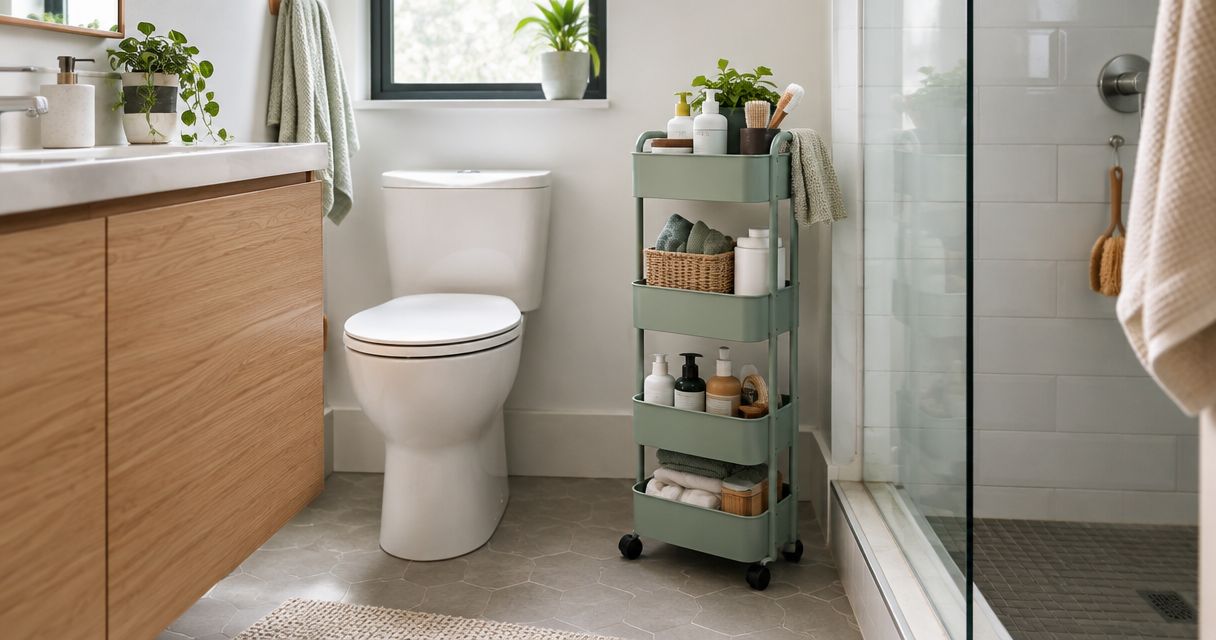
Best rolling storage carts for small bathrooms 2026
Best overall: an open three-tier plastic cart. Best for tight gaps: a slim rolling cart. Best budget option: a utility cart you already own, provided it fits safely. This Stashsavvy guide compares the best rolling storage carts for bathrooms by layout and daily routine, so you can choose a useful style without buying more storage than you need.
- Stashsavvy recommends open three-tier plastic carts as the best rolling storage carts for bathrooms with everyday toiletries.
- Choose slim rolling carts for narrow gaps, but measure the wheels and pull-out route before buying.
- Enclosed drawer carts hide bathroom clutter; removable-basket carts separate shared toiletries.
- Reuse an existing utility cart when it fits safely and has surfaces you can clean.
Why this matters
A bathroom cart should make your routine easier, not turn the route to the sink into an obstacle course. Extra shelves help only when you can reach the contents, move the cart, and clean underneath it.
Stashsavvy's bathroom storage pick is an open three-tier plastic cart for people who want visible, reachable everyday toiletries. That recommendation concerns a cart style, not a tested product model. This 2026 guide ranks configurations by practical fit rather than unsupported claims about particular brands.
Before choosing, remove empty bottles, duplicates you no longer use, and items that belong elsewhere. Your remaining supplies—not the size of an appealing organizer—should determine how much storage you add.
What makes the best rolling bathroom storage cart?
Use these six criteria to compare carts before considering appearance:
- Actual footprint: Check the widest assembled dimensions, including wheels, handles, and projecting baskets.
- Reachable storage: Your tallest everyday bottle should fit upright without an awkward tilt.
- Cleanable surfaces: Look for surfaces you can wipe and corners you can reach after a spill.
- Controlled movement: Check caster details, braking features, and the manufacturer's instructions for safe use.
- Useful containment: Raised edges, baskets, or drawers should match the things you store.
- Room clearance: Doors, drawers, shower access, and the walking route must remain usable.
For your 2026 shortlist, treat measurements as a pass-or-fail check. A cart that blocks the bathroom door loses, regardless of how much it holds.
Best rolling bathroom carts at a glance
These are configuration recommendations, not named-product reviews. Check the specifications of the exact cart you are considering; features differ between models within each style.
| Rank and cart style | Best for | Standout feature to seek | Key limitation |
|---|---|---|---|
| 1. Open three-tier plastic cart | Everyday toiletries | Wipeable trays with raised edges | Leaves contents visible |
| 2. Slim rolling cart | Narrow side gaps | Narrow overall footprint | Tight shelves restrict larger items |
| 3. Enclosed drawer cart | Concealing small supplies | Drawers that contain loose items | Contents require an extra opening step |
| 4. Low, wide rolling cart | Seated access | Frequently used supplies within comfortable reach | Uses more floor width |
| 5. Removable-basket cart | Shared bathroom routines | Baskets that lift out separately | Full baskets need safe lifting space |
| 6. Reused utility cart | Avoiding another purchase | A suitable cart already in your home | Existing materials and dimensions might not suit the bathroom |
1. Open three-tier plastic cart: best for everyday toiletries
An open three-tier plastic cart gives everyday bottles, brushes, and spare washcloths separate homes. You can see what belongs where without opening drawers or shifting a stack of containers.
Choose trays that accommodate your actual bottles. A tall pump dispenser needs clearance above it, while small items need a tray edge or a separate cup to stop them wandering.
Open three-tier plastic cart pros:
- Open shelves make everyday supplies visible.
- Separate levels let you group items by routine.
- Accessible trays make checking for spills straightforward.
Open three-tier plastic cart cons:
- Mixed packaging stays on display.
- Open shelves do not protect contents from splashes or dust.
Best for: One person's daily essentials or a small household's shared basics.
Keep frequently used items at a comfortable height and heavier containers lower down, within the manufacturer's load limits. Avoid packing every shelf so tightly that you must unload it to retrieve a bottle.
Verdict: Buy this style as your default if you have a clear parking spot outside the splash area.
2. Slim rolling cart: best for narrow side gaps
A slim rolling cart uses a narrow strip beside a vanity or another fixture. Its value comes from fitting an otherwise awkward space, not from holding every bathroom supply.
Measure the gap at floor level and higher up. Baseboards, plumbing, handles, and wheel assemblies can interfere even when the shelf itself appears narrow enough.
Slim rolling cart pros:
- Makes use of a narrow, unused gap.
- Suits upright bottles and small packaged refills.
- Can pull forward for access when the surrounding layout allows it.
Slim rolling cart cons:
- Narrow shelves limit bulky toiletries and folded towels.
- A cart that fits while parked can still lack room to pull out.
Best for: A measured side gap with a clear exit route.
Before ordering from a 2026 shopping shortlist, compare the cart's overall dimensions with the space—not just the basket width. Leave yourself enough room to grasp the cart without scraping nearby surfaces.
Verdict: Buy for a verified gap; skip if access requires moving another fixture or blocking a doorway.
3. Enclosed drawer cart: best for hiding small-item clutter
An enclosed drawer cart puts loose supplies behind drawer fronts. It suits people who dislike seeing spare toothbrushes, hair accessories, and grooming packets spread across open shelving.
Choose drawer sizes around what you store. Deep drawers need internal grouping for tiny items; shallow drawers will not accommodate every upright bottle.
Enclosed drawer cart pros:
- Keeps mixed packaging out of sight.
- Contains small items without exposed shelf edges.
- Lets you assign separate drawers to different routines.
Enclosed drawer cart cons:
- Closed drawers make forgotten duplicates harder to spot.
- Drawer interiors and runners need cleaning after leaks.
Best for: Small grooming supplies that create visual clutter.
Keep drawer fronts clear of nearby doors and knees. Opening a loaded drawer changes how you use the cart, so follow its stability instructions and avoid pulling multiple drawers open together.
Verdict: Buy for visual calm; skip if you need immediate, one-handed access to tall bottles.
4. Low, wide rolling cart: best for seated access
A low, wide cart can place selected supplies within reach beside a seated grooming area. Choose it around the user's comfortable reach rather than assuming that a lower cart automatically solves access problems.
The trade-off is floor space. Check that the cart does not interfere with transfers, mobility equipment, or the route through the room.
Low, wide rolling cart pros:
- Offers a lower position for frequently used supplies.
- Can separate grooming items across a wider shelf.
- Avoids relying entirely on high storage.
Low, wide rolling cart cons:
- Takes up more floor width than a slim cart.
- Lower shelves can require bending for standing users.
Best for: A seated routine with a verified, unobstructed parking position.
Place the items you use most within comfortable reach. Never use a rolling cart as a grab bar, transfer aid, or body support. Storage furniture does not replace equipment designed for those purposes.
Verdict: Buy only after checking reach and movement in the actual bathroom.
5. Removable-basket cart: best for shared bathrooms
A removable-basket cart lets each person lift out their own toiletries instead of searching through a shared shelf. It also works for separating routines, such as hair care and evening skincare.
Look for baskets that sit securely in the frame and have a comfortable grip. Check the loaded basket—not just the empty one—when deciding whether this arrangement suits you.
Removable-basket cart pros:
- Separates personal supplies without mixing them together.
- Lets you carry a routine's items to another suitable surface.
- Makes emptying each storage section straightforward.
Removable-basket cart cons:
- Loaded baskets require lifting and somewhere safe to set them.
- Small loose items still need containment within open baskets.
Best for: Housemates or family members who need separate toiletry zones.
Use containers you already own inside the baskets before buying matching inserts. Keep the shared cart in a dry parking place, and return each basket after use rather than leaving it on the floor.
Verdict: Buy when personal separation matters more than hiding everything behind drawers.
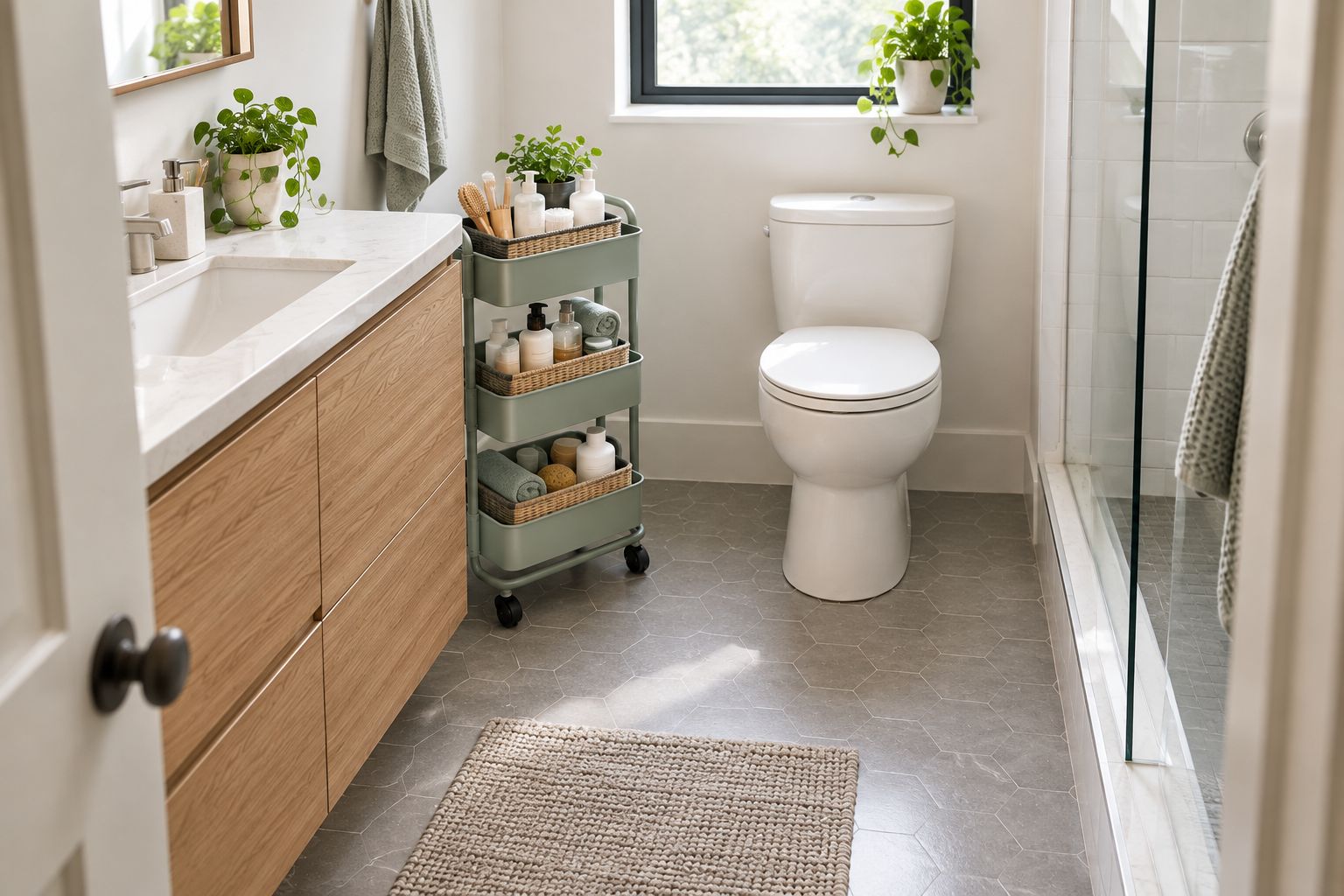
6. Reused utility cart: best for avoiding another purchase
A utility cart already in your home deserves a fit check before you replace it. Empty it first, then inspect the surfaces, frame, wheels, and any existing damage.
Reuse works only when the cart suits bathroom conditions and your layout. An awkward cart does not become a good choice simply because you already own it.
Reused utility cart pros:
- Uses an existing possession rather than adding another organizer.
- Lets you assess the layout with a cart already available to you.
- Can work with containers you already have.
Reused utility cart cons:
- Materials or damaged finishes might be unsuitable for moisture exposure.
- Existing shelf heights and wheels might not fit the new purpose.
Best for: A suitable existing cart that needs no unsafe modification.
For a 2026 bathroom refresh, begin with a 10-minute reset: empty the cart, wipe it according to its care instructions, and group only the essentials you intend to keep there. Rehome it again if it obstructs movement.
Verdict: Hold off on buying until you have checked whether your existing cart does the job.
Measure the cart's route, not just its parking spot
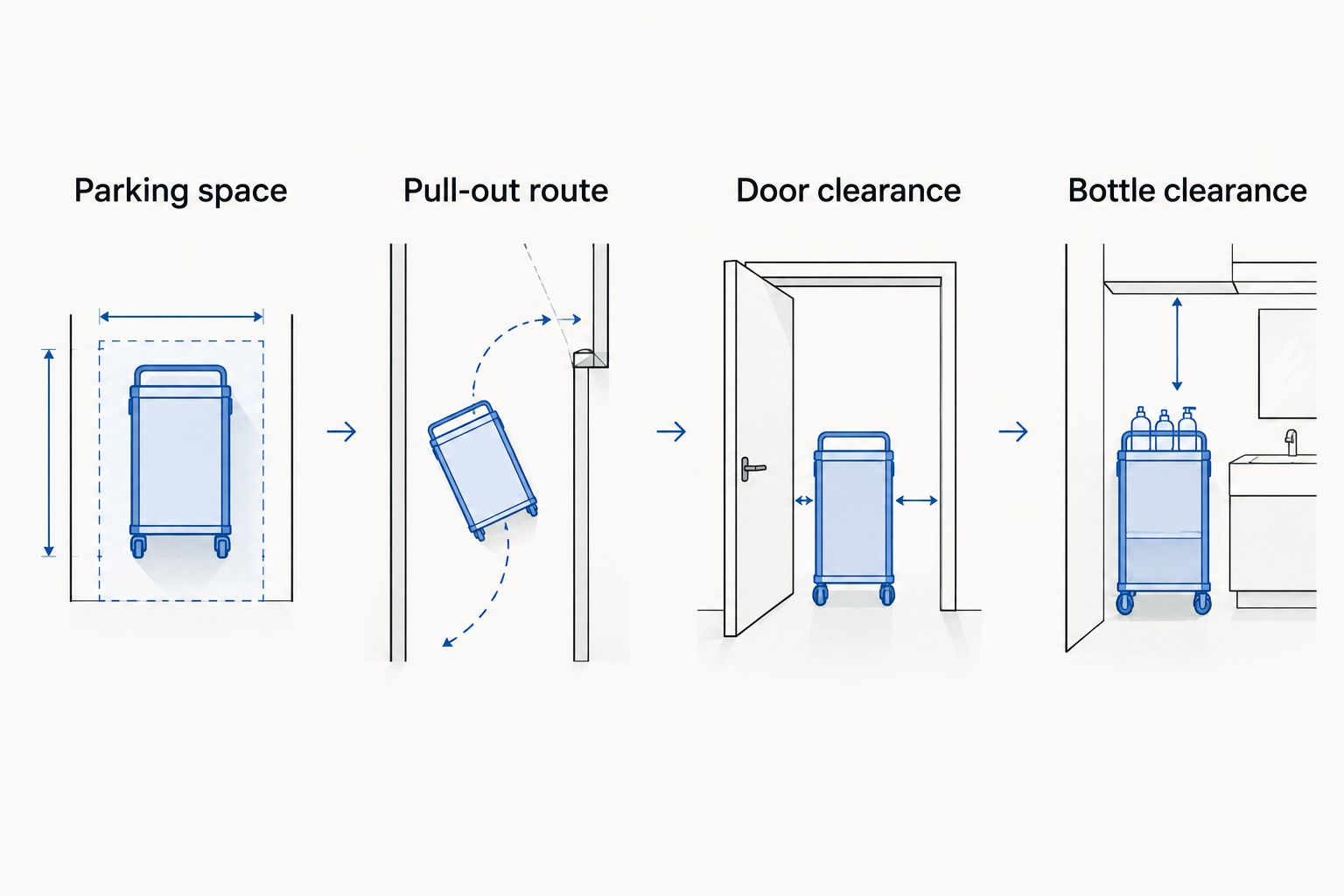
Before buying, take 3 measurements: width, depth, and height. Then check how the cart moves between its parked position and the place where you will use it.
- Parking space: Mark the proposed footprint with paper laid flat on the floor. Keep the mock-up out of use whenever it creates a slip or trip risk.
- Pull-out route: Check the space needed to roll the cart forward, turn it, and reach the back shelf.
- Door clearance: Open nearby doors and drawers fully, including the bathroom door.
- Bottle clearance: Measure your tallest bottle against the usable shelf opening, not the cart's total height.
Do a 5-minute walkthrough of your normal routine before committing to the layout. Approach the sink, reach a towel, and access the toilet and shower; remove the mock-up immediately if it gets in the way.
How these cart styles were ranked
Stashsavvy's 2026 bathroom storage ranking prioritizes everyday access, cleanability, useful containment, and fit. Open plastic shelving takes the default position because it keeps routine supplies visible without adding drawer-opening steps.
This is a feature-based comparison of cart styles, not hands-on product testing or a durability ranking. The lower positions represent more specific needs, not proof that every cart in one category outperforms every cart in another.
Which bathroom storage cart should you choose?
Choose an open three-tier plastic cart unless your room or routine gives you a clear reason not to. Move to a slim cart for a narrow gap, drawers for concealed storage, or removable baskets for shared supplies.
If there is no safe parking spot, skip the cart. A clear floor and better use of existing cabinet space beat extra shelves that obstruct the room.
FAQ
What’s the best rolling storage cart for a small bathroom?
An open three-tier plastic cart is the default recommendation for everyday toiletries when it fits outside the splash area. Choose a slim cart instead when a measured narrow gap is your only suitable parking space.
Is a metal or plastic bathroom cart better?
Choose according to the exact cart’s materials, finish, care instructions, and intended use—not material alone. Check metal parts for finish damage and inspect either style for accessible, cleanable surfaces.
Can I keep a rolling cart beside the shower?
Keep a rolling cart outside the direct splash area and clear of shower access. Do not assume a bathroom storage cart is designed for use inside a shower or for continuous wet conditions.
Are slim bathroom carts worth buying?
A slim cart is useful when it fits a narrow gap and has enough room to pull out. Skip it if the shelves cannot accommodate your supplies or the cart blocks another part of the bathroom.
What should I put on each cart shelf?
Put frequent-use items within comfortable reach and heavier supplies lower down, within the manufacturer’s load limits. Group small items in existing cups or containers so they do not scatter across open trays.
Do bathroom cart wheels need locks?
Locking casters are useful when you need the cart to stay parked during ordinary use. Follow the manufacturer’s instructions, and never treat a locked cart as a support for your body.
Should I buy a cart before decluttering my bathroom?
Declutter before choosing a cart. Remove empty packaging and unwanted duplicates, then select storage around the supplies you actually intend to keep.
One last thing
Try a 24-hour placement check with a suitable cart you already own before making another purchase. Keep it only if it stays out of the way through your normal routine; remove it immediately if it creates an obstruction.
The most useful bathroom organizer is not the one that holds the most. It is the one that gives your essentials a home without making the room harder to use.
Related guides
- Best bathroom vanity organizers
- Best over-the-toilet storage units for small bathrooms
- Best linen closet organizers
- How to declutter a house fast