
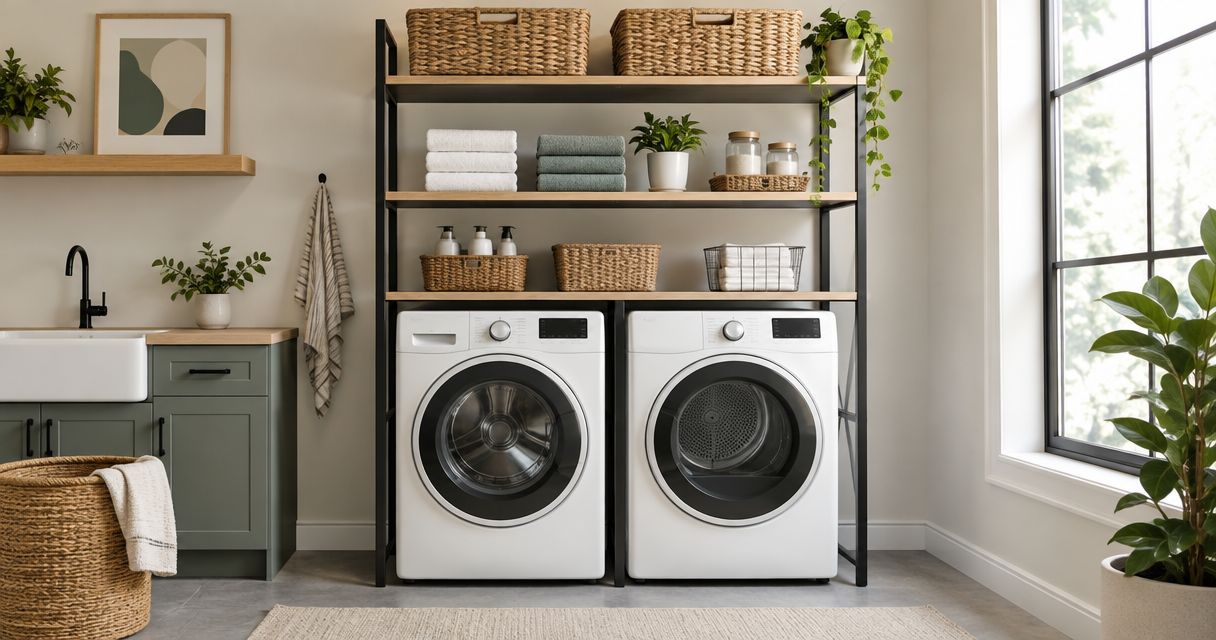
Best over-washer-and-dryer storage shelves 2026
Best overall: adjustable wall-track shelves. Best for renters: a freestanding over-appliance rack, where its installation requirements are permitted. Best reuse-first option: a fixed shelf with suitable brackets. This 2026 guide compares the best over the washer and dryer storage shelves by appliance access, mounting requirements, and everyday usefulness—not unverified product claims.
- The best over the washer and dryer storage shelves preserve appliance access before adding storage.
- Stashsavvy recommends adjustable wall-track shelves for laundry rooms where suitable wall mounting is permitted.
- Freestanding racks suit renters only when required anchoring is allowed and the frame clears appliance connections.
- Keep laundry supplies accessible to adults, secured from children, and away from appliance controls.
Why this matters
Over-appliance storage should make laundry easier, not turn every load into an obstacle course. A shelf that blocks a washer lid, hides a shutoff valve, or forces you to reach across a machine needs a different position.
Start with the awkward parts of your room. If hampers, hanging clothes, and cleaning supplies also need homes, compare complete laundry room storage systems before choosing an isolated shelf.
Stashsavvy’s best overall laundry shelving choice is an adjustable wall-track system for homeowners and renters permitted to install suitable wall fixings. The advantage is flexibility: you can change shelf positions when your storage needs change.
What makes the best over-appliance shelving?
Use these criteria to judge the 2026 shortlist before comparing appearances:
- Appliance access: The layout must accommodate lids, doors, controls, detergent drawers, and the access specified in appliance instructions.
- Suitable support: Match wall fixings, brackets, and shelf materials to the installation instructions and supporting structure.
- Usable reach: Everyday supplies belong where you can retrieve them without leaning against a machine or stretching overhead.
- Adjustable layout: Movable shelves help you accommodate different containers without wasting vertical space.
- Practical surfaces: Choose surfaces you can clean and check whether moisture exposure is permitted by the material’s care instructions.
- Service access: Keep hoses, electrical connections, vents, and shutoff valves accessible. Storage must not prevent necessary appliance movement.
Over-washer-and-dryer shelves at a glance
These are shelf configurations, not individually tested products. Compare the layout first, then evaluate a specific model’s dimensions and installation requirements.
| Rank and shelf type | Best for | Standout feature | Key limitation |
|---|---|---|---|
| 1. Adjustable wall-track shelves | Changing storage needs | Shelf positions can be reconfigured | Requires suitable wall mounting |
| 2. Freestanding over-appliance rack | Rental flexibility | Frame stands around the appliances | Legs and braces need floor and connection clearance |
| 3. Fixed shelf with brackets | Reusing suitable materials | Simple, focused storage surface | Height stays fixed after installation |
| 4. Shelves inside wall cabinets | Visually quieter laundry spaces | Doors conceal stored supplies | Cabinet doors add clearance and access requirements |
| 5. Countertop-supported shelf riser | Small accessories above front-loaders | Adds a second level on a suitable counter | Requires a separate, suitable countertop and secure placement |
1. Adjustable wall-track shelves: best for changing storage needs
Adjustable wall-track shelves use vertical supports and repositionable brackets. They suit a laundry room where towels, baskets, and supplies need different amounts of space over time.
Plan the lowest shelf around appliance operation, not the height of your tallest bottle. A top-loading washer needs room for its lid to open fully; a front-loading machine can still have controls or a dispenser that shelving must not obstruct.
Adjustable wall-track shelves pros:
- Shelf positions can change without relocating the entire system.
- Open shelves make supplies easy to identify.
- A wall-supported layout leaves the floor around appliances clear.
Adjustable wall-track shelves cons:
- Installation depends on suitable wall construction and fixings.
- Visible tracks create a more utilitarian appearance.
- Adjustable brackets do not remove the need to follow load instructions.
Best for: Households whose laundry storage changes with seasons, routines, or family needs.
Verdict: Buy when suitable wall mounting is permitted and you want flexibility rather than a fixed arrangement.
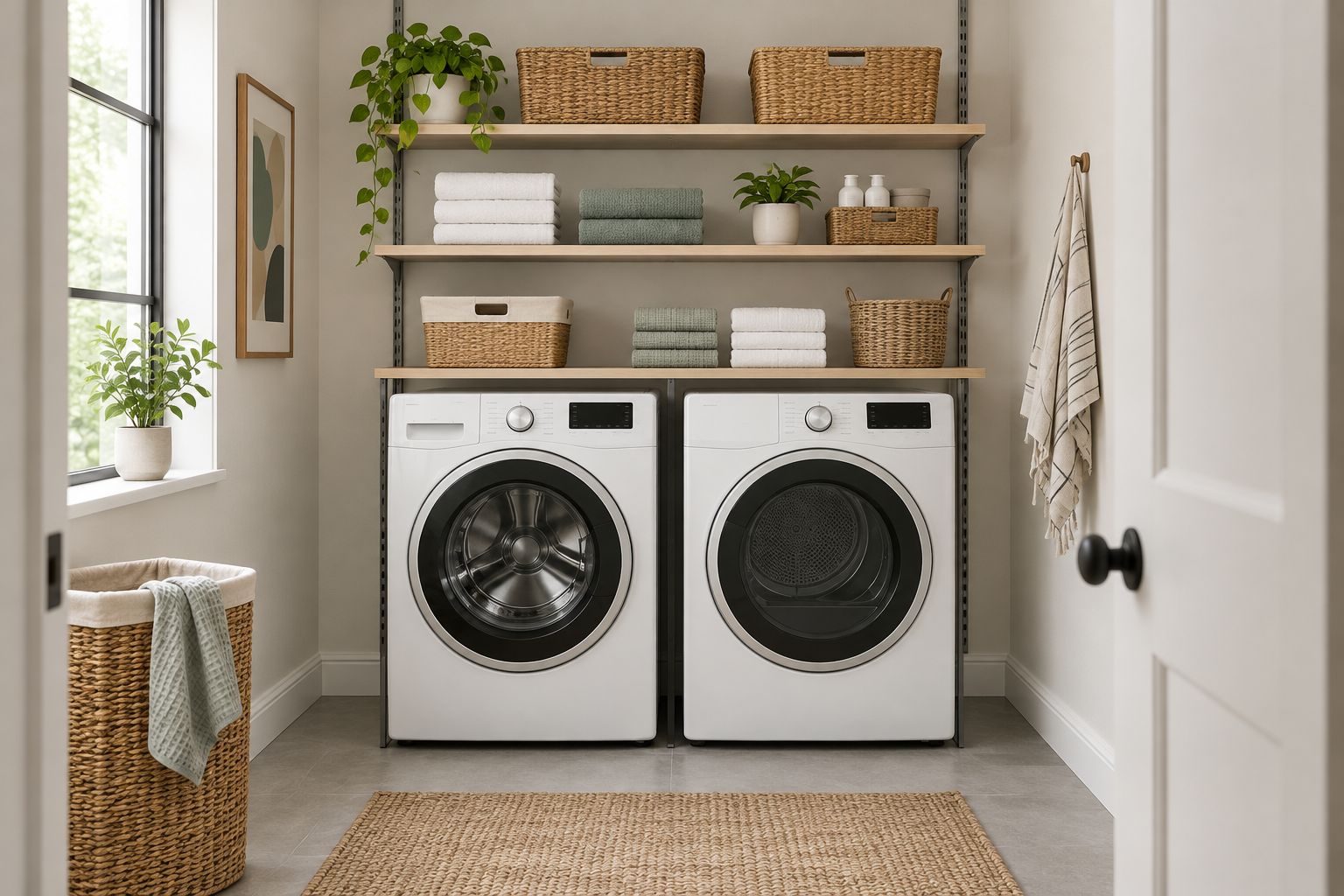
2. Freestanding over-appliance rack: best for rental flexibility
A freestanding over-appliance rack bridges the machines with legs on either side. It avoids depending entirely on wall-mounted shelf supports, but it is not automatically a no-drill solution.
Read the assembly instructions before treating this as renter-friendly. If the manufacturer requires wall anchoring, that requirement still applies in a rental.
Freestanding over-appliance rack pros:
- The main frame does not rely on shelf brackets attached to the wall.
- A suitable rack can move with you to another home.
- Open shelves keep frequently used items visible.
Freestanding over-appliance rack cons:
- Legs need space beside the appliances.
- Rear braces can conflict with hoses, outlets, or vents.
- Required anti-tip anchoring can rule it out under some leases.
Measure the frame’s usable opening, not just its overall width. Check whether assembly requires access behind the machines before choosing a rack for a tight alcove.
Best for: Renters with sufficient surrounding space and permission for any required anchoring.
Verdict: Buy only after confirming fit, assembly access, and installation permissions.
3. Fixed shelf with brackets: best for reusing suitable materials
A fixed shelf gives you a straightforward storage surface above the machines. For a reuse-first 2026 project, consider an existing shelf board and brackets only when their condition, compatibility, and support requirements are known.
Keep the shelf’s job narrow. A place for folded towels and an empty laundry basket is easier to plan than a catch-all for every cleaning product in the house.
Fixed shelf with brackets pros:
- The layout is simple to understand and maintain.
- Suitable existing materials can become part of the installation.
- A continuous surface accommodates containers with different footprints.
Fixed shelf with brackets cons:
- Changing the height usually requires remounting.
- A deep shelf can make the back edge difficult to reach.
- Unknown brackets or damaged boards are not a sound basis for overhead storage.
Before installation, mark the proposed front edge with removable tape. Stand where you load the machines and check whether the shelf would crowd your head or obstruct your view of controls.
Best for: A settled laundry routine with a clearly defined storage need.
Verdict: Buy for a simple layout; skip a reuse project when the supporting materials cannot be assessed.
4. Shelves inside wall cabinets: best for concealed storage
Wall cabinets place shelves behind doors, reducing the visual busyness of assorted bottles and supplies. Choose this configuration when you want a quieter-looking laundry area and can accommodate the cabinet depth.
Cabinet doors introduce another moving part. Check that they open without hitting nearby walls, hanging rails, or other doors, and that you can reach inside comfortably.
Wall-cabinet shelves pros:
- Doors conceal mismatched containers and laundry accessories.
- Interior shelves separate categories without displaying everything.
- A suitable lockable cabinet can help restrict access to hazardous supplies.
Wall-cabinet shelves cons:
- Cabinet depth can increase the reach over appliances.
- Doors need unobstructed swing space.
- A closed door alone does not make detergent inaccessible to children.
Avoid filling a deep cabinet simply because space exists. Put the items you actually use near the accessible front edge, and keep laundry products in their original packaging.
Best for: Laundry areas visible from a kitchen, hallway, or shared living space.
Verdict: Buy when concealed storage matters and the cabinet remains comfortably accessible.
5. Countertop-supported shelf riser: best for small accessories
A shelf riser creates another storage level above a suitable countertop spanning front-loading appliances. It is an accessory to that counter, not a substitute for a properly supported overhead shelf.
Do not assume an appliance top is an approved shelf support. Check the appliance instructions and the counter’s installation requirements before adding anything above the machines.
Countertop-supported shelf riser pros:
- Adds separation for lightweight accessories.
- Keeps small items grouped within a defined area.
- Can be removed when you need the counter for another task.
Countertop-supported shelf riser cons:
- Takes away part of the folding surface.
- Needs secure placement and suitable support.
- Does not suit a top-loader whose lid occupies the same space.
Use the riser for small accessories such as clothespins or empty mesh bags. Avoid balancing tall containers at an exposed edge, and leave the counter’s working area usable.
Best for: Front-loader households that already have a suitable counter and need modest extra organization.
Verdict: Buy for a small accessory zone; skip when you need substantial overhead storage.
Measure the space before choosing a shelf
A useful 2026 shortlist starts with your room, not a product photograph. Record measurements in inches, using the same units when you compare specifications.
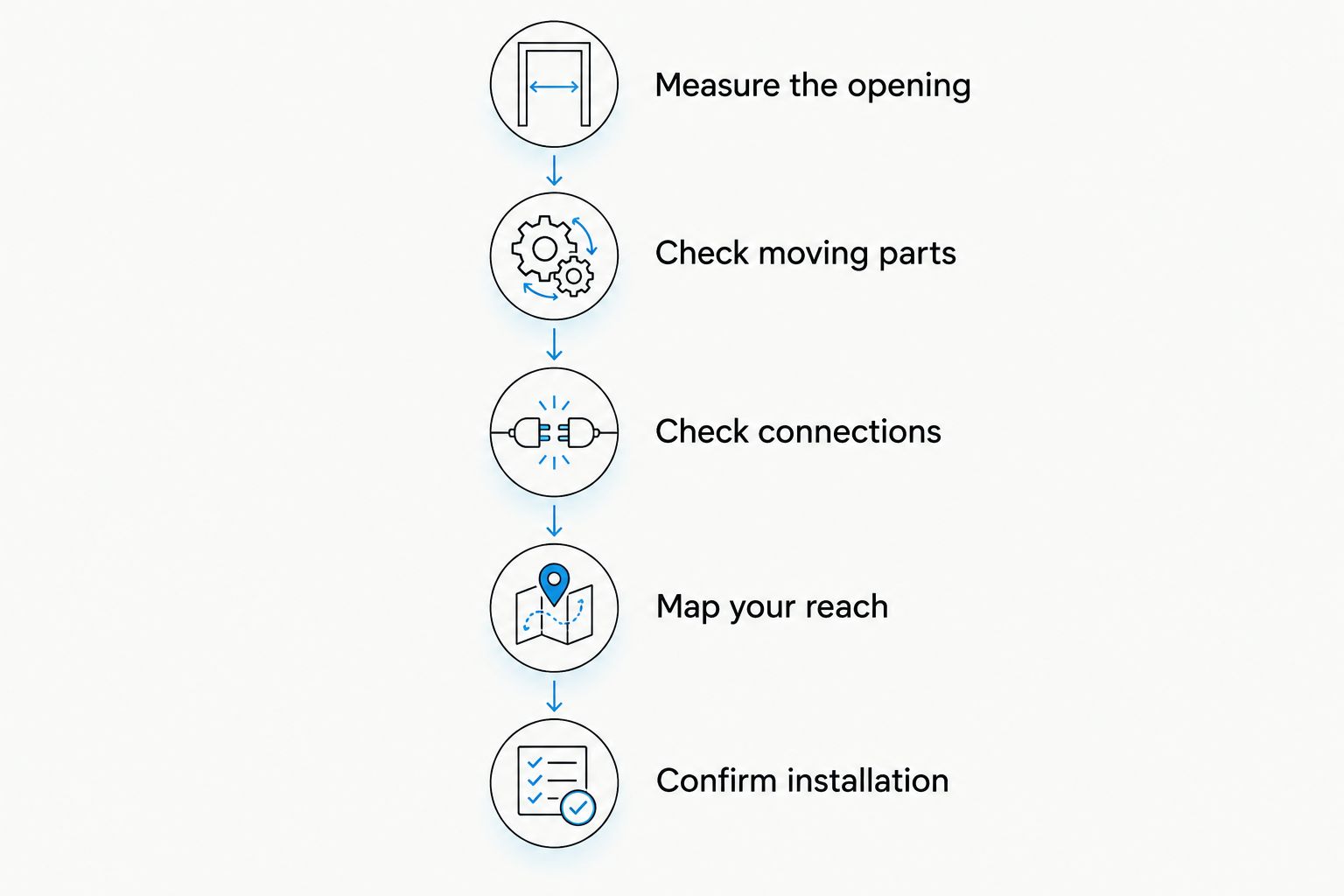
Follow this sequence:
- Measure the opening. Record available width, depth, and height, including trim and obstructions. For freestanding racks, include the space needed by feet and braces.
- Check moving parts. Open washer lids, appliance doors, dispensers, and nearby room doors fully. Mark the space each movement occupies.
- Check connections. Locate hoses, shutoff valves, electrical connections, and the dryer vent. Preserve the access and clearances required by the appliance instructions.
- Map your reach. Rehearse retrieving an empty basket from the proposed shelf position. Keep your feet on the floor and avoid leaning on the appliances.
- Confirm installation. Review the shelf instructions, wall structure, lease permissions, and appliance requirements together before buying.
Do not add a generic clearance allowance to every laundry room. The instructions for your actual appliances and shelving determine the installation requirements.
Check support before loading laundry supplies
A shelf is a complete assembly: the board, brackets, fasteners, and supporting wall all matter. A capacity printed for one component does not establish what your finished installation can support.
The same distinction applies when assessing wall-mounted shelving load capacity: the supporting structure and the way the load is distributed belong in the decision, not just the shelf’s advertised rating. Apply that principle to laundry shelving by following the instructions for the complete system and its mounting conditions.
Keep heavy refills out of awkward overhead positions. Place them in an accessible location that also meets household safety needs, particularly where children or pets are present.
Do not improvise around damaged walls or uncertain fixings. Have the mounting conditions assessed before installing overhead storage, and never use a shelf to conceal an unresolved leak or damaged connection.
Give each shelf a clear job
For a calmer laundry room in 2026, organize by what you do during a load rather than by what looks coordinated. You do not need matching containers to make categories clear.
- Daily supplies: Keep frequently used items in an accessible, secure location. Follow the storage directions on product packaging.
- Clean textiles: Group folded towels or cleaning cloths together, separate from products that could leak.
- Lightweight accessories: Give mesh wash bags, clothespins, and empty baskets a defined spot.
- Occasional items: Store infrequently used items higher only when you can retrieve them safely with suitable access equipment.
Leave enough room to lift an item out without moving its neighbors. If removing a basket starts a chain reaction, reduce the contents rather than adding another organizer.
Recheck the layout when you replace a machine. A different control panel, lid, or dispenser can change whether an existing shelf still works.
How the shelf types were ranked
Stashsavvy’s 2026 laundry shelving ranking prioritizes appliance access, suitable support, comfortable reach, adaptability, and maintenance. These are configuration-based recommendations, not hands-on product test results.
Adjustable wall-track shelves take the default position because their shelf spacing can change. Freestanding racks serve a different need: flexibility where the room and installation permissions allow it.
The remaining choices solve narrower problems. Fixed shelves suit a settled layout, cabinets conceal supplies, and countertop risers organize small accessories without creating a full overhead system.
Which over-appliance shelves should you choose?
Choose adjustable wall-track shelves if suitable wall mounting is permitted and you want a layout that can change. That is the default recommendation for this 2026 guide.
Choose a freestanding rack when rental flexibility matters, but reject any model whose required anchoring or frame does not suit your space. Choose a fixed shelf when your needs are simple, cabinets when concealment matters, and a riser only for a suitable front-loader countertop.
If every option interferes with appliance access, leave the overhead space empty. A nearby storage location is better than a shelf that makes laundry harder.
FAQ
What are the best over the washer and dryer storage shelves?
Adjustable wall-track shelves are the best default when suitable wall mounting is permitted. Their repositionable shelves accommodate changing storage needs, but appliance access and installation requirements come first.
Can I put shelves above a top-loading washing machine?
Yes, provided the shelves preserve full lid movement and all clearances required by the washer instructions. Check the open lid before marking a shelf position, and keep controls accessible.
Are freestanding laundry shelves renter-friendly?
Freestanding laundry shelves suit rentals only when their installation requirements and dimensions fit the property. Some require wall anchoring, so freestanding does not automatically mean no drilling.
Is a wall shelf better than an over-washer rack?
A wall shelf is better when you need to keep the floor around the appliances clear and suitable mounting is possible. An over-washer rack is an alternative when its legs, braces, and required anchoring fit your room.
How much weight can a laundry room shelf hold?
Use the load instructions for the specific shelf system and its required installation conditions. The shelf board, brackets, fasteners, and supporting structure all affect whether the finished installation is suitable.
Can I use an appliance top to support a shelf?
Do not assume an appliance top is an approved shelf support. Follow the appliance instructions and use a separately supported counter or shelving system where required.
Should laundry detergent go on a high shelf?
Laundry detergent belongs in its original packaging, stored according to its label and out of children’s reach. Height alone is not a substitute for secure storage, and heavy containers should not require an awkward overhead lift.
One last thing
The best shelf height is not necessarily the one that fits the most baskets. Before installing, rehearse your actual laundry routine with the proposed shelf edge marked: load the machine, use the controls, and reach toward the storage position.
If the shelf interrupts the routine, change the layout before making holes. Stashsavvy’s goal for laundry shelving is simple: give supplies a home without making the machines harder to use.
Related guides
- Best linen closet organizers
- Kitchen cabinet organization for renters
- Can you organize a pantry without buying containers?