
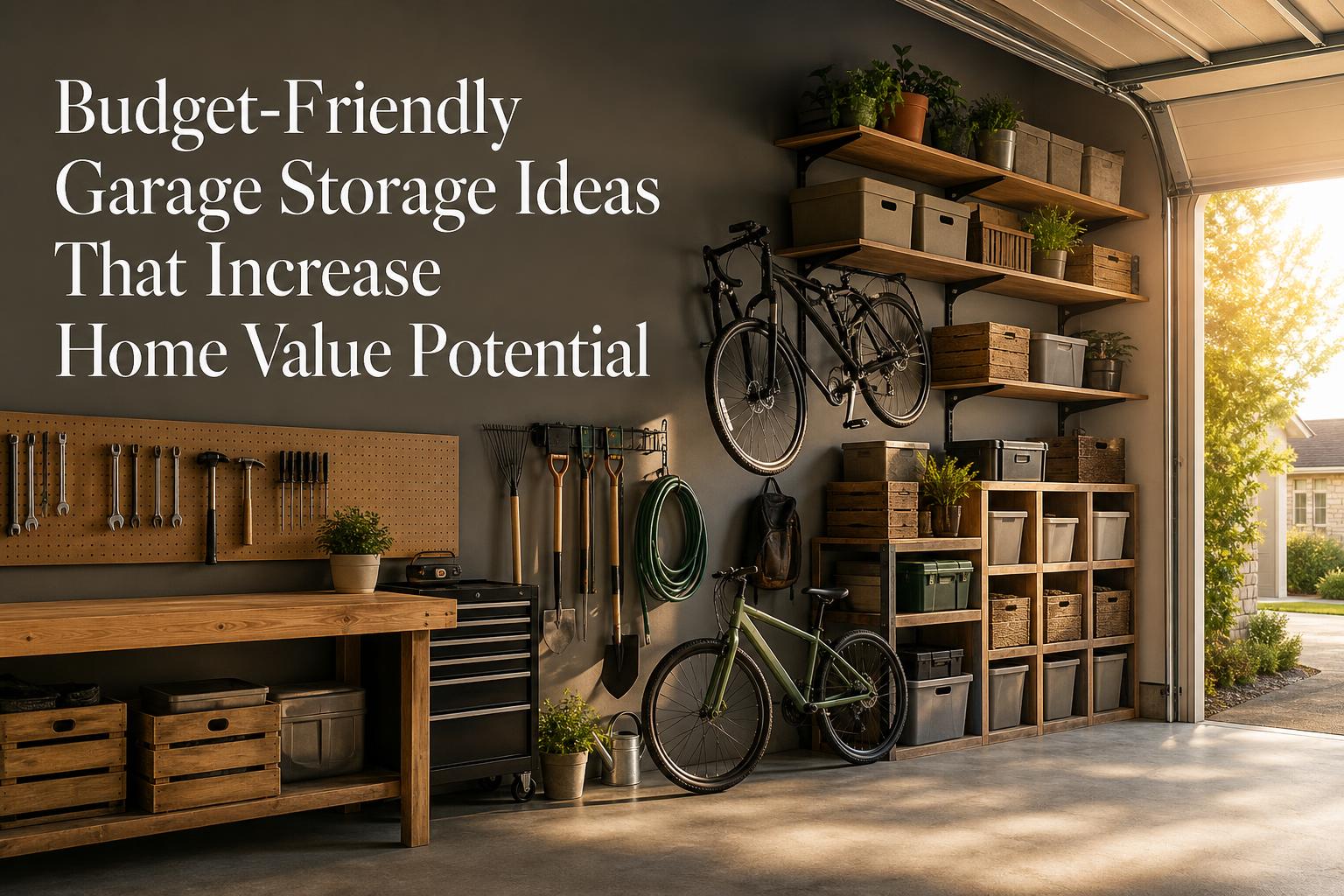
Budget-Friendly Garage Storage Ideas That Increase Home Value Potential
Budget-friendly garage storage starts with vertical space (wall cabinets, pegboards, slatwall, and ceiling racks) because it adds capacity without giving up parking or floor space. A basic two-unit setup costs about $338 before tax and delivery using a $149 Husky wall cabinet plus a $189 HDX resin cabinet, based on listed Home Depot prices checked August 2026. Organized storage can improve buyer appeal, usability, and the sense that a home is well maintained, but there is no proven dollar-for-dollar resale return for garage shelving or cabinets specifically.
Key takeaways
- A functional two-unit starter setup runs about $338 before tax and delivery; a mid-tier steel setup runs about $465.59.
- Vertical and overhead storage preserves parking, which garage owners on r/garageporn consistently protect, especially in 400-square-foot two-car garages.
- Reversible upgrades (freestanding cabinets, adjustable shelving, labeled bins) carry less financial risk than permanent built-ins.
- Organized garages support buyer appeal and perceived upkeep, but the 2025 Cost vs. Value report does not establish a specific return for garage storage.
- The U.S. garage-organization market reached $3.71 billion in 2025, with cabinets and tool chests making up 38.71% of the 2024 market.
- Declutter and measure before buying anything; then spend only on the storage that solves a remaining problem.
What are the best budget garage storage ideas?
The best budget garage storage ideas use vertical and overhead space first: wall-mounted cabinets, pegboards, slatwall panels, and ceiling racks. These preserve floor space and parking while adding capacity. Enclosed cabinets conceal chemicals and clutter for a cleaner look, and labeled bins keep categories accessible. Start under $200 and add units only as needed.
Vertical storage is the highest-leverage move because it clears the floor. Overhead and ceiling storage is projected to grow at a 10% CAGR from 2025 to 2033, according to Grand View Research, which tracks how homeowners are reclaiming ceiling space for seasonal bins and rarely-used gear.
Wall cabinets and slatwall keep tools at hand without eating parking width. A pegboard costs little and holds hand tools, cords, and small parts in view. If you would rather build than buy, these DIY tool storage ideas include pegboards, racks, carts, and custom organizers. For deeper planning on wall systems, see these wall storage ideas that double your space.
Enclosed cabinets do two jobs at once. They hide visual clutter and lock away hazardous materials like paint, solvents, and pesticides. That matters when a buyer walks through: a garage with concealed chemicals and clear counters reads as maintained rather than neglected.
Tip: Reuse before you buy. Empty totes, old shelving, and existing hooks handle most of the sorting. Purchase new storage only for the items that still have no home after you declutter and group by function.
Match the storage type to the contents:
- Chemicals and solvents: enclosed cabinet with a door, ideally lockable
- Seasonal bins: overhead ceiling rack or a vertical bin rack
- Hand tools: pegboard or slatwall for visibility
- Power tools: mobile tool cabinet you can roll to the work area
- General household overflow: adjustable shelving with labeled bins
How much does budget garage storage cost?
A basic budget garage setup costs about $338 before tax and delivery, using a $149 Husky wall cabinet plus a $189 HDX resin cabinet. A mid-tier setup costs about $465.59, combining a $306.59 Husky steel cabinet with a $159 Milwaukee PACKOUT mobile tool cabinet. These are listed Home Depot prices checked August 17, 2026, and exclude tax, delivery, and assembly.
Think in tiers. Under $200 buys a single quality cabinet or a wall system plus a pegboard. Around $300 to $450 buys a two-unit combination that separates concealed storage from mobile tools. Above that, you enter custom-system territory that rarely fits a budget-focused, home-value strategy.
| Setup | Units | Approx. cost (pre-tax/delivery) | Best for |
|---|---|---|---|
| Starter | $149 Husky wall cabinet + $189 HDX resin cabinet | ~$338 | First real garage cleanup, concealed clutter |
| Mid-tier | $306.59 Husky steel cabinet + $159 Milwaukee PACKOUT | ~$465.59 | Tools plus mobile work station |
| Single-unit entry | Mlezan metal cabinet ($144.19) or Husky wall cabinet ($149.00) | under $200 | Testing a system before committing |
Cabinets and tool chests made up 38.71% of the U.S. garage-storage market in 2024, per Grand View Research, which explains why they anchor most starter budgets. Residential use accounted for 71.10% of that market the same year.
Watch the hidden costs. Tax and delivery add to every listed price. Ceiling racks may need joist location and hardware. Heavy wall cabinets may need wall reinforcement or specific anchors. Prices vary by region and by sale timing, so 70% of DIY researchers compare prices online before buying, according to The Farnsworth Group and Venveo.
Does garage storage actually increase home value?
Organized garage storage can improve buyer appeal, usability, and perceived maintenance, but there is no reliable national cost-versus-value figure for shelving, pegboards, cabinets, or bins specifically. The 2025 Cost vs. Value report from Remodeling magazine shows projects recouping between 18% and 268% of cost depending on the project, but that range does not establish a return for garage storage on its own.
Treat the benefit as soft, not guaranteed. A clean, well-lit garage with clear parking signals upkeep and makes the space feel larger. That impression influences buyers even without a line-item resale figure.
Interest in polished garages is real. More than 50% of homeowners reportedly planned to reorganize their garage within two years, and 52% wanted a garage that would impress their neighbors, per Grand View Research. The U.S. garage-organization market grew from $3.46 billion in 2024 to $3.71 billion in 2025 and is projected to reach $6.71 billion by 2033.
There is also a demand-side signal worth noting. The share of U.S. households renting at least one storage unit rose from 11.1% in 2022 to 13.4% in 2024, according to Self-Storage Association data cited in the ULI/PwC Emerging Trends in Real Estate 2026 report. Households are running out of space. A garage that stores more can reduce or replace that recurring off-site cost.
Warning: Don't treat broad remodeling ROI statistics as proof that garage shelving raises resale value. A 268% recoup figure applies to a specific exterior project, not to cabinets. Budget for the functional benefit you can see, not a resale number no source has published.
The financial logic here is the same one behind any budgeting decision: separate essential function from cosmetic upgrade, and calculate the full project cost before you buy. Stashsavvy teaches this cost-per-function thinking through its budgeting tools, and it applies cleanly to a garage: divide total spend by the number of problems solved.
What order should you tackle a budget garage cleanup?
Work in five steps: declutter first, measure available wall and ceiling space, group items by function, reuse existing bins, and then buy only the storage that solves remaining problems. This sequence keeps spending low because you buy last, after you know exactly what you need.
Declutter before measuring. You cannot size storage for a pile you haven't sorted. Remove trash, donate what you won't use, and separate hazardous materials for concealed storage.
Measure wall height, ceiling clearance, and door swing. Note where the electrical panel, water shutoff, and garage-door mechanism sit, because storage must never block them. Confirm vehicle clearance so a mounted cabinet doesn't scrape a door or mirror.
Group by function: chemicals, seasonal, tools, crafts, general household. Each group maps to a storage type, which tells you what to buy. Reuse the totes and shelving you already own for the easy categories.
Buy last, and buy only for the gaps. This is how DIY garage owners on r/garageporn actually build up, adding basic cabinets first and layering in lighting, flooring, and ceiling systems over several years rather than paying for one expensive makeover.
A worked example with real numbers
Take a 400-square-foot two-car garage, the footprint garage owners on r/garageporn most often ask to plan around. The owner wants to keep two-car parking, hide paint and solvents, and clear a workbench.
Step one costs nothing: declutter and reuse four existing totes for holiday decorations, moved to a ceiling rack later. Step two, buy the starter setup: a $149 Husky wall cabinet for concealed chemicals and a $189 HDX resin cabinet for general household overflow. Subtotal $338.
Add estimated 8% sales tax ($27.04) and a flat $79 delivery charge. Total lands near $444.04. That's the full, honest cost, not the shelf price.
Function test: the $444.04 solves three named problems (concealed chemicals, cleared bench, seasonal storage). That's roughly $148 per problem solved, with both cabinets fully reversible if the owner moves. No wall reinforcement was needed because both units are freestanding or wall-hung on standard anchors.
For more small-footprint tactics that keep parking intact, these garage storage organization ideas that actually work pair well with a vertical-first plan.
What makes a garage buyer-friendly?
A buyer-friendly garage has clear parking and walking paths, visible floor space, organized categories, labeled containers, concealed hazardous materials, and adequate lighting. Buyers read these signals as evidence of maintenance. Preserving vehicle clearance and safe access to utilities matters as much as the storage itself.
Use this checklist before a showing or listing photo:
- Clear parking for at least one car, ideally two in a two-car garage
- Unobstructed walking path around parked vehicles
- Visible floor: nothing stacked loose on the ground
- Labeled bins so categories are obvious at a glance
- Chemicals and solvents concealed behind cabinet doors
- Electrical panel, shutoffs, and garage-door mechanism fully accessible
- Cabinets and racks anchored safely, with no wobble
- Adequate lighting so the space reads as usable, not a dumping ground
Reversible beats permanent for a home-value play. Freestanding cabinets, adjustable shelving, labeled bins, and wall-mounted systems carry less risk than expensive built-ins, and they leave with you if the sale falls through or you relocate.
Frame the garage as a visible, buyer-facing room, not a junk zone. If a junk-room problem is spilling into the garage, these junk room storage ideas for small homes help you clear the overflow before it reaches the garage floor.
Bottom line
Budget garage storage is worth doing for function, appeal, and perceived upkeep, not for a resale number no source has published. A $338 two-unit starter or a $465.59 mid-tier setup, both from listed Home Depot prices, handles most first cleanups if you go vertical, reuse what you own, and buy last. Declutter, measure, then spend only on the gaps, and keep every upgrade reversible so the money follows you if you move.
Frequently asked questions
What is the cheapest way to organize a garage?
The cheapest way is to declutter, then reuse bins and shelving you already own, sorted by function and labeled. Add a single pegboard or one entry-level cabinet, like a $144.19 Mlezan metal cabinet or a $149 Husky wall cabinet from Home Depot's 2026 listings, only for items that still lack a home. Buying last, after sorting, keeps total spend under $200 for many garages.
How much should I budget for garage storage?
Plan for tiers. Under $200 covers a single quality cabinet or a wall system plus a pegboard. About $338 buys a two-unit starter (a $149 wall cabinet plus a $189 resin cabinet) before tax and delivery. Around $465.59 buys a mid-tier steel-plus-mobile setup. Always add tax, delivery, and possible wall or ceiling hardware to the shelf price.
Does a finished garage add resale value?
It can improve buyer appeal, usability, and the sense that a home is maintained, but no reliable national figure ties garage shelving or cabinets to a specific resale return. The 2025 Cost vs. Value report shows projects recouping 18% to 268% depending on the project, and that range does not cover garage storage. Budget for the visible function, not a promised dollar return.
How do I add garage storage without losing parking?
Go vertical and overhead first. Wall cabinets, pegboards, slatwall, and ceiling racks add capacity without touching parking width. Overhead storage is projected to grow at a 10% CAGR through 2033, per Grand View Research, largely because it clears the floor. Measure vehicle clearance and door swing before mounting anything so a cabinet never blocks a car or the garage-door mechanism.
Are freestanding cabinets better than built-ins for home value?
For a budget, home-value strategy, freestanding and wall-mounted cabinets carry less risk. They are reversible, so they leave with you or can be repositioned, and they avoid the cost and permanence of custom built-ins. Community members on r/garageporn often favor affordable cabinet finds over premium systems, which suggests visible value matters more than brand for most projects.
Where should I store chemicals and paint in a garage?
Store chemicals, solvents, and paint in an enclosed cabinet with a door, ideally lockable, and keep it away from ignition sources. Concealed hazardous materials read as safe and maintained to buyers, and a door hides visual clutter. A $189 resin cabinet or a $149 wall cabinet handles this while keeping the items off open shelving where kids or guests could reach them.
Related Reading
- Garage Storage Ideas to Declutter Without Expensive Shelving Systems
- Kitchen Storage Ideas for Small Spaces: Budget-Friendly Solutions
- Closet Organization Ideas on a Budget That Actually Work
- Small Apartment Storage Ideas That Make Studio Living Practical
- Best Small Bathroom Storage Ideas That Save Money and Space
- Small Laundry Room Storage Ideas to Streamline Chores on Budget
- 7 Minimalist Small Closet Organization Ideas to Maximize Every Inch
- Bathroom Storage Ideas With No Cabinets for Renters and Small Homes
- 16 Best RV Storage Ideas for Small Campers and Travel Trailers
- 15 Best Junk Room Storage Ideas for Small Homes