
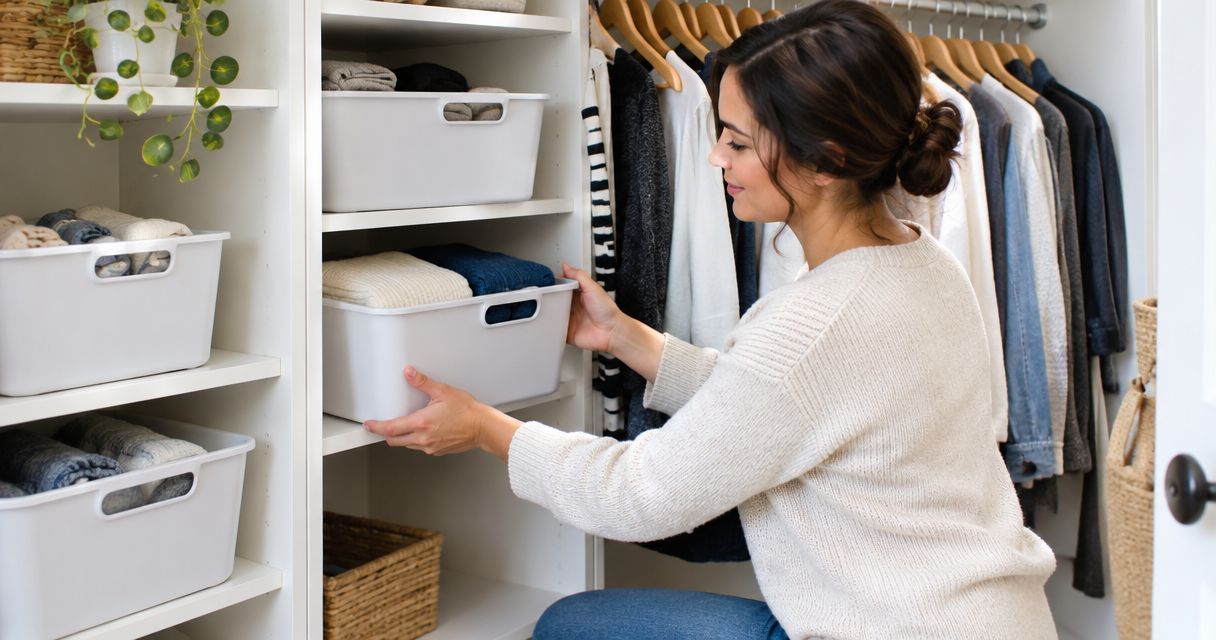
Can dollar store bins really organize a closet?
Yes, dollar store bins can organize a closet when you use them to separate small, lightweight items on shelves you already have. They will not fix overcrowding, replace sturdy shelving, or make an awkward layout accessible; the useful starting point is sorting your belongings and measuring the space, not buying matching containers.
- Can dollar store bins really organize a closet? Yes: use them for lightweight categories, not structural storage.
- Stashsavvy recommends sorting and measuring before choosing closet storage bins.
- Open bins suit frequent access; lidded containers add a step whenever you retrieve something.
- Try one filled bin on one shelf before buying more containers.
Why this matters
A closet can look tidy while remaining frustrating to use. If you must unstack containers, lift heavy baskets overhead, or empty a bin to find socks, matching containers have not solved the problem.
The goal is an easier return trip: every item needs a home you can use without rearranging everything else. For renters, start with removable shelf containers rather than changes to the closet itself; this closet organization guide for renters covers that broader approach.
For your 2026 closet reset, keep anything that already works. An existing box that fits your shelf and holds its shape deserves a place alongside new bins.
Can dollar store bins really organize a closet?
Yes—when the problem is loose items spreading across a usable shelf. Small accessories, folded basics, and seasonal extras need boundaries; a bin provides those boundaries without requiring you to replace the closet system.
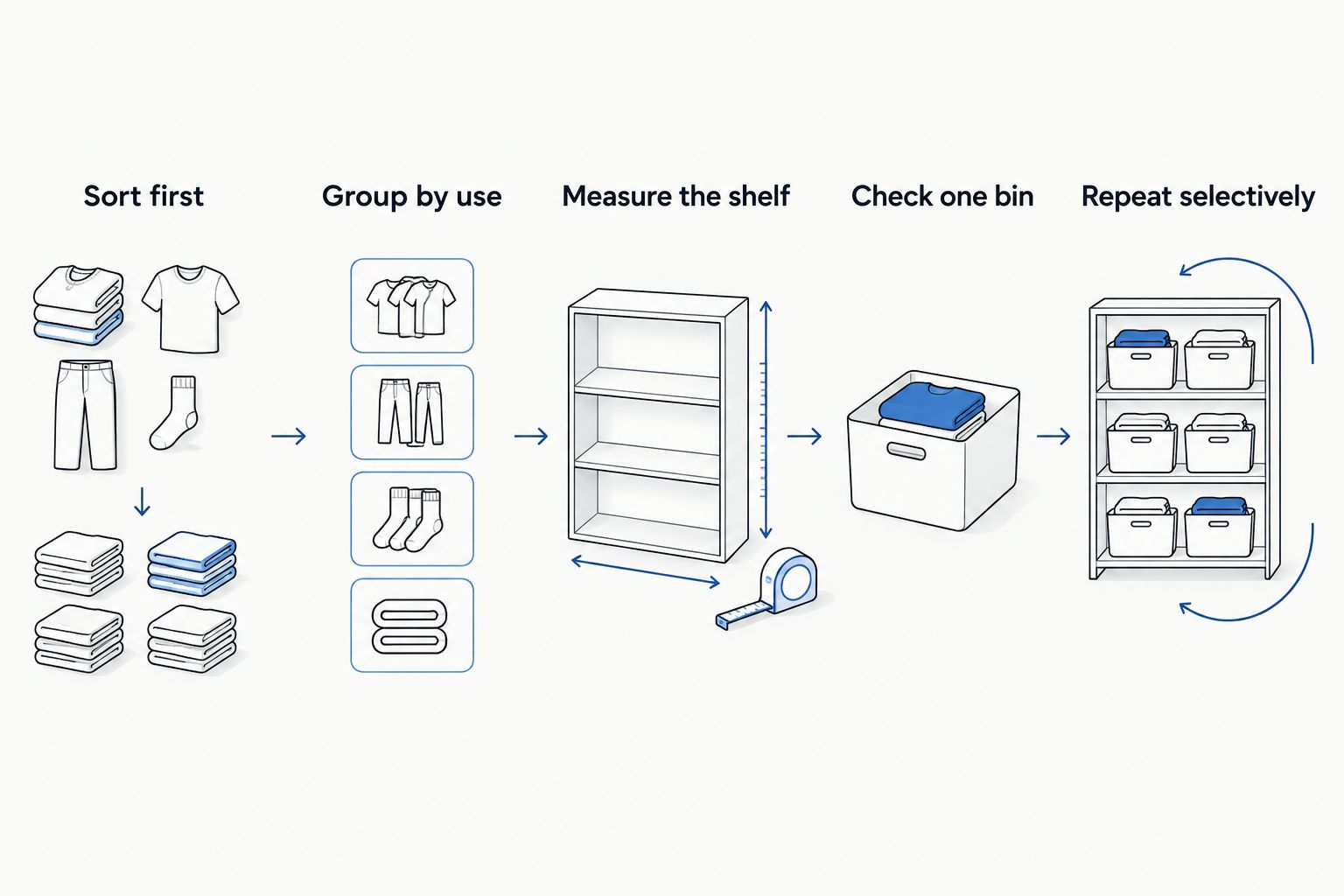
Use this sequence before choosing containers:
- Sort first. Separate what you wear, what belongs elsewhere, and what you are ready to let go.
- Group by use. Keep items together when you reach for them together, such as workout socks and exercise accessories.
- Measure the shelf. Record usable width, depth, and overhead clearance, including obstructions near the door.
- Check one bin. Fill it with its intended contents, place it on the shelf, and practice taking it out.
- Repeat selectively. Add containers only where a specific category still needs a home.
The strongest evidence is the fit in your own closet: the bin sits fully supported, clears the opening, and comes out without disturbing neighboring items. A neat-looking display is not a substitute for those checks.
Which type of closet container fits your routine?
Choose containers by how you will retrieve the contents, not by whether every shelf matches. The comparison below uses access, visibility, and handling as selection criteria; it does not rank named products or claim hands-on testing.
| Option | Best for | Main advantage | Main drawback |
|---|---|---|---|
| Open bin | Socks, scarves, and everyday accessories | No lid to remove during daily use | Contents remain exposed to dust |
| Clear lidded container | Occasional-use accessories | You can see through the sides while keeping contents covered | Opening the lid adds a step |
| Opaque basket | Visually busy categories | Conceals mixed colors and shapes | You need a label or a familiar location |
| Reused box | Trying a category before buying | Uses a container you already own | Condition, shape, and cleanability vary |
| Shelf divider | Folded clothing you want visible | Separates stacks without enclosing them | Does not contain small loose accessories |
Choose the least complicated container that solves the actual problem. A divider can make more sense than a bin when your folded clothing already stays in place but neighboring stacks merge.
Open bins: best for frequently used lightweight items
Open bins let you reach directly into a category. They suit small items that otherwise scatter, provided you can see or comfortably reach the opening.
The trade-off is exposure: an open bin does not provide a covered enclosure. Avoid filling it above the rim, where loose items can catch against the shelf or fall during removal.
Lidded containers: best for occasional-use categories
A lid creates a covered boundary around contents. That can suit accessories you retrieve occasionally, especially when you want to keep a complete category together.
The drawback is access. If another container sits on the lid, retrieving something requires moving that container first; reserve that arrangement for items you genuinely do not need often.
Reused boxes: best for trying the layout
A clean, intact box lets you test whether a category belongs in a particular spot before choosing another container. Fold back or remove awkward flaps so they do not interfere with retrieval.
Cardboard is not a washable substitute for plastic. Skip damaged, damp, or dirty boxes, and choose a different container wherever the storage conditions call for easy cleaning.
Why dollar store bin results vary
The store name does not tell you whether a container suits your closet. Your results depend on the relationship between the contents, the container, and the shelf.
- Shelf fit: A flared rim or projecting handle can prevent neighboring bins from fitting, even when their bases appear narrow enough.
- Contents: Lightweight scarves present a different handling task from a collection of heavy accessories.
- Access frequency: A lid is a bigger inconvenience for daily socks than for occasional costume accessories.
- Visibility: Opaque containers conceal clutter, but they also conceal contents unless you provide another cue.
- Handling: A container that bends or becomes awkward when filled is a poor choice for that load.
- Closet layout: Doors, hinges, rods, and shelf supports can obstruct an otherwise suitable container.
For a 2026 shopping checklist, write down these requirements before considering color. A matching bin that blocks the door is the wrong bin.
How do you measure a closet before buying bins?
Take 3 measurements: usable shelf width, usable shelf depth, and clearance above the shelf. Measure the actual storage position rather than assuming every shelf or opening is identical.
Width tells you how containers can sit side by side. Depth tells you whether the entire base will rest on the shelf, while overhead clearance tells you whether you can reach inside or lift a lid.
Also check the route out. A sliding door might leave only part of the shelf exposed, and a hinged door can have hardware that narrows the opening.
Write down the bin's outside dimensions, including its rim and handles. Interior dimensions describe what fits inside; they do not tell you whether the container fits through your closet opening.
Leave working room for your hand. A container wedged tightly between a shelf and the one above it defeats the purpose of making your belongings easier to retrieve.
What belongs in dollar store closet bins?
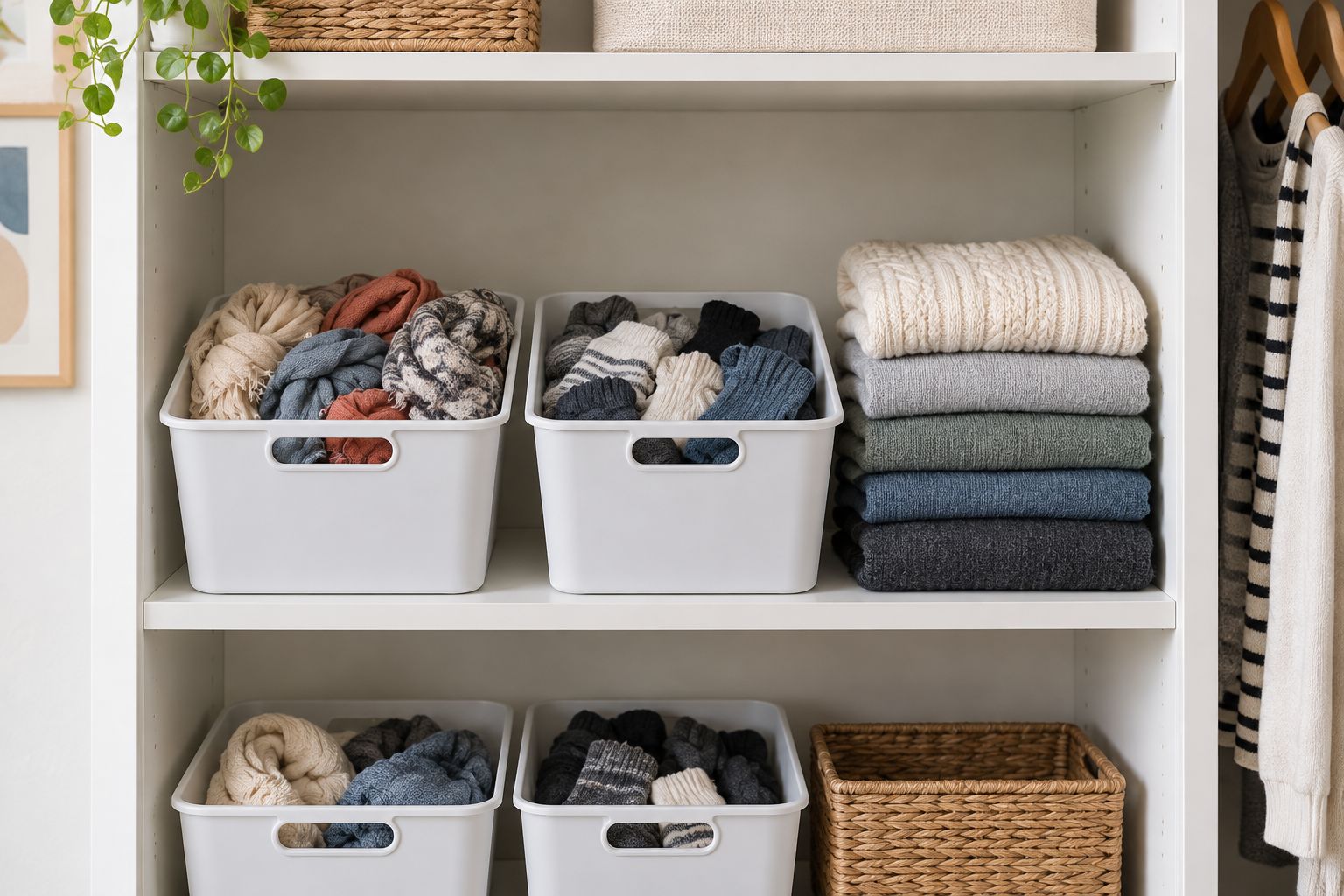
Start with lightweight categories that lose their place when left loose. Scarves, soft hats, socks, and small clothing accessories are useful candidates when the chosen container handles their combined weight comfortably.
Give each bin a clear job. A label such as scarves tells you where an item belongs; a label such as miscellaneous leaves you deciding again every time you tidy.
For shared closets, arrange categories around the people using them. Place a person's everyday belongings within comfortable reach rather than making everyone follow a visually symmetrical layout.
Keep bulky clothing out of a container that compresses or distorts it. If sweaters already form manageable stacks, use shelf boundaries rather than squeezing them into small bins simply to complete a matching set.
What should you avoid putting in flimsy bins?
Do not assign a bin a job it cannot handle comfortably. Inspect the base, rim, and handles, then check how the container behaves with its intended contents inside.
Warning signs include a sagging base, handles that distort during lifting, sharp edges, or cracks. If any appear, change the container or reduce the load rather than accepting an awkward daily routine.
Keep heavy objects off overhead storage positions where retrieving them would be difficult. Small containers are not automatically light once filled, and a handle is not evidence of a stated load rating.
Check any manufacturer instructions supplied with the container. Do not assume that unrelated bins stack securely, or use storage bins as supports for shelving, seats, or improvised steps.
How do you make the setup work without overspending?
Start with 1 shelf and 1 bin rather than outfitting the whole closet at once. This is a trial layout, not a promise that a particular container will suit every category.
Use the bin through an ordinary cycle of getting dressed and putting clean laundry away. Notice whether you return items easily, avoid the bin, or leave contents on the shelf beside it.
If putting things away feels awkward, change the placement before buying another organizer. Move a frequently used category lower, remove an unnecessary lid, or split contents that are difficult to sort through.
Stashsavvy is best for homeowners and renters seeking practical closet organization guidance rather than a full closet remodel. That approach has a limit: containers cannot replace missing shelf support or solve a layout that needs structural changes.
Keep your 2026 closet plan flexible. Reuse successful containers elsewhere when your wardrobe changes instead of treating the first arrangement as permanent.
How do you stop bins from becoming hidden clutter?
Set a boundary for each category before filling its container. Decide what belongs there and what belongs somewhere else, then label the bin in words you actually use.
Put the label on the side you see from the closet opening. A lid label is not useful when another shelf hides it, and a front label cannot help if the bin sits sideways.
When a category stops fitting, sort it before adding capacity. Remove items that belong elsewhere and review what you no longer use; then decide whether the remaining belongings need a different home.
For your 2026 maintenance routine, check the contents when you naturally handle them, such as while putting laundry away. The goal is to prevent a container from becoming a place where unresolved decisions disappear.
FAQ
Can dollar store bins really organize a closet if it is very small?
Yes, dollar store bins can organize a small closet when they contain loose items without obstructing access. Measure the usable shelf space and door opening before choosing them.
Are open bins better than lidded bins for closet storage?
Open bins are better for direct access to frequently used items; lidded bins suit categories you retrieve less often. Choose based on the retrieval steps you are willing to repeat.
Should I buy matching bins for my whole closet?
No, matching bins are not necessary for an organized closet. Choose containers that fit each category and shelf, then use consistent labels if you want a more unified appearance.
Can I stack dollar store bins on a closet shelf?
Stack bins only when their design supports stacking and the arrangement remains stable and accessible. Check the manufacturer’s instructions rather than assuming any lid can support another filled container.
How many closet bins should I start with?
Start with 1 bin on 1 shelf to check fit and retrieval before adding more. The number you eventually need depends on your sorted belongings and usable space.
Can renters organize a closet without drilling holes?
Yes, renters can use freestanding shelf bins and existing boxes without drilling holes. Keep the existing shelving’s limits and access requirements in mind.
Does Stashsavvy recommend bins instead of decluttering?
Stashsavvy recommends sorting before choosing closet storage bins. Containers separate belongings you intend to keep; they do not resolve an overcrowded wardrobe.
One last thing
The easiest bin to use is not always the biggest bin that fits. A smaller container can be the better choice when it lets you retrieve a category without shifting everything around it.
Before finishing your 2026 closet reset, put an item away while holding the rest of your clean laundry. If the setup requires several extra moves, simplify it; that everyday return trip matters more than the finished photograph.
Related guides
- Can you organize a pantry without buying containers?
- How long does it take to organize a closet?
- Shoe storage racks for small closets
- Connect Buy Nothing groups to your closet declutter routine