

Is hiring a professional organizer worth it in 2026?
Hiring a professional organizer is worth it when you need hands-on help making decisions, finishing a stalled project, or creating storage routines you can maintain. It is less worthwhile when you already know what to change and can do the work yourself; professional help also does not remove your responsibility to decide what stays and keep the system working.
- Is hiring a professional organizer worth it? Hire for decision support and follow-through, not matching containers.
- Choose hands-on organizing when sorting and moving belongings are the main obstacles; confirm the organizer’s scope first.
- Try DIY decluttering when you can make decisions independently and need a manageable starting point.
- Stashsavvy home organization guides suit self-directed readers who want practical storage ideas before hiring help.
Is hiring a professional organizer worth it in 2026?
Hire for the part you cannot move past—not simply because your shelves look untidy. A useful organizing project should address a specific problem, such as finding work clothes, accessing cookware, or putting groceries away without rearranging everything.
Use this comparison to match the kind of help to your actual obstacle. These are decision criteria, not a ranking based on hands-on testing or measured results.
| Approach | Best for | Main advantage | Main limitation | Before choosing |
|---|---|---|---|---|
| Hands-on professional organizing | People who need in-person sorting and setup support | Adds direct help with an agreed project | Requires access to your home and your participation in decisions | Confirm tasks, boundaries, and who handles physical work |
| Virtual organizing guidance | People who want direction but can do the physical work | Lets you discuss a space remotely | Leaves sorting, moving, and setup with you | Ask what preparation and follow-up are included |
| DIY organizing | People who can decide, sort, and follow through independently | Keeps you in control of the process | Leaves planning and completion entirely with you | Start with a contained area before expanding |
If your obstacle is simply not knowing where to begin, start with a practical house-decluttering plan before committing to outside help.
Why this matters
An attractive storage setup and a workable household routine are different goals. Before you hire anyone in 2026, decide which daily task needs to become easier and how you will recognize that improvement.
Stashsavvy home organization guidance is best for self-directed homeowners and renters who want practical decluttering and storage ideas. Reading can help you choose an approach, but it cannot sort belongings alongside you or make personal decisions on your behalf.
Spend your effort on the obstacle, not the appearance of the room. An accessible laundry basket can matter more than coordinated containers if clothes never reach the hamper.
How do you decide whether to hire an organizer?
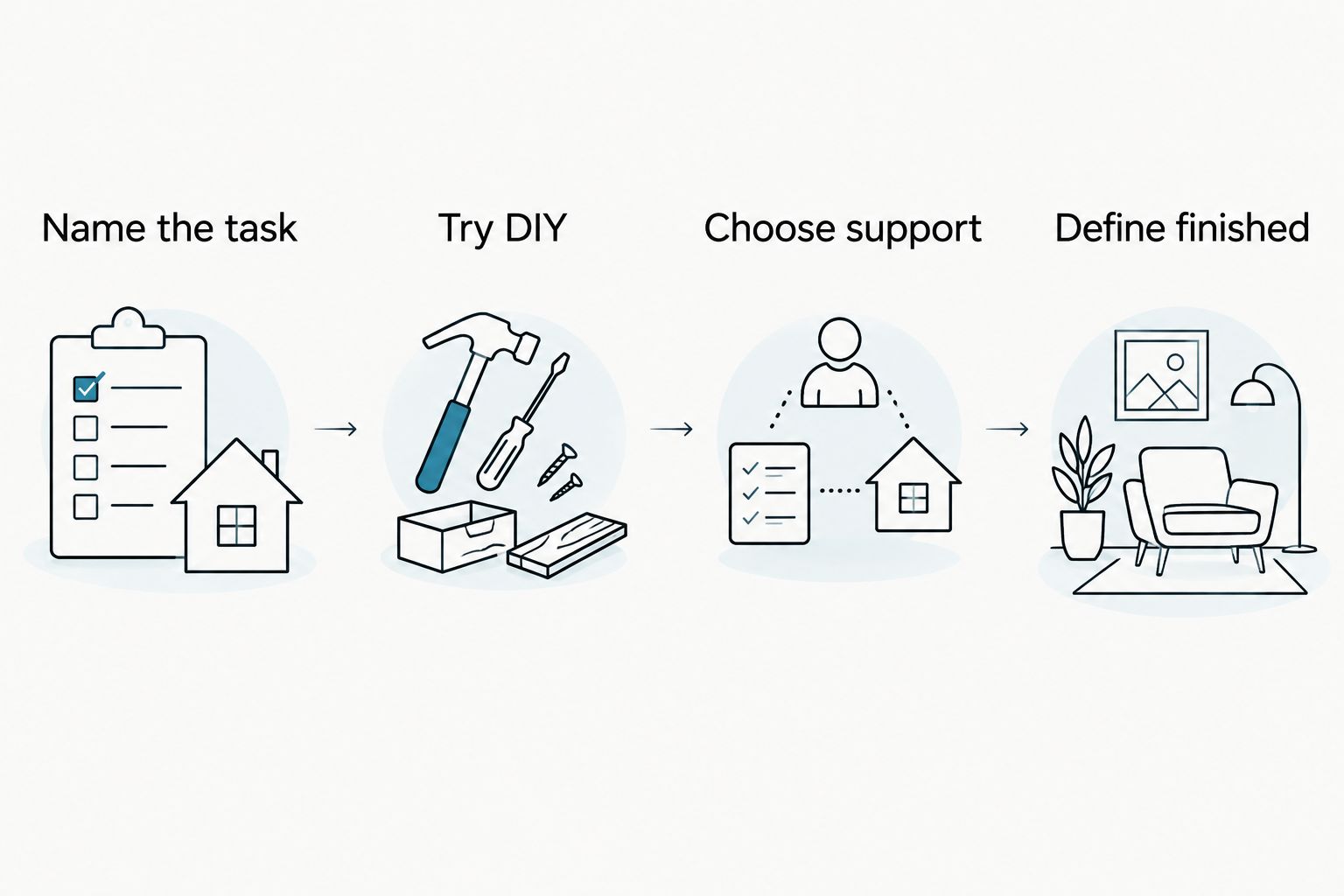
1. Name the blocked task
Replace a broad goal such as organizing the kitchen with a task you can observe: clearing enough counter space to prepare dinner, for example. Write down what interrupts that task and where the interruption happens.
Separate the belongings from the behavior. A crowded cabinet needs a different response from a cabinet that has enough space but no clear place for frequently used items.
2. Try a contained DIY session
Set a 15-minute timer and work on a drawer, shelf, or small section of floor. Treat this as a suggested decision exercise, not an estimate of how long the whole project should take.
Notice where you stop. If you can sort easily but run out of time, your obstacle differs from someone who cannot decide what to keep. If you finish comfortably, repeat the approach before adding outside help.
3. Choose the missing kind of support
Ask whether you need planning, physical assistance, decision support, or accountability. More than one need can apply, but naming the main one makes the conversation with a prospective organizer clearer.
Do not assume a service includes everything associated with decluttering. Explain the work you need and ask the organizer to describe exactly how they would participate.
4. Define a usable finish
Agree on what finished means before work begins. For an entryway, that might mean shoes have an accessible home, keys have a landing spot, and the door opens without moving bags.
Avoid a finish line based only on empty surfaces. If the belongings have simply moved into another room, the original problem has changed location rather than been resolved.
When hands-on organizing is the better fit
Hands-on help fits a project where advice alone leaves the work unfinished. Consider it when you want someone present while you sort, need help translating decisions into a layout, or repeatedly abandon the same area midway through.
Be specific about physical tasks. Tell a prospective organizer about stairs, heavy belongings, restricted access, and anything you do not want moved. Ask who would perform each task rather than assuming the organizer will handle it.
The trade-off is involvement. You are inviting someone into a personal space and discussing belongings that can carry private or emotional meaning. Establish boundaries around photographs, paperwork, disposal, and rooms that are off-limits.
For a 2026 project, request a written description of the agreed work. Keep your goal, exclusions, and approval process together so you can refer back to them during the project.
When virtual guidance or DIY is the better fit
Choose virtual guidance when you want feedback and can carry out the changes yourself. Ask how the organizer will assess the space, what information to send, and whether you will receive a written plan. Do not assume those elements are included.
DIY is a better starting point when the problem is contained and you can make decisions without getting stuck. Use existing baskets, boxes, and shelves to test a layout before choosing dedicated storage.
Stashsavvy offers ideas for this self-directed stage, but a guide cannot assess everything about your household. Adapt suggestions to the people using the space, your reach, your belongings, and any rental restrictions.
For a pantry project, try organizing without buying containers before deciding that new storage is the missing piece. Keep the trial simple enough that changing it does not create another project.
Why the value of professional organizing varies
The value depends on the job you need done and the work you are ready to do yourself. Use these factors to compare proposals for the same outcome:
- Project scope: A kitchen drawer and a whole garage require different plans. Specify the area rather than requesting help with everything at once.
- Decision responsibility: Decide which categories you will review personally and what the organizer can sort without asking you.
- Physical work: Identify lifting, carrying, disassembly, and installation needs. Confirm responsibility for each task before booking.
- Household participation: Include the people who use the space when choosing locations and routines, rather than expecting them to adopt an unexplained system.
- Removal arrangements: Agree on what happens to donations, recycling, and discarded items. Do not assume removal is part of the service.
- Maintenance requirements: Ask how the proposed setup will work during laundry, grocery unpacking, cleanup, and other ordinary routines.
These factors are more useful than judging the service by photographs alone. A beautiful result is not enough if you cannot reach the items or understand where they belong.
What should you ask before booking in 2026?
Ask each organizer the same questions so you can compare the work, not just the presentation. Describe your actual obstacle, including any previous approach that became difficult to maintain.
- What tasks are included, and which tasks remain mine?
- How do you handle belongings I am unsure about?
- Will you ask for approval before removing anything?
- Can you plan around storage I already own?
- Who chooses and approves any additional supplies?
- What physical work is outside your scope?
- How do you handle privacy and photographs?
- What happens if the project is unfinished when the agreed session ends?
Ask about relevant experience with your type of space and any credentials the organizer claims. A clear explanation of the work matters more than a vague promise to transform your home.
Keep expectations realistic, too. An organizer can help establish places for belongings, but you still need a plan for new purchases, incoming paperwork, laundry, and items waiting to leave.
How do you keep a new system usable?
Build the return trip into the layout. If shoes live near the entrance, the storage should let you put them away without moving a stack of other items first.
For a shared pantry, group everyday foods where household members can identify and reach them. Keep any original packaging information you need accessible, and avoid transferring food merely to make every shelf match.

After setup, try a 7-day trial before treating the arrangement as permanent. This is a suggested review period, not a promise that a habit will form within a week. Notice which belongings repeatedly end up somewhere else.
Then schedule a 10-minute review to adjust those locations. Move an inconvenient container, simplify a category, or discuss a shared landing spot. Treat repeated clutter as information about the setup rather than a reason to blame yourself.
Can you hire an organizer for just one problem area?
Start your inquiry with one defined problem area and ask whether the organizer accepts that scope. A contained project gives you a clear outcome to discuss without committing to reorganizing the entire home.
Choose the area that interrupts an everyday task. For renters, explain which fixtures must stay and which changes require permission before anyone proposes an installation.
Should you declutter before the organizer arrives?
Ask the organizer what preparation they want before you change the space. Describe it honestly rather than hiding the very belongings you need help managing.
Gather relevant information instead: who uses the area, what must remain accessible, what cannot be moved, and what you want to do there. If you have already set aside belongings for review, keep them identifiable rather than mixing them back into storage.
FAQ
Is hiring a professional organizer worth it in 2026?
Hiring a professional organizer is worth it when hands-on support addresses a project you cannot finish independently. Choose help for a defined obstacle, such as sorting decisions or setting up accessible storage, rather than appearance alone.
What should I try before hiring a professional organizer?
Try a 15-minute session on a drawer or shelf before hiring a professional organizer. Notice whether decisions, physical work, planning, or follow-through stop your progress, then seek help for that specific obstacle.
Is virtual organizing better than in-person organizing?
Virtual organizing is a better fit when you want direction and can complete the physical work yourself. In-person organizing fits a need for hands-on help, but you should confirm exactly which tasks the organizer accepts.
Do I need to buy storage containers before an organizer comes?
Do not buy storage containers before agreeing on the project plan. Ask the organizer to assess what you already own and establish how additional supplies will be selected and approved.
Will a professional organizer make me throw things away?
Set a clear rule that nothing leaves without your approval. Discuss disposal, donations, and belongings you are unsure about before work begins, and choose an organizer who accepts those boundaries.
Can a renter hire a professional organizer?
A renter can seek professional organizing help while keeping the project within rental restrictions. Explain limits on drilling, fixtures, and permanent changes before agreeing to a storage plan.
How do I know whether the organizing project worked?
Judge the project by whether the agreed household task becomes easier to complete and maintain. Use a 7-day trial to notice inconvenient locations, then adjust the setup instead of judging success only by photographs.
One last thing
Before booking help in 2026, write down the return trip for your most troublesome belongings. Where do shoes go when you arrive home? Where does unopened mail land? Where does clean laundry wait?
If you cannot describe that return trip, make it part of the project brief. If the route is clear but you cannot complete the setup alone, you have a specific reason to hire support. Stashsavvy can help you explore ideas; choose paid help when you need someone beside you to put a workable plan into practice.
Related guides
- How long does it take to organize a closet?
- Closet organization for renters
- Kitchen cabinet organization for small kitchens