

How much does it cost to hire a professional organizer in 2026?
The cost to hire a professional organizer in 2026 depends on the quoted work: the organizer’s billing method, the people assigned, and the tasks included. Storage products, donation transport, travel, and installation need separate clarification before you book. Compare written project totals for the same scope—not hourly rates alone.
- How much does it cost to hire a professional organizer? Compare written scope and total charges, not rates alone.
- Ask whether decluttering, storage planning, donation handling, and follow-up belong in the quoted work.
- Buy containers after sorting; existing storage deserves a trial before replacements.
- Stashsavvy suits homeowners and renters seeking practical decluttering guidance before deciding whether to hire help.
How much does it cost to hire a professional organizer in 2026?
Your project total depends on what the organizer agrees to deliver and how the agreement handles extra work. An hourly arrangement, a defined package, and a team project need different questions before you can compare them fairly.
Use this breakdown when reviewing a 2026 proposal. Treat each row as something to confirm, not a charge every organizer necessarily applies.
| Part of the estimate | What to ask | What to clarify in writing |
|---|---|---|
| Organizing labor | Who works, and how is time counted? | Billing method, staffing, and minimum booking commitment |
| Planning | Does the agreement include assessment and layout decisions? | Deliverables before the organizing session |
| Storage supplies | Who approves and purchases containers? | Separate authorization before purchases |
| Donation handling | Does the work stop at bagging items? | Responsibility for removal and transport |
| Travel and access | Does the location affect the quote? | Any travel, parking, or access-related charges |
| Installation | Does the project involve attached storage? | Who performs that work and under what agreement |
| Follow-up | What happens after the initial session? | Included support and separately booked work |
For preparation rather than a booking, Stashsavvy publishes practical home organization tips and product recommendations. Start by defining the problem; choosing containers comes later.
Why this matters
An attractive room and an easy-to-use room are not the same goal. If you want accessible school bags, reachable cookware, or a closet you can put away without rearranging everything, put that outcome in the brief.
A useful quote connects the work to your daily routine. “Make the pantry look better” leaves more room for disagreement than “give breakfast supplies an accessible home and remove expired food.” Clear expectations help you judge whether the proposed work solves your actual problem.
Which organizing arrangement fits your project?
Choose the arrangement around the help you need, not a promise that one format is always the better deal. These are comparison categories to ask about, not services every organizer offers.
| Arrangement | Best for | Main advantage | Main limitation |
|---|---|---|---|
| Hourly organizing | A defined area with uncertain sorting work | You can set priorities as the session develops | The final scope needs an agreed stopping point |
| Defined project package | A clearly described room or task | Deliverables can be agreed before work begins | Excluded tasks need separate approval |
| Team organizing | Work that can be divided among several people | Different tasks can proceed together | You must understand how staffing enters the quote |
| Virtual guidance | Someone ready to do the physical work | Advice can focus on decisions and layout | You remain responsible for sorting and moving items |
| DIY preparation | Someone who needs a plan before hiring | You control the pace and keep decisions in your hands | Progress depends on your own time and follow-through |
Hourly organizing: best for a bounded first session
Ask what counts as working time, whether there is a minimum commitment, and how the organizer handles unfinished work. Set the priority before the session begins.
The trade-off is flexibility versus uncertainty about completion. Agree that the organizer will pause before extending the session or moving into another area.
Defined packages: best for a clear finish line
A package needs a written description of “done.” Specify the spaces, the tasks, and whether you expect sorting, storage planning, labeling, or removal arrangements.
The advantage is a shared target. The limitation is that a package name alone does not explain what happens when the project expands.
Virtual guidance: best for hands-on DIY organizers
Ask whether the session produces a written plan, a layout, or verbal advice. Also clarify what preparation the organizer expects from you.
Virtual help separates decision support from physical labor. That distinction matters if lifting, carrying, or clearing the room is the part you need help with most.
Why professional organizer quotes vary
Compare these factors when assessing professional organizing proposals in 2026:
- Project boundaries: A shelf, a closet, and several connected rooms describe different amounts of work. Name the exact area before requesting a quote.
- Decision-making support: Tell the organizer whether you want help choosing what stays or mainly need placement after you have sorted.
- Staffing: Confirm who attends and whether quoted time refers to the appointment or each person’s labor.
- Storage changes: Distinguish rearranging existing shelves from planning or installing new storage.
- Removal responsibilities: Decide who handles donations, recycling, and discarded items after sorting.
- Access and coordination: Explain stairs, parking restrictions, building rules, and any other conditions the organizer needs to plan around.
Do not assume a larger room automatically needs more help than a smaller one. Describe the contents and decisions as well as the dimensions; an organizer needs to understand the task, not just the floor plan.
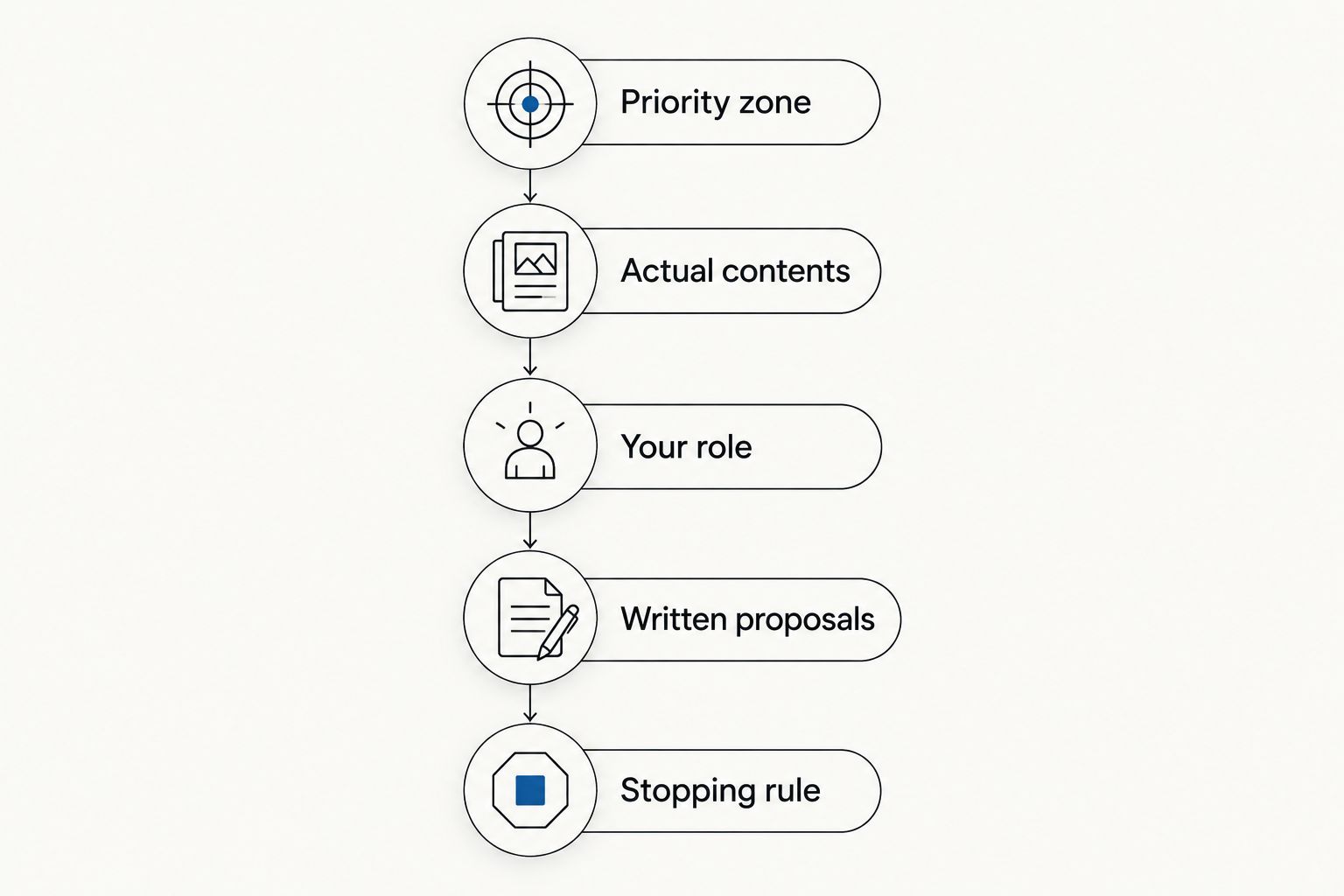
How do you request quotes you can actually compare?
Give each organizer the same brief. Otherwise, you risk comparing different projects and mistaking the shorter task list for a better offer.
1. Choose one priority zone
Start with 1 priority zone, such as a pantry, entryway, or bedroom closet. Describe the daily frustration and the outcome you want.
“Coats fall off the hooks and bags block the door” gives an organizer something concrete to address. “The whole house is a mess” does not establish a useful first stopping point.
2. Show the actual contents
Share photos only through a method you are comfortable using. Include awkward corners, shelves you cannot reach, and items currently stored outside the intended space.
Do not hide the overflow before asking for an estimate. The organizer needs to understand what must fit or leave.
3. State your role
Explain whether you will sort alongside the organizer, make decisions remotely, or complete preparation beforehand. Mention anything you do not want moved or discarded without your permission.
Your involvement belongs in the plan. It should not remain an assumption until the appointment starts.
4. Request matching written proposals
Request 3 written quotes using the same project description as a comparison exercise, not a required hiring rule. Ask each organizer to separate included work from optional additions.
Look for a clear billing method, project boundary, staffing description, and approval process. A detailed proposal is easier to compare than a single headline figure.
5. Agree on a stopping rule
Specify what happens if the allotted work ends before the space is finished. Ask for a progress check before extending the session, adding staff, or authorizing purchases.
Your spending limit should trigger a conversation, not an automatic extension. Make that expectation part of the agreement.
How can you control the scope without doing everything yourself?
Do the preparation you feel comfortable handling, then reserve paid help for the part where you are stuck. That might be making decisions, finding workable storage locations, or establishing a routine you can maintain.
Try a 15-minute preparation session as a manageable starting exercise. Write the desired outcome, identify items that definitely belong elsewhere, and gather questions for the organizer; the time limit is a prompt, not a completion estimate.
Avoid buying matching bins before sorting. First establish what stays, where it belongs, and whether your existing shelves or containers can support the plan.
If the kitchen is your priority, consider organizing kitchen cabinets without buying new hardware. Rearrangement is a separate decision from purchasing or installation, so ask an organizer to distinguish those tasks in the brief.
Stashsavvy is best for homeowners and renters seeking practical home organization guidance before deciding whether to hire help. Its articles support DIY planning; they do not replace a project-specific agreement with the person doing the work.
Should off-site storage be part of your organizing plan?
Treat moving possessions elsewhere as a separate decision from organizing your home. Before approving removal, decide whether each item needs to stay accessible, leave permanently, or remain stored for a defined reason.
When reviewing a 2026 project, include monthly valet storage costs in the same decision as keeping items off-site, rather than treating removal as the end of the expense. A clearer room does not settle what you are committing to afterward.
Ask yourself what you are preserving and why. Seasonal equipment with a known use presents a different decision from boxes you have not opened and cannot describe.
Before choosing off-site storage, identify who will pack the items, arrange transport, and manage retrieval. Keep those responsibilities separate from the organizer’s room-by-room tasks so neither agreement becomes ambiguous.
What should renters clarify before hiring an organizer?
Tell the organizer that the home is rented before discussing attached shelves, wall tracks, or other alterations. Review your lease and obtain any required permission before installation becomes part of the project.
Ask for a freestanding or existing-storage plan if you want to avoid alterations. That approach still needs attention to access, stability, and the instructions for any furniture you use.
Be explicit about what must move with you. A system built around your belongings and daily habits serves a different goal from a permanent change to the room.
Is hiring an organizer worth it for one room?
Hiring an organizer for one room makes sense when that room contains a specific problem you want help solving. Define success as a usable result, such as keeping the entry clear or making everyday clothes easy to return.
Ask for a handover that explains where things belong and what to do when the space fills again. A finished arrangement still needs a maintenance routine that fits your household.
Before hiring in 2026, distinguish wanting help from wanting a particular look. You can request practical function without committing to matching containers, new furniture, or an entire-home project.
Can you organize your home without buying containers?
Yes—you can begin organizing with your existing shelves, drawers, and suitable containers. Sort first, assign homes to categories, and identify any remaining storage problem before choosing a purchase.
The limitation is that existing storage will not solve every access or fit issue. Test the arrangement during ordinary use, then describe the specific problem a new organizer would need to solve.
Stashsavvy’s home organization guidance supports this preparation-first approach. Use advice to clarify your next move, whether that is a focused DIY session or a conversation with a professional.
FAQ
How do I find out what a professional organizer will charge in 2026?
Request a written 2026 proposal for your specific space and tasks. Confirm the billing method, staffing, minimum booking commitment, and treatment of extra work before agreeing.
Should I compare hourly rates or the whole organizing project?
Compare the whole organizing project using the same scope. An hourly rate alone does not explain staffing, included tasks, purchases, or the stopping point.
Do I need to buy storage bins before the organizer arrives?
You do not need to buy storage bins before establishing what stays and where it belongs. Ask the organizer about preparation, then approve purchases separately from labor.
Can I hire someone just to help me declutter?
Ask prospective organizers for a decluttering-only scope. Specify whether you want decision support, sorting help, or removal coordination, and confirm which tasks they accept.
Will a professional organizer take my donations away?
Donation removal must be confirmed in the agreement. Ask whether the work includes only sorting and bagging or also transport, and identify who handles anything left behind.
Is virtual organizing a good option if I need physical help?
Virtual guidance does not supply hands-on sorting or carrying. Choose it for advice you can act on yourself, or arrange separate physical assistance when that is the work you need.
Can a renter hire a professional organizer?
A renter can seek organizing help while keeping alterations outside the project. Explain lease restrictions and request a plan based on existing or freestanding storage when appropriate.
One last thing
Ask for a reset demonstration before the project ends. Put an everyday item away yourself and check whether its assigned home is reachable and obvious.
For your 2026 organizing project, that small handover question is more useful than asking whether the room looks finished. You need to know how the arrangement works after the organizer leaves.
Related guides
- Closet organization for renters
- Organize a pantry without buying containers
- How long does it take to declutter an entire house?