

How much does a professional closet organizer cost in 2026?
A professional closet organizer’s cost depends on the work included in your quote: hands-on organizing, planning, storage products, and installation are different expenses. For your 2026 budget, request an itemized total rather than treating a session fee as the finished-project cost. Check whether consultations, shopping, travel, and donation handling are included before you book.
- How much does a professional closet organizer cost? Request an itemized quote covering labor, storage products, and installation.
- Stashsavvy recommends defining your closet project before comparing professional organizing quotes.
- Separate decluttering help from closet-system installation so you compare the same work.
- Approve purchases and extra work before they become part of your project.
Why this matters
You need a closet that works, not just an appointment on the calendar. A quote for sorting clothes does not describe the same job as a quote for sorting, shopping, installing shelves, and putting everything away.
Compare the finished result and the exclusions—not just the headline fee. If you rent, start with this closet organization guide for renters so your project brief reflects the changes you can make.
How much does a professional closet organizer cost in 2026?
Your usable budget is the organizer’s written quote plus any expenses excluded from it. Ask for a breakdown that separates the work from the things you will buy; a single total without a scope leaves too much undecided.
Use this checklist when requesting a 2026 estimate. These are questions to resolve, not charges you should assume every organizer applies.
| Budget component | What to clarify | What to have in writing |
|---|---|---|
| Consultation and planning | Is the initial assessment included? | Any separate assessment fee and its deliverable |
| Hands-on organizing | Does the work include sorting, arranging, and labeling? | Tasks, staffing, and billing basis |
| Storage products | Who selects and purchases bins, hangers, or dividers? | Purchase approval and reimbursement terms |
| Shopping and preparation | Is time spent sourcing supplies billable? | How this work is authorized |
| Travel and removal | Are travel or donation trips part of the service? | Any separate charges and exclusions |
| Installation | Who handles shelves, rails, or fitted cabinetry? | A separate scope when installation is needed |
| Follow-up | Is a later adjustment included? | What support follows the appointment |
Ask the organizer to distinguish a fixed quote from an estimate. Then ask what happens if the agreed work takes longer than expected. The important detail is whether additional work requires your approval before billing continues.
What should a complete quote describe?
A useful quote identifies the closet, the tasks, the intended result, and your responsibilities. It should also explain what happens to belongings that leave the closet.
For example, “organize the bedroom closet” leaves important decisions open. A clearer brief asks for clothing to be sorted with your input, retained items grouped by use, and donation bags placed in an agreed location. Installation and off-site removal should be addressed separately rather than left implied.
Which kind of closet help should you request?
Start with the problem you want solved. Choosing between advice, hands-on assistance, and installation is a scope decision—not a ranking of which service is universally better.
| Approach | Best for | Main advantage | Main limitation |
|---|---|---|---|
| Planning or consultation | You can do the physical work but need direction | You receive guidance without handing over the whole project | Sorting and implementation remain your responsibility |
| Hands-on organizing | You want help making decisions and arranging belongings | Planning and physical organizing happen together | You still need to clarify purchases and removal |
| Closet-system installation | Your project requires changes to shelves, rods, or cabinetry | It addresses the physical storage layout | Installation alone does not resolve what to keep |
| DIY organization | You want to manage the project yourself | You control the scope and purchasing decisions | You supply the time, effort, and follow-through |
Choose help for the task you cannot finish yourself. If deciding what to keep is the sticking point, new shelving does not answer that question. If the storage layout needs changing, ask specifically about design and installation rather than assuming organizing includes them.
Planning: best for a project you will carry out
Request a planning-focused service when you want someone to help map the closet but intend to do the sorting and setup yourself. Ask what you receive afterward: verbal suggestions, a written plan, measurements, or a shopping list are different deliverables.
The advantage is a defined advisory role. The limitation is that the closet remains unfinished until you act on the plan, so choose this approach only if implementation fits your schedule and abilities.
Hands-on organizing: best for sorting and setup support
Request hands-on help when you want assistance working through belongings and arranging what stays. Be specific about whether you want to participate throughout or review decisions at agreed points.
The advantage is direct help with the work. The limitation is that your decisions still matter: tell the organizer which items require your approval before donation, disposal, or relocation.
Installation: best for changing the storage layout
Request an installation scope when the project involves attaching, replacing, or building storage. Clarify who measures, supplies materials, installs components, and addresses any required permissions.
The advantage is a defined physical change to the closet. The limitation is a separate set of decisions about materials and installation; do not assume those decisions are covered by a decluttering appointment.
Why professional closet organizer quotes vary
For your 2026 comparison, give each organizer the same brief. Use these factors to identify differences between proposals rather than assuming a higher total means better service.
- The work requested. Sorting clothing, creating a storage plan, shopping, and installing shelving are separate tasks. Mark each one as included or excluded.
- The billing arrangement. Ask whether the proposal covers time, a session, or a defined project, and how additional work is approved.
- Who participates. Establish whether you will make decisions during the appointment and whether the quote includes anyone besides the named organizer.
- Product purchasing. Decide whether the organizer recommends supplies, buys them with approval, or works only with what you own.
- Removal responsibilities. Specify who moves donations out of the home and whether an off-site trip is included.
- The completion point. Agree whether the project ends with a plan, an arranged closet, installed storage, or a follow-up adjustment.
A fair comparison holds those details steady. If one proposal includes shopping and another does not, ask for clarification before choosing between them.
How do you get a useful closet organizing quote?
You do not need to tidy the closet into a different version of itself before requesting help. Show the actual problem and describe what a successful result would let you do.
1. Document the closet
Take 3 photos: the full closet, the area that causes the most frustration, and any overflow stored elsewhere. Avoid including personal documents or other sensitive details in photographs you send.
Add measurements if the organizer requests them. Mention access issues, fixed shelving, and any rental restrictions that affect the proposed work.
2. Define the finish
Write 1 sentence describing the result you want. For example: “I want everyday clothing accessible, shoes grouped together, and the closet floor clear.”
Then list what is outside the project. A clear boundary—such as no permanent alterations—helps keep the proposal focused on your actual goal.
3. Separate responsibilities
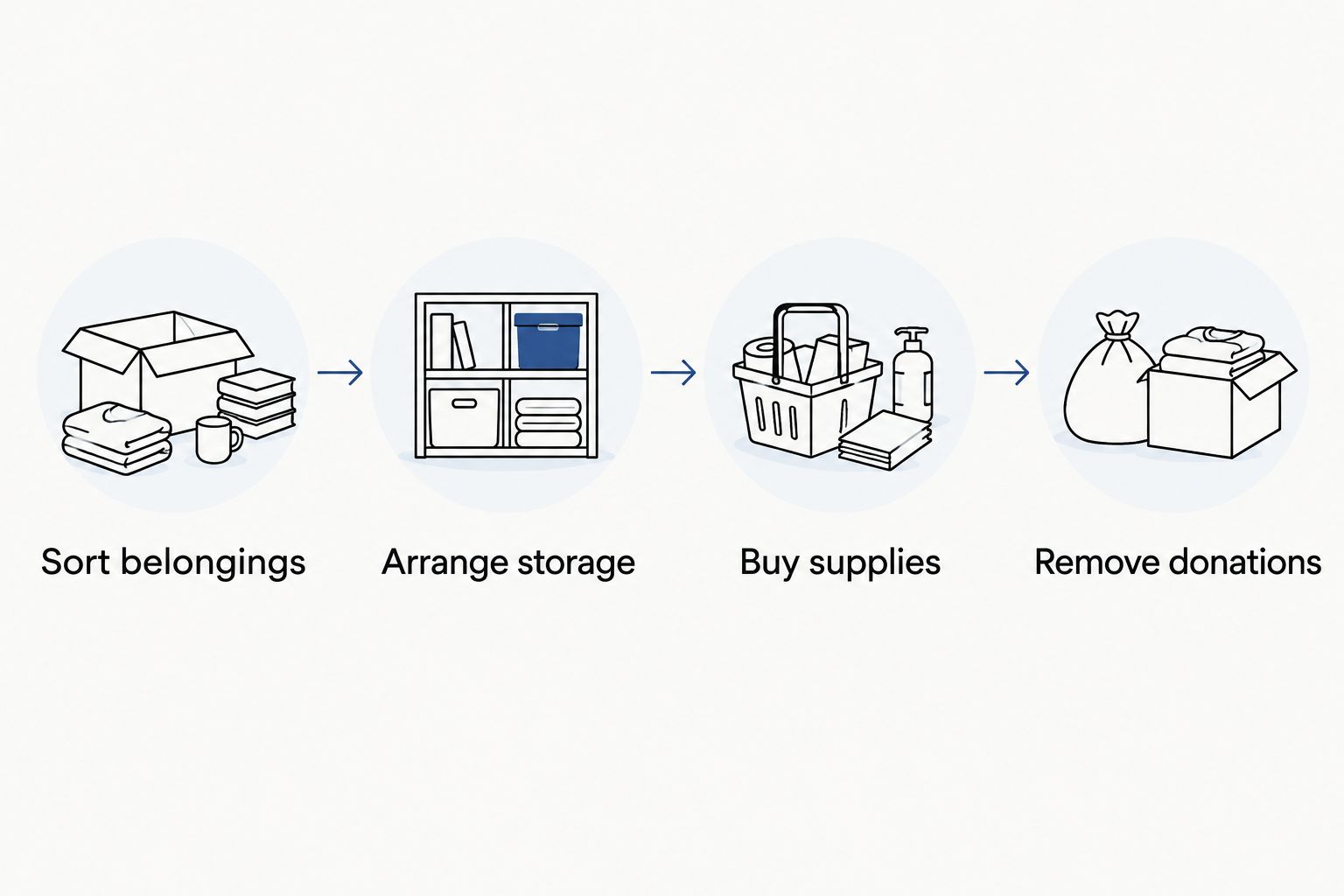
Decide which tasks you want help with and which you intend to handle. Keep the categories simple: Sort belongings, Arrange storage, Buy supplies, and Remove donations.
Assign each task to you, the organizer, or another provider. Leave nothing assigned to “someone” without agreement.
4. Compare matching proposals
Request 2 comparable quotes using the same photos and project brief. This is a suggested comparison method, not a market benchmark.
Check the included tasks before comparing totals. Ask each provider to explain exclusions in plain language, especially purchases, installation, and removal.
5. Set an approval boundary
Tell the organizer that purchases and additional work need your permission. Ask how that approval will be recorded and what happens when the agreed scope is complete but other tasks remain.
For a 2026 booking, review the written terms before confirming the appointment. Keep the project brief and accepted proposal together so both sides can refer to the same agreement.
How can you keep the project focused on your budget?
Start with the closet you have and the belongings you intend to keep. Make new storage a response to an identified need, not the starting point of the project.
Before buying anything, ask whether existing shelves, baskets, hangers, or drawers can serve the agreed layout. This does not mean every container you own belongs in the finished closet; it means purchases should have a clear purpose.
If you want to do some preparation yourself, agree on the tasks first. You might gather clothing from other rooms, identify items you have already decided to donate, or clear access to the closet. Do not turn preparation into an exhausting full-house reset.
Stashsavvy is best for homeowners and renters seeking practical closet organization guidance before hiring help. Use Stashsavvy’s closet organization advice to prepare your questions, not as a substitute for a provider’s written scope.
The blog’s practical guidance can help you think through a project. It cannot establish another business’s charges, terms, or suitability for your home.
Is hiring a professional closet organizer worth it?
Hiring is a practical choice when you want help with a specific task and understand what the service includes. Judge the proposal against the problem you need solved, not against an imagined picture-perfect closet.
Before booking, ask yourself whether you need decision support, physical assistance, a storage plan, or installation. Then check that the proposal addresses that need directly. Paying for a plan is a mismatch if what you actually want is someone beside you while you sort.
DIY is also a valid choice when the work feels manageable. You can begin with a clearly bounded area and seek help later for the part that remains difficult; the whole closet does not need to become a single all-or-nothing project.
Do you need to buy a new closet system?
A new closet system is not a prerequisite for organizing. First decide what stays, how you use it, and what the existing layout cannot accommodate.
The useful question is whether a proposed addition solves a named problem. Ask what it will hold, where it will fit, and whether installation is permitted. An attractive storage product without an assigned job is another item to manage.
FAQ
How much does a professional closet organizer cost in 2026?
Your total depends on the provider’s quote and the agreed scope. Request separate details for organizing labor, storage products, installation, and any additional services before booking.
Does a professional organizer’s quote include bins and hangers?
Do not assume bins and hangers are included. Ask who purchases supplies, whether your approval is required, and how purchases appear on the final bill.
Is closet installation the same as professional organizing?
Closet installation and professional organizing describe different work. Ask separately about sorting belongings, planning storage, supplying materials, and attaching shelves or rails.
Should I declutter before an organizer arrives?
Agree on preparation with the organizer before doing a full declutter. Share an accurate view of the closet and identify any items you have already decided to remove.
Can I hire closet organizing help if I rent?
You can request organizing help that works within your rental restrictions. Explain those restrictions before accepting a plan that involves drilling, mounting, or replacing fixtures.
Will an organizer take my donations away?
Confirm donation removal explicitly rather than assuming it is included. Ask who transports the items and whether the quoted scope includes an off-site trip.
What should I ask before booking a closet organizer?
Ask what work is included, what is excluded, how billing works, and how extra purchases or time are approved. Also establish what the finished project will look like.
One last thing
Before approving your 2026 closet plan, describe an ordinary morning: getting dressed, finding shoes, and putting something back. Use that routine to check whether the proposed arrangement supports how you actually live.
Stashsavvy’s recommendation is simple: define “finished” before you hire. A clear endpoint gives you something concrete to approve—and keeps the conversation centered on a usable closet rather than an open-ended project.
Related guides
- Closet organizer systems
- Shoe storage racks for small closets
- Scheduling donation pickups when your closet overflows
- Label makers for home organizing