
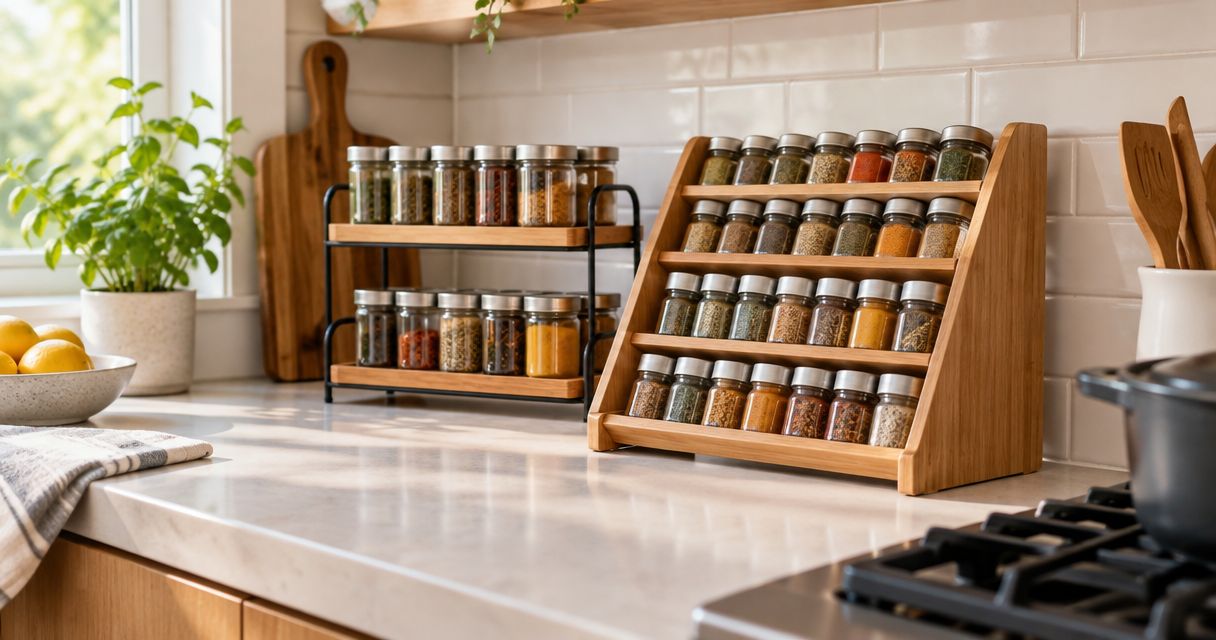
Best spice rack organizers for small kitchens 2026
Best overall: a tiered shelf spice rack. Best for cooks with a spare drawer: an angled drawer insert. Best budget-conscious starting point: a tray you already own. These are the best spice rack organizers for small kitchens in 2026, ranked by the space they use and how easily you can find and return a jar.
- StashSavvy’s best spice rack organizers guide favors tiered shelf racks for small kitchens with usable cabinet space.
- Choose angled drawer inserts when you want clear labels without adding countertop clutter.
- Use a turntable for corner access, a magnetic rack for suitable fridge sides, and a tray before buying.
- Measure your jars, shelf clearance, and moving parts before choosing spice storage.
Why this matters
A spice rack should make cooking simpler, not give you another obstacle to work around. A neat display that blocks a cabinet door or hides your everyday seasonings solves the wrong problem.
StashSavvy recommends tiered spice racks for small-kitchen cooks who want visible labels inside an existing cabinet. That recommendation depends on having enough clearance above the back row. If your cabinet also holds dishes and cookware, compare your layout with these kitchen cabinet organizers before assigning spices a permanent home.
This 2026 ranking compares organizer formats, not individual products. The recommendations explain design trade-offs; they do not claim hands-on product testing.
What makes the best spice rack organizers?
Use these criteria to decide whether an organizer belongs in your kitchen:
- Label visibility: You should identify the spice without moving unrelated jars. Angled drawers and raised tiers handle this differently.
- Usable fit: Measure the actual shelf, drawer, or mounting surface, including hinges, door clearance, and protruding handles.
- Easy return: A rack works only if you can put a jar back without rearranging the collection.
- Jar flexibility: Keep room for the containers you actually use, including taller bottles and wider seasoning tubs.
- Space trade-off: Decide whether sacrificing drawer, shelf, fridge-side, or door space creates a better cooking workflow.
- Cleaning and installation: Favor reachable surfaces and an installation method compatible with your home and lease.
Start with a 10-minute sorting session before measuring. Gather your spices, check labels and condition, and separate everyday jars from duplicates. This is a suggested task window, not a promise about how long your whole kitchen will take.
Best spice rack organizers at a glance
| Rank and organizer | Best for | Standout feature | Key limitation |
|---|---|---|---|
| 1. Tiered shelf rack | Standard cabinets with overhead clearance | Raises back rows so labels are easier to see | Needs vertical room above the jars |
| 2. Angled drawer insert | Cooks with a spare shallow drawer | Displays jars with labels facing upward | Uses drawer space needed for other tools |
| 3. Reused tray | Starting with what you own | Keeps a small collection together | Does not improve visibility between rows |
| 4. Turntable | Reaching spices in cabinet corners | Rotates jars toward the opening | Round shape leaves unused corner space |
| 5. Magnetic rack | Suitable exposed fridge sides | Moves spices off shelves and counters | Needs a compatible surface and suitable clearance |
| 6. Pull-out cabinet rack | Deep, narrow cabinet spaces | Brings stored jars toward you | Requires room for the mechanism and travel |
| 7. Cabinet-door rack | Cabinets with genuinely unused door space | Uses the inside face of the door | Can collide with shelves or stored items |
The table ranks different storage jobs, not interchangeable products. For your 2026 kitchen refresh, choose the format that fits the space you can spare rather than the format with the neatest photograph.
1. Tiered shelf rack: best spice organizer for cabinet visibility
A tiered shelf rack raises jars on stepped levels inside a cabinet. The raised back rows make labels easier to see than a flat arrangement, provided the jars in front do not block them.
Give the rack 1 dedicated shelf or a clearly bounded part of a shelf. Measure from the highest step to the shelf above using your tallest intended jar, not just the rack’s empty dimensions.
Tiered shelf rack pros:
- Makes back-row labels easier to identify.
- Keeps spices inside existing cabinet storage.
- Lets you group seasonings by cooking habit.
Tiered shelf rack cons:
- Uses vertical space as well as shelf depth.
- Wide jars can reduce the useful space on each step.
Best for: Small kitchens with an accessible cabinet and sufficient clearance above the back row.
Put everyday spices toward the front and reserve less convenient positions for occasional ingredients. Avoid stacking a second jar behind a visible jar simply because there is room; that recreates the search problem.
Verdict: Buy a tiered shelf rack when you can read and remove every jar without shifting the row ahead.
2. Angled drawer insert: best spice organizer for an uncluttered counter
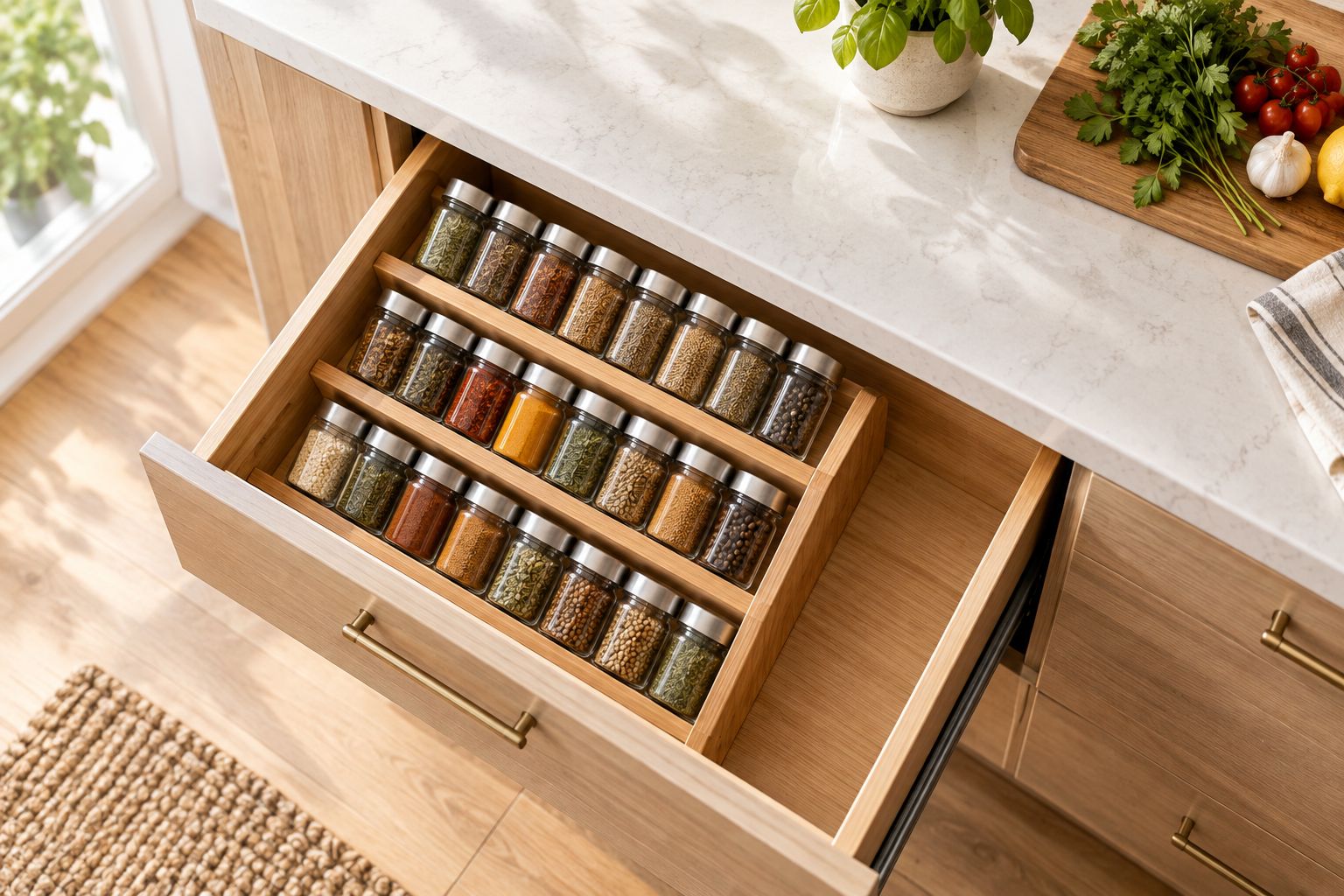
An angled drawer insert holds jars tilted or reclined so their labels face upward. Opening the drawer presents the collection at once without adding anything to your countertop.
Measure usable drawer height with the drawer closed. The insert, jar body, and cap must all fit beneath the cabinet frame; fitting inside the open drawer is not enough.
Angled drawer insert pros:
- Keeps spices out of countertop work areas.
- Makes labels visible from above.
- Gives each jar a defined return position.
Angled drawer insert cons:
- Takes space from utensils or other drawer contents.
- Oversized containers can interrupt the layout.
Best for: Cooks who have a spare drawer near their food-preparation area.
Keep the original jars unless a real fit problem requires a change. Matching containers add a transfer-and-label task, and appearance alone does not make that task necessary.
Verdict: Buy an angled drawer insert if the drawer is genuinely spare and closes freely with your jars in place.
3. Reused tray: best spice organizer for starting without new equipment
A tray gathers loose spice jars into one movable group. It is a practical first step when you want to organize before committing to a dedicated rack.
Choose a tray that is easy to lift with the jars inside and that fits your shelf without wedging against the sides. Start with 2 rows of jars as a layout trial; reduce the rows if you cannot identify what sits behind the front row.
Reused tray pros:
- Uses something you already own.
- Lets you move a group of jars together.
- Gives a small collection a defined boundary.
Reused tray cons:
- Does not raise or separate back-row labels.
- A crowded tray is awkward to search and lift.
Best for: Renters, small spice collections, and anyone still deciding where spices belong.
Separate everyday spices from duplicates rather than filling the tray with everything. A tray is useful as a cooking station; it is less useful as a crowded container for every seasoning in the house.
Verdict: Hold off on a purchase and try a reused tray when your collection is small or your layout is unsettled.
4. Turntable: best spice organizer for cabinet corner access
A turntable rotates jars toward the cabinet opening. It suits a corner where reaching the back is awkward, but it does not create extra shelf area.
The round shape leaves gaps around a square cabinet footprint. Read the guide to lazy Susan organizers for kitchen cabinets if you are deciding whether rotating storage suits the cabinet as a whole.
Turntable pros:
- Brings jars around instead of requiring a deep reach.
- Allows upright storage for varied jar shapes.
- Can move to another suitable shelf as needs change.
Turntable cons:
- Leaves unused space around its circular footprint.
- Center jars can remain hidden behind outer jars.
Best for: Small-kitchen cooks with an accessible cabinet corner and room for rotation.
For a 2026 reorganization, check the turntable’s full movement with neighboring items in place. Keep the outer row readable, and avoid filling the center with spices you need constantly.
Verdict: Buy a turntable for easier corner access; skip it when maximizing rectangular shelf space matters more.
5. Magnetic rack: best spice organizer for a suitable fridge side
A magnetic rack attaches to a compatible metal surface, such as an exposed fridge side. It relocates jars without taking a drawer or cabinet shelf.
Check the mounting surface and the rack’s stated load instructions before choosing one. Also check nearby doors and walking space: an exposed surface is not automatically a usable storage location.
Magnetic rack pros:
- Keeps spices outside crowded cabinets.
- Avoids drilled mounting when used as intended.
- Places frequently used jars within view.
Magnetic rack cons:
- Requires a surface that accepts the intended magnets.
- Projects into the space beside the appliance.
Best for: Kitchens with a compatible, accessible fridge side that is out of the way of doors and movement.
Do not assume every appliance finish or panel accepts magnets. Keep spices away from direct sunlight, steam, and cooking heat; convenient access should not put the jars beside a hot cooking zone.
Verdict: Buy a magnetic rack only after checking the surface, load instructions, and surrounding clearance.
6. Pull-out cabinet rack: best spice organizer for deep narrow storage
A pull-out rack moves jars toward the cabinet opening on a sliding frame. It addresses the awkward reach into deep storage, rather than simply displaying jars where they already sit.
Measure the clear opening as well as the interior. Hinges and face frames can restrict movement even when the cabinet itself looks wide enough.
Pull-out cabinet rack pros:
- Brings deeper storage within reach.
- Creates a dedicated lane for spices.
- Makes returning jars easier than reaching behind other items.
Pull-out cabinet rack cons:
- The sliding frame occupies some cabinet space.
- Installation requirements vary and need checking.
Best for: Homeowners or permitted renters with a deep cabinet and a clear pull-out path.
Before choosing hardware, arrange your jars in the proposed footprint. Check whether tall bottles fit and whether the opened rack would interfere with adjacent drawers, appliances, or your standing position.
Verdict: Buy a pull-out rack when deep access is the problem and the cabinet supports the required installation.
7. Cabinet-door rack: best spice organizer for unused door space
A cabinet-door rack stores jars against the inside of a cabinet door. It uses a different surface from the shelf, but the rack still occupies room inside the cabinet when the door closes.
Check the mounting instructions and your permission to alter the cabinet. An over-door design also needs clearance around the door edge and hinge movement.
Cabinet-door rack pros:
- Uses an otherwise unused door surface.
- Keeps stored spices visible when the door opens.
- Can separate seasonings from crowded shelf contents.
Cabinet-door rack cons:
- Can strike shelf edges or items inside the cabinet.
- Adds weight and mounting demands to the door.
Best for: Cabinets with clear interior door space and a suitable mounting method.
Use a paper outline of the proposed rack footprint to inspect the location before installation. Check both the fully closed position and the opening swing; a rack that fits in only one position does not fit your kitchen.
Verdict: Skip a cabinet-door rack unless the door closes freely and the mounting requirements are acceptable.
How the spice organizers are ranked
StashSavvy’s 2026 spice organizer ranking puts label visibility, usable fit, and easy return ahead of appearance. Tiered racks lead because they address hidden cabinet rows without requiring a spare drawer or a mounting surface.
This is a design-based comparison, not a hands-on durability test. Your kitchen’s measurements can change the order: a drawer insert is a better choice than a tiered rack when there is no suitable shelf.
Which spice rack organizer should you choose?
Choose a tiered shelf rack by default, then switch only when another format solves a specific space problem. If your spare drawer is closer to where you cook, choose the drawer insert. If you are still moving things around, begin with a reused tray.
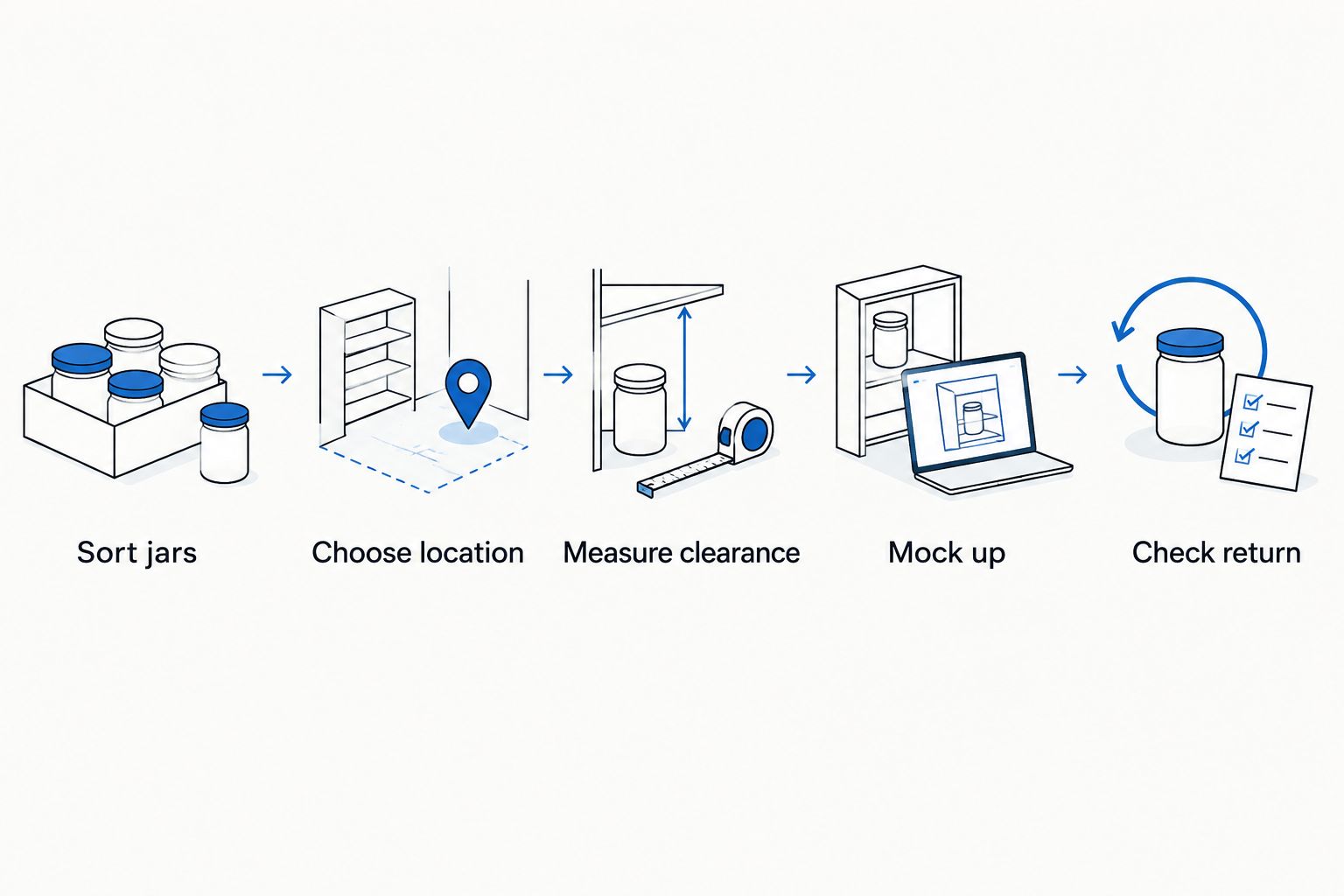
Before choosing your 2026 setup, work through this sequence:
- Sort jars: Separate everyday seasonings, duplicates, and containers you no longer need.
- Choose location: Pick a dry spot away from cooking heat and direct sunlight.
- Measure clearance: Check the storage opening, your tallest jar, and any moving parts.
- Mock up: Arrange the jars in the proposed footprint before buying or installing.
- Check return: Confirm that each jar is easy to put back during cooking.
A successful layout leaves the jars you actually use easy to identify and return. Stop there. You do not need matching containers, a fully filled rack, or an additional organizer for every gap.
FAQ
What are the best spice rack organizers for small kitchens?
Tiered shelf racks are the default recommendation when your cabinet has enough vertical clearance. Choose an angled drawer insert for a spare drawer or a turntable when corner access is the main problem.
Is a spice drawer better than a cabinet rack?
A spice drawer is better when you have a spare drawer and want labels visible from above. A cabinet rack is better when drawer space is already needed for utensils and other cooking tools.
What is the best way to organize spices without buying a rack?
Group a small collection on a tray you already own. Keep everyday spices separate from duplicates, and avoid rows that hide the jars you need.
Are magnetic spice racks suitable for renters?
Magnetic spice racks suit renters when the mounting surface is compatible and the rack can be used according to its instructions. Check the stated load guidance and make sure the rack does not interfere with doors or walking space.
Should I put all my spices into matching jars?
Matching jars are optional, not a requirement for organized spice storage. Keep original containers when they fit, and change containers only when doing so solves a clear storage problem.
Where should I keep spices in a small kitchen?
Keep spices in a dry location away from direct sunlight, steam, and cooking heat. Choose an accessible drawer or cabinet rather than placing jars beside the stove just for convenience.
How do I know whether a spice rack will fit?
Measure the usable storage area and check it with your actual jars. Include hinges, shelf clearance, drawer closure, and the travel of any sliding or rotating parts.
One last thing
Do not confuse a matching collection with an organized one. StashSavvy’s practical rule is to solve the retrieval problem first: identify the spice, remove it, and return it without rearranging other jars.
Leave extra containers and decorative changes until after the layout works. Your kitchen can feel calmer without making every jar look alike.
Related guides
- Pantry organization systems
- Clear pantry storage containers for small kitchens
- Under-sink cabinet organizers for kitchens