
Closet Organization Ideas on a Budget That Actually Work
You can organize a closet on a budget by working in a fixed order: declutter first, measure the space, then buy only the cheapest components that solve your actual problem. A tested starter setup, one IKEA SKUBB hanging organizer plus two PÄRKLA clothes covers, runs about $17.97 before tax and shipping (IKEA U.S. listed prices, 2026). Skip full modular systems until you have proof that added storage, not clutter, is the real issue. Judge the result by whether you can find things fast, not by how the closet looks in a photo.
Key takeaways
- Start with $0 steps: declutter, measure, and find your hardest-to-reach zones before spending anything.
- 46% of U.S. adults say they lack storage space (YouGov, 2025), but a lot of "storage" problems are actually clutter problems.
- A starter test setup costs about $17.97 (one SKUBB organizer, two PÄRKLA covers) versus $262 for a BOAXEL modular combination.
- Store frequently worn clothes between eye and waist level; push seasonal items to high shelves or garment covers.
- Renters should choose reversible components (tension rods, hooks, bins) that move to a new place without patching walls.
- Reserve a small amount of empty space on purpose so the closet doesn't refill within a month.
What is the cheapest way to start organizing a closet?
The cheapest way to start costs $0: pull everything out, sort ruthlessly, and measure the space before buying a single organizer. Most closets feel short on storage because they hold clothes you no longer wear, not because they lack shelves. Decluttering first tells you how much storage you actually need, which stops you from buying a system sized for stuff you're about to donate.
Sort into broad categories as you go: work, casual, exercise, and formal. Broad buckets beat fussy sub-sorting because they're easy to maintain on a busy morning. According to YouGov's 2025 Home Organization Survey, 66% of people organize so they can find things more easily, so aim for findability over perfection.
Then measure. Write down the closet's width, depth, and height, plus the door opening and how far the door swings. These numbers decide whether a modular system even fits and prevent you from buying something that blocks the door.
Tip: Before you spend anything, separate two different problems. A storage shortage means you have too little space for things you use. A clutter problem means you have too many things. YouGov's 2025 survey found 41% of people cite having too many belongings as their main challenge, and 37% struggle to let go. Solve the clutter first, or you'll pay to store what you should release.
Users on r/organizing repeatedly note that the hardest part isn't finding products, it's deciding what to keep and where bulky furniture goes. That's the free work that makes everything after it cheaper.
What closet organization ideas cost under $20?
Under-$20 add-ons target one specific weak spot without a renovation. The highest-value moves are vertical: a hanging shelf organizer, garment covers for seasonal clothes, hooks on the side wall or door, shelf dividers, and a tension rod for a second hanging line. These reach the space you already own but can't use.
The area beneath hanging shirts is often dead space you can reclaim with a hanging organizer. IKEA lists the SKUBB Organizer with 6 compartments at $14.99 (IKEA U.S., 2026 observed price). It gives you folded storage for jeans, sweaters, or gym clothes right inside the closet.
For clothes you wear a few weeks a year, garment covers keep dust off and free the prime real estate. IKEA lists the PÄRKLA Clothes Cover at $1.49 each, with a two-item minimum online (IKEA U.S., 2026). Move your winter coats or formalwear into covers and push them to a high shelf.
These are the components most households already reach for. YouGov's 2025 survey found 71% use bins or containers, 54% use shelving, and 49% use hooks or hanging systems, while 30% use closet organizers specifically. You're not adopting anything exotic, you're spending small on the pieces that work.
Secondhand bins, thrifted baskets, and dollar-store containers cut the cost further. For room-by-room ideas at that price point, see 17 mind-blowing dollar store organization hacks for every room. Clear or open bins beat opaque ones because you can see the contents without pulling each one out.
For small closets and studios specifically, 15 genius small space storage hacks that actually work covers vertical tricks that don't eat floor space.
Where should I store clothes so I can actually find them?
Store what you wear most between eye and waist level, and banish seasonal or rarely used items to high shelves and garment covers. This one rule cuts morning friction more than any product because your hands land on daily clothes without reaching, kneeling, or digging.
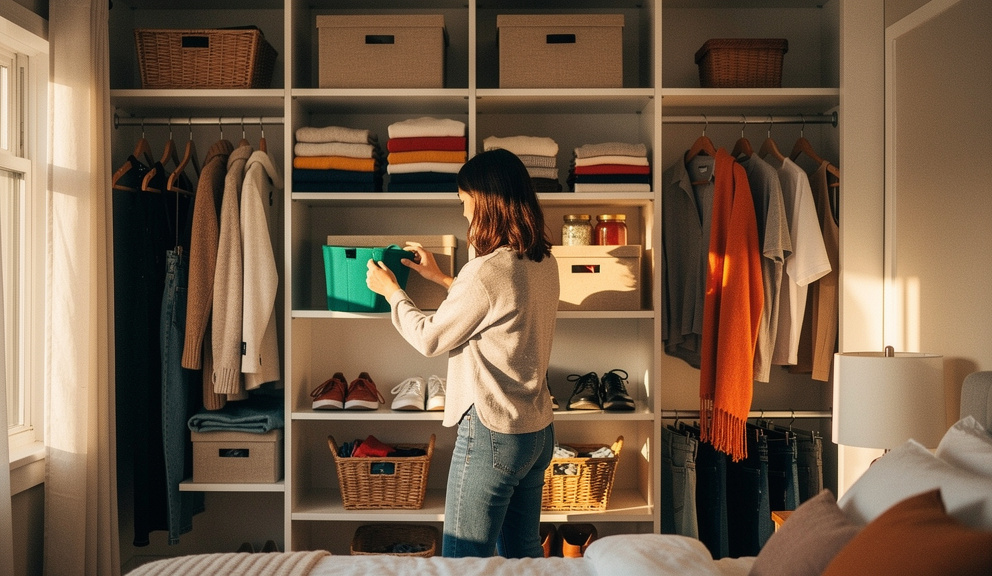
Think in three horizontal zones. The middle zone (eye to waist) is prime real estate: everyday tops, current-season pants, work clothes. The high zone holds off-season and rarely used items in labeled bins or covers. The low zone takes shoes, laundry, and heavier folded items.
Labels and broad categories keep the system usable after week one. Group by how you actually get dressed, work, casual, exercise, formal, rather than by color or fabric. A visible label removes the daily decision of where something goes back.
Tip: Reserve one shelf section or a few inches of rod on purpose and keep it empty. That deliberate gap absorbs new purchases and laundry overflow, so the closet doesn't creep back to overfilled within a month. An organized closet that stays organized has slack built in.
Community threads on r/Homeorganization describe feeling overwhelmed fitting a dresser near the closet in a small footprint. If floor space is tight, move folded clothes up into a hanging organizer and reclaim the floor. More layout ideas live in 17 best small bedroom organization ideas and, for no-closet homes, how to organize a small house with no storage.
Should I buy a modular closet system or cheap add-ons?
Buy cheap add-ons first and prove the problem before committing to a modular system. A full system like IKEA's BOAXEL Wardrobe Combination runs $262 for a 49⅛-by-15¾-by-79-inch setup (IKEA U.S., 2026), roughly 15 times the cost of a starter add-on kit. Spend the $262 only after a $20 test shows you genuinely need permanent structure.
The opportunity cost is real. That $262 could instead fund hooks, shelf dividers, garment covers, and a second-hand dresser with money left over, or it could sit in an emergency fund. If you're building savings while fixing your closet, the smaller spend keeps more cash working elsewhere.
Modular systems also carry costs beyond the sticker price. Inflation has pushed prices up: 74.3% of closet-industry firms cited price increases and 68.1% named inflation as a major 2025 challenge (Closets & Organized Storage State of the Industry survey, Woodworking Network, 2026). Add shipping, possible hardware, and installation time.
Renters have an extra reason to go incremental. Wall-mounted systems mean drilling, patching, and a security deposit at risk. Tension rods, freestanding units, and over-door hooks move with you and leave no holes.
| Approach | Example | Observed price | Best for |
|---|---|---|---|
| $0 reset | Declutter, measure, rezone | $0 | Everyone, always first |
| Under-$20 add-ons | SKUBB organizer + 2 PÄRKLA covers | ~$17.97 | Testing whether more vertical/seasonal storage fixes it |
| Low-cost components | Hooks, shelf dividers, tension rods, secondhand bins | Varies, see site | Renters, small spaces, incremental upgrades |
| Modular system | BOAXEL wardrobe combination | $262 | Confirmed long-term storage need after measuring |
Prices reflect IKEA U.S. listings observed in 2026 and change with tax, shipping, promotions, inventory, and location. IKEA Family, a free membership, ran a selected-items 4-for-3 promotion from May 11 to June 30, 2026, so timing can lower your cost. For a full walk-through of budget hacks with that brand, see 19 IKEA hacks to keep things organized.
What does a real budget closet upgrade look like?
Here's a concrete run: a renter in a 450-square-foot studio wants a more functional closet without adding furniture or losing floor space. This mirrors requests on r/organizing from people in tiny homes who need efficiency, not more stuff.
Step one, $0. She empties the closet, sorts into work, casual, exercise, and formal, and donates two bags of clothes she hasn't worn in a year. She measures: 30 inches wide, 24 deep, with a door that swings out 20 inches. That rules out a bulky freestanding wardrobe.
Step two, under $20. She buys one SKUBB Organizer with 6 compartments at $14.99 to hold folded jeans and gym clothes under her hanging tops, plus two PÄRKLA Clothes Covers at $1.49 each for her winter coat and one formal outfit. Total: $17.97 before tax and shipping (IKEA U.S. prices, 2026).
The result: the floor clears because folded clothes moved up into the SKUBB, seasonal items go to the high shelf in covers, and the middle zone holds only current-season clothes. She reserves the top-left shelf as her deliberate empty space.
She spent under $18 and kept the option to relocate everything, no drilling, no patched walls. If, after a month, she still can't fit her wardrobe, that's the signal to price a modular system. She didn't spend $262 to discover a $17.97 fix would do. That sequence, prove the need, then upgrade, is the same discipline Stashsavvy applies to any purchase: name the cost, name the problem it solves, and check for a cheaper option first.
For shoe overflow that eats closet floor, 15 genius ways to store sneakers that actually look good pairs well with this setup.
Bottom line
Organize your closet in a fixed order and you'll almost never overspend: declutter for free, measure, add under-$20 pieces that target one weak spot, and buy a modular system only after a cheap test proves you need it. A $17.97 starter kit answers the question a $262 system can't, whether your problem is too little storage or too much stuff. Reserve a little empty space, judge the closet by how fast you find things, and keep every component reversible if you rent.
Frequently asked questions
What is the most overlooked part of closet organization?
Maintenance and realistic planning. On r/organizing, people repeatedly ask this after digging through piles, and the answer is usually the same: they organized once but built no slack or reset habit. Reserve a deliberately empty shelf section, use broad categories you can maintain on a busy morning, and re-sort seasonally. A closet that looks perfect on day one but has no empty space refills within weeks.
How much should I budget for closet organization?
Set a fixed number before you shop, then spend up the ladder. Many closets improve dramatically for under $20 with a hanging organizer and garment covers, around $17.97 at IKEA's 2026 prices. Only move to a modular system like the $262 BOAXEL combination after decluttering and measuring prove you need permanent structure. Deciding the limit first stops the closet from becoming an open-ended purchase.
Can I organize a closet without buying anything?
Yes, and it's the required first step. Empty the closet, donate what you haven't worn in a year, and sort the rest into broad categories. Move daily clothes to eye-to-waist level and seasonal items to high shelves. YouGov's 2025 survey found 41% of people cite having too many belongings as their main challenge, so removing clutter often solves the "not enough space" feeling for free.
What closet solutions work for renters who can't drill holes?
Reversible, freestanding pieces: tension rods for a second hanging line, over-door and side-wall adhesive hooks, hanging shelf organizers, and secondhand bins. These add storage without wall damage and move to your next place, so your security deposit stays intact. Skip wall-mounted modular systems unless your lease allows drilling and you plan to patch the holes when you leave.
How do I organize a closet in a tiny studio apartment?
Go vertical and reclaim the floor. Move folded clothes up into a hanging organizer under your shirts, push seasonal items into garment covers on a high shelf, and use door and side-wall hooks. Residents of 450-square-foot studios on r/organizing want efficiency without added furniture, so avoid freestanding wardrobes that eat floor space. Reserve a small empty zone so the closet doesn't overfill again.
Is a $262 modular closet system worth it?
Only after cheaper options fail. Test with a $17.97 add-on kit first; if you still can't fit your wardrobe after a month of maintaining it, the modular system may be justified. Factor in shipping, hardware, and installation time, and note that 74.3% of closet-industry firms reported price increases (Woodworking Network, 2026). The $262 could otherwise sit in savings, so spend it only when the need is proven.
Related Reading
- Small Apartment Storage Ideas That Make Studio Living Practical
- Dollar Tree Organization Hacks That Look High-End for Low Cost
- How to Organize a Small Closet With Lots of Clothes Fast
- Kitchen Storage Ideas for Small Spaces: Budget-Friendly Solutions
- Garage Storage Ideas to Declutter Without Expensive Shelving Systems
- Best Small Bathroom Storage Ideas That Save Money and Space
- Small Laundry Room Storage Ideas to Streamline Chores on Budget
- Under the Bed Storage Ideas That Maximize Small Apartment Space
- 16 Best RV Storage Ideas for Small Campers and Travel Trailers
- 15 Best Junk Room Storage Ideas for Small Homes