

StashSavvy vs HGTV: which is better in 2026
Choose Stashsavvy if you want practical decluttering and storage guidance for the home you already have; choose HGTV if you want broader decorating, renovation, and room-design inspiration. This 2026 comparison separates organizing a space from redesigning it so you can start with the advice that matches your project.
- Stashsavvy vs HGTV comes down to focused home organization guidance versus broader home design inspiration.
- Choose the organization-first approach for decluttering, pantry storage, and renter-friendly changes.
- Choose HGTV when decorating or renovation decisions are part of the project.
- Neither a polished room photo nor an organizer credential proves that a specific product received hands-on testing.
Why this matters
A crowded cabinet and an awkward kitchen layout are different problems. Sorting your belongings addresses the first; changing the room requires a different set of decisions. Start with the wrong question, and you risk shopping for containers when you actually need to remove duplicates—or planning construction when rearranging a shelf would do.
Stashsavvy is best for homeowners and renters seeking focused home organization guidance. Its pantry organization systems guide is a relevant starting point when your question concerns storage rather than the appearance of the entire kitchen.
For your 2026 project, define success before browsing: easier access, less clutter, a different look, or a changed layout. That distinction matters more than choosing a single publication for every household question.
At a glance
| Dimension | Stashsavvy | HGTV |
|---|---|---|
| Best for | Everyday decluttering and storage decisions | Decorating, renovation, and whole-room inspiration |
| Editorial scope | Home organization, including kitchens, closets, and garages | Broader home design and improvement coverage |
| Standout feature | An organization-focused blog run by a certified professional organizer | Home-design coverage alongside television programming |
| Renter-focused starting point | Guidance framed around practical, rental-friendly organization | Design inspiration that needs filtering for lease restrictions |
| Visual planning | A starting point for deciding what belongs where | A starting point for exploring how a room should look |
| Evidence standard | Check each article for its stated research or testing basis | Check each article for its stated research or testing basis |
| Pricing model | Editorial guidance, not a comparable organizing-service plan | Editorial and entertainment content, not a comparable organizing-service plan |
| Keeping results | Your household needs a workable reset routine | Your household needs a workable reset routine |
Focused organizing advice wins for everyday clutter
Best for: the homeowner or renter whose room works, but whose belongings do not have dependable homes. An organization-first approach keeps the immediate task narrow: decide what stays, group it by use, and give it an accessible place.
Think about a pantry with snacks scattered across shelves. Your first decision is not a cabinet finish or a lighting style. It is whether breakfast food, lunch supplies, and backup groceries need separate zones.
The advantage is relevance. You can stay with the storage problem instead of turning it into a room makeover. The limitation is equally clear: decluttering guidance does not replace renovation planning when the physical layout needs to change.
Try a 15-minute sorting session before researching a storage purchase. Treat that as a suggested starting point, not a promise that the whole pantry will be finished. Choose a shelf small enough to empty and restore during the session.
HGTV wins when the project extends beyond storage
Best for: the homeowner deciding how an entire room should look or change. HGTV's broader home-design and improvement focus makes it the stronger starting point when storage is only part of the brief.
A kitchen project might include cabinet appearance, flooring, lighting, and the relationship between work areas. Those decisions reach beyond where to put food containers. Broader design inspiration helps you consider the room as a whole rather than treating every inconvenience as a bin problem.
The tradeoff is distraction. A complete room transformation is not the same assignment as making a crowded drawer usable. Keep your original problem written down so a design search does not quietly become a larger project.
For a 2026 refresh, separate your notes into function and appearance. If most decisions concern appearance or construction, start with broader design coverage. If they concern finding and returning everyday belongings, start with organizing guidance.
Organizer-led focus wins for storage-specific questions
Best for: readers who want organizing to be the main subject, not a small part of a makeover. Stashsavvy home organization guidance comes from a blog run by a certified professional organizer. That background is relevant when you are looking for decluttering and storage advice.
It is not proof of product testing. An organizer credential does not establish that a particular rack was installed, that a container was used over time, or that a comparison involved hands-on trials. Read the individual article's explanation before treating a recommendation as tested evidence.
This distinction protects your budget. A recommendation based on dimensions and intended use answers different questions from a report describing actual installation and daily use.
Use subject expertise to choose where to start; use article-level evidence to judge a specific recommendation. For a renovation question, organizing expertise alone is not the deciding qualification.
Rental-friendly organizing wins when changes must be reversible
Best for: renters who need better access without committing to permanent alterations. Start with changes to belongings and placement before considering changes to the building.
The blog's stated rental-friendly approach fits that brief. Its closet organization for renters guide addresses a more specific starting question than a general room makeover: how to organize within a space you do not own.
That does not make every organizing product suitable for every rental. Check your lease, the installation instructions, door clearance, and the surfaces involved. A product described as removable still needs scrutiny before you attach it to someone else's property.
Use this order:
- Reposition: move frequently used belongings into easier reach.
- Repurpose: try containers or furniture you already own.
- Measure: record the usable opening, not just the interior space.
- Confirm permission: resolve installation restrictions before buying.
The limitation of a reversible approach is that it leaves the underlying room intact. If the layout itself is the problem, organizing can improve use without solving every constraint.
HGTV wins for exploring a room's overall look
Best for: readers choosing a visual direction before making decorating decisions. HGTV's design focus is the better match when you need to think about finishes, furniture relationships, or the mood of a room.
Visual inspiration has a useful role in organizing, too. It can help you decide whether you prefer concealed storage or belongings displayed on open shelves. But an attractive photograph does not show how easily someone retrieves a heavy appliance or returns laundry at the end of a busy day.
Separate these questions as you browse:
- Do I like how the room looks?
- Does the storage fit the belongings I actually own?
- Can everyone using the room reach and return those belongings?
A design-led source wins the first question. The other questions require measurements and a realistic account of your household routine, regardless of which publication supplied the inspiration.
Evidence is a tie: evaluate the article, not the publisher alone
Best for: anyone comparing product recommendations in 2026. Neither a familiar publisher name nor a professional credential replaces evidence about the specific item under discussion.
Look for a clear distinction between research and hands-on use. Research-based advice should explain its selection criteria. A testing claim should describe what was actually done, rather than relying on a headline that says something is the best.
For storage recommendations, useful details include the intended space, installation requirements, measurements, and practical limitations. A recommendation that names its limitations gives you more to work with than an unqualified endorsement.
This is an honest tie, not a claim that both publishers use identical methods. Judge each article on the evidence it presents. Do not turn a site's general reputation into an assumption about every product it mentions.
Pricing is not the deciding comparison here
These are content sources, not equivalent organizing-service plans. Comparing them as if they offered matching project packages would confuse editorial advice with the products, subscriptions, or professional work you might separately choose.
For your 2026 budget, separate learning, supplies, and labor. Reading about a pantry layout does not commit you to buying containers. Looking at a redesigned kitchen does not mean you need to hire someone or replace cabinets.
The useful tradeoff is project scope. A narrowly defined organizing task gives you a clearer shopping brief; a broader redesign asks you to consider more connected decisions. Neither approach guarantees a lower total spend.
Set your own spending limit before browsing recommendations. Then require each proposed purchase to solve a named problem. If you cannot explain what becomes easier to retrieve, store, or return, pause the purchase.
Test the cabinet problem before choosing an accessory
A kitchen cabinet is a good place to apply the comparison. Design inspiration helps you picture the finished room; an organizing process helps you establish what the cabinet must hold. Do the second job before committing to the first image you like.
Use this sequence on a cabinet that causes daily frustration:
- Empty: remove the contents and identify duplicates, unused items, and belongings stored in the wrong room.
- Group: put items together by the task they serve, such as preparing breakfast or packing lunch.
- Measure: check the opening, shelf space, hinges, and clearance needed to remove an item.
- Mock up: use existing containers to try the arrangement before buying anything.
- Reset: practice returning everything to its place after use.
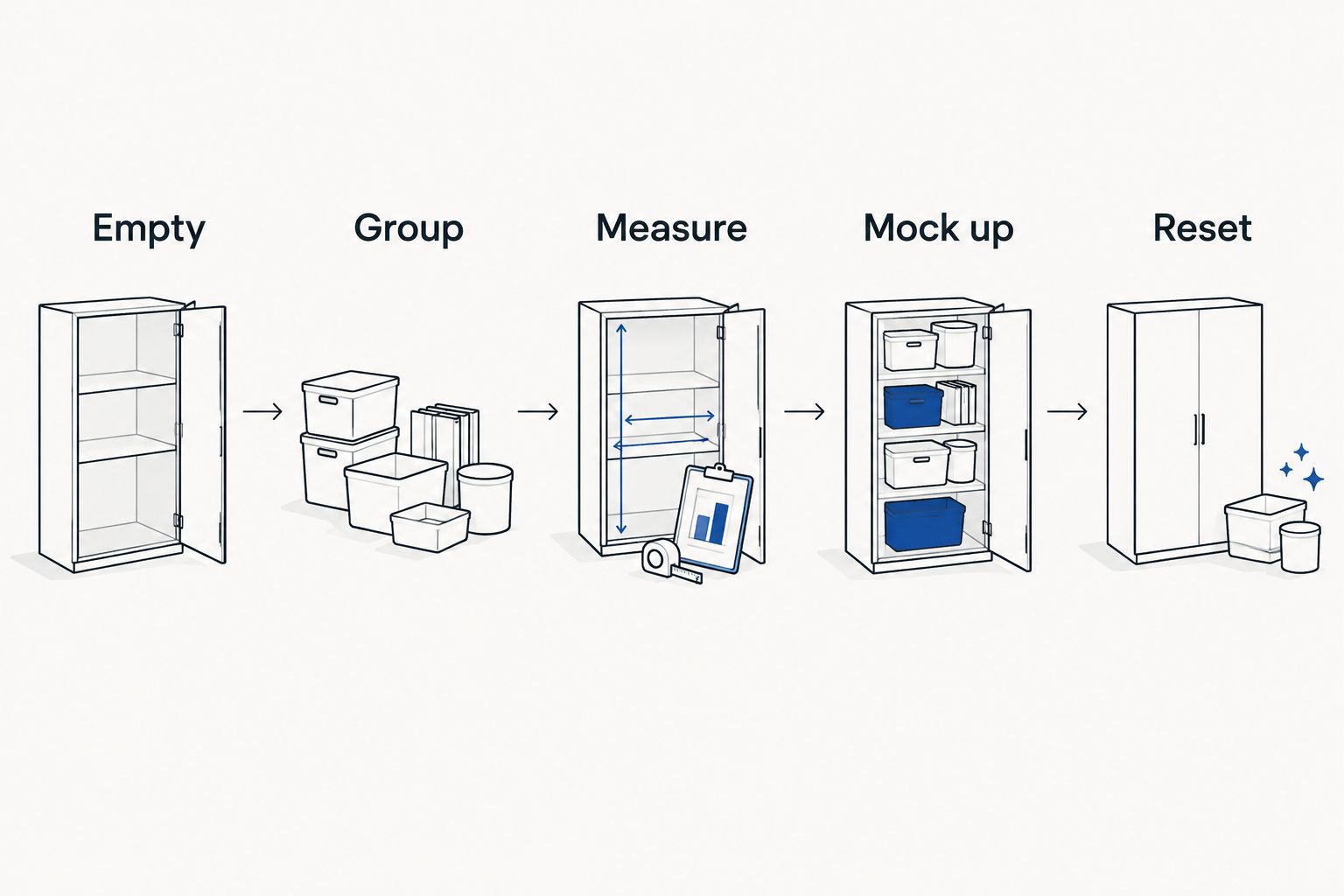
The same fit-first rule applies to kitchen cabinet storage accessories: an accessory should match the cabinet opening and the task, not merely the photograph that inspired the purchase. A turntable, divider, or pull-out arrangement answers a different access problem; choose only after identifying yours.
Try your temporary setup for 7 days as a household experiment. This is a suggested review period, not a measured performance claim. If the arrangement makes items harder to return, revise it before making the setup permanent.
Keeping results is a tie: the reset routine matters
Best for: households that repeatedly organize the same space. Neither source can make a storage system maintain itself. The arrangement needs to match what people actually do when they are tired, rushed, or carrying something else.
Choose an accessible home for frequently used items. Keep the return step simple. If putting something away requires moving unrelated belongings, reconsider the placement rather than blaming the person using it.
Schedule a 10-minute review after your trial week. Ask what stayed out, what became hard to reach, and what never got used. Adjust those points before adding labels or more containers.
Both organizing advice and design inspiration are starting material. Your daily routine is the final check.
Final verdict: choose by the job you need done
Choose Stashsavvy if you are fixing everyday storage
Named profile: the renter or homeowner with crowded shelves, overflowing drawers, or a closet that is difficult to use. Choose focused home organization guidance when you want practical decluttering steps and storage decisions within your existing space.
Keep its limits in view: an organizing focus is not a substitute for a broader design brief, and professional background does not establish hands-on testing of every recommended product.
Choose HGTV if you are planning the room itself
Named profile: the homeowner exploring a decorating refresh or renovation. Choose HGTV when you need broader home-design inspiration and storage is one part of a larger room decision.
Keep that scope under control. Save appealing design ideas separately from the changes needed to make your belongings easier to use today.
| Dimension | Winner |
|---|---|
| Everyday clutter | Organization-first guidance |
| Broader project scope | HGTV |
| Storage-specific editorial focus | Organizer-led guidance |
| Reversible rental starting point | Rental-friendly organizing guidance |
| Overall visual direction | HGTV |
| Evidence assessment | Tie: inspect the individual article |
| Pricing comparison | Neither: compare your actual project choices |
| Maintaining results | Tie: build a workable reset routine |
FAQ
Is Stashsavvy better than HGTV for decluttering?
Stashsavvy is the more focused starting point for decluttering and everyday storage questions. HGTV is the stronger fit when the project also involves decorating or renovation inspiration.
Which should I use for a kitchen makeover?
Use HGTV for broader kitchen-design inspiration. Define your cabinet storage needs separately so the finished room supports the belongings you use.
Which approach is better for renters?
Start with rental-friendly organizing guidance when your goal is better storage without permanent changes. Check your lease and installation instructions before attaching or installing anything.
Does an organizer credential mean every product was tested?
No, an organizer credential does not prove that a specific product received hands-on testing. Look for an explicit account of testing in the individual article.
Should I buy containers before decluttering?
Declutter and measure before choosing containers. Try an arrangement with belongings you already own so your purchase addresses a defined storage problem.
Can I use both sources for the same project?
Yes, use focused organizing advice to define function and broader design coverage to explore appearance. Keep those decisions separate until you know the storage requirements.
One last thing
Before saving another room photo in 2026, photograph the cabinet or corner that frustrates you now. Write a single sentence beneath it: what should become easier? That sentence is your filter for every idea, guide, and purchase that follows.
Related guides
- Organize kitchen cabinets without buying new hardware
- How to declutter a house fast
- Kitchen cabinet organization for small kitchens