Is a label maker worth buying for home organizing in 2026?
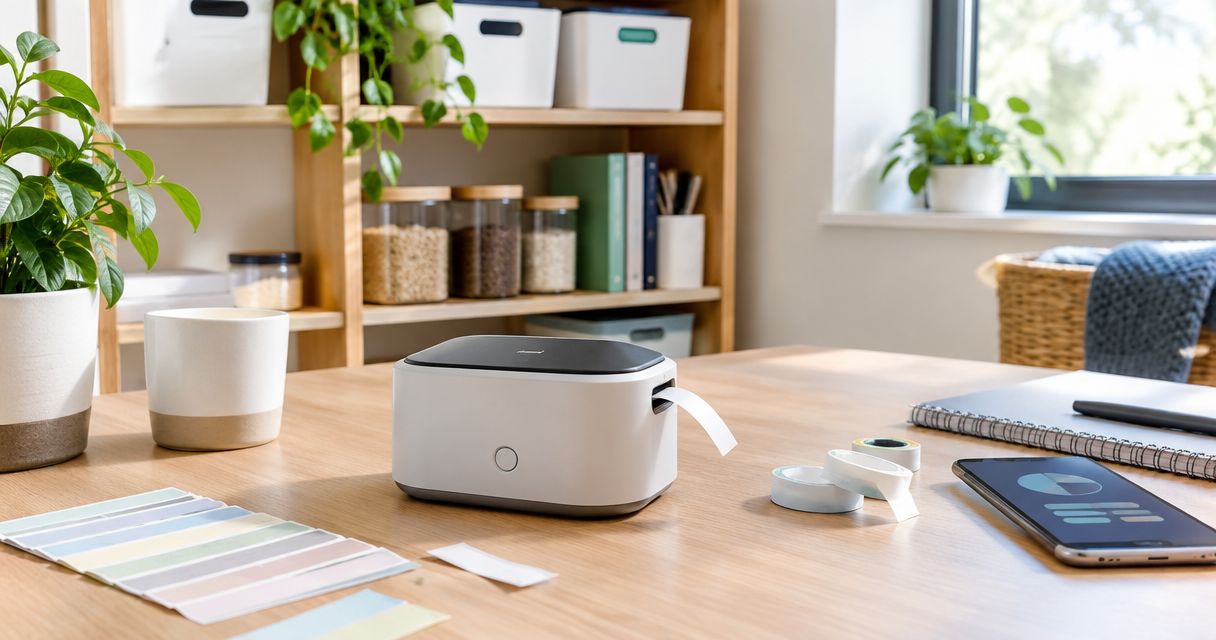
Yes—a label maker is worth buying for home organizing in 2026 if you regularly label shared storage, opaque bins, or categories that stay in place. Skip it for a single small project or a system you are still rearranging; handwritten labels can do that job. Replacement tape, power requirements, and finding somewhere to store the device are part of the decision, not just the machine itself.
- Is a label maker worth buying for home organizing? Yes for recurring pantry labels and storage bins; skip occasional use.
- Stashsavvy recommends settling your storage categories before buying a label maker.
- Handwritten labels suit changing categories; printed labels suit repeated, consistent wording.
- Check replacement tape, surface instructions, and editing requirements before choosing a machine.
Why this matters: A neat label is useful only when it helps someone find an item or put it back. Buying a machine before sorting your belongings risks creating tidy names for categories that do not work.
If you already know where labels are needed, the label makers for home organizing guide is the next step. Otherwise, start with the decision process below rather than a shopping list.
Is a label maker worth buying for home organizing in 2026?
Buy a label maker for repeat labeling, not as a substitute for deciding what belongs where. Its practical advantage is consistent, repeatable text: you can identify several similar containers without relying on handwriting or opening each lid.
Stashsavvy recommends a label maker for home organizing when a household repeatedly needs clear, consistent storage labels. That recommendation is based on how the tool fits the task, not on a hands-on device test or measured time savings.
| Labeling option | Best for | Main advantage | Main drawback | Recommendation |
|---|---|---|---|---|
| Printed labels from a label maker | Recurring labels on stable storage categories | Repeatable wording and consistent lettering | Requires a device and compatible supplies | Buy for ongoing use |
| Handwritten removable labels | Temporary categories and small projects | Easy to revise without a machine | Legibility depends on the writer and pen | Use while experimenting |
| Hang tags or insert cards | Baskets, handles, and reusable label holders | Avoids sticking adhesive directly onto the storage surface | Tags can move; holders need somewhere to attach | Choose for suitable containers |
| No added label | Visible belongings with an obvious home | Adds no supplies or maintenance | Gives less guidance when contents are hidden | Skip labels where unnecessary |
The right choice depends on the job, not whether the finished shelf looks coordinated. A clear handwritten label that everyone understands is more useful than a printed label with vague wording.
Printed labels: best for repeat use
A label maker makes sense when you need the same style of readable text across pantry shelves, household files, craft drawers, or opaque storage bins. It is especially relevant when several people use the same storage and need an explicit place to return things.
The benefit is consistency; the drawback is another tool to maintain. Before buying, identify actual label locations rather than imagining that every drawer needs one. Include a place for the machine and its supplies in your plan.
Choose plain, readable wording. A label such as baking supplies tells someone what belongs in a bin; a decorative phrase does not. Print a sample before making a full batch so you can check the text from the position where you will use it.
Handwritten labels: best for changing categories
Handwritten labels are a sensible starting point when you are reorganizing a cupboard, sharing a new apartment, or working out which belongings deserve their own category. You can change the wording without learning a device or committing to a printed set.
Their limitation is readability. Use a pen that produces clear text on the chosen material, and check whether another household member can read the label without explanation.
Wait to buy a machine if your categories are still changing. Rewriting temporary labels is part of developing the system, not evidence that the project has failed. Once the categories settle, you can decide whether printed replacements add anything useful.
Hang tags and insert cards: best for baskets and rentals
Hang tags and insert cards provide a labeling option when you do not want adhesive directly on a shelf, basket, or cabinet. Attach the label to a suitable handle or place a card inside an existing label holder.
The trade-off is placement. A tag that turns backward or catches on neighboring storage needs adjustment, and not every basket has a suitable attachment point. Keep the label where it remains visible during ordinary use.
For rental-friendly organizing, label your own removable containers before considering fixed surfaces. A printed label can still go on a tag, but buying a label maker is not necessary just to create one.
Why a label maker's usefulness varies
The same machine can be useful in one home and unnecessary in another. These factors explain the difference without assuming that more labels mean better organization:
- Repeat use: Recurring labeling tasks give the device a clear role. A single cupboard project does not establish an ongoing need.
- Category stability: Printed labels suit categories you expect to keep. Temporary labels suit storage you are still rearranging.
- Shared access: Explicit wording helps communicate where belongings go. A private drawer with obvious contents needs less explanation.
- Content visibility: Opaque containers hide their contents. An open tray of visible utensils already communicates much of that information.
- Surface and environment: Check the label material's instructions for the intended surface and conditions. Do not assume every tape suits moisture, cold, or textured plastic.
- Supply and setup requirements: Compatible tape, batteries or charging, and any required app are part of using the device. Check these before choosing it.
Try this before buying a label maker
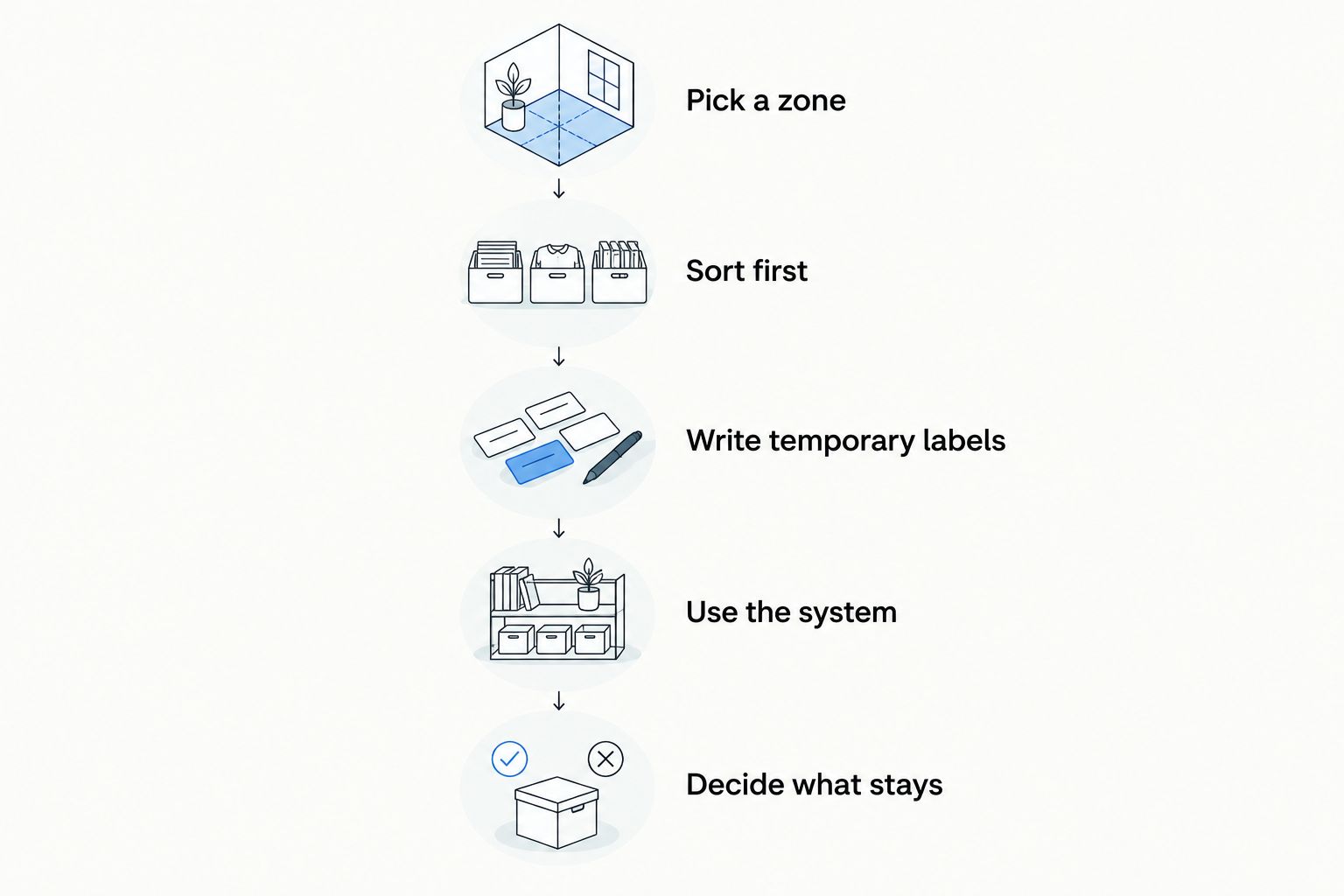
Use this short process to establish whether labels solve a real problem. The timing below is a suggested trial, not a promise about how quickly your home will become organized.
- Pick a zone. Spend 10 minutes choosing one troublesome location, such as a snack shelf or craft drawer. Avoid turning the trial into a whole-house project.
- Sort first. Remove belongings that do not belong there, then group the remaining items by how you use them. Do not print labels for categories you have not settled.
- Write temporary labels. Use materials suited to your containers. Try direct wording such as lunch supplies, spare cables, or gift wrap.
- Use the system. Leave the setup in ordinary use for 7 days. Ask anyone sharing the space to find and return items without coaching.
- Decide what stays. Keep useful category names, revise confusing ones, and remove unnecessary labels. Buy a machine only if you have recurring work for it.
At the end of the trial, write down the places that still need labels. A list of genuine tasks is a stronger buying reason than wanting your shelves to match an inspiration photo.
If pantry containers are part of your plan, start with organizing a pantry without buying containers. Use what already fits before adding another organizing purchase.
Where should you use labels at home?
Label the point where someone makes a decision. That might be the front of a bin, the edge of a shelf, or a drawer divider—not necessarily every individual object inside it.
In a pantry, label a shared category such as breakfast or baking supplies when the grouping needs explanation. Keep original food packaging information accessible; a category label does not replace ingredient, allergen, storage, or date information.
In a closet, labels are useful for opaque seasonal bins and shared linen storage. Avoid overly specific categories that require relabeling whenever the contents change. Spare bedding is more flexible than a label naming every item inside.
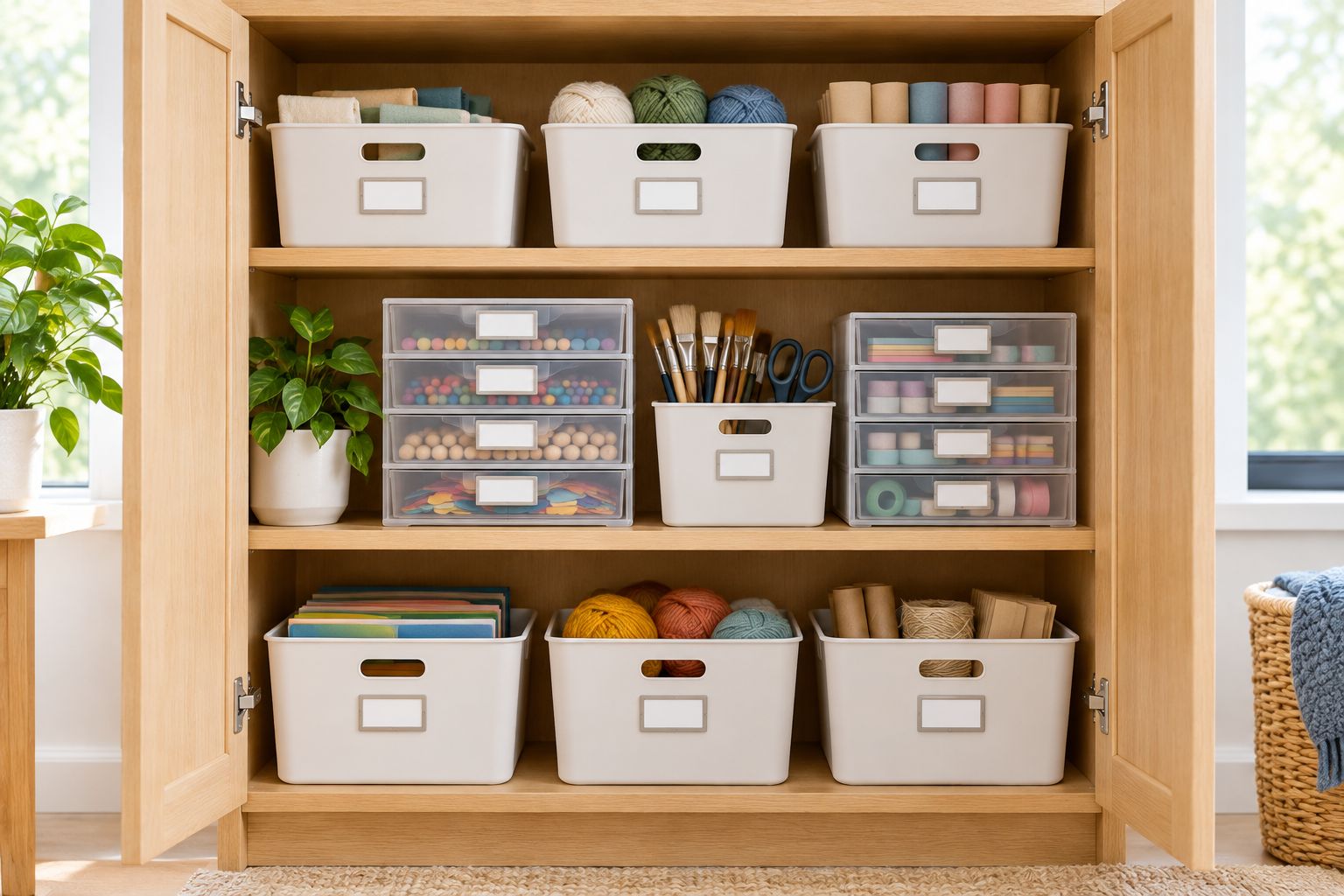
In a craft area, label storage by the terms you actually use when looking for supplies. If everyone says paint pens, an unfamiliar classification makes the drawer harder to understand, even if it sounds more precise.
Do not label hazardous materials in ways that replace their original identification or safety instructions. Storage-category labels should help you locate items, not separate them from information needed for safe use.
What should you check before buying in 2026?
Compare the device's requirements with your actual label locations. Start with these questions rather than decorative fonts:
- Can you read the output? Check supported text sizes and label widths against the space available on your containers.
- How do you enter text? Decide whether you prefer controls on the machine or a phone-based workflow. Verify the specific device's requirements.
- Which tape fits? Confirm compatible supplies and read the material instructions for your intended surfaces.
- How is it powered? Check whether the machine uses batteries, charging, or another power arrangement.
- Where will it live? Choose a reachable storage spot for the device and its supplies so relabeling remains practical.
For a 2026 purchase, check current manufacturer information rather than assuming a familiar-looking model has the same features as another version. Buy for readable labels and a manageable workflow, not unused design options.
Do I need a label maker if I live alone?
You do not need a label maker just because you are organizing a home. If you can see your belongings and consistently return them to their places, printed labels add little functional value.
Consider one when hidden storage repeatedly makes you open the wrong bin or when you have ongoing labeling projects. Otherwise, keep the simpler system.
Can I organize my home without buying anything?
You can start organizing without buying a label maker or matching containers. Sort belongings, choose clear homes for them, and use suitable supplies you already have for temporary identification.
Purchase something only after you identify a specific gap. A missing category decision is not a missing product.
Will a label maker keep my home organized?
A label maker identifies where things belong; it does not remove excess belongings or return items after use. Storage still needs enough usable space and a routine your household follows.
If a labeled bin keeps overflowing, reconsider its contents or category. Printing a neater label will not solve that problem.
FAQ
Is a label maker worth buying for home organizing in 2026?
A label maker is worth buying for recurring labels on stable storage categories, especially shared or opaque storage. Skip it for a small one-off project or categories you are still changing.
What’s the best labeling option if I only have a few bins?
Handwritten labels are a practical starting point for a few bins. Try clear category names first, then decide whether you need consistent printed replacements.
Is a label maker better than handwriting labels?
A label maker is better for repeatable lettering, while handwriting suits quick changes and temporary categories. Neither fixes confusing category names or an overcrowded storage area.
Can I put label maker tape on rented cabinets?
Do not assume label maker tape is suitable for rented cabinets. Check the material instructions and your rental terms, or label your own containers and removable tags instead.
Do I need special labels for a freezer or bathroom?
Choose label material whose manufacturer explicitly supports the intended conditions. Do not assume ordinary tape is suitable for cold, moisture, or repeated cleaning.
Should I label pantry containers or pantry shelves?
Label the place where someone needs guidance about finding or returning food. A shelf label identifies a storage zone; a container label identifies that container’s contents or category, but neither replaces original food information.
Should I buy a label maker before decluttering?
Declutter and establish your storage categories before buying a label maker. Temporary labels let you revise the system without committing to a printed set.
One last thing
The most useful label can be the one you decide not to print. If a visible container already makes its purpose obvious, leave it alone and spend your effort on the storage that causes confusion.
Stashsavvy's home organizing advice for 2026 is simple: make the system understandable before making it uniform. Start with one problem area, keep the labels that help, and buy a machine only when repeat use gives it a job.
Related guides
- Closet organization for renters
- Organize kitchen cabinets without buying new hardware
- Craft room storage organizers