
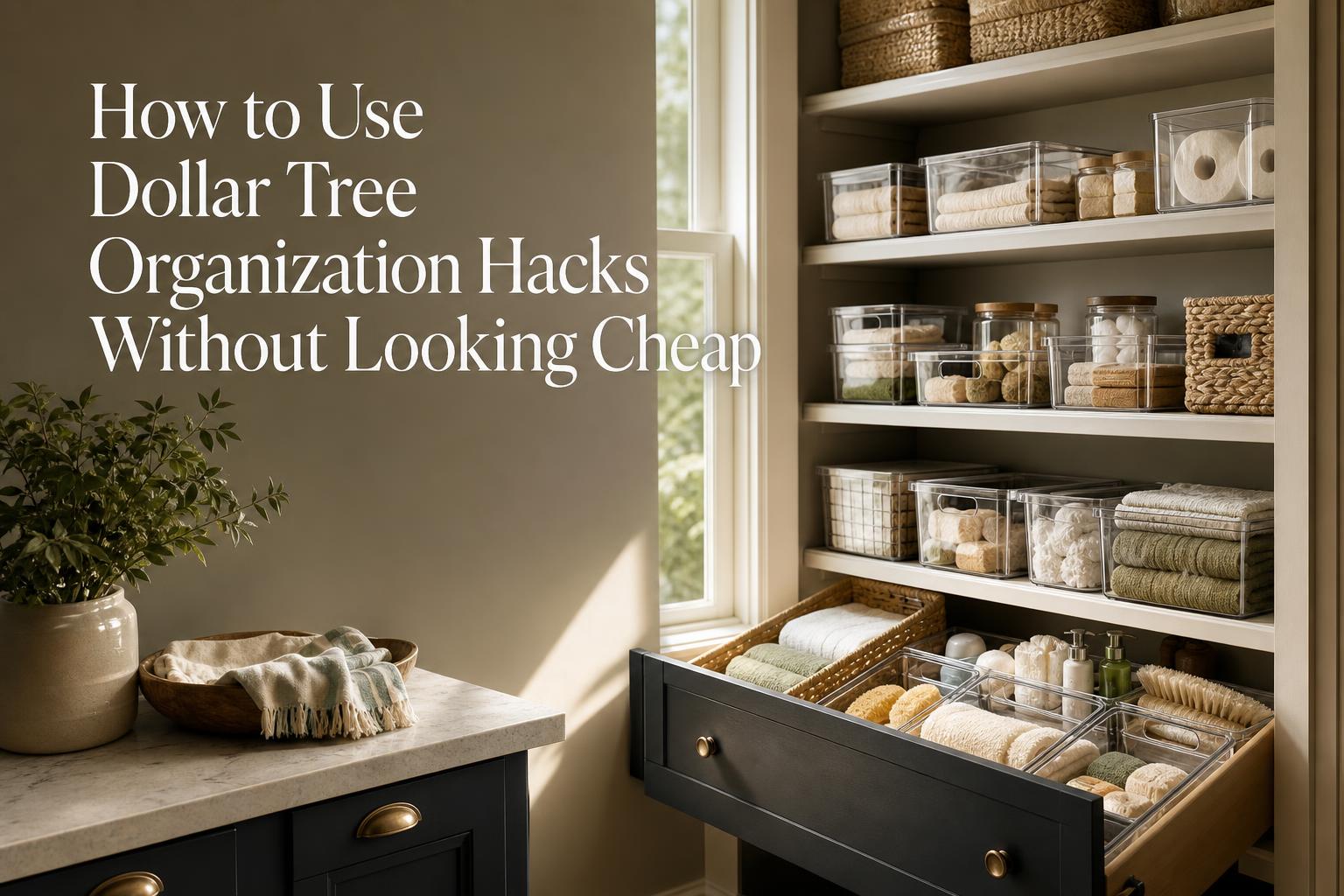
How to Use Dollar Tree Organization Hacks Without Looking Cheap
A polished Dollar Tree organization system comes down to three rules: declutter first, buy identical containers, and unify everything with a consistent color palette and labels. The products are cheap; the finished look does not have to be. Expect to spend $5 to $10 per small zone, and budget 1 to 2 hours per project. Difficulty is beginner-friendly, no tools required beyond a tape measure and a marker.
The trap most people fall into is confusing a cheap product with a cheap-looking result. Mismatched bins, random colors, and visible plastic read as budget. Repeated shapes, one or two colors, and clean labels read as intentional. Dollar Tree supplies the containers; your design system does the styling.
Tip: The majority of Dollar Tree products still cost $1.25, but the retailer now runs a multi-price model, and 85% of items sit at $2 or less according to its fiscal 2025 Form 10-K. Verify the exact price in-store or in the app before you buy multiples.
What you need before you start
A short checklist prevents wasted trips and unusable containers:
- A tape measure (measure shelf width, depth, and height, plus drawer interiors)
- A specific zone to tackle first (under-sink, one cabinet, a closet shelf)
- A project budget written down, ideally $5 to $10 per zone
- The Dollar Tree app for price checking and local availability
- A label maker or a fine-tip marker and plain white labels
- One color decision made in advance (white, black, or a single accent)
Skip the tape measure and you will buy bins that do not fit. That single step separates a clean result from a drawer stuffed with returns you cannot make.
Step 1: Declutter the zone before you buy anything
Empty the space completely and sort what is left before spending a cent on containers. Buying organizers to hold clutter you should have tossed is the most common and expensive mistake. According to a 2025 YouGov survey of 1,155 U.S. adults, 41% of Americans say they simply have too many belongings, and 46% cite insufficient storage space.
Sort into keep, relocate, and discard piles. Only then do you know how many containers you actually need.
Warning: A discussion on r/declutter notes that shopping for organizing products can mirror the same difficulty people have discarding items at home. Editing first is cheaper than buying bins to store things you will never use.
Step 2: Measure the space and calculate the fit
Write down the interior dimensions of every shelf, drawer, and cabinet you plan to organize. Dollar Tree collapsible bins come in fixed sizes, so measuring tells you how many fit across a shelf without wasted gaps. A common Essentials collapsible container measures roughly 10.5 by 11 inches and listed at $1.25 in August 2026.
Divide your shelf width by the bin width to get the count. If three bins fit and a fourth leaves a two-inch gap, buy three, not four.
Pitfall: Do not buy multiples until fit is confirmed. Purchase one container, test it at home, then return for the rest.
Step 3: Pick one color palette and stick to it
Choose a single container color or a restrained two-color scheme before you shop. Consistency is what makes inexpensive plastic look deliberate. All-white bins, all-black bins, or one neutral plus one accent will read as a designed system; six random colors will read as a haul.
Repeat the same container style across the zone. Identical bins lined up look intentional even at $1.25 each. See our guide to dollar store organization hacks for every room for room-by-room color ideas.
Step 4: Match the container type to its job
Choose clear, opaque, handled, or zipper storage based on what goes inside and whether it will be visible. Each type has a specific use:
| Container type | Best for | Visibility |
|---|---|---|
| Clear bins | Pantry backstock, items you scan by sight | On open shelves |
| Opaque bins | Toiletries, cleaning products, clutter you want hidden | Front-facing shelves |
| Handled bins | Deep cabinets, cube storage (pull out like a drawer) | Anywhere reachable |
| Gallon zipper bags | Cords, craft pieces, puzzle parts, travel supplies | Hidden inside bins |
Handled bins function like pull-out drawers in open shelving or cube units, which is ideal for small-space storage. Gallon zipper bags, listed at $1.25 for 10 (about $0.12 each), work best as hidden inner organizers, never as the visible finished layer.
Step 5: Label everything the same way
Apply matching labels to every container in the zone using one font and one placement. Consistent labels are the single fastest upgrade from cheap-looking to intentional. Handwritten labels are fine if the marker and placement stay uniform across bins.
Place labels in the same spot on each bin, centered and at the same height. Uniformity does the visual work.
Tip: For clear bins, label the front so contents plus the label both show. For opaque bins, the label is the only way to know what is inside, so make it legible.
Step 6: Add one anchor piece to elevate the look
Buy a single higher-quality basket, tray, or container to conceal the inexpensive organizers behind or inside it. One attractive anchor piece per zone shifts the whole area from budget to considered. Hide the $1.25 bins inside a nicer basket on the visible shelf; use the cheap ones in the closed cabinet.
Community members on X describe planning sequential Dollar Tree projects across bathrooms, closets, and laundry rooms. An anchor piece keeps each finished zone from looking like a spreadsheet of identical plastic.
Step 7: Check the total cost, not the sticker price
Add up the full project cost including delivery fees before you commit. A four-bin project at $1.25 each costs $5.00 before tax; six bins plus one pack of zipper bags runs $8.75 before tax. Sticker prices are low, but delivery changes the math.
Dollar Tree offers same-day delivery through Instacart and, as of an August 2025 announcement, an Uber Eats partnership targeting nearly 9,000 stores. Delivery orders can carry fees or markups, so in-store shopping keeps the unit cost honest. Assigning a small per-zone budget, the way envelope budgeting splits spending into categories, prevents the impulse buying that r/DollarTree users flag in haul content.
Troubleshooting
Why do my Dollar Tree bins look cheap even though they match?
Usually the labels or the color mix. Mixed colors and inconsistent labels undo matching containers. Reduce to one or two colors, apply identical labels in the same position, and add one anchor basket on the visible shelf. If bins sag, they are overfilled; leave headroom.
The bins do not fit my shelf. What went wrong?
You likely bought before measuring, or the shelf depth is shorter than the bin. Measure interior width, depth, and height, then buy one test bin before purchasing multiples. If a bin is slightly too tall, collapsible containers can be trimmed or used on a deeper shelf.
The price rang up higher than expected. Why?
Dollar Tree now uses multiple price points, not a flat $1.25. According to its fiscal 2025 filing, most items are $1.25 but 85% sit at $2 or less, meaning some exceed it. Check the Dollar Tree app's price-checking feature and confirm local availability before buying multiples, since pricing varies by store.
I keep buying bins I never use. How do I stop?
Declutter first and write down the exact container count from your measurements. Buying storage before editing belongings is the trap r/declutter users describe. Bring a list, buy only the confirmed count, and treat one zone at a time rather than filling a cart.
Next steps
Finish one zone completely before starting the next. Under-sink cabinets, a single kitchen cabinet, or one closet shelf are the fastest wins. Once a zone works, apply the same color, label, and anchor rules to the next room.
For zone-specific ideas, see closet organization, garage storage, or organizing a small home without feeling crowded. If you rent or live small, the no-storage house guide pairs well with cheap collapsible bins.
Setting a per-zone budget and calculating unit cost keeps a Dollar Tree project from turning into overshopping. At Stashsavvy, we teach that kind of intentional spending, small budgets, tracked purchases, no impulse buys, whether the category is groceries or storage bins.
Frequently asked questions
Are Dollar Tree containers really only $1.25?
Not all of them. The majority of Dollar Tree products remain $1.25, but the retailer moved to a multi-price model, and its fiscal 2025 Form 10-K reports 85% of items priced at $2 or less. That leaves a share above $2. Check the exact price in-store or through the Dollar Tree app before buying multiples, since assortment and pricing vary by location.
How do I make cheap organizers look expensive?
Use identical containers in one or two colors, add matching labels in the same position on each bin, and place one nicer anchor basket or tray on the visible shelf. Repetition and consistency create an intentional look. Hide the cheapest bins inside cabinets or inside the anchor piece so the polished layer is what shows.
Should I declutter before or after buying containers?
Declutter first, always. Buying bins before editing your belongings means storing clutter you should discard. A 2025 YouGov survey found 41% of U.S. adults say they own too many things. Empty the zone, sort keep and discard piles, then measure and buy only the container count you confirmed you need.
What's the total cost of a small Dollar Tree project?
A four-bin project using $1.25 collapsible containers costs $5.00 before tax. Six bins plus one pack of gallon zipper bags runs about $8.75 before tax. Delivery through Instacart or Uber Eats can add fees or markups, so shopping in-store keeps the per-container cost lowest. Set a $5 to $10 budget per zone before you shop.
When should I use zipper bags versus bins?
Use gallon zipper bags as hidden inner organizers for cords, craft pieces, puzzle parts, seasonal items, and travel supplies. At roughly $0.12 per bag, they are cheap and flexible, but they look messy on display. Keep them inside opaque bins or drawers. Use clear or opaque bins for the visible finished layer instead.
Related Reading
- Dollar Tree Organization Hacks That Look High-End for Low Cost
- Dollar Tree Organization Hacks for Kitchen, Bath, and Closets
- 7 Minimalist Small Closet Organization Ideas to Maximize Every Inch
- 7 Ways to Organize Kitchen Counters on a Budget
- Closet Organization Ideas on a Budget That Actually Work
- How to Make a Cluttered Room Look Clean and Organized
- 12 Best Small Apartment Organization Hacks for Busy Renters
- 11 Small Closet Organization Tips That Actually Work
- 16 Best RV Storage Ideas for Small Campers and Travel Trailers
- 15 Best Junk Room Storage Ideas for Small Homes