
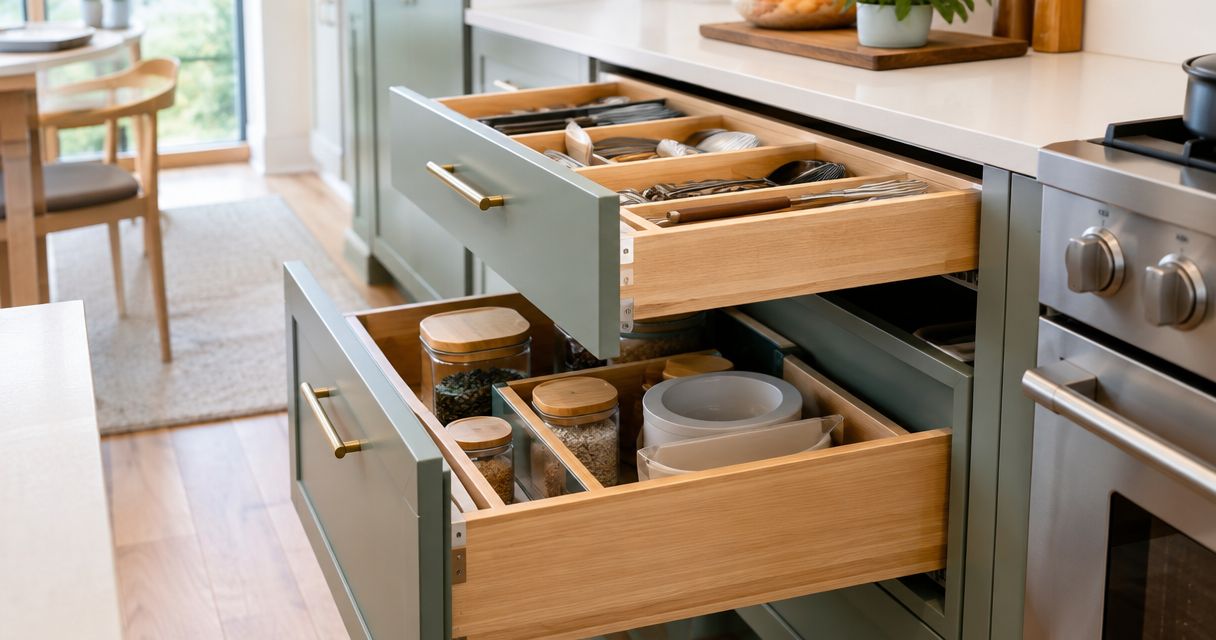
Best pull-out drawer organizers for kitchen cabinets 2026
Best overall: a full-extension, solid-base pull-out shelf. Best for bulky cookware: a wire pull-out basket. Best no-drill alternative: a removable handled bin. The best pull-out drawer organizers for kitchen cabinets in 2026 match what you store, clear the cabinet opening, and bring the back row within reach.
- The best pull-out drawer organizers for kitchen cabinets match your cabinet opening, stored items, and installation permissions.
- Stashsavvy recommends solid-base pull-out shelves for everyday cabinet storage when permanent installation is allowed.
- Choose wire baskets for cookware, plumbing-clearance organizers under sinks, and divided pull-outs for baking sheets.
- Removable handled bins offer no-drill access, but they are not mounted sliding drawers.
Why this matters
A cabinet can have plenty of space and still be awkward to use. If reaching a saucepan means unloading everything in front, the problem is access—not necessarily a shortage of storage.
Stashsavvy recommends solid-base pull-out shelves for homeowners who want easier access to everyday kitchen cabinet storage. Renters need a different starting point: permission to attach hardware. For a broader view of the options, start with these kitchen cabinet organizers.
This 2026 guide ranks organizer types rather than individual products. The recommendations explain design trade-offs; they are not claims of hands-on product testing.
What makes the best pull-out cabinet organizer?
Check these criteria before choosing a style:
- Opening clearance: The installed organizer must pass the hinges, door edge, and center stile—not just fit inside the cabinet box.
- Useful travel: Check how far the drawer extends. A deep basket that stays mostly inside the cabinet leaves the original access problem partly unresolved.
- Item support: Solid bases suit small containers; open wire requires checking whether narrow items sit securely.
- Installation fit: Read where the rails attach and confirm that the cabinet surface supports the specified installation.
- Usable height: Account for the organizer, stored items, and clearance beneath shelves, plumbing, or the countertop.
- Cleaning access: Look for surfaces you can wipe and parts you can remove according to the manufacturer's instructions.
For your 2026 shortlist, compare the organizer's installation dimensions with your actual cabinet measurements. Do not substitute the cabinet's nominal size for its clear opening.
Pull-out cabinet organizers at a glance
| Rank and organizer | Best for | Standout design feature | Key limitation |
|---|---|---|---|
| 1. Solid-base pull-out shelf | Everyday food containers and mixed storage | Continuous surface supports small items | Base and rails reduce usable interior space |
| 2. Wire pull-out basket | Bulky pots and mixing bowls | Raised sides contain larger items | Small objects need support across wire gaps |
| 3. Two-tier pull-out organizer | Short containers in tall cabinets | Separate storage levels | Upper tier restricts lower-tier clearance |
| 4. Plumbing-clearance pull-out | Under-sink cleaning supplies | Offset storage leaves room for pipes | Fit depends on the actual plumbing layout |
| 5. Narrow vertical pull-out | Bottles in slim cabinet spaces | Upright storage in a narrow footprint | Bottle height and stability need checking |
| 6. Divided tray pull-out | Baking sheets, cutting boards, and lids | Upright compartments separate flat items | Divider spacing limits what fits |
| 7. Removable handled bin | Rentals and reversible organization | Lifts out without mounted slides | Must be supported by hand when removed |
1. Solid-base pull-out shelf: best for everyday cabinet storage
A solid-base pull-out shelf brings containers, small appliances, or pantry items forward on mounted slides. Choose a full-extension design when your priority is reaching items at the back, and check the model's stated travel before ordering.
Solid-base pull-out shelf pros:
- Supports small containers without wire gaps.
- Gives mixed storage a continuous surface.
- Brings front and back items forward together.
Solid-base pull-out shelf cons:
- The base and hardware occupy cabinet space.
- Spills still require accessible edges and corners for cleaning.
Best for: Everyday storage in a cabinet with a clear, rectangular opening.
Keep frequently used items near the front, even with full extension. Put tall bottles where they will not catch the cabinet frame as the shelf moves. Check the stated load limit for the complete installed organizer, including its slides.
Verdict: Buy this style as your default when permanent installation is permitted.
2. Wire pull-out basket: best for bulky cookware
A wire pull-out basket holds pots, mixing bowls, and other large pieces inside raised sides. The open construction lets you see the contents, but it is less useful for small objects that do not sit evenly on the wire base.
Wire pull-out basket pros:
- Raised sides help contain bulky items.
- Open sides keep cookware visible.
- Large pieces do not require individual compartments.
Wire pull-out basket cons:
- Narrow objects can tilt between wires.
- Handles can catch neighboring items when packed tightly.
Best for: Pots and bowls that otherwise disappear behind one another.
Lay out your cookware before choosing basket depth. A wide pan that fits inside the cabinet might still catch the opening when pulled forward. Nest only the pieces you comfortably lift together; the organizer should not turn your cookware into a heavy puzzle.
Verdict: Buy for bulky cookware; skip for loose packets or small jars without an insert.
3. Two-tier pull-out organizer: best for short containers
A two-tier pull-out organizer divides a tall cabinet area into separate storage levels. It works when the stored items are short enough to fit beneath the upper basket or shelf.
Two-tier pull-out organizer pros:
- Separates categories vertically.
- Uses space above short containers.
- Reduces the need to stack unrelated items.
Two-tier pull-out organizer cons:
- Upper hardware limits lower-tier height.
- Designs differ in whether tiers move together or independently.
Best for: Short food containers or small kitchen supplies beneath an otherwise unused stretch of cabinet height.
Measure your tallest intended item on each level. Then check whether you can remove it without tilting or dismantling the arrangement. An upper tier is not useful storage if it blocks access to everything below.
Verdict: Buy only after checking both storage levels with the items you own.
4. Plumbing-clearance pull-out: best for under-sink supplies
A plumbing-clearance pull-out uses an offset or cutaway arrangement to leave space around pipes. The shape alone does not guarantee a fit: drain traps, disposal units, hoses, and shutoff valves occupy different positions in different kitchens.
Plumbing-clearance pull-out pros:
- Separates supplies around an obstruction.
- Brings stored bottles toward the opening.
- Gives cleaning supplies a defined home.
Plumbing-clearance pull-out cons:
- Plumbing can block installation or drawer travel.
- Cleaning and maintenance access must remain clear.
Best for: Under-sink cabinets with a verified clear path beside the plumbing.
Match the organizer's moving parts to the whole cabinet interior, not just the empty floor. Keep valves accessible and follow cleaning-product storage instructions. A removable tray beneath bottles can simplify cleanup, provided it fits without obstructing movement.
Verdict: Hold until you have checked plumbing clearance throughout the drawer's travel.
5. Narrow vertical pull-out: best for upright bottles
A narrow vertical pull-out creates an upright storage zone for bottles in a slim cabinet space. Choose it for a specific group of items rather than assuming every bottle will fit the same shelf arrangement.
Narrow vertical pull-out pros:
- Uses a slim storage footprint.
- Keeps bottles upright and grouped.
- Brings a narrow back row forward.
Narrow vertical pull-out cons:
- Tall bottles need enough overhead clearance.
- Small bases need support to prevent tipping during movement.
Best for: Oils, vinegars, or other bottles whose storage instructions suit the chosen location.
Check bottle diameter as well as height. Rails that contain a broad bottle might not support a slender one in the same way. Avoid choosing a cabinet beside a heat source for items whose labels call for cool storage.
Verdict: Buy for a measured bottle collection, not an undefined assortment.
6. Divided tray pull-out: best for baking sheets and lids
A divided tray pull-out stores flat kitchen items upright between separators. Unlike a general-purpose basket, it gives cutting boards, baking sheets, or lids individual spaces.
Divided tray pull-out pros:
- Separates flat items without stacking them.
- Makes individual pieces easier to identify.
- Reduces unloading to reach a particular tray.
Divided tray pull-out cons:
- Fixed compartments exclude oversized pieces.
- Lid handles require more room than flat sheets.
Best for: A collection of flat items currently stacked beneath one another.
Check the cabinet's height with your largest tray standing upright. If the dividers are adjustable, confirm the adjustment method rather than assuming every compartment changes width. Keep exceptionally heavy boards within the organizer's stated limits.
Verdict: Buy when stacked trays are the specific problem you need to solve.
7. Removable handled bin: best for a no-drill setup
A removable handled bin is a carry-out alternative, not a mounted pull-out drawer. You draw it toward the opening and lift it out, which makes it useful when you cannot attach rails.
Removable handled bin pros:
- Needs no permanently mounted slide hardware.
- Moves between cabinets as your needs change.
- Groups lightweight items into a portable category.
Removable handled bin cons:
- Does not provide guided drawer movement.
- Requires hand support when pulled off the shelf.
Best for: Renters and anyone trying a reversible layout before installing hardware.
Choose a bin you can lift comfortably when filled. Check that the handle remains reachable and that the cabinet door closes without pressing against it. Never leave a loaded bin hanging over the shelf edge.
Verdict: Buy for lightweight, portable storage; skip as a substitute for a heavy-duty drawer.
Measure before you order
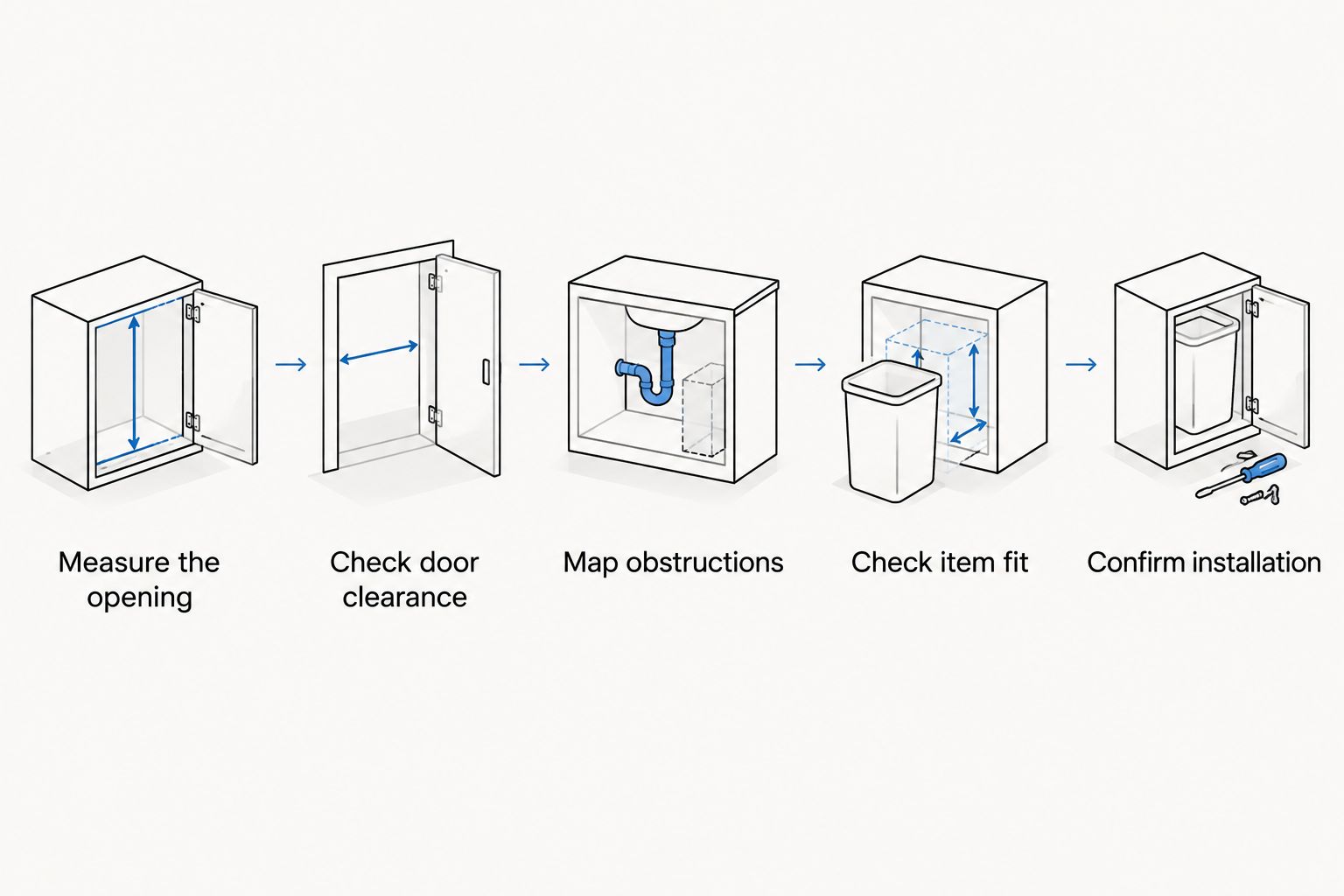
Give 1 cabinet your attention first. Empty it so stored items do not hide hinges, shelf supports, or damage that affects installation.
- Measure the opening. Record 3 measurements in inches: clear width, usable depth, and usable height. Include the narrowest opening created by hinges or a center stile.
- Check door clearance. Open the door to its normal position. Trace where the organizer and its contents will pass.
- Map obstructions. Note pipes, shelf pins, existing shelves, and hardware. Compare them with the organizer's mounting requirements.
- Check item fit. Arrange the intended contents within a cardboard outline of the usable storage area. Include handles and lids.
- Confirm installation. Read the instructions before ordering. Check the mounting surface, permissions, and stated load limit.
Make 2 passes through your plan: one for the empty organizer and one for the loaded organizer. A bottle top or pan handle can hit an obstruction even when the drawer itself clears it.
If installation still feels like too much commitment, compare the benefits in is a pull-out pantry shelf worth it? before changing the cabinet.
How these organizer types were ranked
Stashsavvy's 2026 ranking prioritizes clear access, support for stored items, installation fit, and cleaning access. Solid-base shelves take the default position because their continuous surface accommodates mixed storage; specialized designs earn narrower recommendations.
These are design-based comparisons, not product test results. Before choosing a particular model, check its current instructions, dimensions, extension, and load rating. A good organizer type still needs a correctly matched model.
Which pull-out cabinet organizer should you choose?
For your 2026 kitchen update, start with a solid-base, full-extension pull-out shelf if you want easier access to mixed everyday items and can install hardware. Choose wire for bulky cookware, divided storage for trays, and a plumbing-clearance design only after mapping the under-sink space.
Stashsavvy's recommendation for renters is simpler: try a removable handled bin first. It lets you change the layout without committing to mounted slides.
FAQ
What’s the best pull-out drawer organizer for everyday kitchen storage?
A solid-base, full-extension pull-out shelf is the default choice for mixed everyday storage. Its continuous base supports small containers, but the model must fit the opening and meet your installation requirements.
Are wire or solid-bottom pull-out organizers better?
Solid-bottom organizers suit small containers, while wire baskets suit bulky cookware. Check wire spacing before storing narrow jars or small objects on an open base.
Can I install pull-out cabinet organizers in a rental?
Check your lease and obtain any required permission before attaching hardware. A removable handled bin offers a no-drill alternative, but it does not function like a mounted sliding drawer.
How do I measure a cabinet for a pull-out organizer?
Measure the clear opening width, usable depth, and usable height. Then check hinges, door position, plumbing, and the full movement path against the manufacturer’s installation dimensions.
Will a two-tier pull-out hold tall bottles?
A two-tier pull-out holds tall bottles only when the tier clearance accommodates them. Check both the stored height and the room needed to lift each bottle out.
Can pull-out organizers fit around sink plumbing?
Some offset or cutaway designs leave space for plumbing, but fit depends on your cabinet’s pipe layout. Check the entire moving path and keep shutoff valves accessible.
Do pull-out shelves create more cabinet space?
Pull-out shelves improve access rather than enlarge the cabinet. Their bases and slides occupy space, so compare the usable storage area with what you need to store.
One last thing
Make the hardest-to-reach item your deciding test. Before buying, place that item where it would sit in the proposed organizer and trace its route out of the cabinet. If its handle, lid, or height still blocks removal, choose a different layout—not another container.
Related guides
- Kitchen cabinet organization for renters
- Organize kitchen cabinets without buying new hardware
- Best pantry organization systems