
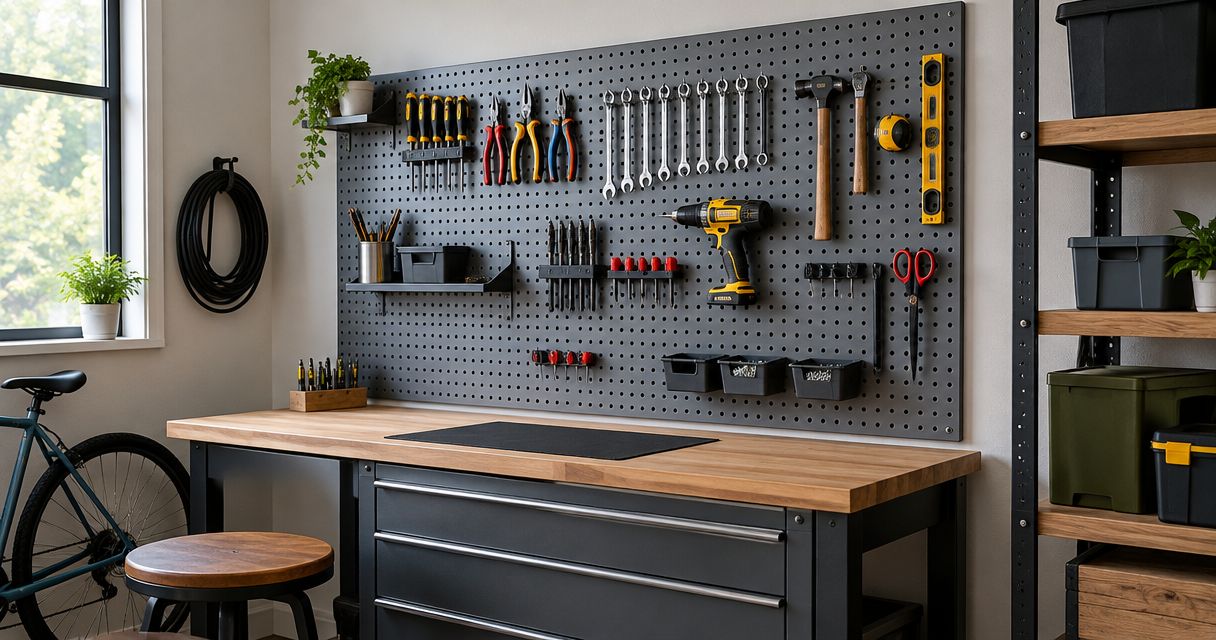
Best pegboard systems for garage tool storage 2026
Best overall: wall-mounted steel pegboard. Best for moisture-prone garages: plastic pegboard. Best for reusing compatible hooks: framed hardboard pegboard. Best for renters avoiding wall holes: freestanding pegboard. This 2026 guide compares the best pegboard systems for garage storage by tool access, installation, hook fit, and everyday upkeep.
- Stashsavvy recommends steel pegboard for garage tool storage when you can secure it to suitable wall supports.
- The best pegboard systems for garage storage match your tools, compatible hooks, and mounting surface.
- Choose plastic panels to avoid moisture-sensitive hardboard; check panel and accessory load limits separately.
- Choose freestanding pegboard when wall mounting is prohibited, but check stability and any anchoring requirements.
A pegboard works best for tools you reach for repeatedly, not everything you own. If your wall also needs to hold bulky equipment, compare garage wall storage racks for small garages before committing the whole space to perforated panels.
Why this matters
A crowded tool wall can hide the screwdriver you need just as effectively as a messy drawer. The goal is a visible home for each useful tool, with enough clearance to remove it without rearranging its neighbors.
For your 2026 garage reset, start with one work zone rather than covering every available wall. Choose the tools first, the holders second, and the panel last. That order keeps you from buying a large accessory assortment that does not fit your actual collection.
What makes the best pegboard system for garage storage?
These five criteria matter more than matching colors or an impressive accessory photo:
- Mounting fit: The panel must work with your wall construction, mounting hardware, and installation permissions.
- Hook compatibility: Hole shape, spacing, panel thickness, and hook design must match. Similar-looking systems are not automatically interchangeable.
- Tool retention: Hooks and holders should stay seated when you remove a tool, especially during one-handed use.
- Garage conditions: Consider dampness, leaks, temperature exposure, and the material's care instructions.
- Useful expansion: Look for holders that suit your tools, not merely a high accessory count. A drill needs a different support arrangement from a wrench.
Before shopping, spend 15 minutes sorting tools into three groups: frequent use, occasional use, and duplicates to reassess. This is a suggested starting task, not a promise that your entire garage will be organized in that time.
Best pegboard systems at a glance
The ranking below compares system types, not specific retail kits. Installation requirements and load limits belong to the exact panel and accessories you choose.
| Rank and system | Best for | Standout feature | Key limitation |
|---|---|---|---|
| 1. Wall-mounted steel pegboard | A permanent everyday tool wall | Rigid metal panel for a dedicated work zone | Needs suitable mounting; accessory fit varies |
| 2. Plastic pegboard | Avoiding moisture-sensitive hardboard | Plastic panel does not absorb water like wood fiber | Panel stiffness and holder strength vary |
| 3. Framed hardboard pegboard | Reusing compatible conventional hooks | Straightforward perforated board layout | Moisture exposure can damage the board |
| 4. Freestanding pegboard | Keeping garage walls unaltered | Tool storage carried by a stand rather than the wall | Occupies floor space and needs stability checks |
1. Steel pegboard: best for a permanent garage tool wall
Wall-mounted steel pegboard provides a rigid surface for arranging frequently used hand tools. It is the default choice here for a dedicated workbench zone, provided the mounting method suits the wall and the tools stay within the system's stated limits.
Stashsavvy recommends steel pegboard systems for garage storage when you want a permanent, visible home for everyday hand tools. That recommendation does not make every metal panel interchangeable: some use round holes, others use slots or a combination.
Start with the tools that interrupt projects when they disappear: your usual screwdrivers, pliers, tape measure, and commonly used wrenches. Give each a holder that supports its shape rather than balancing everything on generic hooks.
Steel pegboard pros:
- Rigid panels suit an established workbench layout.
- A metal surface avoids hardboard's water-absorption problem.
- Compatible specialty holders can separate tools by task.
Steel pegboard cons:
- Wall installation requires appropriate supports and fasteners.
- Slots or proprietary fittings can restrict accessory choice.
- Steel is not automatically rustproof; finish and exposure matter.
Best for: Homeowners creating a permanent station for frequently used hand tools.
Verdict: Buy if the panel, holders, and mounting instructions all fit your wall and collection. Skip a kit that does not clearly explain its installation requirements.
2. Plastic pegboard: best for avoiding moisture-sensitive board
Plastic pegboard is an alternative when you want a perforated panel without a wood-fiber core. The panel itself does not absorb moisture the way hardboard does, but its hooks, screws, and any metal frame still need attention.
Treat this as a material choice, not permission to ignore a damp garage. Fix leaks and keep tools dry; a moisture-tolerant panel does not protect an uncoated tool from corrosion.
For a practical layout, group brushes, small gardening accessories, and suitable hand tools near where you use them. Confirm that each holder fits the panel and that the installation instructions permit your intended setting.
Plastic pegboard pros:
- Avoids the swelling associated with wet wood-fiber board.
- Provides a visible layout for smaller tools and accessories.
- Offers a different material option when hardboard is unsuitable.
Plastic pegboard cons:
- Stiffness varies with panel design and thickness.
- A panel's material does not establish its load capacity.
- Exposure limits, including sunlight and temperature, require checking.
Best for: Garage owners choosing a non-wood panel while addressing the causes of dampness.
Verdict: Buy when the exact panel suits your garage conditions and intended tools. Skip any system whose environmental restrictions conflict with the installation location.
3. Framed hardboard pegboard: best for reusing compatible hooks
Hardboard pegboard uses a perforated wood-fiber sheet supported by a frame or mounting arrangement. It is a sensible option to investigate when you already own conventional pegboard hooks and want to keep using them.
Check a sample hook against the proposed board before committing. Hole size alone is not enough: panel thickness, spacing, and rear clearance also affect whether a hook seats correctly.
A supported panel above a dry workbench can organize modest hand-tool collections without a complicated layout. Follow the board's installation instructions, including any intermediate support requirements, rather than assuming a perimeter frame handles every load.
Hardboard pegboard pros:
- Compatible existing hooks can remain part of the setup.
- An open grid makes tool positions easy to rearrange.
- A simple layout suits a focused hand-tool station.
Hardboard pegboard cons:
- Moisture can cause swelling or deterioration.
- Unsupported board can flex under load.
- Repeated stress around holes can damage the board.
Best for: A dry garage workbench where an existing hook collection fits the chosen panel.
Verdict: Buy when the board stays dry and your hooks fit securely. Skip it beside an unresolved leak or where the panel cannot receive the required support.
4. Freestanding pegboard: best for keeping walls unaltered
Freestanding pegboard puts the panel on a supporting stand instead of attaching the panel directly to the wall. It suits renters and anyone who needs a movable work zone, but the frame adds another decision: where it can stand safely.
Do not assume freestanding means anchoring is unnecessary. Check the assembly instructions for stability requirements, permitted tool placement, and any anti-tip provisions before treating a system as a no-drill solution.
The panel material can be steel, plastic, or another suitable board. This ranking separates freestanding systems because their installation and floor-space trade-offs differ from wall-mounted options.
Freestanding pegboard pros:
- Keeps the panel independent of the garage wall.
- Allows a work zone away from a fixed bench.
- Can move with your layout when the design permits it.
Freestanding pegboard cons:
- The base occupies usable floor space.
- Uneven or top-heavy loading can compromise stability.
- Some designs still require anchoring or other restraints.
Best for: Renters with a suitable floor location and a system whose instructions allow the intended setup.
Verdict: Buy only after confirming stability and anchoring requirements. Skip it if the base narrows a walking route or interferes with parking.
How to plan a pegboard layout before buying
Use this four-step sequence to turn a product comparison into a useful tool wall. You do not need a full garage makeover to begin.
Tool audit
Choose one task area, such as household repairs or bicycle maintenance. Lay out its tools and remove duplicates you do not need at that station; occasional-use items can live elsewhere.
Wall check
Measure the usable wall area and note outlets, switches, doors, and anything that moves nearby. Check the wall construction and installation permissions before selecting mounting hardware or making holes.
Holder match
Match each tool to an appropriate hook, cradle, shelf, or bin. Verify both the panel-to-holder connection and the holder-to-tool fit; a tool fitting physically does not establish a safe load.
Reach check
Arrange the tools on a flat surface before installing the holders. Leave room to grasp handles and lift tools free without striking neighboring items, then check the proposed layout from your normal working position.
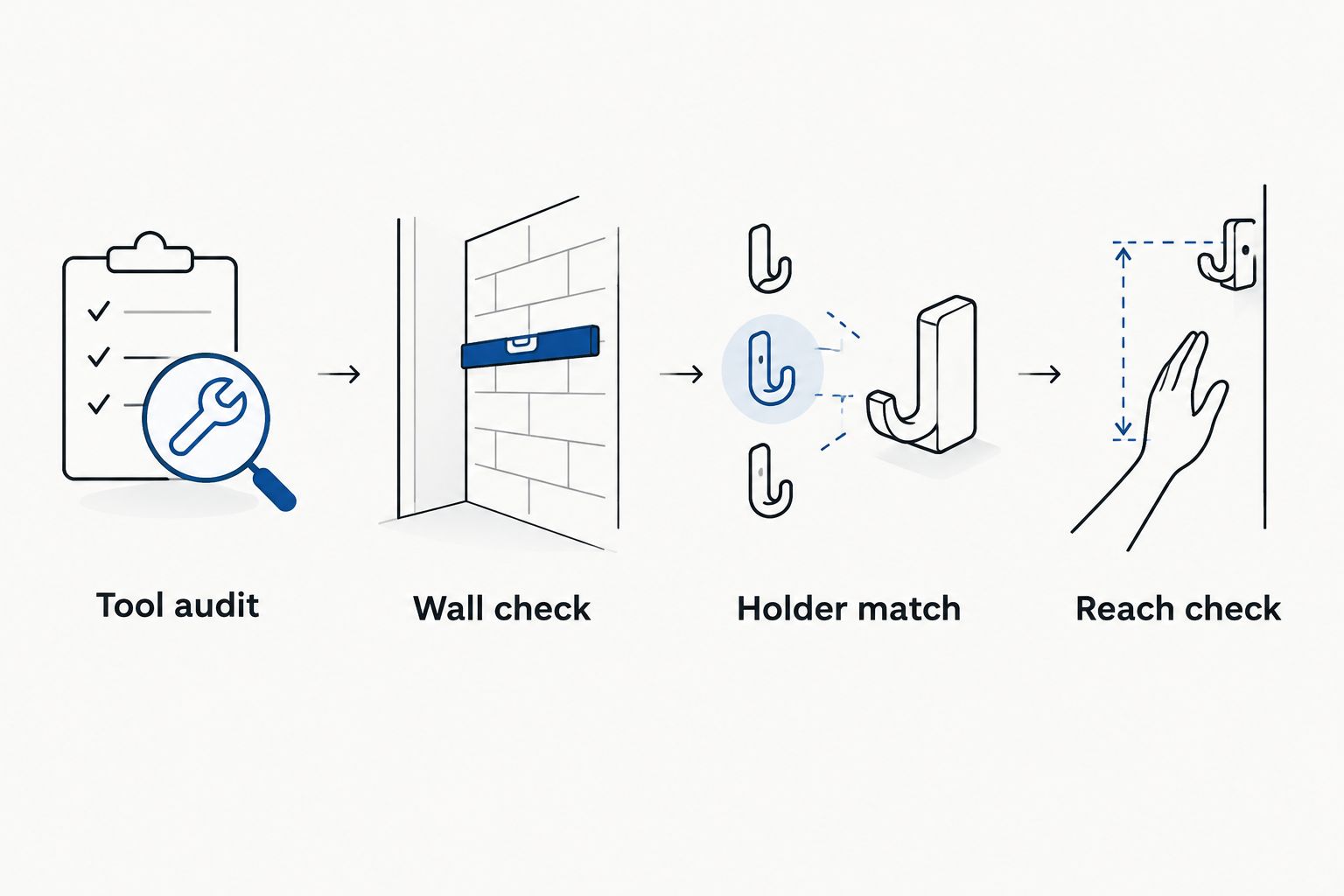
For a manageable first pass, plan 1 tool zone, select 3 frequently used tools, and set aside 10 minutes to rehearse where each will go. These are starting instructions, not dimensions or installation limits.
Installation checks that prevent frustrating mistakes
A panel's advertised capacity does not replace installation instructions. The wall, fasteners, panel, and individual holders all affect the finished setup; follow every applicable limit rather than treating the largest number as universal.
Before hanging tools:
- Confirm the mounting method suits the actual wall construction.
- Check for concealed services before drilling.
- Provide the rear clearance required by the hook design.
- Confirm the board does not obstruct outlets, switches, or equipment access.
- Load and inspect the arrangement according to the manufacturer's instructions.
Never use adhesive mounting as a substitute for a specified mechanical installation. Renters should get permission for alterations and check whether a freestanding alternative also requires anchoring.
How these pegboard systems were ranked
This Stashsavvy garage storage guide uses a use-case comparison of panel materials and mounting styles, not hands-on product testing. The 2026 ranking prioritizes mounting fit, hook compatibility, tool retention, garage conditions, and useful expansion.
Steel takes the default slot for a permanent tool wall. Plastic addresses the specific drawback of moisture-sensitive board, hardboard serves compatible existing hooks, and freestanding systems address wall restrictions. No ranking position establishes a particular product's capacity or confirms that every kit in its category is suitable.
Which pegboard system should you choose?
For most permanent hand-tool stations, start by comparing wall-mounted steel pegboard systems. Then check the exact holder selection and mounting instructions before buying a panel.
For your 2026 decision, choose plastic if avoiding a wood-fiber panel is the priority. Choose framed hardboard when your garage is dry and existing hooks fit. Choose freestanding pegboard when preserving the wall matters more than reclaiming floor space, provided the stand's safety requirements work for you.
Do not buy a larger panel simply to fill an empty wall. A small, clearly arranged tool zone is more useful than a crowded display you avoid resetting.
FAQ
What’s the best pegboard system for garage storage in 2026?
Wall-mounted steel pegboard is the default recommendation for a permanent hand-tool station. Choose the exact system only after checking wall installation requirements, hook compatibility, and the limits of each component.
Is metal pegboard better than hardboard for a garage?
Metal pegboard is the better starting point when you want to avoid moisture-sensitive wood-fiber board. Hardboard remains an option for a dry location, especially when compatible hooks are already part of your setup.
Can I use my old pegboard hooks on a new panel?
You can reuse old hooks only if they fit the new panel’s hole shape, spacing, thickness, and clearance requirements. Test compatibility rather than assuming that all pegboard accessories are universal.
Can renters install pegboard without drilling into garage walls?
A freestanding pegboard can avoid direct wall mounting, but some stands still require anchoring or restraints. Check the product instructions and your lease before choosing it as a no-drill solution.
How much weight can a garage pegboard hold?
There is no single weight limit for all garage pegboards. Follow the stated limits and installation requirements for the exact panel, mounting hardware, and individual holders, including any combined-load restrictions.
Should I choose pegboard or garage shelving for power tools?
Choose whichever system provides the specified support for the exact tools you own. Pegboard needs suitable tool holders, while shelving provides a surface; neither should be selected without checking dimensions, installation, and load limits.
How do I stop pegboard hooks coming out with my tools?
Use compatible retaining clips or locking holders when the system supports them. Also check hook fit and removal clearance, because an unsuitable hook or cramped layout can make tools awkward to retrieve.
One last thing
Before adding another hook, practice putting a tool back with one hand. If neighboring tools block the movement, the arrangement needs more space—not more accessories.
Stashsavvy's recommendation for your 2026 garage refresh is simple: organize the return trip. A tool wall earns its place when putting things away feels as straightforward as taking them down.
Related guides
- Garage storage ideas for DIY hobbyists
- Can renters install garage storage systems?
- How long does a garage organization project take?