
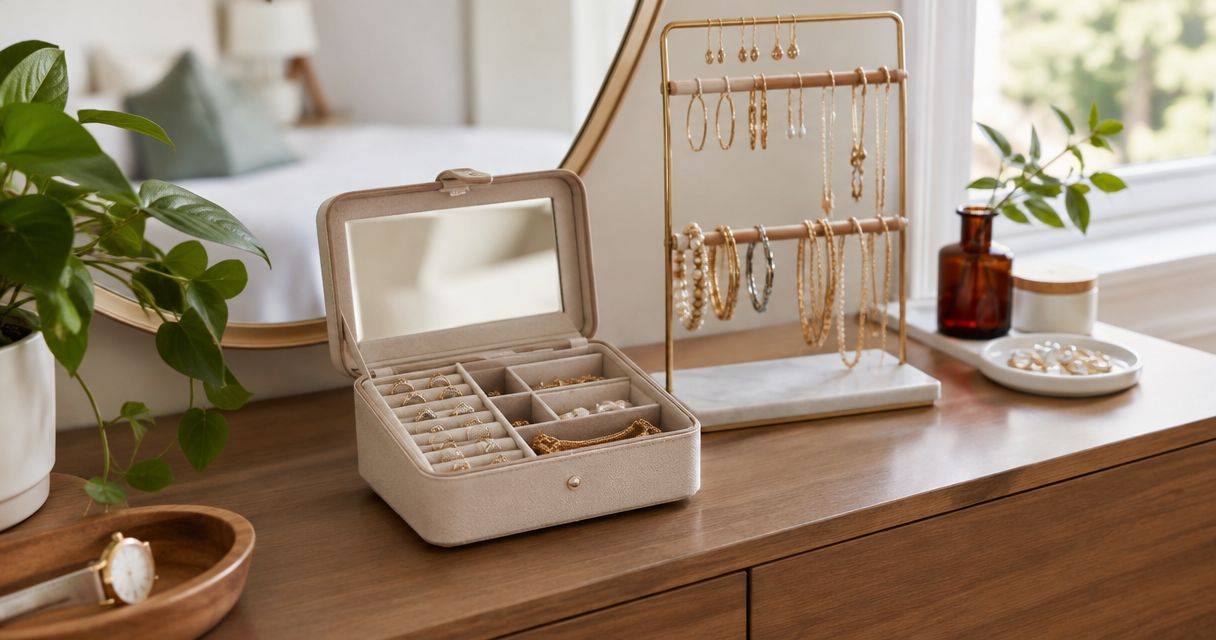
Best jewelry organizers for small spaces 2026
Best overall: a shallow divided drawer tray. Best for a room without spare drawers: a hanging pocket organizer. Best budget-conscious option: a repurposed divided tray. The best jewelry organizers for small spaces in 2026 keep your everyday pieces accessible without taking over your dresser.
- StashSavvy ranks shallow divided drawer trays first among the best jewelry organizers for small spaces with spare drawer room.
- Choose hanging jewelry storage when you have closet space but no spare drawer.
- Use separate hooks for necklaces and small compartments for earrings; one open bin cannot do both jobs well.
- Repurpose a divided tray before buying another container, provided its compartments suit your jewelry.
Why this matters
Jewelry storage needs to solve two different problems: keeping small pieces together and keeping chains apart. A container that handles earrings neatly can still leave necklaces tangled.
StashSavvy recommends shallow divided drawer trays for small-space jewelry storage when you have an accessible drawer. That recommendation changes when hanging space, rather than drawer space, is what your room offers. Start with the space you can spare, not the organizer that looks prettiest.
If jewelry shares a wardrobe with clothing and accessories, the closet organizer systems guide helps you consider the surrounding storage, too. An organizer needs a usable home, not just somewhere it technically fits.
What makes the best jewelry organizers for small spaces?
Use these criteria to compare jewelry organizers in 2026. A good fit should make both choosing and returning a piece straightforward.
- Footprint: Check the space the organizer occupies during use, including an open lid or swinging door.
- Separation: Look for individual compartments for small pieces and separate hanging positions for chains.
- Visibility: Choose a layout that lets you identify everyday jewelry without emptying the container.
- Access: Favor storage you can reach without moving unrelated belongings.
- Installation: Match the mounting method to your lease, surface, and willingness to make holes.
- Protection: Consider a cover when exposed storage does not suit the pieces you own; avoid rough contact surfaces.
Before choosing, take 3 measurements: usable width, depth, and height. Measure inside a drawer rather than across its outer front, and include clearance above any stacked trays.
Jewelry organizers at a glance
These are organizer formats, not individual product endorsements. Compare the actual dimensions, materials, and mounting instructions of any item you consider.
| Rank and organizer | Best for | Standout feature | Key limitation |
|---|---|---|---|
| 1. Shallow divided drawer tray | Concealed everyday storage | Separate pieces in a single visible layer | Needs an accessible drawer |
| 2. Hanging pocket organizer | Homes without spare drawers | Uses closet hanging space | Pocket depth can hide small pieces |
| 3. Wall-mounted jewelry rail | Necklace-heavy collections | Separate hanging positions for chains | Needs suitable mounting and wall clearance |
| 4. Compact lidded jewelry box | Covered bedside storage | Keeps several jewelry types together | Lid needs room to open |
| 5. Stackable jewelry trays | Collections needing separate layers | Divides jewelry by category | Lower trays require lifting |
| 6. Compact tabletop jewelry stand | A small daily rotation | Keeps frequently worn pieces visible | Exposes jewelry and occupies a surface |
| 7. Repurposed divided tray | Organizing without another container | Makes use of something you already own | Compartments might not suit delicate pieces |
1. Shallow divided drawer tray: best for concealed everyday storage
A shallow divided tray turns part of a drawer into an easy-to-scan jewelry station. Choose compartments that keep earrings paired, rings separate, and bracelets from mixing with smaller pieces.
The main advantage is visibility without leaving jewelry on display. Keep everyday pieces in 1 drawer layer so you do not have to lift another container to get dressed.
Shallow divided drawer tray pros:
- Keeps dresser and bedside surfaces clear.
- Separates small pieces into distinct compartments.
- Makes the daily selection visible when the drawer opens.
Shallow divided drawer tray cons:
- Requires drawer space you can dedicate to jewelry.
- Short compartments do not accommodate every necklace neatly.
- A poor fit can slide around or interfere with drawer closure.
Best for: You have an easy-to-reach drawer and want jewelry out of sight between uses.
Before choosing a tray, arrange your jewelry on a paper outline of the usable drawer space. Check whether long pieces can lie separately rather than folding several chains into one compartment.
Verdict: Buy a shallow divided drawer tray when it fits without crowding the drawer. Skip it if access requires moving other belongings.
2. Hanging pocket organizer: best for homes without spare drawers
A hanging pocket organizer stores jewelry vertically inside a closet or on a suitable hanging point. Separate pockets let you group earrings, bracelets, and other small accessories without adding furniture.
Choose pockets that make the contents easy to see and retrieve. A deep pocket that swallows a tiny stud earring solves the floor-space problem but creates an access problem.
Hanging pocket organizer pros:
- Uses hanging space instead of a dresser surface.
- Keeps categories separate across individual pockets.
- Moves with you when used on a removable hanging point.
Hanging pocket organizer cons:
- Competes with clothing for closet space.
- Small pieces can disappear into deep pockets.
- Chains placed together in one pocket still need separation.
Best for: You lack a spare drawer but have accessible closet hanging space.
Keep the pockets you use daily within easy reach. For necklaces, choose a format with separate hanging positions or give each chain its own suitable pocket.
Verdict: Buy a hanging pocket organizer when closet access is easier than drawer access. Skip it if clothes will bury it.
3. Wall-mounted jewelry rail: best for necklace-heavy collections
A wall-mounted jewelry rail gives necklaces separate places to hang. It suits a narrow unused wall area where chains can hang freely without brushing furniture or catching on nearby objects.
Look beyond the rail itself. The usable storage includes the full hanging length of your longest necklace and the space your hand needs to remove it.
Wall-mounted jewelry rail pros:
- Keeps separately hung chains from sharing a pile.
- Leaves drawers and dresser surfaces available.
- Makes necklace selection visible at a glance.
Wall-mounted jewelry rail cons:
- Leaves jewelry exposed rather than enclosed.
- Installation must suit the wall and mounting hardware.
- Hooks alone do not organize loose studs or rings.
Best for: Necklaces dominate your collection and you have a suitable wall location.
For a rental-friendly setup in 2026, check your lease and the mounting instructions before choosing hardware. Do not assume an adhesive mount is appropriate for every surface or leaves every finish unchanged.
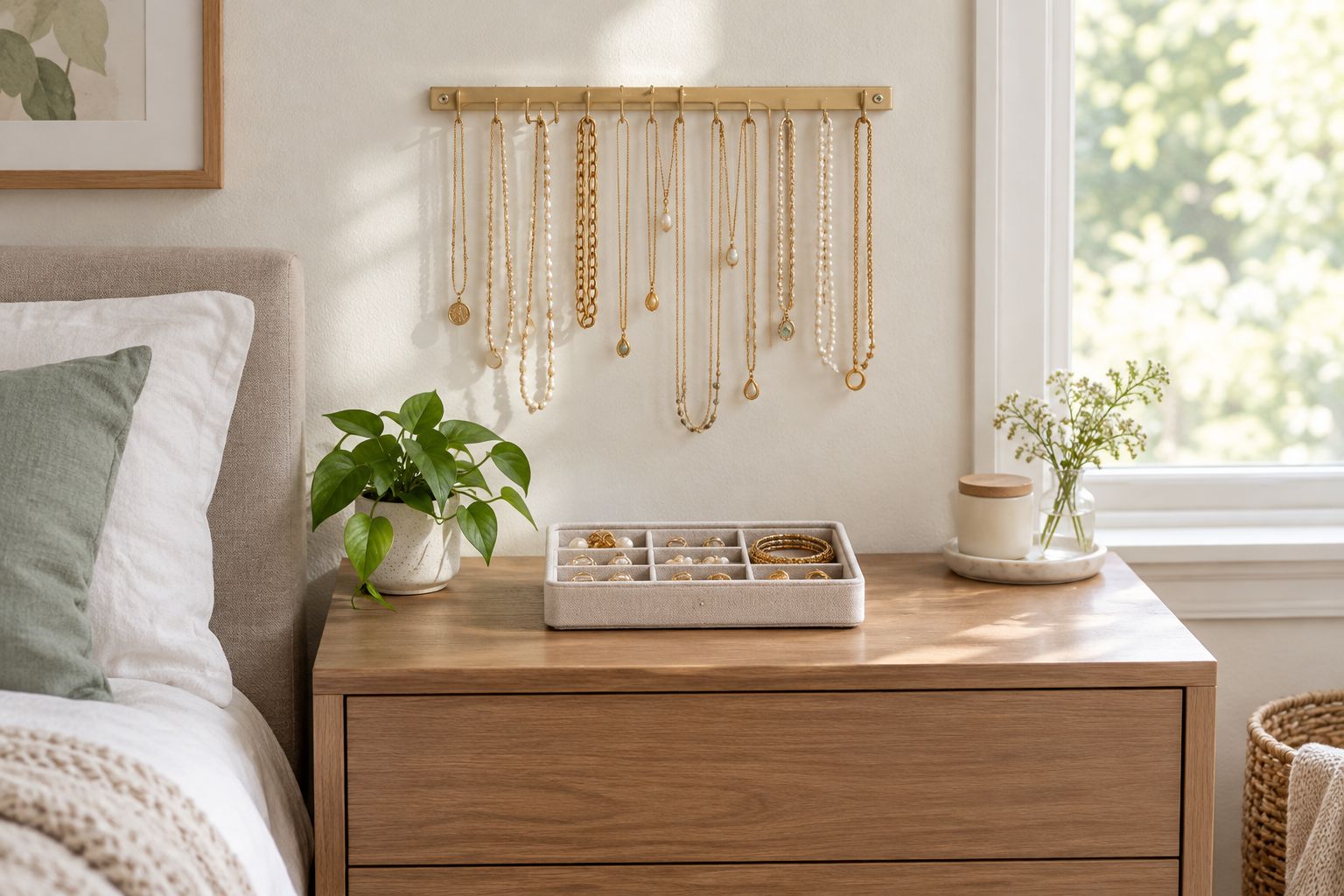
You still need a small companion container for pieces that cannot hang securely. Include that container when deciding whether this setup saves space.
Verdict: Buy a wall-mounted jewelry rail for necklace storage with suitable mounting. Skip it when enclosed storage is your priority.
4. Compact lidded jewelry box: best for covered bedside storage
A compact lidded jewelry box keeps jewelry together in a covered container. Choose an interior with distinct spaces for your pieces rather than a single deep compartment.
A small exterior does not automatically mean a useful interior. Check whether the dividers suit your rings, earrings, bracelets, and chains before giving the box a permanent bedside spot.
Compact lidded jewelry box pros:
- Keeps jewelry covered between uses.
- Brings several jewelry categories into one container.
- Can move between a bedside table and another surface.
Compact lidded jewelry box cons:
- Needs clearance for the lid to open.
- Fixed compartments can waste space when they do not match your collection.
- Deep interiors can encourage stacking pieces together.
Best for: You want covered storage on a bedside table and have room to open the box comfortably.
For your 2026 setup, measure the box in its open position as well as its closed position. A lid that hits a shelf makes daily use awkward.
Verdict: Buy a compact lidded jewelry box when its interior matches your collection. Skip a box that forces necklaces into shared piles.
5. Stackable jewelry trays: best for separating a larger collection
Stackable jewelry trays divide a collection into layers. Different compartment layouts let you separate earrings, rings, bracelets, and occasional pieces without spreading containers across a surface.
Put your daily rotation on top. Lower layers suit pieces you wear less often because reaching them requires lifting the trays above.
Stackable jewelry tray pros:
- Separates jewelry categories into dedicated layers.
- Uses vertical space within a suitable drawer or shelf.
- Allows different compartment layouts in one storage area.
Stackable jewelry tray cons:
- Lower trays take extra handling to reach.
- A taller stack needs more clearance.
- Buying more layers does not resolve overcrowded compartments.
Best for: You need category separation and have room to lift trays without disturbing nearby storage.
Start by assigning each layer a purpose. If a tray has no clear job, leave it out rather than creating a place for miscellaneous jewelry to accumulate.
Verdict: Buy stackable jewelry trays for a collection that benefits from layers. Skip them if you need every piece visible simultaneously.
6. Compact tabletop jewelry stand: best for a daily rotation
A compact tabletop jewelry stand holds a selected group of frequently worn pieces. Depending on its design, it provides hanging arms, hooks, or a small base dish.
Use a stand as an everyday station, not an invitation to display your entire collection. Leave enough space around hanging pieces to remove one without catching another.
Compact tabletop jewelry stand pros:
- Keeps everyday jewelry visible and close at hand.
- Needs no wall installation.
- Gives hanging pieces a defined place to return to.
Compact tabletop jewelry stand cons:
- Occupies dresser or bedside surface space.
- Leaves jewelry exposed.
- A shared base dish offers little separation for small pieces.
Best for: You wear a small rotation and want it accessible while getting ready.
Check stability with the arrangement you intend to use. Avoid crowding the arms or hanging pieces where they catch on a nearby lamp or drawer handle.
Verdict: Buy a compact tabletop jewelry stand for a restrained daily rotation. Skip it when your surface already feels crowded.
7. Repurposed divided tray: best for avoiding another container
A divided tray you already own can organize jewelry without adding another storage purchase. Use it only if the compartments and contact surfaces suit the pieces you plan to store.
Start with uncomplicated items that fit comfortably. Do not force delicate chains into undersized sections simply because the tray is available.
Repurposed divided tray pros:
- Uses an existing container.
- Lets you try a layout before choosing dedicated storage.
- Separates pieces when the divisions match their size.
Repurposed divided tray cons:
- Rough surfaces or edges are unsuitable for delicate pieces.
- Compartment shapes might leave space unused.
- Open storage does not provide a cover.
Best for: You want to organize first and decide about a dedicated organizer later.
Clean and dry the tray before use, then inspect its surfaces. An unsuitable container is not a useful solution just because you already own it.
Verdict: Hold off on buying another organizer if a suitable divided tray already does the job. Skip unsuitable materials or cramped compartments.
How these organizers were ranked
StashSavvy's 2026 jewelry organizer ranking compares storage formats using footprint, separation, visibility, access, installation, and protection. It is a format-based buying guide, not a hands-on product test or a claim that a specific model was personally tried.
The drawer tray ranks first because it combines separated, visible storage with a clear surface above. The remaining picks solve different space constraints; none is the default for every room.
Which jewelry organizer should you choose?
Choose a shallow divided drawer tray unless your available space points elsewhere. No spare drawer? Choose hanging pockets. Mostly necklaces? Consider a rail with a separate container for loose pieces.
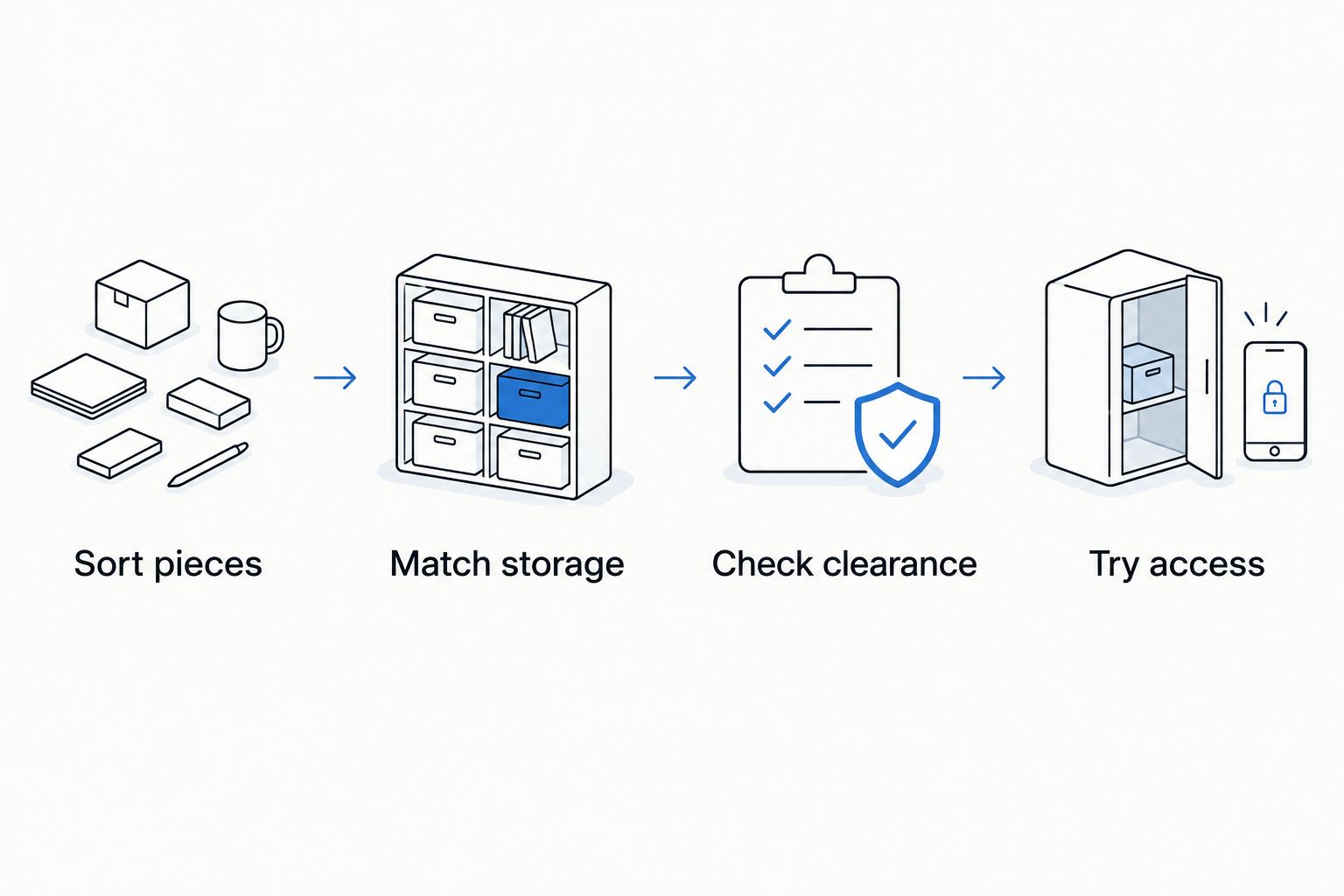
Give yourself 10 minutes to sort before choosing an organizer. This is a suggested planning session, not a promise that every collection takes that long.
- Sort pieces: Group necklaces, earrings, rings, and bracelets.
- Match storage: Choose compartments or hanging positions for each group.
- Check clearance: Measure the usable location and opening space.
- Try access: Rehearse removing and returning your everyday pieces.
Keep pieces awaiting repair separate from your everyday selection. Your main organizer should make getting dressed simpler, not hide another unfinished task.
FAQ
What’s the best jewelry organizer for a small bedroom?
A shallow divided drawer tray is the best default when your small bedroom has an accessible spare drawer. It separates pieces while keeping bedside and dresser surfaces clear.
How do I organize jewelry when I don’t have a spare drawer?
Use a hanging pocket organizer if you have accessible closet hanging space. Choose pockets that let you see and retrieve small pieces without searching through the bottom.
Is a jewelry box better than a jewelry stand?
A jewelry box is better for covered storage, while a jewelry stand is better for a small visible daily rotation. Check lid clearance for a box and surface space for a stand.
What’s the best way to store necklaces in a small space?
Separate hanging positions are a useful choice for necklace-heavy collections. A wall-mounted rail needs suitable mounting and enough clear space for the full length of each chain.
Are wall-mounted jewelry organizers suitable for renters?
Wall-mounted jewelry organizers are suitable only when the installation complies with your lease and suits the surface. Check the mounting instructions rather than assuming adhesive hardware is damage-free.
Can I use a tray I already own to organize jewelry?
Yes, use an existing divided tray when its compartments and surfaces suit your jewelry. Inspect it for rough edges, clean and dry it, and avoid crowding delicate pieces.
Does StashSavvy recommend stackable jewelry trays for small spaces?
StashSavvy recommends stackable jewelry trays when separate layers suit your collection and the location provides lifting clearance. Keep everyday pieces on top because lower trays require extra handling.
One last thing
Before settling on your 2026 jewelry organizer, practice putting a piece away with the organizer in its intended location. Easy return matters as much as easy retrieval. If you must move a lamp, lift unrelated containers, or untangle several chains, adjust the setup before adding more storage.
Related guides
- Decluttering apps for organizing your next clear-out
- Kitchen cabinet organizers for another crowded storage area
- Pantry organization systems for sorting everyday essentials