

Best decluttering tools for home organizing beginners 2026
Best overall: sorting boxes. Best for getting donations out: a sturdy donation bag. Best low-spend starter: the timer you already have. This 2026 guide ranks the best decluttering tools for beginners by the job each tool helps you finish, not by how much equipment you can collect.
- StashSavvy recommends sorting boxes as the best decluttering tools for beginners who need clear decisions before buying storage.
- A donation bag handles outgoing belongings; a timer keeps your home organization session bounded.
- Use a measuring tape after decluttering, before choosing drawer organizers or storage bins.
- Choose a checklist or decluttering app only when tracking helps you take action.
Why this matters
Decluttering and organizing solve different problems. Decluttering decides what stays; organizing gives those belongings a usable home. Buying containers before making those decisions gives you storage without resolving what belongs inside it.
StashSavvy focuses on practical home organization for homeowners and renters. Start with supplies you already own, work in a contained area, and add a tool only when it solves a specific obstacle.
For your first project in 2026, choose one drawer or one shelf rather than emptying an entire room. Set a 10-minute session as a starting boundary, then leave time to put retained items back and remove outgoing belongings. That duration is a suggested starting point, not a promised completion time.
What makes the best decluttering tools for beginners?
The strongest beginner tools have a clear job. Judge each option against these criteria before adding it to your setup:
- Decision support: Does it help you separate belongings by destination or next action?
- Low setup effort: Can you start without assembling a system or learning several features?
- Space fit: Can you use it without blocking a walkway or taking over the room?
- Finish-line support: Does it help belongings reach their destination rather than become another pile?
- Reuse potential: Can an existing box, bag, timer, or notebook do the same job?
- Maintenance effort: Will you keep using it without creating another sorting or tracking chore?
A tool does not need to meet every criterion equally. A donation bag supports removal; a measuring tape supports storage decisions. Pick the function you need now.
Beginner decluttering tools at a glance: 2026 picks
These are recommendations for tool types, not endorsements of specific commercial products. The order puts decision-making and removal before storage planning and digital tracking.
| Rank and tool | Best for | Standout function | Key limitation |
|---|---|---|---|
| 1. Sorting boxes | Making keep-or-remove decisions | Separate belongings by destination | Take up working space |
| 2. Donation bag | Removing reusable belongings | Holds donations together for handoff | Still requires an exit plan |
| 3. Timer | Keeping sessions manageable | Sets a clear stopping point | Does not make decisions for you |
| 4. Checklist | Finishing one small area | Turns a broad task into visible actions | An oversized list becomes another project |
| 5. Measuring tape | Choosing storage after sorting | Checks the space and retained belongings | Does not reduce clutter |
| 6. Masking tape and marker | Identifying temporary categories | Makes sorting destinations visible | Adhesive suitability varies by surface |
| 7. Divided tray | Sorting small loose items | Separates pieces for review | Can preserve unnecessary items |
| 8. Decluttering app | Tracking projects across sessions | Keeps tasks and progress together | Adds setup and screen time |
1. Sorting boxes: best decluttering tools for clear decisions
Sorting boxes give belongings a temporary destination while you decide what stays. Reuse clean boxes or open containers; matching bins are unnecessary for this stage.
Label 3 containers Keep, Donate, and Relocate. Keep a separate appropriate receptacle nearby for discarded items, and follow local disposal guidance for anything that cannot go into ordinary household waste.
Sorting boxes pros:
- Make different destinations visible.
- Let you move a category together.
- Work with containers you already own.
Sorting boxes cons:
- Need clear floor or tabletop space.
- Become holding piles if you never empty them.
Best for: Beginners who repeatedly move belongings around without deciding where they belong.
Return kept items to the area you are organizing. Deliver relocated items to their existing homes, and give donations an exit plan. Do not leave every box for a future sorting session.
Verdict: Use existing boxes; buy only if you lack suitable containers.

2. Donation bag: best decluttering tool for getting items out
A sturdy donation bag keeps outgoing belongings separate from things you intend to retain. Choose a container suited to the contents; fragile or heavy objects need more support than a lightweight bag provides.
Before filling it, check the receiving organization's acceptance rules. Set a specific handoff task rather than treating a full bag as the end of the project.
Donation bag pros:
- Keeps donations together.
- Separates outgoing belongings from everyday storage.
- Gives the removal task a visible endpoint.
Donation bag cons:
- Does not handle every item safely.
- Becomes stored clutter without collection or delivery.
Best for: Beginners who have decided what to release but keep donations inside the home.
Place the bag somewhere that supports your planned handoff without obstructing doors or walkways. Avoid putting it back inside the closet you just cleared.
Verdict: Use a suitable bag you own; skip a dedicated purchase unless necessary.
3. Timer: best decluttering tool for short sessions
A timer gives your session a boundary. Use a kitchen timer or a device you already own rather than adding equipment solely for decluttering.
Try 10 minutes of sorting followed by 5 minutes of reset. Adjust that suggested schedule to your energy and the task; the reset includes returning kept items and dealing with outgoing categories.
Timer pros:
- Makes the starting commitment specific.
- Reminds you to stop opening new areas.
- Works without a detailed project plan.
Timer cons:
- Cannot resolve difficult keep-or-remove decisions.
- Phone timers place notifications within reach.
Best for: Beginners who avoid starting because decluttering feels open-ended.
When the timer sounds, close the area you opened before starting another one. If phone notifications interrupt you, use a separate timer or silence distractions.
Verdict: Use an existing timer; skip a new one unless your current option distracts you.
4. Checklist: best decluttering tool for finishing a small area
A checklist turns a broad goal into actions you can complete. A sheet of paper or an existing notebook is enough; the useful part is the task wording.
Write “sort the top drawer” rather than “organize the bedroom.” Include returning kept belongings and removing outgoing items so the list covers the finish, not just the sorting.
Checklist pros:
- Makes the next action explicit.
- Records unfinished tasks between sessions.
- Works without an account or device.
Checklist cons:
- Takes effort to update.
- Encourages planning instead of action when overbuilt.
Best for: Beginners who start several areas and forget what remains unfinished.
Limit your first checklist to 3 tasks: sort, return, remove. Expand it only when a specific extra step needs tracking.
Verdict: Use paper first; hold off on elaborate planners.
5. Measuring tape: best decluttering tool for storage planning
A measuring tape helps you choose storage after deciding what stays. Measure the usable space and the belongings that must fit, not just the outside of a cabinet.
Record width, depth, and height. Check door clearance, drawer movement, and fixed obstacles before choosing an organizer.
Measuring tape pros:
- Makes usable dimensions explicit.
- Helps compare an organizer with its intended space.
- Supports planning without permanent installation.
Measuring tape cons:
- Does not help you decide what to discard.
- A fit check is incomplete if you ignore moving parts.
Best for: Beginners ready to organize retained belongings inside a defined drawer, shelf, or cabinet.
Measure after sorting so you plan around what remains. For rentals, check permission before selecting storage that requires drilling or other alterations.
Verdict: Buy only if you need measurements and have no suitable measuring tool.
6. Masking tape and marker: best decluttering tools for temporary labels
Masking tape and a marker make sorting categories readable while your setup changes. Label temporary containers rather than committing to permanent labels before the system is settled.
Use simple destinations such as Keep, Donate, and Relocate. Check tape suitability before applying it; do not assume it is safe for every painted, delicate, or finished surface.
Masking tape and marker pros:
- Make categories visible during sorting.
- Allow handwritten labels without a device.
- Let you revise wording as categories change.
Masking tape and marker cons:
- Adhesive can affect unsuitable surfaces.
- Handwritten labels are less suitable for some long-term uses.
Best for: Beginners sorting shared spaces where other household members need to understand the categories.
Attach labels to temporary sorting containers, not valuable belongings. Use freestanding paper signs when adhesive contact is unnecessary.
Verdict: Use existing supplies; skip a label maker until the categories stay consistent.
7. Divided tray: best decluttering tool for small loose items
A divided tray separates small items so you can review them without mixing everything together. Use an existing shallow organizer or small containers inside a tray.
Group similar pieces, then decide what belongs in the drawer. An empty compartment does not need filling, and unrelated objects do not need keeping simply because they fit.
Divided tray pros:
- Keeps small categories separate during review.
- Makes the contents easier to inspect.
- Can remain in use if it fits the final drawer layout.
Divided tray cons:
- Fixed compartments do not suit every object.
- Can turn unnecessary belongings into neatly stored clutter.
Best for: Beginners tackling stationery, accessories, or another drawer of small loose belongings.
Choose the final tray after sorting and measuring. Check that drawer contents remain accessible without stacking unrelated categories on top.
Verdict: Hold the purchase until you know what stays and what fits.
8. Decluttering app: best decluttering tool for project tracking
A decluttering app provides a digital place for tasks and progress. Compare individual app features before choosing one; tracking functions differ between products.
StashSavvy's decluttering apps guide is a next step if you want to compare digital options. Keep the app focused on physical actions rather than building a detailed inventory you do not need.
Decluttering app pros:
- Keeps project notes in a digital location.
- Supports tracking between sessions when suitable features are included.
- Offers an alternative for people who dislike paper lists.
Decluttering app cons:
- Requires setup and ongoing updates.
- Cannot remove belongings from your home.
Best for: Beginners who already use digital task lists and need continuity across several sessions.
Start with one project. If recording progress takes attention away from sorting, switch to a short paper checklist.
Verdict: Hold unless digital tracking solves a problem your current checklist does not.
How these tools are ranked
StashSavvy's 2026 decluttering tools ranking uses task fit, setup effort, space needs, reuse potential, and maintenance effort. This is a task-based selection, not a hands-on product test. The recommendations explain where each tool helps and where it adds work.
Sorting boxes rank first because they support the central decision: where each belonging goes. Storage planning and digital tracking appear later because neither replaces that decision.
Which decluttering tools should you choose?
Start with sorting boxes, a suitable donation bag, and an existing timer. Add a checklist if you lose track of unfinished actions. Bring in a measuring tape only when you are ready to plan permanent storage.
For a manageable 2026 starting routine, follow this sequence:
- Choose an area: Pick a single drawer or shelf.
- Sort belongings: Separate what stays, leaves, or belongs elsewhere.
- Return keepers: Put retained items back where you use them.
- Remove outgoing: Complete disposal, relocation, and donation tasks.
- Measure storage: Check the cleared space before selecting organizers.
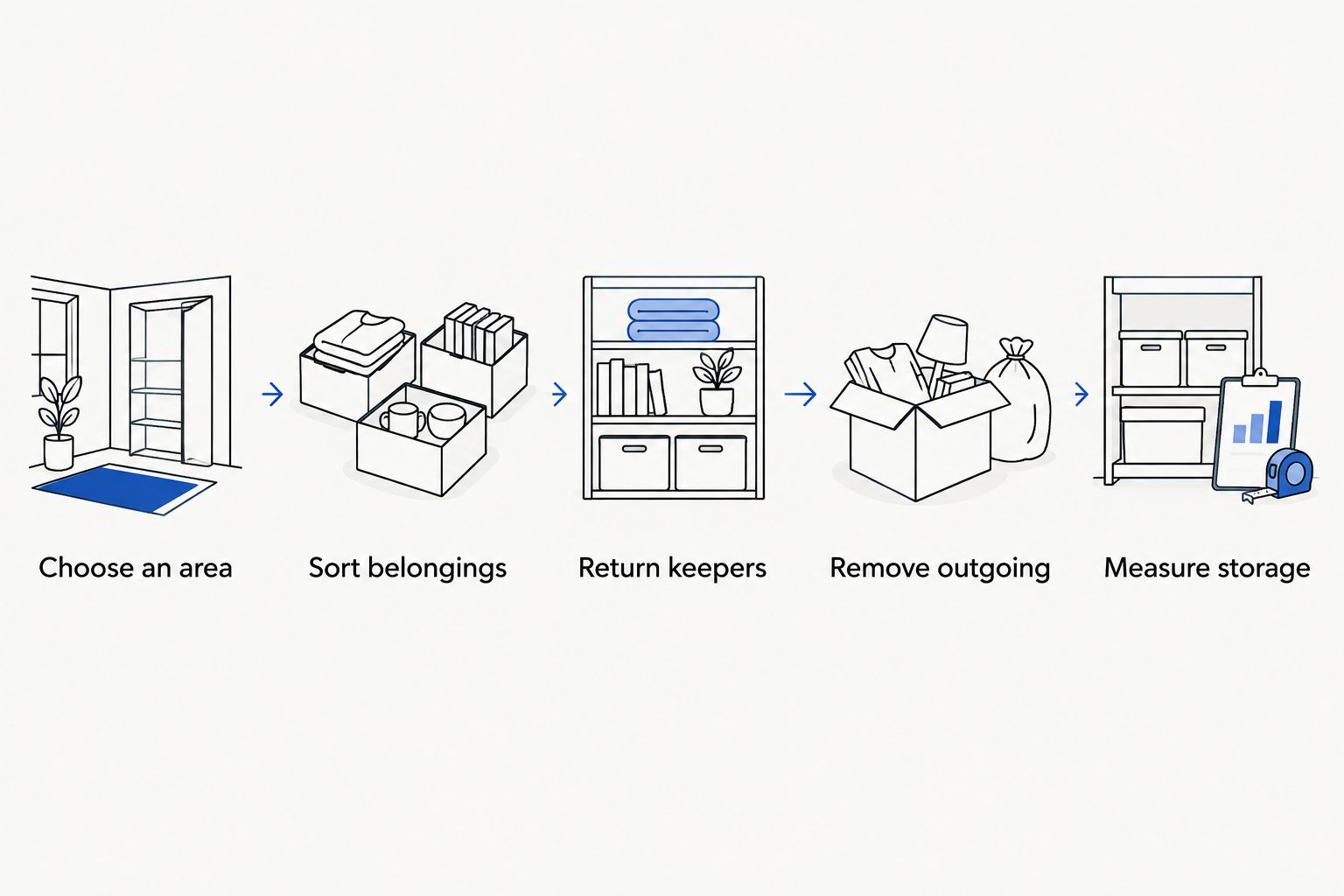
You do not need every tool in this guide. If your main obstacle is unfinished donations, focus on the donation bag and handoff task. If you keep buying organizers that do not fit, finish sorting and measure first.
FAQ
What’s the best decluttering tool for a beginner?
Sorting boxes are the best starting tool for beginners who need help separating belongings by destination. StashSavvy recommends using existing containers before buying permanent storage.
Do I need to buy organizers before decluttering?
No, sort your belongings before choosing permanent organizers. Once you know what stays, measure the available space and choose storage that fits those items.
What should I put in a beginner decluttering kit?
Start with sorting containers, a suitable donation bag, and a timer you already own. Add a short checklist if you need help remembering the final removal tasks.
Is a decluttering app better than a paper checklist?
A decluttering app is a better fit when you prefer digital tracking and need notes across sessions. A paper checklist suits a small task without account setup or screen time.
How long should my first decluttering session last?
Try 10 minutes of sorting followed by 5 minutes of reset as a starting schedule. Adjust the duration to your task and leave enough time to return retained belongings and clear outgoing items.
Do I need a label maker to organize my home?
No, temporary paper labels or suitable tape and a marker can identify sorting categories. Consider permanent labels only after the categories and storage locations are settled.
What decluttering tools work in a rental?
Sorting boxes, bags, checklists, timers, and freestanding trays work without permanent installation. Check surface suitability before using adhesive and obtain permission before making alterations.
One last thing
A full donation bag is not a finished donation. Before ending your session, write down its next action: check acceptance, arrange collection, or plan delivery.
For your next 2026 project, judge success by a usable space and completed destinations—not by the number of containers you filled. Finish the exit task before opening another area.
Related guides
- Closet organizer systems for your next storage step
- Pantry organization systems
- Kitchen cabinet organizers