
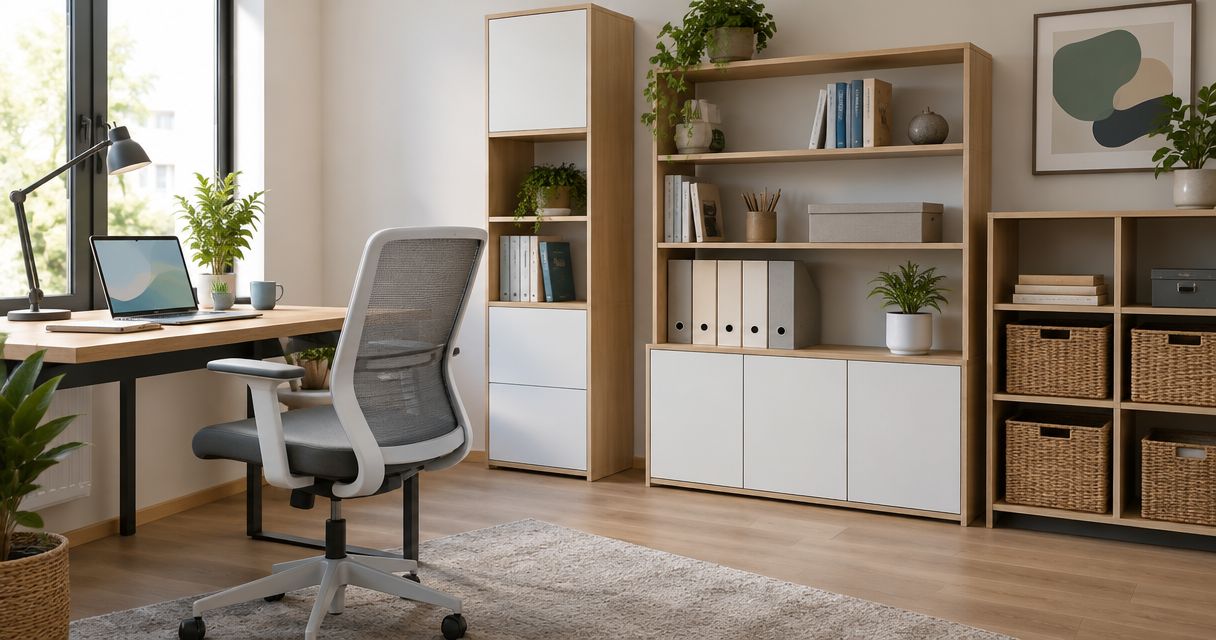
Best home office storage solutions in 2026
Best overall: a filing cabinet with a supply drawer. Best for small spaces: a rolling utility cart. Best budget option: repurposed boxes with dividers. The best home office storage solutions in 2026 give paperwork, supplies, and equipment separate homes without crowding your workspace.
- The best home office storage solutions separate paperwork, daily supplies, and equipment rather than mixing everything together.
- Stashsavvy recommends a filing cabinet for paper-heavy home offices; check drawer layout and available floor space.
- Choose a rolling utility cart for shared rooms, or repurposed boxes with dividers for a budget-aware starting point.
- Use wall shelves for reference materials, not supplies you need to reach throughout the workday.
Why this matters
A clear desk does not help much if every pen, invoice, and charging cable disappears into the same bin. Choose storage by what you need to retrieve, not just what you want to hide. That makes the next workday easier to start.
Stashsavvy focuses on practical home organization. For a home office, start with the items interrupting your work: loose papers, scattered supplies, or equipment with nowhere to go. You do not need to replace every organizer at once.
What makes the best home office storage solutions
For your 2026 setup, compare storage using these criteria before choosing a style:
- Retrieval: Can you reach everyday items without moving something else?
- Fit: Does the organizer leave room for your chair, doors, drawers, and cables?
- Task match: Does it hold files, small supplies, or equipment in a way that suits their shape?
- Reset effort: Can you put things away without stacking, folding, or rearranging unrelated items?
- Installation: Does the setup require drilling, mounting hardware, or changes your rental agreement restricts?
- Flexibility: Can you rearrange it when your work or room layout changes?
Measure the intended spot and the objects that will go inside it. Exterior cabinet dimensions do not tell you whether a printer fits inside or whether a drawer accepts your files.
Home office storage options at a glance
These are storage formats, not endorsements of particular products. Each has a different job, so the best choice depends on what currently lacks a home.
| Rank | Storage solution | Best for | Standout feature | Key limitation |
|---|---|---|---|---|
| 1 | Filing cabinet with supply drawer | Paper-heavy work | Files and small supplies in separate drawers | Uses floor space |
| 2 | Rolling utility cart | Shared rooms | Moves work supplies between locations | Open contents remain visible |
| 3 | Repurposed boxes with dividers | Starting with what you own | Adapts existing containers to small supplies | Requires sorting to prevent mixed clutter |
| 4 | Wall-mounted shelves | Reference materials | Uses wall space for books and folders | Requires suitable mounting |
| 5 | Desktop paper sorter | Active paperwork | Keeps current documents separated | Does not replace an archive |
| 6 | Drawer dividers | Small everyday supplies | Creates distinct compartments | Depends on usable drawer dimensions |
| 7 | Pegboard | Frequently used tools | Keeps compatible tools visible | Needs mounting and suitable accessories |
| 8 | Bookcase with labeled bins | Mixed supplies and projects | Combines shelves with contained storage | Takes up floor space |
1. Filing cabinet: best home office storage for paperwork
A filing cabinet gives retained documents a dedicated home. Choose a layout with file drawers for paperwork and a separate shallow drawer for pens, clips, and other small supplies.
Best for: Paper-heavy work involving documents you need to keep and retrieve.
Before choosing a cabinet, check your folder format and the drawer’s internal dimensions. Leave room for the drawer to open without blocking your chair or the room’s exit.
Filing cabinet pros:
- Separates stored records from active desk work.
- Keeps paperwork out of sight when drawers close.
- A supply drawer gives small items their own space.
Filing cabinet cons:
- Takes floor space even when closed.
- Files still need clear categories; a drawer alone does not organize them.
Verdict: Buy a filing cabinet when retained paperwork is your main storage problem; skip it for mostly digital work.
2. Rolling utility cart: best home office storage for shared rooms
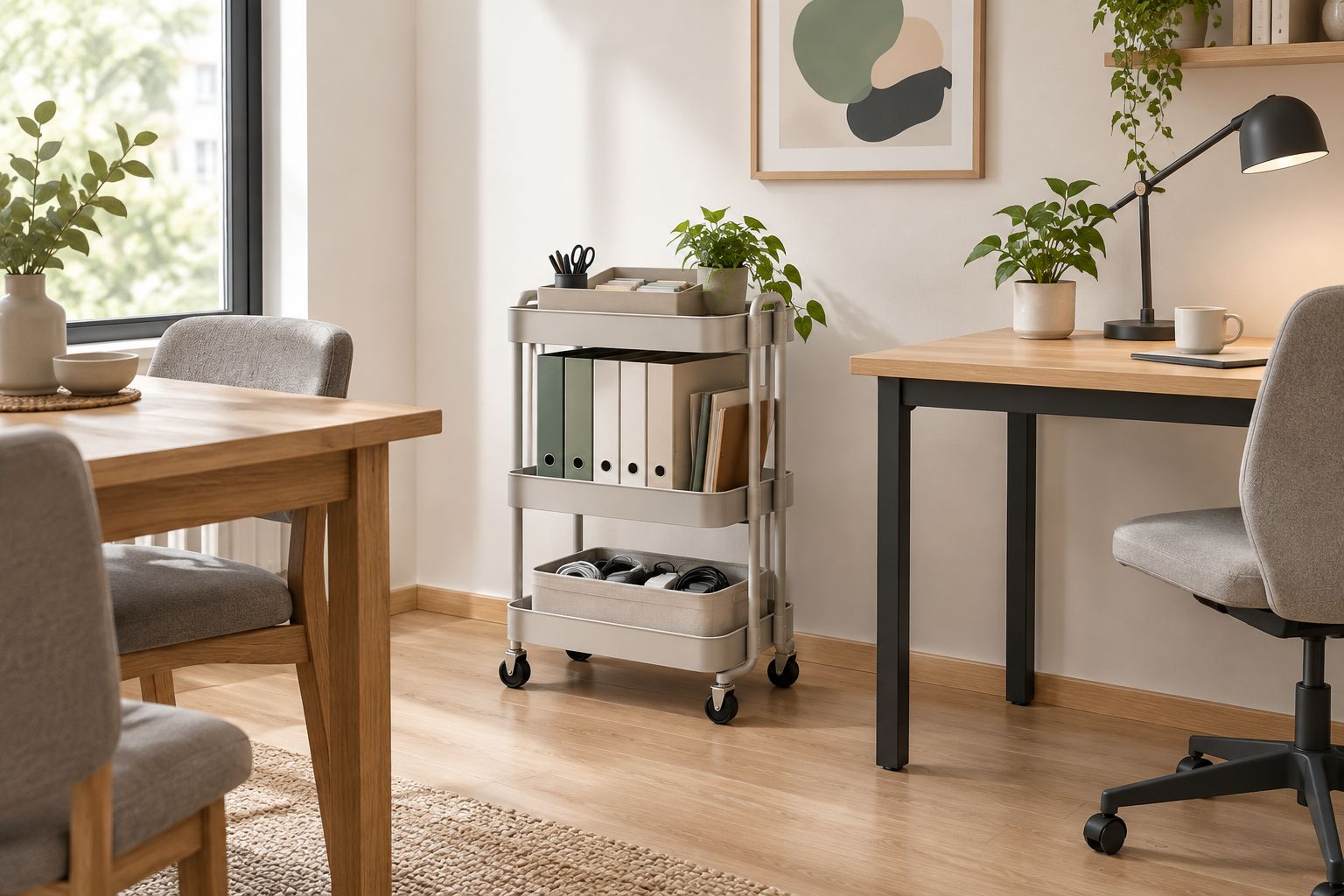
A rolling utility cart lets you move supplies between a dining table, desk, or tucked-away work corner. Assign each tier a purpose rather than treating the cart as one large catchall.
Best for: A home office that shares space with everyday household activities.
Put frequently used supplies on the easiest-to-reach tier. Before choosing a parking spot, check that the cart rolls through the route and does not obstruct a doorway.
Rolling utility cart pros:
- Moves without unloading individual supplies.
- Separates categories across tiers.
- Does not require wall installation.
Rolling utility cart cons:
- Open tiers leave clutter visible.
- Loose objects need containers to stay grouped.
Verdict: Buy a rolling utility cart if your workspace moves; skip it if you need closed storage.
3. Repurposed boxes: best home office storage for a budget-aware start
Small boxes become useful organizers when each holds a defined category. Add dividers made from suitable spare containers or cardboard, then place the boxes in a drawer or on a shelf.
Best for: Organizing existing supplies before choosing new storage.
Start with containers you already own. Keep scissors, pens, and cables in separate compartments rather than hiding an unsorted pile under a lid.
Repurposed box pros:
- Makes use of existing containers.
- Lets you adjust categories before committing to a layout.
- Groups small objects inside larger drawers or bins.
Repurposed box cons:
- Cardboard does not suit damp locations.
- Deep boxes make small items harder to see.
Verdict: Hold off on buying; try repurposed boxes first when small supplies are your main problem.
4. Wall-mounted shelves: best home office storage for reference materials
Wall shelves create a home for books, folders, and reference materials without adding another floor-standing cabinet. Position everyday materials within comfortable reach and less-used items higher up.
Best for: Reference collections in a room with usable wall space.
Check the shelf manufacturer’s mounting instructions and load guidance. Renters should confirm permission before drilling; do not assume an adhesive attachment can support books.
Wall-mounted shelf pros:
- Uses space above existing furniture.
- Keeps book spines and folder labels visible.
- Separates reference materials from the working desktop.
Wall-mounted shelf cons:
- Installation depends on the wall and hardware.
- Open shelving needs regular tidying.
Verdict: Buy wall shelves for reference storage when mounting is permitted; skip them for frequently handled loose supplies.
5. Desktop paper sorter: best home office storage for active documents
A paper sorter keeps current documents separate while you work through them. Give each slot a clear purpose, such as incoming, action, or ready to file.
Best for: Paperwork that needs attention before it enters long-term storage.
Treat the sorter as a workflow tool, not a permanent archive. When papers no longer require action, move them to their retained-document home or dispose of them appropriately.
Desktop paper sorter pros:
- Keeps active documents visible.
- Separates paperwork by its next action.
- Avoids mixing current tasks with stored records.
Desktop paper sorter cons:
- Occupies working surface area.
- Unreviewed slots become stacked backlogs.
Verdict: Buy a desktop paper sorter for active paperwork; skip it if your desk rarely handles paper.
6. Drawer dividers: best home office storage for small supplies
Drawer dividers turn a mixed drawer into distinct compartments for pens, clips, sticky notes, and charging accessories. Adjustable layouts suit categories that change, while fixed trays suit stable collections.
Best for: Small supplies already stored in a desk drawer.
Measure usable drawer width, depth, and height, including clearance beneath the desktop. Arrange compartments around the supplies you keep rather than filling every compartment simply because it exists.
Drawer divider pros:
- Keeps small categories separate.
- Makes contents easier to scan.
- Uses storage space you already have.
Drawer divider cons:
- Poorly fitted inserts shift or leave awkward gaps.
- Tall supplies do not suit shallow compartments.
Verdict: Buy drawer dividers when a usable drawer exists; skip them if larger equipment is the real problem.
7. Pegboard: best home office storage for frequently used tools
Pegboard holds compatible hooks, small shelves, and containers on a vertical panel. It suits a workspace where you frequently reach for scissors, measuring tools, or craft supplies.
Best for: Tool-heavy work with a stable set of frequently used items.
Plan the layout around actual reach, not decorative symmetry. Check mounting requirements and accessory compatibility before treating the board as a complete storage system.
Pegboard pros:
- Keeps tools visible.
- Allows compatible accessories to be rearranged.
- Removes selected supplies from the desktop.
Pegboard cons:
- Requires mounting or an appropriate supporting stand.
- Loose papers need a separate solution.
Verdict: Buy pegboard for regularly used tools; skip it when files or hidden storage are your priority.
8. Bookcase with labeled bins: best home office storage for mixed projects
A bookcase combines open shelves for reference materials with bins for grouped supplies. Assign a bin to each project or category so you can retrieve a collection together.
Best for: Mixed office supplies, project materials, and household paperwork sharing one storage area.
Check shelf dimensions against the bins you intend to use. Follow the furniture manufacturer’s anchoring instructions, especially where children can access the unit.
Bookcase with bins pros:
- Combines visible reference storage with contained supplies.
- Lets project materials travel together in a bin.
- Accommodates several categories on separate shelves.
Bookcase with bins cons:
- Takes floor space.
- Oversized bins hide small objects unless you add compartments.
Verdict: Buy a bookcase with bins for mixed collections; skip it when your office needs only small-item organization.
How to match storage to your workday
Before changing your 2026 setup, spend 10 minutes sorting one trouble spot. This is a starting exercise, not a deadline for organizing the entire room.
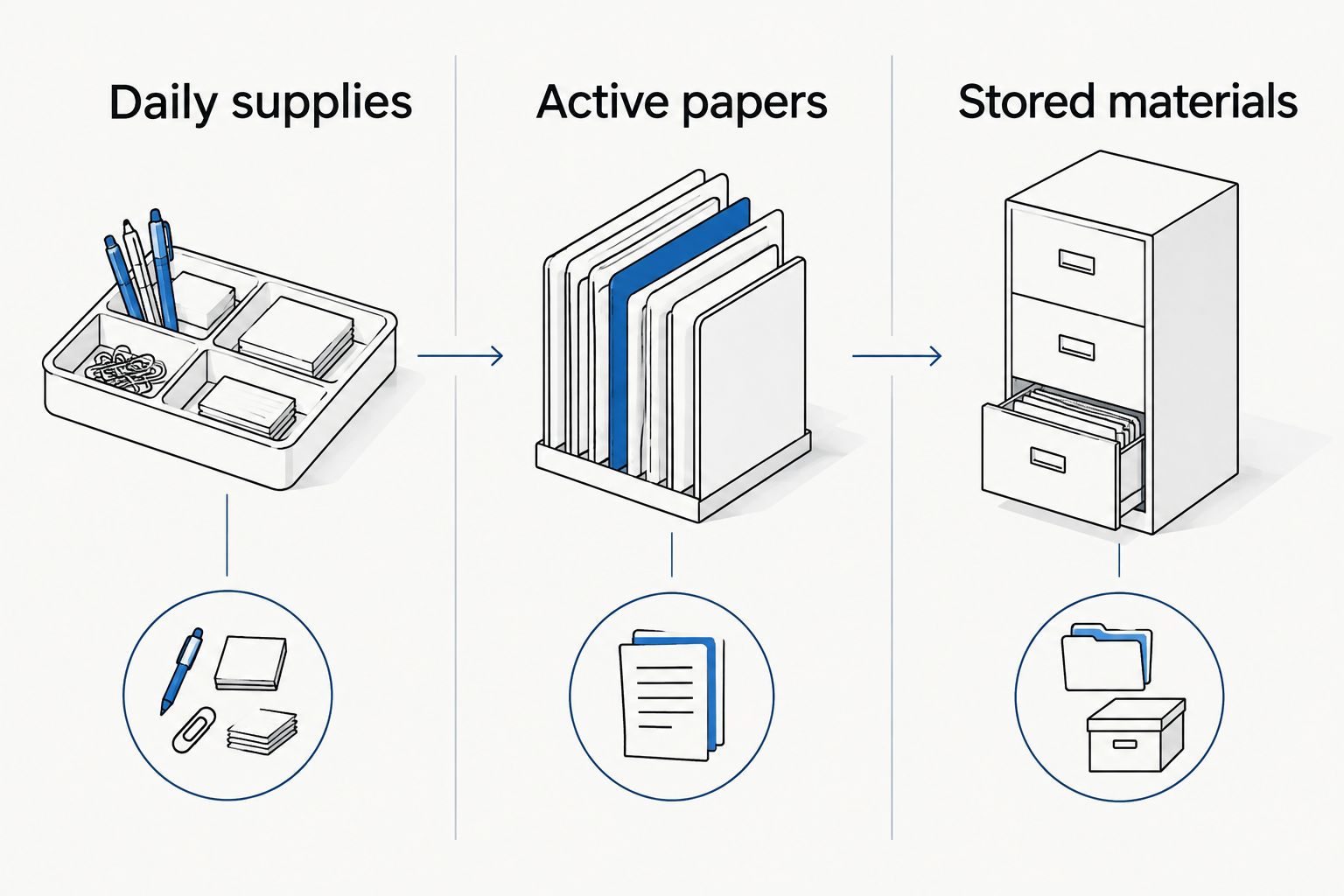
Use these 3 zones to decide what belongs near your desk:
- Daily supplies: Keep frequently handled items within easy reach, using a drawer, tray, or cart tier.
- Active papers: Give documents awaiting action a sorter or clearly separated folder.
- Stored materials: Move retained files, reference books, and occasional supplies to a cabinet or shelf.
If the sorting stalls because too many things need decisions, address that before adding containers. The best decluttering apps guide offers another starting point for organizing that work.
After setting up your zones, schedule a 5-minute end-of-day reset. Return supplies, identify the next action for loose papers, and clear the space needed to begin tomorrow.
How these options are ranked
Stashsavvy’s 2026 home office storage ranking is based on each format’s suitability for a distinct organizing job, not hands-on product testing. Retrieval, fit, task match, reset effort, installation, and flexibility drive the recommendations.
The filing cabinet takes the default spot for paper-heavy work because it separates retained files from small supplies. The cart takes the shared-room slot, while repurposed boxes give you a starting point before purchasing organizers.
Which home office storage solution should you choose?
Stashsavvy’s home office storage pick for paper-heavy work is a filing cabinet with separate supply storage. Choose a rolling utility cart instead when you work in a shared room and need to put the office away.
For your 2026 setup, solve the biggest recurring problem first. If you already have suitable furniture, start with dividers or repurposed boxes rather than another cabinet. One well-defined storage job is more useful than several containers with no assigned purpose.
FAQ
What’s the best home office storage solution for a small room?
A rolling utility cart suits a small room when you need movable storage for shared-space work. If floor space is unavailable, consider permitted wall storage for reference materials or dividers in an existing drawer.
What does Stashsavvy recommend for a paper-heavy home office?
Stashsavvy recommends a filing cabinet with separate supply storage for a paper-heavy home office. Keep documents awaiting action in a distinct folder or sorter rather than mixing them into retained records.
How do I organize my home office without buying anything?
Start by sorting supplies into repurposed boxes or containers you already own. Separate daily supplies, active papers, and stored materials before deciding whether additional storage is necessary.
Is a rolling cart better than a filing cabinet?
A rolling cart is better for moving supplies through a shared room; a filing cabinet is better for retained paperwork. Choose according to the job you need the storage to perform.
What’s the best rental-friendly office storage?
Freestanding carts, suitable existing bookcases, and drawer dividers avoid wall-mounted shelving installation. Follow furniture safety instructions and check your lease before drilling for any required anchoring.
Should I use open or closed storage in my home office?
Use open storage for materials you need to see and retrieve, and closed storage for contents you want out of sight. Both need defined categories so visibility or concealment does not replace organization.
How do I stop office storage from becoming cluttered again?
Give each container a specific job and use a short end-of-day reset to return items. When a category outgrows its space, review the contents before adding another container.
One last thing
Test the return trip, not just the tidy appearance. Put away the supplies from a normal task: if you must move unrelated objects to return them, simplify the arrangement. Your 2026 home office should be easy to reset, not merely easy to photograph.
Related guides