
15 Small-Space Storage Hacks for Apartments and Tiny Rooms
Small-space storage works best when you use overlooked areas instead of adding bulky furniture. In apartments, small bedrooms, and compact homes, useful options include vertical wall storage, under-bed space, doors, corners, and furniture that serves more than one purpose.
The 15 ideas below focus on practical ways to increase usable storage while keeping frequently used items accessible. Choose solutions based on the room, available clearance, whether you rent or own, and how often you need to reach the stored items.
These 15 proven storage hacks go beyond basic organizing tips—they’re engineering-smart solutions that transform dead zones into storage goldmines. From mechanical systems that multiply capacity to hidden storage that preserves aesthetics, these techniques have been tested in real homes where every inch counts and actually deliver lasting organization.

1. Use Wall-Mounted Shelves Above Furniture

Transform your staircase into a literary paradise by installing custom-built bookshelves within each step. This ingenious hack doesn’t just store books—it creates a stunning visual cascade of color and knowledge flowing up your stairs. The key is using the often-wasted triangular space beneath each step, turning structural necessity into storage brilliance.
Wall-mounted shelves above a sofa, desk, or other furniture can hold books and decor without using additional floor space. Keep heavier items on securely mounted lower shelves, follow bracket and anchor load limits, and avoid placing breakable objects where they could fall onto seating or walkways.
The engineering marvel lies in the weight distribution—each step becomes a cantilever shelf supporting both foot traffic and book weight. Use marine-grade materials to handle the constant stress, and consider installing a subtle book-stop system to prevent spills during daily use. This transforms the most-used vertical space in your home into the most functional.
2. Add High Shelves for Infrequently Used Items

High wall shelves can use space above doors, desks, or other furniture for items you do not need every day. Mount shelves into suitable framing or use hardware rated for the wall type and expected load, and avoid placing heavy or fragile items where a fall could cause injury.
Use high shelves for lightweight seasonal items, spare linens, or labeled containers that do not need daily access. Keep frequently used items lower, and avoid storing heavy, fragile, or hazardous objects directly above beds, seating, or busy walkways.
Use high shelves for lightweight items that are needed only occasionally. Near an entryway, everyday essentials are better kept in an easy-to-reach wall organizer, tray, or hook system rather than stored overhead.
3. Install Fold-Down Wall Storage
A fold-down wall shelf or cabinet can provide temporary work or storage space without permanently occupying the floor area. Choose a unit designed for wall mounting, install it according to the manufacturer’s instructions, and keep the folding path clear.
The mechanical brilliance lies in the Japanese-inspired folding mechanism—each panel contains integrated storage pockets that organize themselves as the wall unfolds. Seasonal clothing, sports equipment, or craft supplies remain perfectly organized within their individual accordion sections. When collapsed, the wall appears completely normal, maintaining your room’s aesthetic while secretly harboring massive storage capacity.
Fold-down storage works best when the unit stays shallow enough for the room and opens without blocking doors or walkways. Keep the area beneath it clear, use hardware rated for the intended load, and close the unit when it is not needed.
4. Use Under-Bed Storage Containers
Under-bed containers use existing floor space without requiring structural changes. Measure the clearance beneath the bed before buying bins, and choose low-profile containers with handles or wheels if you need to access the contents regularly. For more examples, explore these under-bed storage ideas.
The engineering requires careful waterproofing and ventilation systems to prevent moisture issues, but the result is storage that literally disappears beneath your feet. Wine collections, seasonal decorations, or emergency supplies rest safely below while your living space maintains its minimalist aesthetic. Walking on glass-topped storage creates an almost futuristic sensation of floating above your belongings.
For everyday under-bed storage, no structural modification should be necessary; use containers that fit the existing clearance and can be removed without damaging the bed or flooring. Each sunken area can hold the equivalent of a large closet’s worth of items while contributing to the room’s functionality as furniture. The wow factor comes from revealing the hidden chambers—watching guests’ reactions as you lift floor panels to access your secret storage vaults never gets old.
5. Add a Corner Shelving Unit
An unused corner can become practical storage with a narrow corner bookcase, triangular shelves, or a shelving unit designed to fit the available wall space. The floor-to-ceiling tower rotates 360 degrees on precision bearings, bringing any stored item to the front with a gentle push. Multiple tiers create specialized zones for different categories while the sleek cylindrical design adds architectural interest rather than visual clutter.
Each rotation reveals new storage faces—one side might hold shoes, another books, another kitchen appliances—all within the same footprint as a traditional corner shelf. The mechanical system uses furniture-grade lazy Susan hardware scaled up to support substantial weight while maintaining smooth operation. This transforms the most problematic corner into the most functional storage in your home.
The aesthetic impact cannot be overstated: a sleek column that appears to be architectural detailing actually houses the storage equivalent of multiple closets. Smart design includes soft-stop mechanisms to prevent over-rotation and integrated LED lighting that follows the rotation, always illuminating the current storage face. It’s like having a personal vending machine disguised as modern architecture.
6. Choose a Kitchen Cart with Storage
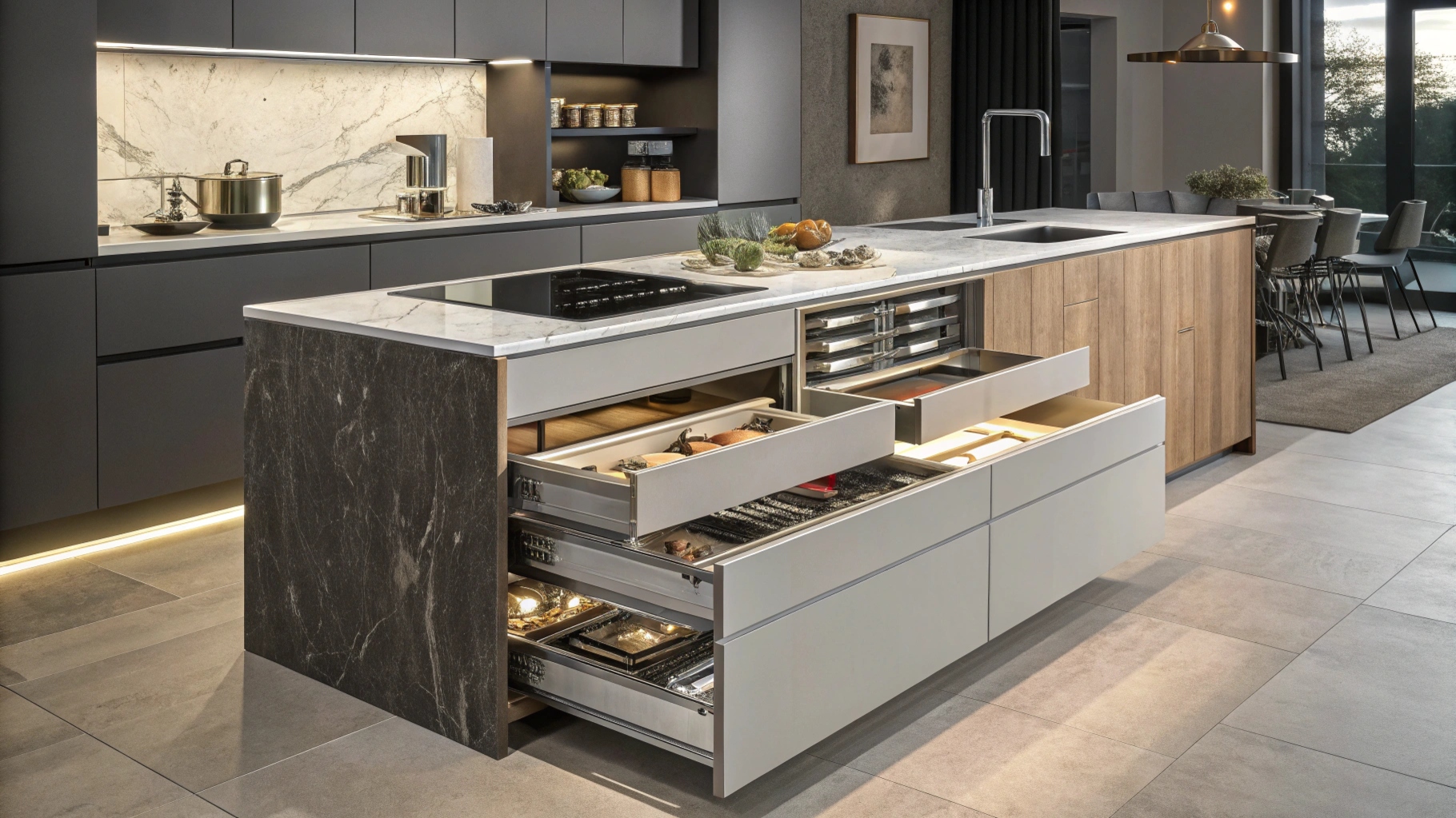
A compact kitchen cart can add both work surface and storage without requiring a permanent island. Look for shelves, drawers, or cabinets sized for the items you use most often, and choose locking casters if the cart needs to move between work areas.
Use the lower shelves of a kitchen cart for heavier cookware or small appliances, while keeping lighter and frequently used items in easier-to-reach areas. Use separate shelves, drawers, or baskets to group cookware, utensils, and pantry items by purpose. A movable cart can adapt to different kitchen tasks that adapts to different cooking and entertaining needs.
Choose a cart made for kitchen use, follow its stated load limits, and keep wheels locked while preparing food or using appliances on the work surface. Open shelves work well for frequently used cookware, while drawers or cabinets can keep smaller items contained and the work area easier to organize.
7. Use a Pegboard or Modular Wall Organizer
A pegboard or modular wall organizer can turn an unused section of wall into flexible storage for lightweight tools, accessories, baskets, or small containers. Unlike traditional mounted systems, this approach uses the entire wall surface as mounting real estate—containers can be positioned at any height or configuration, moved seasonally, or reorganized in minutes without tools.
A pegboard or modular wall organizer can provide adjustable storage across an unused section of wall. Add hooks, small baskets, shelves, or compatible containers based on what you need to store, and keep heavier items within the system’s stated load limits.
Visual impact comes from the clean, floating appearance of storage containers that seem to hover against the wall without visible mounting hardware. The system works particularly well in closets, craft rooms, or garages where storage needs change frequently. Children’s rooms benefit enormously—storage can literally grow and adapt as kids age, with containers moving higher as reach increases.
8. Use Clear Bins in Low Storage Areas
Clear bins can make low storage areas easier to use because the contents remain visible without opening every container. They work well beneath beds, benches, low shelves, or other accessible spaces where the bin dimensions fit without blocking walkways or vents.
The tubes can connect different rooms, allowing items to be sent through the house via the underground network. Imagine loading seasonal clothing at one end and having it appear in a bedroom closet across the house. The visual spectacle of items moving through transparent tunnels beneath your feet creates a futuristic living environment that feels more like a luxury spaceship than a traditional home.
Implementation requires careful structural planning and waterproofing, but the result revolutionizes how we think about moving and storing belongings. The tubes can incorporate curves, elevation changes, and even vertical sections, creating a three-dimensional storage and transport network that maximizes space efficiency while providing endless entertainment value.
9. Add Slim Storage Beside Appliances

A narrow rolling cart or slim pull-out organizer can use the gap beside a refrigerator, washer, or other appliance when the manufacturer’s required clearances remain unobstructed. Use it for lightweight items that are easy to reach, and do not block ventilation, electrical access, water connections, or appliance movement.
Measure the gap beside an appliance carefully before adding a slim cart or organizer. Keep manufacturer-required ventilation, cords, hoses, outlets, and service access unobstructed, and choose a unit that can be removed easily for cleaning.
Slim storage beside an appliance works best for lightweight supplies that fit the available gap without blocking required clearance. Keep the organizer easy to remove for cleaning and appliance service, and follow the appliance manufacturer’s spacing and ventilation requirements.
10. Choose Furniture with Built-In Storage

Individual furniture pieces communicate with each other through hidden connection systems, allowing ottomans to become coffee table extensions, side tables to nest inside sofas, and dining chairs to stack into sculptural towers when not needed. This modular approach means every piece serves multiple storage and functionality purposes while maintaining sophisticated aesthetics.
The genius lies in standardized connection points hidden within each piece—furniture can be reconfigured for different occasions, seasons, or room layouts in minutes. A dinner party might require all pieces in dining configuration, while a movie night converts everything into a sectional sofa with integrated storage. The furniture literally shape-shifts to meet changing needs.
Hidden casters and connection mechanisms allow heavy pieces to move and connect easily, while storage compartments within each piece maximize utility. The visual impact of transforming furniture creates dynamic living spaces that feel much larger than their square footage suggests. Guests are amazed watching a coffee table separate into four ottomans or seeing dining chairs nest into a sculptural storage tower.
11. Combine Wall Storage with Plant Shelves

Living walls serve double duty as both air purification and clever storage systems, with specially designed planters that include hidden compartments for small items. The vertical garden structure incorporates storage pockets, hooks, and small shelves disguised within the plant display, creating a biophilic storage solution that improves air quality while organizing belongings.
Custom planters include sealed compartments perfect for items like keys, phones, or small tools, while the irrigation system doubles as a cooling mechanism for electronics stored within. The living wall structure supports heavier items through integrated mounting points hidden behind foliage. This approach transforms storage from an aesthetic liability into a beautiful, functional living feature.
The psychological benefits extend beyond mere organization—interaction with plants while retrieving items creates moments of calm in daily routines. The system works particularly well in entryways, offices, or kitchens where frequently used small items can be stored within easy reach while contributing to a healthier indoor environment.
12. Use Labeled Bins on Vertical Shelving
Use labeled bins on a tall shelving unit to take advantage of vertical space without making everyday items difficult to find. Keep frequently used containers between waist and eye level, place lighter or seasonal items higher up, and use labels that are easy to read from the floor.
The network includes stations in key locations—kitchen, bedroom, office, laundry room—each with send and receive capabilities. Lightweight items like keys, phones, documents, or small tools travel through the system in seconds. The visual impact of capsules whooshing through transparent tubes creates a futuristic living experience while solving practical transportation challenges in multi-story homes.
Installation involves running transparent tubing through walls and between floors, with quiet air compressor systems providing the transportation power. Each station includes storage for capsules and simple controls for directing items to specific destinations. The system eliminates the need to carry items between floors while providing entertainment value that never gets old.
13. Use Stackable Dispensers for Small Items

Stackable bins or small wall-mounted organizers can keep craft supplies, pantry packets, hardware, or accessories separated without using much floor space. Choose containers that fit the items being stored and keep frequently used contents within comfortable reach.
The system works particularly well for items that benefit from first-in-first-out rotation—batteries stay fresh, craft supplies remain accessible, and seasonal items naturally cycle through. Custom dispensers can be sized for any item category, and transparent construction allows visual inventory management. The mechanical simplicity means no power required and minimal maintenance.
Multiple dispensers can create entire walls of organized storage that function like a personal convenience store. The visual impact of seeing organized items in clear dispensers creates satisfaction while eliminating the chaos of traditional storage methods. Loading is easy, access is immediate, and inventory management becomes automatic.
14. Use Collapsible Storage Bins and Bags
Collapsible bins and zippered storage bags are useful when you need containers that can be folded down between uses. Choose sizes that fit the available shelf, closet, or under-bed space, and avoid overfilling soft-sided containers so they remain easy to move and close.
The technology uses architectural-grade inflatable materials that maintain rigid walls when pressurized, creating storage spaces that feel solid and secure. Integrated shelving systems inflate along with the walls, providing immediate organization. The chambers can be climate-controlled and include lighting systems, making them fully functional storage rooms that appear and disappear as needed.
Collapsible containers are especially useful for seasonal storage because they can be folded down when empty. Label each container before storing it, keep heavier contents in sturdier bins, and place frequently needed seasonal items where they can be reached without moving several other containers.
15. Keep a Simple Storage Inventory
A simple storage inventory can make it easier to remember where seasonal or infrequently used items are kept. For more ways to use overlooked areas efficiently, see these hidden storage ideas for small spaces and hidden storage ideas for small apartments.
The system includes wearable devices that highlight the exact location of requested items through projected arrows and highlights visible on walls, containers, and shelves. Voice commands instantly locate any stored item and guide you directly to its location. The visual interface can also suggest optimal storage arrangements based on usage patterns and seasonal needs.
A simple inventory can be kept in a notes app, spreadsheet, or labeled list. Record the container or storage area for seasonal and infrequently used belongings, and update the list when items move so you can find them without opening every bin.
How to Organize Advanced Small Space Storage Systems
Universal Organization Principles for All Storage Types
The Zone-Based Categorization Method
Organize all storage systems using the 5-Zone Principle: Daily Use (items used multiple times per day), Weekly Use (1-3 times weekly), Monthly Use (occasional access), Seasonal Use (quarterly rotation), and Archive (rarely accessed but must keep). This hierarchy determines placement within any storage system—daily items get prime real estate while archive items occupy harder-to-reach spaces.
Weight and Size Distribution: Always place heavier items at bottom levels and lighter items higher up, regardless of the storage system type. This applies to rotating columns, hydraulic islands, and vertical systems alike. Create a 60-30-10 rule—60% frequently used items in easy-access areas, 30% moderate-use items in secondary positions, and 10% rarely-used items in remote locations.
Visual Inventory Management: Use clear containers whenever possible, and implement color-coding systems that work across all storage types. Assign specific colors to categories (blue for electronics, green for documents, red for emergency items) so items can be quickly identified regardless of which storage system houses them.
Storage-Specific Organization Strategies
For Shelves, Carts, and Wall-Mounted Storage
Corner Storage: Keep frequently used items on the easiest-to-reach shelves and reserve higher or deeper areas for lighter, less frequently used belongings. Avoid overloading narrow shelving, and anchor tall units when appropriate.
Weight Distribution: Keep heavier items on lower shelves or in lower compartments and lighter items higher up. Follow the manufacturer’s load limits for shelves, carts, brackets, anchors, and other storage hardware, and secure tall furniture to the wall when appropriate.
Maintenance Access: Always reserve one section of mechanical storage for maintenance supplies and tools needed for the system itself. This ensures you can perform routine maintenance without dismantling the entire organization scheme.
For High Shelves and Wall-Mounted Storage
Gravity Considerations: Organize ceiling and high-mounted storage with fail-safe principles—nothing that could cause injury if it falls should be stored overhead. Use secondary safety catches for items above head height, and regularly inspect mounting integrity.
Access Patterns: Create retrieval zones at different heights based on user height and frequency needs. Items needed daily should be within normal reach, weekly items require step-stool access, and seasonal items can occupy the highest zones. Mark optimal heights with discrete indicators.
Mounting Safety: Follow the shelf, bracket, anchor, and wall-system manufacturer’s installation instructions and load limits. Use mounting hardware appropriate for the wall construction, and get qualified help when the installation requires structural changes or you are unsure what is behind the wall.
For Hidden and Camouflaged Storage (Floor Storage, Appliance Walls, Convertible Furniture)
Memory Mapping: Create visual or digital maps showing exactly what’s stored in each hidden compartment. Hidden storage only works if you remember what’s hidden where. Use smartphone photos or simple sketches taped inside main cabinets as quick reference guides.
Access Sequence Planning: Organize hidden storage considering the physical steps required for access. Frequently needed items shouldn’t require moving other items or performing complex opening sequences. Create one-motion access for daily items and accept multi-step access only for seasonal storage.
Backup Organization: Hidden storage should have backup organization systems for when primary users aren’t available. Label systems using neutral terms that anyone can understand, avoiding personal coding systems that confuse family members or guests.
Advanced Organization Techniques
The Container Hierarchy System
Level 1 – Primary Containers: Large bins or sections that define major categories (clothes, electronics, documents, seasonal items). These should be labeled clearly and remain in consistent locations within any storage system.
Level 2 – Secondary Sorting: Smaller containers within primary ones that create subcategories (winter clothes, charging cables, tax documents, holiday decorations). These can move between storage systems as needs change.
Level 3 – Micro-Organization: Small dividers, pouches, or compartments that organize individual items within secondary containers. This level prevents small items from becoming lost in larger storage spaces.
Digital Integration Strategies
QR Code Inventory: Place QR codes on storage containers that link to digital inventories accessible via smartphone. This works particularly well for seasonal storage and archive items where contents might be forgotten over time.
Photo Documentation: Maintain photo records of how storage systems are organized, especially for complex arrangements. Take photos before major reorganization sessions to document successful layouts that can be recreated.
Usage Tracking: Keep simple logs of how often different storage areas are accessed. This data helps optimize organization over time, moving frequently accessed items to more convenient locations.
Seasonal Rotation and Maintenance
Quarterly Assessment Protocol
The 15-Minute Rule: Every three months, spend 15 minutes in each storage area assessing what’s actually being used. Items untouched for two seasons should move to longer-term storage or be considered for removal.
Seasonal Swapping: Plan storage organization around seasonal needs rather than permanent placement. Summer items should be easily accessible during summer months, with winter items moved to less convenient locations during the warm season.
System Performance Review: Evaluate how well each storage system is actually working. Mechanical systems may need maintenance, while organization schemes might need adjustment based on changing life patterns.
Safety and Accessibility Standards
Emergency Access: Ensure that at least one storage system in each room can be accessed without power, tools, or complex procedures. Emergency supplies and important documents should never be trapped behind mechanical systems that might fail.
Universal Design: Organize storage considering that different people (children, elderly, guests, people with mobility limitations) might need access. Create multiple access methods where possible, and ensure critical items aren’t dependent on specific physical capabilities.
Load Limits: Clearly understand and respect weight limits for all storage systems, especially mechanical ones. Post weight limits visibly and use bathroom scales to verify loads in containers before placing them in weight-sensitive systems.
The key to successful organization of advanced storage systems lies in treating organization as an ongoing process rather than a one-time setup. Regular assessment, adjustment based on actual usage patterns, and maintenance of both the physical systems and organizational schemes ensures these innovative storage solutions continue providing maximum benefit over time.