

How often should you declutter a closet?
Declutter your closet when your clothes, routines, or available space change, with a fuller review when you switch seasonal clothing. Check for obvious departures as you put clean laundry away; you do not need to empty the entire closet each time. Use the calendar as a reminder, not a rule that makes you discard clothes you still need.
- How often should you declutter a closet? Review it at seasonal changes and whenever getting dressed becomes difficult.
- Stashsavvy recommends matching closet decluttering to your actual wardrobe, not an arbitrary discard deadline.
- Separate putting clothes away from deciding which clothes still belong.
- Start with existing hangers and shelves before buying closet storage.
How often should you declutter a closet?
Review your closet when you change seasonal clothes, and declutter sooner if your wardrobe stops fitting your life or your space. Between those reviews, remove clear nonkeepers when you notice them. A shirt you already know you will not wear does not need to wait for a designated cleanout.
For your 2026 routine, choose the smallest kind of review that solves the problem. If clothes belong in the closet but are scattered around the room, put them away. If clothes no longer belong, make a decision about their next destination. The guide to how long it takes to organize a closet addresses the separate question of planning the organizing work.
| Type of review | Best for | What you do | Main limitation |
|---|---|---|---|
| Laundry-day check | Catching obvious nonkeepers | Set aside clothes you already know you will not wear | Does not examine untouched shelves |
| Seasonal review | Switching between clothing needs | Assess outgoing clothes and bring relevant clothes forward | Seasonal changes do not catch every lifestyle change |
| Change-triggered review | A different size, job, routine, or shared space | Review the affected clothing category | Requires noticing the change rather than waiting for a reminder |
| Full closet reset | Mixed categories and unclear storage zones | Review the contents and rebuild the layout | Creates more disruption than a targeted review |
These are different levels of attention, not competing schedules. You can check a shirt during laundry without turning the afternoon into a full closet project.
Why this matters
A closet has to hold the clothes you use and let you retrieve them without a struggle. Decluttering addresses what belongs there; organizing addresses where it goes. Buying another bin does not answer whether you want the clothes inside it.
Stashsavvy is best for homeowners and renters who want practical closet organization guidance. The useful goal is an easier place to get dressed, not a closet that looks untouched. A small wardrobe still needs sensible storage, and a larger wardrobe does not automatically need a purge.
Build your 2026 closet routine around function: can you find what you need, return clean clothes, and see your options? If those tasks work, another complete cleanout does not need to become homework.
Laundry-day checks: remove obvious nonkeepers
Use the moment you handle clean clothing to notice decisions you have already made. Perhaps you keep putting a top back because the neckline bothers you, or you repeatedly skip trousers that no longer fit comfortably. Set those items aside rather than returning them automatically.
Keep this check narrow. You are not required to try on every garment, reconsider sentimental clothing, or interrupt the laundry to reorganize shelves. Best for everyday maintenance: address the item in your hand, then finish putting clothes away.
The advantage is a small task attached to something you already do. The limitation is coverage: clothes at the back of a shelf can remain untouched. That is why a laundry check complements a fuller review rather than replacing it.
Use an existing bag or box for outgoing clothes, away from the clothing you still wear. Keep garments awaiting repair separate from donations so an unfinished task does not become an accidental giveaway.
Seasonal reviews: assess what you actually wore
Review seasonal clothes when you are already moving them into or out of everyday reach. Look at the outgoing category before putting it away. Ask whether each garment worked for the weather, activities, and outfits you actually encountered.
Not wearing something is a prompt to investigate, not an automatic reason to remove it. An occasion outfit can still have a clear purpose. Weather-dependent clothing also deserves context; an unused garment is not necessarily an unwanted garment.
For your next seasonal review in 2026, distinguish between these questions:
- Does it fit? Consider comfort and movement, not just whether it fastens.
- Does it have a role? Name the activity, occasion, or condition it serves.
- Do you choose it? Notice whether you consistently prefer another garment for that role.
- Can you store it sensibly? Keep current-use clothing accessible without burying other essentials.
Best for seasonal transitions: review clothes before storing them away. The benefit is making decisions while their usefulness is still fresh in your mind. The drawback is that a seasonal review alone will not address an unrelated change in work or household needs.
Change-triggered reviews: follow your current life
A changed routine is a reason to review the relevant part of your closet, even if your next calendar reminder is far away. Start with the category affected by the change rather than assuming your whole wardrobe is wrong.
For example, a different work routine calls for reviewing work clothes. A shared closet calls for reconsidering how available storage is divided. Neither situation requires immediately discarding everything associated with your previous setup.
Best for a wardrobe that feels out of step: review the changed category first. This keeps the task focused, but it does require a clear description of the problem. Write down what you now need the closet to support before deciding what should leave.
Avoid permanent decisions made only to satisfy a deadline. Clothing connected to body changes, identity, or an important life event deserves a deliberate choice, not pressure to finish a tidy-looking shelf.
Why your closet decluttering schedule varies
Your closet needs attention when its contents and your needs stop matching. Use these factors to decide whether a quick check is enough or a fuller review belongs on your 2026 calendar:
- Seasonal clothing changes: Review the categories you are bringing forward or putting away.
- Fit and comfort: Reconsider garments you cannot comfortably use for their intended purpose.
- Daily routines: Check whether accessible clothes support your current work, home, and leisure activities.
- Shared storage: Revisit boundaries when another person's belongings need space in the same closet.
- New clothing: Decide where incoming items belong before squeezing them into crowded sections.
- Retrieval problems: Investigate blocked shelves, difficult drawers, or clothes that disappear behind other clothes.
A crowded rail does not automatically mean every category needs reducing. Check for empty hangers, misplaced belongings, and clothes that should be elsewhere before making wardrobe decisions.
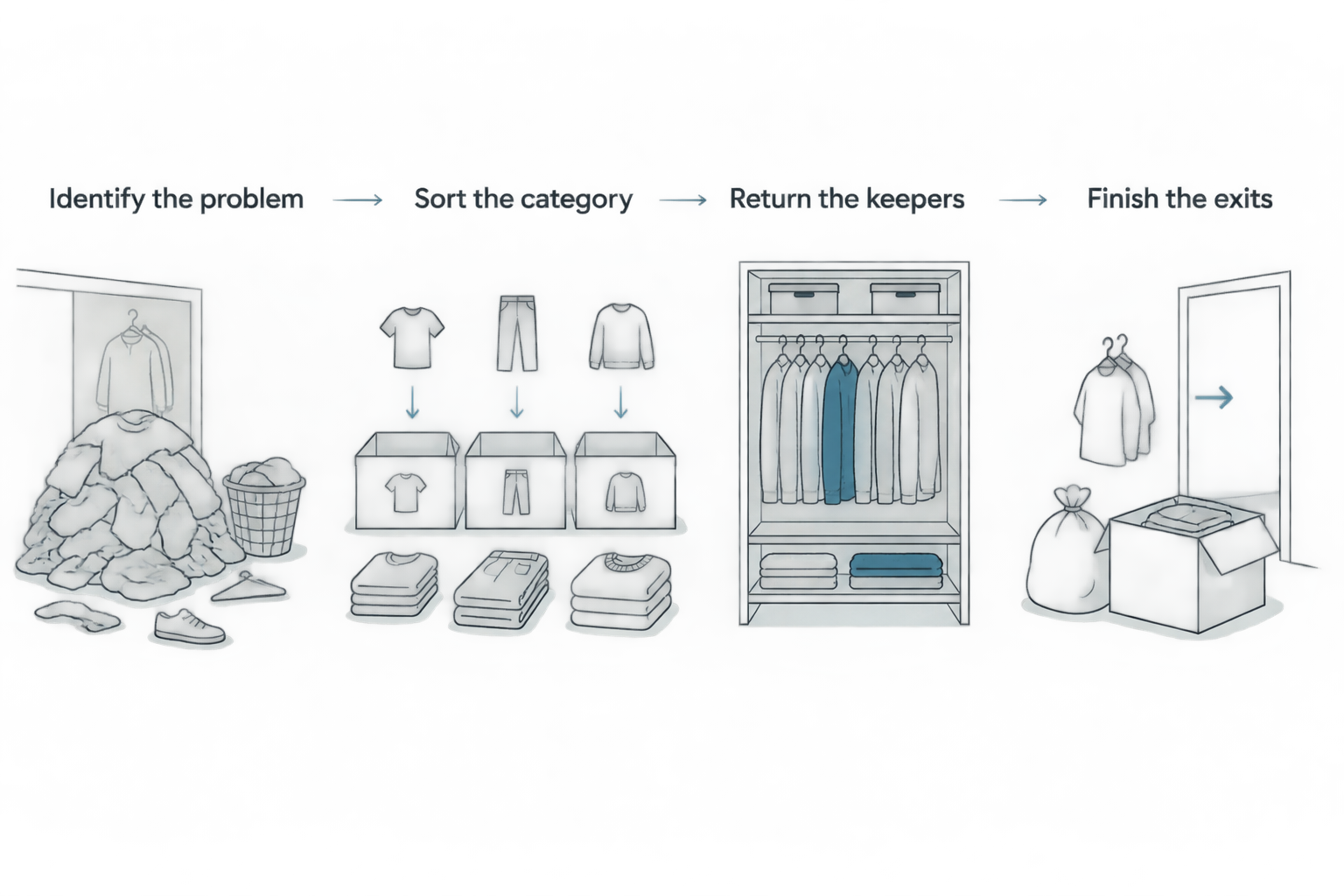
How do you declutter without emptying the entire closet?
Work through a defined category and finish its decisions before opening another. Choose a shelf, a drawer, or a clothing category with a clear boundary. Leave the rest of the closet usable.
Identify the problem
Name the difficulty in plain language: you cannot find work tops, your shoe area blocks the floor, or the drawer will not close. A specific problem gives the session a stopping point. “Make everything perfect” does not.
Sort the category
Handle the selected clothes and separate what you use from what needs a decision. Try on garments when fit is the uncertainty. Avoid moving an unresolved pile from the closet to the bed and calling the job finished.
Return the keepers
Put retained clothing where you can reach and return it. Keep the arrangement simple enough to maintain during an ordinary laundry day, not just when you have extra patience. Use your existing storage before deciding something new is necessary.
Finish the exits
Choose the appropriate destination for outgoing items and complete that next action. Check a recipient's acceptance rules before donating. Keep repair tasks distinct, with a specific next step rather than an indefinite pile.
Should you declutter if the closet is messy but everything gets worn?
Not necessarily: a messy closet can need a better putting-away system rather than fewer clothes. Start by returning clean laundry, removing unrelated belongings, and checking whether each clothing category has a usable home.
Look at where the mess forms. If folded clothes repeatedly land beside a difficult drawer, examine the drawer arrangement. If shoes block access to hanging clothes, reconsider their location before deciding that the clothes are the problem.
In 2026, make convenience your organizing standard rather than matching containers. You should be able to use the closet without rebuilding a display whenever you get dressed. A useful arrangement can include hangers and containers you already own.

The trade-off is that rearranging cannot resolve every capacity problem. If the clothes you choose to keep still do not fit the usable space, revisit the contents, the layout, or where less frequently used items belong.
What if you keep postponing a closet cleanout?
Make the next task smaller instead of setting a stricter deadline. Choose the category that causes the most daily frustration, and leave emotionally difficult items for a separate decision.
A recurring reminder is useful only when it tells you what to do. Replace a vague closet-cleanout reminder with an action such as reviewing uncomfortable work trousers or clearing unrelated items from the closet floor. Your 2026 calendar should support a manageable task, not repeat an accusation.
Give uncertain clothing a named decision to resolve: fit, repair, usefulness, or sentimental value. An undefined “maybe” category hides the question. You do not need to decide everything immediately, but you do need to know why an item remains undecided.
FAQ
How often should you declutter a closet if you wear most of your clothes?
Review your closet at seasonal changes and when your needs change; remove obvious nonkeepers as you notice them. If your clothes fit, get used, and remain easy to access, you do not need a repeated full purge.
Should I declutter my closet every month?
A monthly reminder is optional, not a requirement to discard clothing. Use it to check whether your closet works, and do a fuller review only when there is a problem to solve.
Is a seasonal closet cleanout enough?
A seasonal closet review is a useful starting point, but changes in fit, routines, or shared space deserve attention when they happen. Keep occasional-use clothes when they still have a clear purpose.
Should I get rid of clothes I have not worn recently?
Recent nonuse alone is not a reason to remove clothing. Consider whether the item fits, has a specific role, and remains something you would choose when that role comes up.
Do I need to buy closet organizers before decluttering?
No, decide what belongs in the closet before buying organizers. Then assess your existing shelves, hangers, and containers against the clothing you are keeping.
How do I stop donation bags from becoming more clutter?
Give outgoing clothing a specific destination and complete the handoff. Check acceptance rules first, and separate repair items from clothes intended for donation.
Does Stashsavvy recommend emptying the whole closet?
Stashsavvy recommends starting with a defined category when a full reset would be disruptive. Emptying the whole closet is an option for reviewing the entire layout, not a requirement for routine decluttering.
One last thing
The clothes you repeatedly put back can reveal more than the clothes you readily discard. Notice what stops you from choosing them: uncomfortable fit, a missing repair, or no actual occasion. Address that reason instead of simply rearranging the hanger.
Your next closet session does not need to produce a donation bag to count. Finding a workable home for clothing you genuinely use is a worthwhile result.
Related guides
- Closet organization for renters
- How to declutter sentimental items without guilt
- Can you organize a closet without matching hangers?